Get the unmissable news stories of the day.
This is the Beijing Hour.
Examining the events that impact and shape China, and the rest of the world.
This is the Beijing Hour.
One hour of news and information brought to you every weekday.
Now here's your host.
Shane Begum with you on this Wednesday, December the 4th, 2024.
You're listening to the Beijing Hour.
Come to you live from the Chinese capital.
On today's program, South Korea's opposition parties have submitted a motion to impeach the President after a declaration of martial law plunged the country into political chaos.
The UN General Assembly's adopted resolutions demanding that Israel withdraw from Palestinian and Syrian territories.
An official from the Pacific island nation of Nauru is visiting China, aiming to deepen ties between the two countries.
In business, China's service sector continues to grow but at a slower pace, and today we bring you the ninth episode of a nine -part special report that delves into China's journey towards sustainable development.
Now checking the day's top stories.
Opposition parties in South Korea have submitted a motion to impeach President Yoon Seok -kyul who declared an emergency martial law on Tuesday night.
Yoon lifted the law on Wednesday after the National Assembly voted against it.
He said he issued the order to eradicate anti -state forces and uphold free constitutional order.
Nearly 200 lawmakers from the main opposition Democratic Party and five other minor opposition parties proposed the motion to oust Yoon from office.
They plan to vote on the motion between Friday and Saturday.
The office of the presidents defended the attempt to declare the martial law, saying that it's justified within the bounds of the constitution.
It also denied that martial law forces interfered with lawmakers' access to parliament.
Cabinet ministers have expressed intentions to resign en masse to Prime Minister Han Duk -su.
The senior presidential staff and the defense staff also offered to resign.
Han expressed willingness to serve the public until the final moment.
The martial law decree is the first such declaration issued in South Korea since the military dictatorship ended in the 1980s.
Jack Barton has more.
Many South Koreans didn't even know that one of the most dramatic turns in the last five decades in their country had actually happened until they woke up, many of them then heading down to the National Assembly to protest on the steps, to call for the impeachment of President Yoon Seok -kyul or to call
for him to step down immediately and avoid that process.
One hundred and ninety lawmakers pushed through the military, some climbing over the fence, the military breaking windows to try and stop them, get in to try and seize control of the assembly.
But once inside they had that vote overturning the state of martial law.
The army said they would not leave these premises until the president had given them the order to do so, which he did around 4 .30, accepting that vote inside the assembly.
But of course, the big question, what comes next?
This may be a little calm before the storm, not the calm after the storm, because what we're hearing is there are growing calls for the president to step down.
Many of his key aides have often to resign and ministers, even within his own party.
The head of the People Power Party has said that the party is embarrassed by this, that they were caught off guard, that it was a serious mistake and that change must happen.
So it sounds like even within his own party there are moves to really get rid of President Yoon and get him to step down.
People are very angry about the state of martial law, so reminiscent of the military dictatorship.
Nothing like this has really happened since 1979 and people say it should never have happened in the first place just because president doesn't have a majority in the national assembly and can't get his budget and other measures through.
Nobody sees that as a serious reason to declare martial law.
That was Jack Barton reporting.
The South Korean president's martial law declaration has alarmed many other countries.
The Chinese embassies reminded citizens to enhance security awareness, reduce unnecessary outings and comply with the official orders issued by the South Korean government.
The United States Embassy in Seoul has advised US nationals in the country to avoid areas where demonstrations are taking place.
Swedish Prime Minister Auf Kristerson is cancelled his scheduled visit to South Korea this week.
The United Kingdom and Germany say they're closely following the situation.
Tungjian Chun, the director of the Diplomacy Studies Center at Hunan Normal University, explained the reasons why the South Korean president declared martial law.
The director's reason is that the contradiction between the president and the prosecutors in ROK because of the wrongdoing of the president's wife in recent years.
So this is the director's reason.
And the in -depth reason, we can say, is actually a struggle between the president and the opposition parties in the politics of ROK.
So this is actually a very complicated issue for the current situation in ROK.
Tung says such a declaration has a very negative impact on South Korean diplomacy and the president's own political career.
I think that the martial law actually is violation of the law of ROK, and the president just gave such a decree.
It gave a very negative impact on the democracy, on the society and on his political career.
So the future of the development of the situation in ROK will give some negative impact on the political career of the president and his family.
The current president will give some damage management matters to such a situation.
And the opposition parties or the politicians in ROK will continue the struggle against the current president.
So this is actually a very complicated situation that ROK is facing now.
He also warns that the incident may have an impact on the regional security and stability of Northeast Asia.
The political crisis in France is continuing, as Prime Minister Michel Barnier and his government face a no confidence vote.
The country is struggling to tame a massive budget deficit.
Ross Collin has more.
The MPs will be debating the no confidence votes.
They will be already in transit through Parliament.
And then around 7 p .m.
local time, Michel Barnier will be facing the music as lawmakers go to vote in favour or against the no confidence motion.
There are two that have been submitted.
The first one by the Left Wing Alliance, the new popular front, and the second one by the far right national rally.
Their parliamentary leader, Marine Le Pen, saying the time has come to push forward with this, her party voting in favour.
She says of any no confidence motions that are submitted.
So they're going to vote for their own, of course.
She's also said that she would be voting for the one that has been put down by the Left Wing Alliance.
So if everybody votes according to their party political position, then Michel Barnier will be out of a job.
If you lose a no confidence vote as prime minister, then it is customary you will be submitting your resignation to the president, who can then refuse to accept it and reappoint you or can choose to embark upon another journey of trying to find a new premier.
Now bear in mind Jamie, it took Emmanuel Macron weeks over the summer following the inconclusive election on the 7th of July, to finally appoint Michelle Barnier at the end of the summer as prime minister.
And if he were to lose the no confidence votes tomorrow, he would be the shortest serving prime minister in modern French history.
And it would be the first time that a French government has collapsed since 1962.
That was Ross Collin reporting.
Coming up, the UN General Assembly tells Israel it needs to leave occupied territories in Palestine and Syria.
Search deep dive on your favorite podcast platforms and get ready to dive in.
Around nine minutes past the hour, the United Nations General Assembly's adopted resolutions demanding Israel withdraw from Palestinian and Syrian territories.
The document on Palestine also expressed support for the two -state solution and emphasized the urgent need for a peace process.
Another resolution at the Assembly declared that Israel's jurisdiction over the occupied Golan Heights is null and void.
It urged Israel to resume talks with Syria and Lebanon.
UNGA President Philemon Young said force or occupation will never bring peace or security.
UN coordinator Adam Abdul -Moula is warned of escalating hostilities in Syria amid violence and limited resources.
Abdul -Moula said the priority needs include food, health care, water, and protection services.
We are scrambling to provide as much assistance as we can given the limited resources and the limited access.
Some of the public health concerns are already rising, including due to the presence of unburied bodies and lack of clean water for days.
He also noted that a local hospital sustained damage, leaving hundreds of patients without essential care.
Coordinator Raman Than Balakrishnan said the UN and its partners are providing food, winter items, and emergency services in northwest Syria.
As of 2 December, over 2 ,600 people, mainly women and children, have sought shelter in 12 reception centers with 15 NGO partners maintaining a multi -sector humanitarian response.
He added that the gap in humanitarian funding will have significant consequences for the region, particularly with the massive influx of Syrians and Lebanese fleeing violence in Lebanon into Syria.
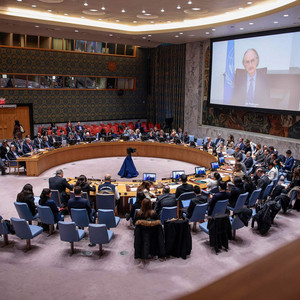
The UN Security Council has held an emergency meeting over Syria as the conflict intensifies.
The Syrian rebels captured the city of Aleppo last week, reigniting the war.
Poppy Imputing has more.
In a surprise lightning attack last Wednesday, rebels in Syria captured the town of Aleppo in a blow to Syrian President Bashar al -Assad.
The rebel coalition, led by an al -Qaeda offshoot, has continued its push into surrounding territory in northwestern Syria in a rapidly escalating onslaught that continued Tuesday as rebel groups closed in on the city of Hama.
The Syrian government is striking back with air support from its international ally, Russia.
The UN Security Council convened an emergency meeting Tuesday at the request of the Syrian government.
The rebel attack in Syria has reignited a war that began in 2013 and has been dormant since 2020 when a Russia -Turkey brokered ceasefire took hold.
The fighting in Syria is further destabilizing the Middle East, playing out against the backdrop of Israel's wars against Hamas in Gaza and Hezbollah in Lebanon.
The Syrian government was also largely insulated from rebel attacks in recent years, with support from allies Iran and Hezbollah, currently engaged in protracted conflicts in the region with limited ability to fight off the rebels.
That was Poppy Imputing reporting.
The Syrian Defense Ministry says additional troops have been deployed to Hama province.
The Syrian Observatory for Human Rights says, Fightings erupted between government forces and the Syrian Democratic Forces in Deir al -Zor.
It adds that the Fightings left hundreds of people dead, including civilians.
Ray Addison has more.
In Syria, the death toll is rising.
The United Nations says dozens of civilians have been killed, including women and children.
With claims that both government and rebel forces are responsible, warplanes had hit residential areas of Aleppo, along with medical facilities and a displaced people's camp in Idlib province, resulting in several fatalities, including children.
In rebel -held Aleppo, Syrian local media says insurgents have formed a so -called military government and imposed a curfew, prompting thousands of residents to flee in search of safety.
Meanwhile, a food crisis is looming in the city, as residents struggle to snap up essential supplies amid the ongoing conflict.
The UN says more than 48 ,000 people have been displaced in the country so far, and key infrastructure, including schools and water stations, have been damaged as the fighting continues.
Rebels have already captured a swathe of land across the northwest of the country and say they're making further gains.
However, the Syrian government says it has killed hundreds of fighters in recent days.
The country's state news agency says the army is reinforcing defensive lines in the countryside surrounding the central city of Hama ahead of a planned attack.
Meanwhile, sources say at least 300 Iraqi fighters have now crossed into Syria to support the military.
Troops such as these proved key to the success of pro -government forces when rebels rose up against President Bashar al -Assad in 2011.
However, with Russian support stretched due to the conflict in Ukraine and Hezbollah's leadership in Lebanon refusing to send troops, it remains to be seen what impact they will have.
That was Ray Addison reporting.
China's UN envoys urged the Security Council to act for a ceasefire in Gaza and safeguard the rights of women in the region.
At a meeting on Women, Peace and Security, Futsong noted that over 600 million women are suffering in conflict areas globally, with women and children accounting for 70 % of the over 44 ,000 Palestinian deaths in Gaza.
If the Security Council fails to take action to ensure women's safety, its discussions will be seen as nothing more than empty rhetoric for women suffering in war zones.
We once again urge all security members to unite, uphold the authority of the Council's mechanisms and resolutions, and support the Council in taking strong action to secure an immediate ceasefire in Gaza and restore peace.
We also emphasize China's commitment to fostering a peaceful environment for women's development and its support for women's causes globally.
The UN Agency for Palestinian Refugees distributed bags of flour to families in central Gaza.
People gathered in front of a warehouse in Nusarat refugee camp to take their share, with each family of 10 receiving one 25 kilogram bag.
The Israeli Army said that it helped the World Food Programme send 40 trucks carrying 600 tons of flour to south Gaza.
However, UNRWA officer Louise Wateridge said the flour distribution cannot meet the urgent needs in the region.
WFP, our partners, have managed to bring in flour through the fence road that we're distributing today, but it's not enough.
It continues to not be enough.
People are getting one bag of flour between an entire family, and there is no certainty when they'll receive the next food.
She added that UNRWA has been struggling like other humanitarian agencies to deliver essential supplies across Gaza.
The agency stopped using the Karem Shalom crossing to protect its staff after looters seized aid convoys entering the area.
Israel's launch and air strike on a southern Lebanese town.
The attack on Sheba that killed a person came amid a fragile truce between Israel and Hezbollah.
Both sides have accused each other of repeated cease -fire violations.
Israel's warned that it'll expand attacks and include targets linked to the Lebanese state if the truce collapses.
Jonathan Raghav has more from Tel Aviv.
Both sides seem to blame the other for violations.
The two rockets that were fired from Hezbollah yesterday afternoon came according to Hezbollah in response to Israeli breaches of violations.
This is according to what the organization is saying.
There have been, according to Hezbollah, some 50 incidents or so in which Israel fired towards Lebanon.
And shortly after those rockets fired from Lebanon came the Israeli response.
With a fire towards Hezbollah, installations were hearing of at least 15 people in Lebanon being killed.
Having said all that, both sides, Israel and Lebanon, not Israel and Hezbollah, but Israel and Lebanon, have reiterated to the American mediators that they will continue to comply with the cease -fire agreement.
Meaning it is still in place, but it's very, very fragile.
Meaning it can collapse at any minute.
We can see that there are constant incidents, constant violations of both sides.
Both sides are saying that the other has violated it.
So the cease -fire is in place.
Yes. Is it at risk of collapsing?
Also yes. And we visited the communities in northern Israel this week.
They're still empty.
People are still not coming back because of the sort of lack of faith in this cease -fire, which we'll see exactly a week since it was signed, but it's very, very fragile at this time.
That was Jonathan Raghav reporting.
In the United States, cleanup works continuing around parts of the Great Lakes region after snowstorms dumped several feet of snow.
Forecasters have warned that another storm system could bring more snow later in the week.
In Ohio, residents worked clear snow from their driveways and rooftops.
North Perry resident Todd Bernard, standing in snow nearly knee -deep, scraped off his roof.
You do what you got to do to get through it.
The kids are enjoying their extended Thanksgiving holiday, but snow doesn't bother me too much because I grew up here and I'm used to doing what you have to do to survive.
Many schools in western Pennsylvania remain closed as the storms finally began to subside.
Coming up, a Pacific island nation is reaffirming its ties with China.
Discover the realities and responses to our changing climate with Climate Watch.
Uncover critical issues such as the Maasai Murray's disrupted roller -beast migration and the drop in the Panama Canal's water levels.
Delve into solutions for a sustainable future.
Tune in to Climate Watch on your favorite podcast platform.
Become more eco -conscious and take action to protect our planet.
Twenty minutes past the hour, Nauru Parliament Speaker Marcus Stephen is visiting China to deepen exchanges and foster mutual learning between the two countries.
He's affirmed that resuming diplomatic ties with China was the right decision for his country.
The speaker says lawmakers unanimously approved the decision in Parliament and that the decision aligns with the UN resolutions on China.
It's important that the resolution of the Parliament which represents our people was put in the Parliament for the members to pass.
And I am happy to confirm the resolution was unanimous.
So on behalf of all the people, the members have agreed unanimously to resume ties with China and also to recognize the OneChina policy.
It's important for us because it's also we're looking at our own development as a nation.
And we believe we have made the right decision to realize the diplomatic relationship with China.
I think we have made the decision.
We have recognized the OneChina policy through the UN resolution.
So I think that is more important to us that it is the legal bonding decision that was made at the United Nations.
Nauru resumed diplomatic relations with China in January.
Some insiders have criticized Taiwan regional leader Lai Ching -deh's visit to Pacific Island countries.
They accuse Lai of using the visit to push his secessionist agenda under the guise of peaceful engagement.
This so -called transit is just a disguise.
Lai Ching -teh always says one thing and does another.
He uses flowery language like freedom and democracy to glorify his actions.
But it's all lies aimed at deceiving the Taiwan people and the international community.
Taiwan has no real diplomacy, yet Lai Ching -teh persists in these farcical visits.
Traveling thousands of extra kilometers for meaningless so -called transit is absurd.
It wastes public funds, undermines China -U .S.
relations and violates the OneChina principle.
Taiwan is part of China and Lai's actions will not win genuine international support.
Lai Ching -teh's transit through the U .S.
is another attempt to push his agenda by leaning on American support.
We, the overseas Chinese, firmly oppose these actions and urge the Taiwan authorities to face reality.
The firm determination of the Chinese government and the Chinese people to safeguard peace in the Taiwan Strait is something no one can intimidate.
The Chinese foreign ministry said that it's closely monitoring Lai's visit.
Spokesperson Lin Jian reaffirmed that the Taiwan question is at the core of China's core interests, and that the country's determination to defend national sovereignty and territorial integrity is unwavering.
China has also condemned the United States for arranging the transit for the Taiwan regional leader.
A deputy director of the Taiwan Center for Security Studies says regional leader Lai Ching -teh's approval rating has fallen since he was elected.
Minon Chan made the remarks during an interview with Leo Jashin.
I was wondering how satisfied the people in the Taiwan region are with their leader currently.
Lai Ching -teh has 40 percent of the voters.
However, within the DPP, I understand that they're also having great fractions in terms of policy direction.
So I think Lai's support perhaps is less, much less than 40 percent.
So it is an alarm. I believe someone Lai and his staffers should be quite aware of.
In your opinion, what situation will Lai Ching -teh's visit put the people of the Taiwan region in?
Will this connectivity between the two sides be affected?
I, for one, always believe that the cross -strait exchange should not and cannot be stopped.
Only by exchange that people get to know each other better and our friendship will be rekindled during the past eight years, during the Mayanjung era.
I believe that Lai is always on the learning curve, and he has to have eyes wide open and understand what is really going on in the geopolitical and geo -economic dynamics.
And it is for him to live up to the leadership role and then to make political harmony, regional stability, and economic prosperity in the region.
That was Minan Chan, Deputy Director of the Taiwan Centre for Security Studies.
Industry insiders are gathering at the 12th Global Video Media Forum in Trangjou to discuss the potential of emerging technologies in media and the importance of collaboration on shaping the global media landscape.
Adrian Wells is the Managing Director of European News Exchange, and during an interview with Daikai he shared his insights on how embracing artificial intelligence and fostering media cooperation can further improve the media industry.
How much potential do you think AI possesses in shaping the media landscape?
In the professional broadcast and digital industry we have enough intelligence to know that we have to embrace this technology.
We have to take the best parts of it.
We have to integrate it with what we already have, our experience, our professionalism, our mission for our consumers, and use the best parts of it to try and enhance our products, our services, how we're creating content, how we're distributing content, how we're organizing ourselves.
I think if we get all of those things right, then we have an enormous possibility here to surf that wave of new technology and come out of the other end in a much better state than we're entering it now.
Because actually media is a very challenged environment now.
We do have a lot of threats to our traditional ways of going about things.
We have to use these new technologies like AI in order to transform ourselves, and we really have to be at the forefront of embracing it, not resisting it.
What role do you think this forum plays in helping shaping global media collaboration landscape?
It's always good to talk, and I said in my speech earlier that I don't have all the solutions.
I think there are very few people who've got all the solutions worked out.
It's very difficult to find the right pathway through all of these difficult choices that we have to make.
And how do we really go about finding those right choices?
It's by looking at what everyone else is doing, taking the best of how different organizations are using new technologies, adapting their business models, trying to reach consumers in a different way, and really cherry picking the best examples, the best use cases across the industry to try and reimagine
what we're doing in our own environments, whether it's in China, in the United Kingdom, in the United States, or in any European country.
Look across the industry.
Who is doing what? How are they solving some of these problems?
And use that as a kind of nice salad mixture to try and find the solutions in your own newsroom organization.
What more do you think should be done for global media outlets to foster ties between different countries and people of different cultural backgrounds?
I think that if you ask anyone about cooperation and collaboration, everyone's for it, right?
It's a no -brainer. Of course, we want to collaborate.
We want to cooperate.
But actually, when you come to collaborating and cooperating, it's actually a bit of a pain as well, because you've got a devote time to reaching out, to be aware of what other industries are doing, what your colleagues are doing across the industry.
So I think the good thing about this forum is that we're in an environment now where we can mix.
You've got a lot of different people from news organizations, from different parts of the world who've got different ideas.
And I think we all learn a lot from hearing about different experiences across the world and really trying to sort of create some of these ties that otherwise, if we don't make that effort, they just won't be there.
That was the managing director of European News Exchange.
Beijing is down to minus two this evening.
Cloudy skies with a high of 10 on Thursday.
It's time for a short break.
So far this hour, South Korea's opposition parties have submitted a motion to impeach the president.
The UN General Assembly's adopted resolutions demanding that Israel withdraw from Palestinian and Syrian territories.
And an official from the Pacific island nation of Nauru is visiting China.
Shane Begum with you.
Stay with us here on The Beijing Hour.
The best military commander is not he who fights 100 battles and wins every one of them.
The best military strategy does not lead to the desiccation of the enemy's capital city.
Decoding the art of war will help you understand why there's no art in war and how citizens stayed undefeatable using the science of war with fun stories and insightful breakdown of famous battles.
Find Decoding the Art of War wherever you listen.
Mashin! Hyatt! I'm back!
I'm backing Kool -E -op!
I love you, Betty. Love.
Remember? Thank you for being friends.
Hey, I'm Bingangans.
Fate. Take care. Me too.
What do they truly mean?
Mashin, where did you go?
Mashin! Mashin! Embark on a century -long journey with CGTN Radio's latest offering.
Echoes of Kool -E -op, a gripping audio -drama series inspired by real -life tales.
From unexpected encounters to heartfelt reunions, immerse yourself in a narrative of love, peace and enduring friendship.
Listen to Echoes of Kool -E -op on radio .cgtn .com and all major podcast platforms.
Bing. Bing -an. Bing -an.
Thank you, Shane. China Coast Guard has warned the Philippines to stop provocations after a collision near Huangyuan Island in the South China Sea.
A CCG spokesperson said Manila is responsible for the incident after a Philippine ship dismissed warnings from China and deliberately rammed into a Chinese vessel.
China Coast Guard responded with legal measures after Philippine Coast Guard vessels and fishing boats intruded into Chinese territorial waters near Huangyuan Dao.
The CCG spokesperson accused the Philippines of provocation and misleading the international community under the pretext of fishing.
The UN Chiefs Special Envoy for Syria has described the situation there as extremely fluid and dangerous.
Garrett Patterson briefed the Security Council and called on all parties to protect civilian lives.
A vast wave of Syrian territory has come under the control of non -state actors including Security Council -listed terrorist group Hayat Tahiriyya Al -Sham.
The UN envoy said these groups are in de facto control of territory home to an estimated seven million people.
Forces opposing Syrian President Bashar al -Saud have captured large parts of Aleppo as well as towns and villages in southern parts of Idlib in the northwest.
Government forces have since retaken some territory they lost last week.
Chinese Ambassador to the United Nations Fu Chong has reiterated China's opposition to terrorism.
China supports serious efforts in fighting against terrorism and maintaining national security and stability.
The international community should follow the same standards and aid serious government forces in eliminating risks that come from terrorist groups with a zero -tolerance attitude.
The Chinese Permanent Representative called on all countries to take action to cut the routes the terrorists use to move forces and weapons.
Fu also expressed regret at the decision of the United States, the current holder of the Security Council presidency, for inviting serious civil defense, also known as the White Helmets, to brief the council without consulting with other members.
China has witnessed its warmest autumn since complete meteorological observation records began in 1961.
The average temperature nationwide between the first day of September and the last day of November was nearly 12 degrees Celsius.
That is 1 .5 degrees higher than the average of the same period in previous years.
The country also recorded higher precipitation during the period.
The annual Shanghai Taipei City Forum will open in mid -December in Taipei.
Chinese authorities said that the forum provides a platform for exchanging expertise and fostering collaboration in urban governance.
The event will focus on areas such as sustainable transportation, river management, and urban cultural development.
The Shanghai government said that the two cities will sign new memorandums to strengthen cooperation.
Since the forum's inception in 2010, Shanghai and Taipei have signed 45 memorandums of exchange.
And finally, South Korea's opposition says President Yoon Seok -kyo's decision to impose martial law is reckless and absurd.
Yoon's government has lifted the martial law after a parliamentary vote a few hours after it was put in place.
The president said he declared martial law to eliminate what he deems anti -state forces.
He urged parliament to stop undermining the government's efforts.
I request that parliament immediately seizes the reckless actions that are paralyzing the functions of the state, such as repeated impeachment, legislative manipulation, and budget manipulation.
The government has pulled military forces out of the National Assembly.
Lawmaker Kim Byung -ju from the main opposition democratic party said they did not anticipate Yoon's sudden move.
We had raised the issue that President Yoon Seok -kyo and his administration could declare martial law at any time in the worst -case scenario.
But no one could have predicted that such actions would happen so quickly.
In fact, the Democratic Party has consistently pointed out that if impeachment became a reality, he would draw the sword of martial law.
People took to the streets and gathered in front of the parliament building demanding Yoon's impeachment.
Some say they don't support the president's unilateral act.
Alright, thank you very much.
That was Tianyue with Headline News.
This is Shane Bigham in the Chinese Capitol.
Coming up in business, China's service sector continues to grow, but at a slower pace.
What's the narrative of this relationship?
Ever wondered what's actually going on in Africa through the perspective of an African?
How are things really going between China and Africa?
What's the narrative of this relationship?
Well, get a perspective with China Africa Talk.
Hear from African diplomats, entrepreneurs, academics, Chinese natives, and more.
Get on our wavelength every week to find out what's real with China Africa Talk.
Find us on your favourite podcast.
We'll see you there.
37 past the hour now.
Turning to business and here's Wang Zihang.
Thank you, Shane. Stocks on the Chinese mainland closed lower on Wednesday.
Investor in sentiment across the Asia -Pacific region remained mixed following the political crisis in South Korea.
Major stock indices in China all experienced declines with the Shanghai Composite Index falling by 0 .4 % and the Shenzhen component dropping 1%.
The ChinaX Index, which tracks technology companies, plummeted by 1 .4%.
In Hong Kong, the Hang Zang Index was a little below flat.
In Japan, investor sentiment was largely stable as the key benchmark in EK showed little change.
A private survey shows that China's services sector continues to expand, albeit at a slower pace.
The Cai Xin S &P Global Services Purchasing Manager's Index stood at 50 .5 % in November.
That's down half a point from October.
Cai Xin says services providers are still confident that the markets are improving with government policy support.
For more insight on China's services sector, Lincoln Humphrey spoke with Cheng Jiahe, Chief Investment Officer of Novim Arcade Technologies.
The November Cai Xin Services PMI data indicates continued expansion at that slower rate compared to October.
Was this expected and what are the main factors contributing to this slowdown?
For this November, the Cai Xin Service PMI was reported at 51 .5%.
It is half points lower than the last record.
But this data is still well above the level of 50.
Showing the service sector is still having an expansion trend.
Meanwhile, the overall Cai Xin PMI index was reported at 52 .3%, slightly higher than the last record.
So, combined both the service PMI and the overall PMI, we can see that the confidence for economy is still positive.
According to the data, the slower service PMI is mainly due to the dropping of new order index as well as a smaller export index.
But because the scale of dropping, which is just half a point, is actually too small, so this impact is not that significant.
What opportunities do you see emerging from China's recent policy package aimed at boosting the services sector?
Currently, the service sector is taking up more than half of China's GDP.
And in order to boost the service sector, China has set out a lot of economic policies.
And with these policies, many business opportunities have emerged.
Let me just try to name a few of them.
For example, there have been a lot of policy set out to help the probly market, which is taking up a large part for China's service sector, such as the wide list of real estate developers, the dropping of mortgage rates and down payment ratio, removing buying restrictions, etc.
Also, many policies have been set to boost the consumption.
The old for new program has provided many opportunities for companies who produce home appliances and cars.
Also, many policies have been set to stimulate the tourism market.
The visa -free policy is now covering many countries, and the duration has been extended to 30 days.
So it is not much easier to make a trip to visit China.
For global tourists, I will say, why not take the chance?
There was Chen Jiahe, Chief Investment Officer of November Arcade Technologies, talking about China's services sector.
Instant retail, a rapidly growing retail model, is transforming traditional shopping methods and consumer habits in China.
Younger consumers in particular are demanding greater immediacy and efficiency in their shopping experiences.
Olivier He has more.
Undermount retail is quickly becoming a new shopping habit for customers.
It's when you place an order online, and then retailers, either directly or through a third -party service, deliver your items right to your door, usually within 30 to 60 minutes.
I recently ordered some fish on a delivery app because I needed it to arrive really fast.
And when I want to send a gift to a friend, like a phone or earphones, I usually just use delivery apps for that too.
Sometimes when I head out, I forget stuff like my contact lenses or phone charger.
If I order online, I'd have to wait two days, and I don't have time to go to the store.
Now, I just order everything for delivery, and within 30 minutes, it's all at my door.
These days life moves so fast that shopping habits have changed too.
People expect their orders to arrive quickly and efficiently.
Delivery riders, who used to deliver just three meals a day, are now bringing all sorts of items.
Food, everyday essentials, medicine and even electronics.
Now our platform has grown to include five different delivery options.
Dedicated delivery, fast delivery, errand services, self -delivery and hybrid delivery all to better meet our customers' shopping needs.
As on to mount, retail has grown with three main models have emerged.
First, the model where warehouses and stores are combined.
Second, the model with warehouses set up closer to customers.
And third, the platform model, where businesses connect with customers through online platforms.
According to the instant plus 2023 on -demand retail transport, the on -demand retail market is expected to grow by 25 % every year from 2023 to 2030.
By 2030, it's predicted to be worth 3 .6 trillion won, making up about 6 % of total retail sales for consumer goods during that time.
There was Olivia Hu in Beijing.
And finally, Chinese industrial associations have voiced strong opposition to the United States' latest control measures on semiconductor exports and urged domestic companies to exercise caution when purchasing US chips.
Among day, the US government announced a new round of export restrictions on China, adding more than 140 Chinese companies to the trade restriction list, involving multiple types of semiconductor products.
The associations of Internet Semiconductor and Automobile and Manufacturers all released a statement saying the US has once again undermined the long -standing consensus on fairness, rationality and non -discrimination reached by global industries.
The association said the US abuse of export control measures has shaken the industry's trust and confidence in US chip products.
Alright, thank you very much, that was Wang Zihang with Business.
You're listening to The Beijing Hour.
Coming up next, our special report, Greener China, a journey to 2060.
China's decision to expand access to foreign investment in hospitals has become a hot topic for global healthcare providers.
While welcoming the increased openness, they also have concerns.
What contributes to a wait -and -see attitude among investors before they commit their resources to the Chinese market?
Among cities eligible for investment in wholly foreign -owned hospitals, which one may be most favored by investors?
And can China gain a foothold in global medical tourism?
Get it all on this week's chat lounge on your favorite podcast platform and CGTN radio.
At 44 past, now and time for our special report, Greener China, a journey to 2060.
It's a nine -part program dedicated to exploring China's efforts in carbon reduction.
In this final episode, Yang Guang takes us through the challenges the industrial bases of northeast China face in their transformation to low -carbon production.
The pressure on petrochemical enterprises in pursuing carbon neutrality is indeed immense.
When I first met Sun Sheng -Yong, an engineer at Daqing oil field in Heilongjiang Province, he introduced me to CCUS, Carbon Capture Utilization and Storage, a technology well -established at Daqing.
Using carbon dioxide to drive oil extraction, they consume hundreds of thousands of tons of CO2 annually.
Initially, I thought this was impressive, until I learned the other side of the story.
Hello and welcome to Greener China, a journey to 2060.
I'm Yang Guang. In our last episode, we explored the steps industrial bases in northeast China have taken to curb carbon emissions.
But with each visit and conversation there, I became more aware of the immense pressure Sun Sheng -Yong had mentioned.
300 ,000 versus 20 million.
The stark contrast in CO2 figures at Daqing oil field highlights the challenge.
Our ultimate goal at this stage is to inject 3 million tons of carbon dioxide.
This year, our target is 300 ,000 tons.
We're on track to achieve that.
That's director Pang Juchin of Daqing oil field's new energy business department.
However, I learned that the city of Daqing emits over 20 million tons of CO2 annually.
The huge gap between emissions and capture underscores the difficulty of the battle against the CO2, a major greenhouse gas contributing to climate change.
Old industrial bases in northeastern China, like Daqing oil field, face many hurdles on their path to carbon reduction.
The most depressing challenge is the cost.
At Daqing oil field, CCUS allows for the capture of CO2 from natural gas, where concentrations range from 30 to 60 percent.
The CO2 comes from tail gas produced during natural gas extraction.
I wondered why large -scale CO2 capture isn't conducted at petrochemical plants, like refineries, which emit CO2 with concentrations as high as 95 percent.
Wouldn't capturing this purer CO2 be beneficial both for production and emissions reduction?
Director Pang explained.
Firstly, the cost of CO2 supply, transportation and injection remains high.
Secondly, we only use CO2 injection for lower quality oil reservoirs with reduced output.
Extracting one ton of oil requires three tons of CO2.
Storing and injecting CO2 also needs regular maintenance and management, which produces additional costs.
Moreover, the country has not fully implemented a carbon tax or trading system, so the potential carbon reduction benefits are not yet financially reflected.
In short, it's simply too costly.
For example, the Ushulin oil plant, one of the most successful in using CO2 for oil extraction, still faces cost challenges.
Purifying CO2 demands financial investment.
Engineer Li Ronghua elaborated.
The CO2 we use comes from Shushen -jiu natural gas field, where CO2 is separated as part of industrial production.
It's free. But as CO2 injection scales up, we may need CO2 from other sources, which would require purification process, adding to the cost.
The cost of the control is also a challenge at An Steel, the largest steel plant in northeast China.
Hydrogen -based direct -reduced iron making, in combination with the electric arc furnaces, currently represents the most viable strategy for reducing emissions and putting the sector on a path to net zero.
However, this could cost An Steel billions.
Zhang Feng from An Steel's research institute noted it's not a pragmatic approach.
While we recognize the importance of low -carbon steel production, cost control remains a key issue.
Achieving zero -carbon steel production with hydrogen would require replacing our entire production line.
The technological barriers to decarbonization are also significant.
Hydrogen -based metallurgy and alternative to coal is being researched globally.
The prospect of near -zero carbon emissions is appealing.
But transitioning from traditional fossil fuels is no easy task.
Tian Yuan, director of An Steel's strategic department, said it's not an overnight effort.
Netallurgy has relied on carbon for iron reduction since its inception thousands of years ago.
Changing this long -standing process is extremely challenging indeed.
Sun Sheng -yong from Daqing Oilfield added that while carbon sources like coal and natural gas are readily available, producing carbon -free hydrogen comes with stringent requirements.
There are several types of industrial hydrogen.
The first is gray hydrogen, produced from natural gas which still emits CO2.
Blue hydrogen captures CO2 during production.
Green hydrogen, the only carbon -free type, is produced via water electrolysis.
Plus, all the power used for electrolysis must come from renewable energy.
China's first hydrogen -based direct -reduced iron -making plant with 1 million town capacity was established last year in Zhanjiang, South China's Guangdong Province.
However, it hasn't yet implemented green hydrogen usage.
In the case of green hydrogen, the construction of a gigawatt scale electrolysis plant is required.
This presents significant challenges for steel producers like An Steel.
Hu Dai -chao of An Steel's research institute said the current electrolysis method doesn't produce hydrogen that is cost -effective enough for large -scale steel production.
The cost of green hydrogen production is just too high.
Lowering these costs could make hydrogen -based and metallurgy promising.
With large -scale green hydrogen -based steelmaking not being popularized anytime soon, carbon is still the first choice.
Coal still provides around 75 % of the iron and steel industry's total energy demand at the current stage globally.
As long as carbon -based fields like coal and natural gas are used, industrial production will emit carbon from the start.
Shifting to green energy, while maintaining profitability, requires further technological breakthroughs, not only for northeast China, but globally.
Despite the adoption of carbon -capture technologies, such as EDDA -CHIN, Sun Sheng -Yong emphasized that more innovation is needed for reducing CO2 emissions.
The focus should be on reducing emissions by optimizing processes and advancing technology in traditional industries.
CCUS captures carbon only after it's been emitted.
So, it's the last resort.
Dr. Zhou Jingfeng from the China Biodiversity Conservation and Grain Development Foundation gives a second opinion about the benefits of CCUS.
Carbon capture and storage still consumes energy.
We should consider natural solutions as a better approach.
Dr. Zhou also suggests an alternative view on decarbonization for industry.
He says that beyond emission reduction, scaling down production with modern technologies could also be effective.
Traditional industries operate on mass production, which often leads to mismatches in supply and demand, and a crisis of overproduction.
With technologies like big data and AI, we can shift to customized production models.
Technological progress relies on skilled talent.
But northeast China faces a shrinking talent pool due to population decline and aging.
In 2022, the population of the three northeastern provinces dropped nearly 5 % from the previous year, with a decade -long decline of over 11 million people from 2010.
Once the backbone of the country's industrial sector, northeast China has experienced economic stagnation as development shifts to more prosperous delta regions of the country.
This shift has led to an exodus of talent, with some even calling the northeast the Rust Belt of China.
Employees at Anstil and Da Qin Oilfield expressed their concerns about talent retention.
The region focuses heavily on traditional industries and has limited opportunities and resources compared to other cities.
High -tech companies like Huawei are based elsewhere, making skilled workers prefer those regions.
Northeast China used to play the leading role, but it has fallen behind.
Older people tend to stay, but young people live for better opportunities.
Many of my peers have moved away, young people want to explore new possibilities outside of their hometowns.
Despite the challenges, traditional industrial enterprises in northeast China, such as Anstil and Da Qin Oilfield, remain committed to reducing carbon emissions.
Their transformation has shed light on the complexities of carbon dioxide management and the determination to build a greener China.
We have gradually deepened our understanding of this gas.
Initially, all we knew was that it was simply carbon dioxide.
Many still don't fully grasp the importance of reaching carbon peak and neutrality, while it may conflict with immediate economic interest.
Carbon neutrality is the future and represent the long -term trend for enterprises and the economic development.
We can't measure it by short -term gains alone.
With that we wrap up the first part of our special series, Greener China, a Journey to 2060.
From the wildlife kingdom of Southwest China's Yunnan Province to the ecologically restored landscape in Ningxia in the north -west, and the industrial innovations in the northeastern part of the country, we took a glimpse of how China is paving the way toward a greener future.
The journey to carbon neutrality extends far beyond these efforts.
Advances in renewable energy, electric vehicles, the carbon trading market and more are top on our net -zero carbon agenda.
In the coming months, we will continue to explore these mega -projects across the country and bring you more stories on China's green path.
I'm Yang Guang, thank you for being with us.
Goodbye. And that was the final episode of our special report, Greener China, a Journey to 2060.
You can subscribe to our podcast Climate Watch for the whole series and more insights into climate change.
58 passed, now in Beijing's down to minus two Wednesday evening, cloudy skies in 10 degrees on Thursday, and Anshang has a slight rainfall continuing through the day tomorrow with a low of 11 and a high of 12.
That's all the time we have for this edition of The Beijing Hour.
Making news today, South Korea's opposition parties have submitted a motion to impeach the president after a declaration of martial law plunged the country into political chaos.
On behalf of the staff, this is Shane Bigum in the Chinese Capitol.
Hoping you'll join us for the next edition of The Beijing Hour and open a window to the world together.
Take away Chinese, where you can take some Chinese away and experience progress day by day.
Take away Chinese, we will promise you a difference.
Hello everybody, welcome to Round Table, coming to you live from Beijing.
Round Table, Round Table, Round Table, connecting China and the world.
We bring you fun and timely discussions about what's affecting our lives everywhere, every day.
Tune in to Round Table, where the East meets the West and understanding is the goal.
From North to South, East to West, people in China are chasing their dreams and leaving their mark.
Want to know how they beat their odds and made a difference?
Footprints brings you the true life stories of their journeys.