I'm Ayesha Rascoe and this is a Sunday story from Up First. Every Sunday we do something special, going beyond the news of the day to bring you one big story.
Today that story comes from Laura Sullivan, a correspondent on the investigations team here at NPR, who was on the ground in Western North Carolina last fall, five days after Hurricane Helene.
Laura, tell us what that was like.
Okay. So first, you have to understand that as much as 30 inches of rain fell in some places, and all that rain came slamming down North Carolina's mountains, just wiping out entire towns.
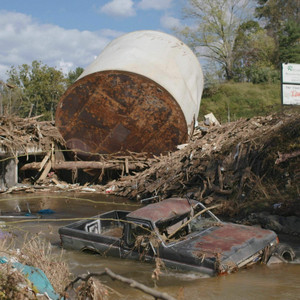
And when we got there, many homes were like piles of match sticks.
Tractor trailers were smashed into homes.
There were helicopters, carrying pallets of water over our heads to people who were trapped.
Now, you've covered a lot of disasters, did this one feel different?
No, that's the thing.
I've covered disasters in Florida, New York, Texas, Puerto Rico.
And each time the type of destruction is different, but the impact, the impact is the same.
And in North Carolina, standing there in this town called Swannanoa, it was hard to imagine how any of this was gonna work out for anyone.
and not only were they going to have to look at all the decisions that they had made that may have left them vulnerable, but figure out what they want to do now, now that they know how bad things can get.
You've spent the past eight months on a reporting mission with PBS Frontline trying to figure out how exactly communities are building back from disasters.
And I know from the places you've been, that some of the communities have gotten it wrong.
Why is this such a hard thing to do?
Re -building after a storm is really complicated.
I mean, no two people are going to agree on exactly how it should be done.
And that conflict means a lot of communities are just getting stuck.
These big plans falter.
The big ideas, they just fizzle out.
And over the past few months, we've seen North Carolina struggle to rebuild, just as we once saw other communities struggle.
So we decided to go back to places that we've been to see if there were lessons for North Carolina.
We went back to New York, which had been hit by Superstorm Sandy in 2012.
We went back to Houston, which had been hit by Harvey in 2017, to see if all these years later, had they figured it out, had they figured out how to put their communities and their neighborhoods back together and whether they had done so in a way that might help them survive the next storm.
What did you find? What we found were powerful forces undermining the choices communities make, leaving homes and neighborhoods more vulnerable to future disasters, and in some cases allowing private developers to profit.
So, where do you want to start this story?
This story starts on the side of the road in Swannanoa when we first heard the names Nola and Robert Ramsore.
They were an older couple that was missing and some search and rescue volunteers had stopped us and they asked us if we had seen them.
We hadn't seen them, but we decided to go down the street to where they had lived to see what had happened.
and that's where we met the couple's daughter.
When we come back, an investigation into what really happens when communities try to rebuild.
Stay with us. This message comes from Dataiku.
AI is raw power. It's alive in every agent, every decision, every workflow.
So do you let it take over, Or, do you become the force behind it?
Take control with Data Icoo, the universal AI platform.
For business teams and AI experts, designed for trust and engineered to scale, make AI flow through your enterprise.
Don't just keep up with AI, control it with Data Icoo, the universal AI platform.
Find out more at dataiku .com slash npr.
These days there is a lot of news.
could be hard to keep up with what it means for you, your family, and your community.
Consider this from NPR as a podcast that helps you make sense of the news.
Six days a week, we bring you a deep dive on a story and provide the context, the backstory, an analysis you need to understand our rapidly changing world.
Listen to the Consider This podcast from NPR.
Decades ago, Brazilian women made a discovery.
They could have an abortion without a doctor, thanks to a tiny pill.
That pill spawned a global movement, helping millions of women have safe abortions, regardless of the law.
Hear that story on the network from NPR's Embedded and Futuro Media, wherever you get your podcasts.
We're back with NPR correspondent Laura Sullivan, who's going to pick up our story on how we recover from disasters.
Nolah and Robert Ramsar lived in a trailer park along the Swannanoa River.
Five days after Helene, the Ramsar's daughter, Shilinna Jordan, drove the couple hours from her home in Winston -Salem to see if she could figure out what had happened to her parents.
Only a week before, she and her husband and kids had visited her parents here.
And now her parents' home was barely recognizable.
And this is the first time you've seen this?
Yes, I've only seen helicopter footage, Facebook stuff.
That's how I've been trying to make a timeline of what happened, if they were evacuated, if they left on their own accord. Shelina reaches the trailer.
It's ripped open, exposing the bedroom and bathroom, the tub full of brown water.
All the furniture is smashed into the far side of the trailer, and a black pickup truck is wedged up against one end.
What do you think? It's just unbelievable.
Ugh. We are just here.
She looks around, hoping her parents left a note.
All the other neighbors have been found.
My parents are the only ones that haven't been found yet.
I mean, of course, Friday, you know, I'm like, oh, they got a lot of rain, whatever, she'll call me back, you know, because she stopped texting me around 730.
She stopped texting you at 730.
730 am on Friday morning.
The cars are still here.
That black jeep with the door that's open and that red car.
Those are their cars.
That's their cars. If they were to go into the river to maybe try to escape.
Neither one of them can swim.
They can't swim. Neither one of them can swim.
and if they get washed away like what they did by themselves, they may die alone.
The Ramseurs' trailer was about 60 feet from the river's edge.
Ben Larrabee lived next door and standing outside the remains of his own trailer, he tells us he knows exactly what the Ramseurs went through the morning of the storm.
When we woke up, the water was already above my knees.
And it was just raising so fast, you couldn't even, it was like you couldn't even make decisions.
The entire trailer park in every direction was already engulfed in raging brown water.
Larabee called his brother to discuss whether his mattress might make a good flotation device.
Then he took out his phone and started reporting video.
This is nuts. I never seen something like this.
Man, I don't know what to do, guys.
— Look how fast it is.
You can't jump in that.
— No, you can jump in that.
— We see a semi -trailer floating by.
— Here's one of the trailers that are gone.
And then it rose to the top.
— Oh, boy. — And then Larrabee pulls up one final video.
In it, he points his phone at the Ramseurs trailer.
Oh man, I hope these guys are gonna be alright.
And in the very back, you can see a tiny figure, a man in a dark coat, waiting out onto the porch. And that's him down there.
There he is. See, it's already almost to his knees.
It's on his feet. Yeah.
It was the last time anybody saw Robert Ramsore alive.
Larabee was lucky. He survived the worst of the storm with his trailer intact.
He waded to safety after the water receded.
From the spot on the river's edge, on all sides, you can see homes and trailers pulled off their foundations and ripped apart, but just across the way, we could see a row of sturdy duplexes.
They seemed barely touched, some of the only man -made structures still standing.
They're set back from the river's edge, elevated far off the ground on stout, concrete foundations.
There are wide slots under the house, flood vents, meant to open under the pressure of water to let it flow through.
These homes survived.
They were built to survive in a place that has flooded repeatedly.
And standing here, amid all this destruction, the question seems obvious, why weren't more of the homes built like this?
And this question took us on a journey to understand what happens after a catastrophic storm and how communities prepare for an uncertain future.
Breaking news, Hurricane Harvey barrelling into the Texas coastline.
To find some answers, we had to go back to a place we had visited eight years ago, Houston.
Hurricane Harvey rolled in off the Gulf of Mexico and then lingered, pouring more than four days of relentless rain over the city.
The Houston area is dealing with a disaster of epic proportions from Hurricane Harvey, Houston is different from North Carolina where flooded mountain rivers swept houses away.
Houston is low, barely rising above sea level.
Here when flood waters come, it's usually a slow rise foot by foot until entire neighborhoods are engulfed.
That's what happened during Harvey where the water rose as high as 12 feet in some places but if Houston's flood was less chaotic, it was no less heartbreaking.
A week after the flood, we visited one of the dams built above the city.
Its earthen walls hold back the rain that rolls down the vast Texas prairies on its way to the Gulf, storing it in large natural reservoirs.
It was a solution the Army Corps of Engineers came up with almost a century ago to slow the water, but during Harvey, it wasn't enough.
The floodwaters were still rushing through the gates of the dam.
when we arrived to talk to Richard Long, who oversaw the dams for the Army Corps, and he told us of a harrowing choice he and his colleagues had to make.
As the reservoirs filled up, they had to decide whether to follow the dam's protocol and release the water into Houston, or hold it and potentially watch the dams fail.
He released the water.
You gotta realize that some of these people are my friends and neighbors that I've known for years.
So this has been tough, but we did what we had to do.
But he said he was confident Houston would find a solution in the years ahead, so this would never happen again.
We're going to put it back together again.
We're going to build a city back better and stronger than before, and we'll be back in business before you know it.
That's not exactly what happened.
On a recent rainy day, we return to the dams above Houston.
A horn signals a controlled release of water.
We are here every day and we arrived this whole dam.
We looked for any imperfections.
Gerry Meese is the Army Corps lead Ranger here now.
He's just come by to check on the flow of water and stops to talk to us.
He says in the years since Harvey, they've shored up the dam's earthen walls, and they've rebuilt the outflows.
But the problem Richard Long faced back then hasn't changed.
If there's too much water, some of it has to be released.
We do have a protocol to where we have to release.
If we don't release at a certain point, the last thing we want is the water to go over the top of the dam because it'll grow very quickly.
And that's where you can have a catastrophic wall of water.
For nearly a century, Houston and Harris County have tried to control water with enormous infrastructure projects like these dams. They've built storage basins the size of small lakes, carved out channels to move water to the Gulf.
And in the last few years, the county has spent millions on smaller projects to keep neighborhoods dry.
Tina Peterson is in charge of flood control for the county.
I asked her if all these efforts would be enough to protect against the next Harvey.
Well, we don't use Harvey as a metric.
Harvey was a one -time example.
You think it was a one -time example?
Well that's based on the data we have meaning it won't happen no I mean it's statistically an infrequent event but not a never will happen again about oh yeah so when you do these projects do you take into account the fact that it happened once and it might happen again certainly we are concerned about Harvey certainly we are concerned about storms of those magnitudes but the storms that affect people frequently are those smaller storms. As those smaller storms have gotten bigger, so has Houston.
One of the hardest things for us is finding solutions where we know that development has happened.
That development didn't just happen.
Charles Irvine is a lawyer who's been researching the dams and their reservoirs as part of litigation on behalf of residents whose homes flooded during Harvey.
He says when the Army Corps first built the dams, they didn't buy enough land in the natural basin of the reservoirs, leaving much of it in private hands.
In the years since, Harris and another neighboring county allowed developers to purchase large tracks.
When the reservoirs were built, most of those were ranches and rice fields, but then as Houston grew westwards, the ranchers were sold off, developers moved in, they were subdivided.
and now if you go out there, those just look like everyday American subdivisions.
There are now more than 20 ,000 homes built inside the natural reservoirs, areas designed to flood during a severe storm.
When 20 ,000 people were buying homes inside a reservoir… They had no idea.
They didn't know? No. These days, much of Houston looks exactly as it did before Harvey.
Neighborhoods I rode a boat through are bustling again, full of rebuild homes and shops, residents are counting on the flood control projects to keep them dry.
But it's not clear if the results will be enough.
Phil Bedian is a civil engineer who studies flood models at Rice University and he brought us to one of the county's most recent undertakings.
So what you're looking at here is, Brae's Bayou, it drains all the way down to the Houston Ship Channel.
Now, don't picture a natural, meandering bayou.
What he's pointing to is an enormous, man -made concrete canal, full of water.
It was recently upgraded, mostly since Harvey, at a cost of $480 million to make it wider and lessen the flooding in nearby neighborhoods.
So, you can see where it's flat here.
They widen this all the way out 30 miles.
So how much did it lower the water?
According to my calculations, it lowered it in the range of a foot or so.
A foot? That's it. But Harvey flooded this neighborhood with four to six feet of water?
Yes, it did. Is this what we're doing now, saving a foot?
I think they just had no choice but to move forward. They had the money, it had been approved.
remember, these are Army Corps of Engineer projects, that take decades to come to fruition.
Do we have decades?
I'm not sure we do.
I'm not sure we do.
When we come back now, North Carolina has to decide how it's going to rebuild.
Stay with us. I'm Tanya Mosley, co -host of Fresh Air.
At a time of sound bites and short attention spans, our show is all about the deep dive.
We do long form interviews with people behind the best in film, books, TV, music, and journalism.
Here our guests open up about their process and their lives in ways you've never heard before.
Listen to the fresh air podcast from NPR and WHYY.
On the Planet Money podcast, you've seen those labels that say made in China or made in France, but what do they really mean?
The reaction was, it can't possibly work like that.
That can't possibly be right.
We dig into the delightfully convoluted rules behind country of origin.
What makes say a Chinese product, Chinese.
And how companies facing tariffs are getting creative.
From Planet Money on NPR, wherever you get your podcasts.
This week on Consider This, we look into the message underneath Trump's military parade.
Also, the administration's revamped travel ban and how the chaotic new aid operation in Gaza turned deadly.
We have reporters everywhere to bring you the stories you care about.
Listen now to the Consider this Podcast on the NPR app or wherever you get your podcasts.
We're back with the Sunday story.
We just heard how Houston is trying to engineer its way out of flood danger but keeps running into problems. Now, we're headed back to North Carolina where the question is, should homes be built to withstand floods?
As we returned to Western North Carolina in the months after Helene, we found rebuilding was already getting complicated.
Communities were struggling, more than 12 ,000 people were still displaced, unemployment was high.
Some people like Frances Buckner, who was trying to rebuild on her family's property, were confused about where to start.
We haven't had no one stop by or help or anything.
Morgan -Clark was trying to replace a workshop that the river washed away, but a county inspector told her she wasn't allowed to.
It was there before the flood.
We're just building it back.
And he was like, well, the flood took it.
So who says that to someone that just lost almost everything.
Homeowner Carla Gay was struggling with how she was going to pay for it all.
Even if we found out that the funding was approved in the next, say, tomorrow, they said, yay, the funding's here.
It may be years until the action actually happens.
After a disaster, even with FEMA, there's no magic check that comes in the mail for homeowners to rebuild.
Money can trickle down from Congress through federal and state programs, but usually with rules attached.
Often individual homeowners have to turn to government loans or rely on volunteer groups to rebuild.
Down in Asheville's historic Biltmore Village, Kit Cramer, the head of the local chamber of commerce, told us the need to reopen has been intense.
even if that means rebuilding exactly the same in a place that repeatedly floods.
Right now, we need the jobs, we need visitors, we need customers.
So you're thinking let's get the businesses open, and let's worry about the resiliency a little bit later?
As we're working on things.
How people rebuild after a flood has always been fraught.
Telling people in devastated situations to elevate their properties or waterproof their walls often doesn't go over well, even if it might save them from another flood down the road.
Decades ago, the federal government did weigh in on this debate through its national flood insurance program run by FEMA.
It gives storm victims in flood -prone areas cash, but if they rebuild their substantially damaged homes, they often have to do so differently, usually by elevating them.
Except in the months we spent in western North Carolina, we rarely came across anyone who was part of this program.
A data scientist in New York City named Jeremy Porter found the same thing.
He works at a company called First Street that studies the places or zones where FEMA requires anyone with a federally backed mortgage to join the program.
They looked at the area hit by Helene.
Ultimately we found that only about 2 percent of the properties that were impacted, actually were in a FEMA zone.
Two percent of the properties that were flooded were in the FEMA zone.
Right. And 98 % of the properties were not.
Yeah, the models just aren't developed to pick up heavy precipitation events.
Since FEMA doesn't map precipitation and Helene's damage came from rainfall, most people weren't in the program.
So not only were most people out of luck when it came to insurance money, the vast majority of people in these risky areas had never been required to build in a way that could have helped them withstand Helene.
Lots of communities have this problem.
First Street found millions of Americans live in dangerous flood prone areas that have not been required to build for a flood and May not even know that they're at risk Surprising in the sense that everybody is talking about it.
Everybody knows it's an issue.
FEMA knows it's an issue.
The Politicians definitely know it's an issue, but we don't see it in any sort of formal Way being brought forward as a possible change to the way in which we create our flood map the world.
Outside these FEMA flood zones there are few federal requirements.
So when a disaster hits, it falls to state and local communities to make decisions on how to rebuild.
All right, we're coming in here.
This is your office?
This is my office. We went to talk to Asheville's mayor, Esther Mannheimer, from her office in a historic art deco building downtown.
Mannheimer can help residents with small grants and guidance, but she can't tell them how to construct their homes.
I know the limitations of what the government can require folks to do, but we can incentivize.
If the City wanted to tell people, look, we want you to build to a higher standard, could you do that?
What we can do is we can provide them with an advisory regarding what height to build to given this flood event.
So you can't tell them to do it, but you can ask nicely?
We can only enforce the building code.
We can't make you exceed the state building code.
The state building code.
Well, FEMA calls North Carolina's building code outdated and says that with some of its requirements, it, quote, weakened hurricane resistance and weakened flood resistance.
FEMA now rates North Carolina a 0 out of 100 for its hazard resistance.
Mannheimer worries homeowners will be just as vulnerable when the next storm rolls in.
If we could get everyone to adhere to current code requirements or even strengthened code requirements to try to prevent this sort of effect of a disaster on a community, we could lessen the overall disruption to a community, the hit on the economy, on the lives of the people, and we would rebound from it quicker.
But I think individual property owners would say, well, why do I have to bear the burden of that?
Manheimer says it's been difficult.
Isn't this the fundamental question that we ask in America all the time, which is, do we do something for the greater good at a cost to individuals?
Or do we lift up those individuals at a cost to the greater good?
Chuck Edwards now represents a western part of the state in Congress, but for years, he served in the North Carolina state legislature, he's with the individuals.
What's difficult is the premise that our government would tell a property owner what they can and they can't do on their own property.
Edwards says the state's codes already ensure what he calls safe homes that will last for generations.
And he says he's worried that government regulations are keeping people from rebuilding quickly.
There are reasonable regulations that we should consider out there, but number one I think we need to consider the rights of the people who own the property.
Still, decisions property owners make don't always stay on their own property.
During Helene, homeowners described shoring up their own homes only to have them smashed by someone else's that came off its foundation.
And what about people like Nora and Robert Ramsore, the missing couple by the river?
They were renters and, like most renters, would have had little knowledge or say in how or where their trailer was built.
Edwards says you can't build based on fear.
The primary thing that has to be considered is the likelihood in a particular area that it would experience a storm like that ever again.
Everything is a risk.
There is no guarantee.
property, but property owners should be able to make up their own mind how they want to rebuild.
We've heard that before back in Houston.
Why change the rules and rebuild first storm that may never happen again.
In our next episode, we go to two states that did plan for the next storm.
After Superstorm Sandy, New York and New Jersey felt like they had the best ideas, the best plans, programs that would make everyone safer.
But when we got there recently, we heard a very different story.
They lied to us! All those great ideas don't always pan out.
What's the plan here?
There is no plan. People like to think there's a plan.
And back in North Carolina, we found industry insiders who tell us when developers say their focus is on building safe and affordable homes … It's bullsh— plain and simple.
On the next part of our story, how politics and profits shape how we rebuild.
This message comes from Betterment.
Don't just imagine a better future, start investing in one with Betterment.
Whether it's saving for today or building wealth for tomorrow, Betterment works to help people and small businesses put their money to work.
automating to make saving simpler, optimizing to make investing smarter, and building innovative technology backed by financial experts.
Invest in yourself, invest in your business.
Invest in better with Betterment at betterment .com.
Investing involves risk, performance not guaranteed.
This message comes from Squarespace offering a library of professionally designed website templates.
Grow your business with a customizable website.
Visit squarespace .com slash npr for 10 % off your first purchase of a website or domain.
This message comes from Capital One.
Banking with Capital One helps you keep more money in your wallet with no fees or minimums on checking accounts.
What's in your wallet?
Terms apply. See capitalone .com slash bank for details.
Capital One N -A, member FDIC.