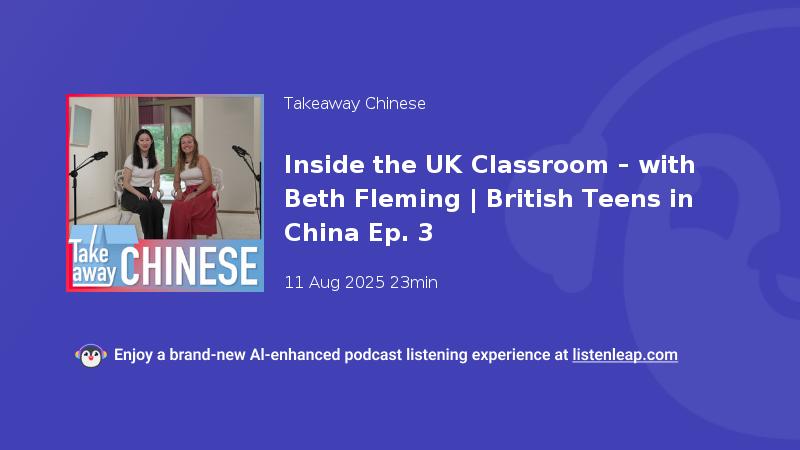
你好,欢迎收听随行汉语。 Welcome to Takeaway Chinese.
I'm Niu Niu, and this is a special edition of our show.
In this episode, we're taking you to Beijing Language and Culture University, where a group of enthusiastic students from the UK are exploring the world of Mandarin through a unique summer camp experience.
My colleague Ma Jing visited the campus and caught up with Beth Fleming, one of the teachers accompanying the group.
Beth has spent years learning and teaching Chinese back in the UK, and she brings a fascinating perspective on the joys and hurdles of studying the language, especially in a British classroom setting.
She's also traveled extensively across China, and in this episode, she shares her thoughts on the culture, the people, and what has left the deepest impression on her.
Whether you're on your own Chinese learning journey or just curious about how international students connect with the language and culture, we hope this episode can offer some fresh insights and inspiration.
Hello, I'm Ma Jin. Today I'm meeting a special guest from the UK, Beth Fleming.
Hello, hi hao. My name is Beth. I'm a Chinese teacher from the UK.
I work at a school called Macmillan Academy in the north of England.
I've been learning Chinese for 12 years and I'm still learning.
And I've been teaching Chinese in England for...
Five years now. This is my fifth year. So this is not your first time in China, right?
No, no. It's my fifth time in China, I think.
Fifth time? I think so, yeah. So which city have you been to?
Lots. Obviously Beijing. I used to live in Hangzhou.
I studied for one year at Zhe Da. I've also lived in Weifang because I worked there for one year teaching English at a primary school.
And then traveling and as a tourist, I've been to Xi'an, Chengdu, Zhengjiajie, Harbin, lots of places, Nanjing, Suzhou, lots of places.
Oh, and Hong Kong. Yeah, Xi'an Gang. Wow, you've been to more places than I did.
So which place do you like best? Oh, I love Xi'an.
Yeah, and I love Binh Mai Yong. It just fascinates me, the whole history behind it and how huge it is.
I also really love Chengdu. I think the first Chinese friend that I made is from Chengdu.
So it's got like a special place in my heart.
Can you eat spicy food? Yes, I do like spicy food.
But some of it was a little bit too spicy when I was there.
But I do like spicy food. So you have a Chinese name.
How do you get that? So the first... Every time I came to China was 2014, when I was 19 years old.
And my first ever Chinese teacher in China was called Li Laoshu.
And she, at the beginning of the trip, said, right, I'm going to give you all Chinese names.
And I've never been given one before, so I was quite excited.
But it took a little, she said, I want to get to know you all first before I give you your Chinese names.
So it took her a few days. But then she gave me mine.
So my second name in English is Fleming.
So she gave me Fu from Shifu, which means master.
Yes. And so she chose that Fu for my second name.
And then my name is Bethany. So she gave me Sini as my Chinese name.
And it's like Sishang. Yeah. Because she said I was always thinking and quite thoughtful.
So she gave me Si and then Ni. It sounds like my English name, so she put that on there as well.
And it's usually for girls. Usually for girls, yeah.
Good. So that's where that comes from. Could you share one thing you really enjoy about being in China?
So much. If I could only choose one thing, what would it be?
I don't know. I love... Chinese people I love interacting with Chinese people because I think when I first moved to China I felt like sometimes people felt a little bit abrupt like you know you go to a Chinese shop and you put what you want on the counter and they just say the price and then buy whereas like in England you know they'd say oh, is this everything?
Like, well, sometimes they say that in China, to be fair, but they'd say, please, can you give me like this money?
But Chinese people don't necessarily, they just say the price.
And I suppose, especially because I'm foreign and they maybe don't expect me to speak Chinese.
So that felt really abrupt at first. But I think when you actually interact with Chinese people in Chinese, they're really open, really friendly, really generous.
And I think There's a quote I always like to say when I explain this to people, but Nelson Mandela said, if you speak to someone in a language they understand, that goes to their head, but if you speak to them in their own language, that goes to their heart.
And I think that's so true in any country, but especially in China when people don't expect you to be able to speak their language.
It really goes a long way if you can, even just a little bit. yeah i remember once zuckerberg went to a college and he said that's our whole and everyone is praising her his chinese is super good yeah yeah if they just said that yeah yeah yeah so so people's comments in english he just said hello everyone yeah yeah yeah exactly that's it even just a little bit goes a long way i think yes what is your favorite chinese dish jiaozi Yeah, they're definitely up there.
But when I lived in Hangzhou, I also really enjoyed eating all the time.
Yeah, I really like that. Have you got any souvenirs to bring back home?
I think it would have to be Chinese tea, you know?
Probably some Longjing Cha from Hangzhou.
Well, you can buy it everywhere, but yeah, Longjing Cha.
I love it. Do you think there's a big difference between Chinese tea and UK tea?
Yeah, big difference. Obviously, well, one of the main differences is in England we tend to have bags of tea, and in China it's loose leaf a lot of the time, and I prefer loose leaf tea.
Yeah, I just think Chinese tea just tastes better.
I can't really say why. And then everywhere I go, I always try and buy a magnet for me and for my granddad.
And I've got a couple of magnets as well from the Great Wall yesterday.
So you chose your Chinese as your major in university.
Why? How do your family members react to that?
Yeah, so I just love learning languages and cultures and I've always wanted to travel ever since I was really young.
And then when I got a place at university, I was the first person in my family to go to university.
I thought, well, if I'm going to study languages and cultures at university, I should learn something I wouldn't have the chance to learn anywhere else.
So I went to Durham University and they offer a whole range of languages.
And I looked into all of them and Chinese really stood out to me just because China as a country had always fascinated me a little bit.
And I thought, oh, I'll give that a try. see how it goes and then obviously absolutely loved it still do and that's why i'm teaching it now do you think your students chose chinese maybe out of the same reason as you did i think i think so yeah i think a lot of students choose it because it's different some students choose it because they want to challenge themselves some students choose it because they just really love chinese culture or they've already watched chinese tv shows and they want to learn more Some students choose it because obviously it is the most spoken language in the world.
So they see it as an opportunity to get better jobs in the future and travel and get a higher salary and things like that.
So lots of different reasons. So as a Chinese teacher, what's the biggest challenge for you now?
What do you think? For me now, I think...
I suppose it's maintaining that motivation because although Chinese is a fascinating, different, unique language to learn and the culture's really, like, obviously, yeah, amazing, some students do struggle with the challenge of it once they've started and they realise, oh, actually, this is really difficult. some of them do want to give up sometimes and it's kind of trying to keep them motivated and remind them that it's okay to make mistakes.
Just keep going, you'll get there. And yeah, so keeping them motivated when it's challenging, I think is probably my biggest challenge.
Wow, that sounds a lot of jobs. So here's another question from me.
So when I was learning a second language, I always think which is better?
Should I learn from a native speaker or should I learn from someone from the same cultural background as I am?
Yeah, I think both have their advantages.
Obviously, with a native speaker, they're going to understand the language in much more detail, they're going to have a wider range of vocabulary to draw from.
And yeah, they're like the real experts because they're the natives.
But then I think a non-native teacher also has their benefits, have their benefits too, because they can understand what you're going through as a learner.
So like when I was teaching English in Weifang, it really challenged me to really think about my own language, because even though they were only primary school students, but some of them would say, right, OK, well, if this is this, why is this that?
And I'd be like, oh, that's a good question.
I'd never thought about it. So whereas, you know, a Chinese person that had learned English might have been able to explain that in a much more relatable way.
So. Yeah, they both have their advantages.
Great. Yeah. I heard you are super, super good at Chinese.
So I prepared a little quiz about that. Okay.
Let's see if you can do it, right? So I will challenge myself.
Yes. So, you know, online Chinese could be quite different from textbook Chinese.
Yeah. So have you heard people say, 我睡了?
我睡了? Yeah. 睡了? 睡了? No. So informal Chinese, we must have heard it.
For example, hua ping sui le. I'm sounding really silly now.
No worries, no worries. I feel like I've got lots to learn.
Yeah, no worries. In formal Chinese, we often say, 花瓶碎了.
Do you know 花瓶? 花瓶 is... A vase. Yeah, yeah, yeah.
Flower bottle. Yes, sure. So 花瓶碎了 is the vase was broken.
Yes. For example, 杯子碎了. Yeah, the cook's broken.
Yes, great, smart. Okay. So... Those are an object.
So 我碎了 . A person can be broken. So that's kind of mean heartbroken, actually.
Oh, it means heartbroken. But it's not formal Chinese.
It's online Chinese. Okay. Yes, spoken Chinese.
Yeah. So people would say 我碎了 to me. I feel a little bit sad.
I'm a little bit heartbroken. Or sometimes I feel a little bit annoyed.
I feel like I've been played. So for example, I bought a dress for 200 RMB.
And then I found my friends bought the same exact same dress for half the price.
So I would say we're sweet love. I'm a little bit sad.
I feel I've been played. This happened to one of my students yesterday, actually.
She... We were at Changchun and they were shopping and they saw chess sets and they were like, oh, I'm going to buy a chess set.
So one of my students bought one and it started at like 680 yuan and she got it down to 450.
So she was like, oh, I got a good deal there, miss.
And then another boy comes up and he says, well, I got it for 200.
So she could have said, well, so and so.
Yeah, you could teach her that. Yeah, I can teach you that next time.
OK, have you ever accidentally said something totally inappropriate in Chinese without knowing it?
I mean, there's one story I sometimes tell my students from when I lived here, when I took my partner to Harbin and we were in the taxi.
And obviously in Harbin, their accent's a little bit different.
Well, everywhere you go in China, people have a different accent.
So in Harbin, there's lots of like R's and, you know, and I was still, you know, learning Chinese then.
I didn't know as much as I know now, but I
I had to be brave and take the lead because my partner speaks no Chinese at all.
So I was trying to say to the taxi driver that we wanted to go to number 90.
Like our hotel address was number 90. So I should have said 九时好.
But I think what I was actually saying was 九时好.
And so he kept thinking we were like in the right place already.
So he kept stopping and I was like... We're not here.
So I kept trying to say 90, but he kept thinking I was saying we're here.
And yeah, it was a bit confusing. Yeah, yeah, sure.
Since you mentioned that, I'm also wanting to ask you this.
So in English-speaking countries, when you're trying to fall asleep, you probably count sheep.
Because sheep sounds close to sleep, right?
Do you know what we count in Chinese? I don't actually.
I would like to know though. Yeah, we were told that we should count 羊. You know, 羊 is sheep, right?
We should count that. But then people argue that English people do that.
We should count 睡觉 because it sounds close to 睡觉.
That's good. I have to tell my students that.
Yeah, so you should say 一个水饺,两个水饺, something like that.
That's really good. I'll teach them that tonight so they can actually go to sleep.
Have you encountered any culture shocks or funny stories?
I remember when I first moved here, though, obviously it takes a lot of getting used to.
And there are lots of things that people do here that we would, we just don't do in England or don't have in England.
So like, for example, like kai shui, like in England, everyone drinks cold water or at least room temperature water.
But you don't see many people drinking hot water.
So when I first moved here, I thought that was, strange a little bit culture shock yeah that was a bit of a culture shock um but now i love drinking roche and and drink it at home too um and things like squat toilet oh like the toilets they're very different as well so when i first my students now have had that culture shock oh we have to use scott i know it's like yes okay you know you know asian squads are quite popular on tick tock so people are trying to see if they can do Yeah, one of my students the other day said, Miss, I've mastered the Asian squat.
And she just squatted in front of me on the pavement to show me.
She was like, look, my heels are down. And I said, yes, well done.
So can you also do that? Yes. That's good.
Also mastered it. Okay. So I think your learning method is pretty different from the students because you are an advanced learner.
What's your usual way of learning Chinese?
So... I think for me, it's more about connecting with native Chinese speakers, practicing with them, networking with them on WeChat or however, and then trying to, when I can, maybe keep up with with my Chinese by maybe watching TV shows in Chinese or listening to music in Chinese or podcasts in Chinese as well.
And then that also teaches me new little things every now and again as well.
Do you think when you're learning Chinese, teaching Chinese, you also adopt the Chinese way of thinking?
Yeah, sometimes. Even if I'm back home in England, there are certain situations where the Chinese word comes to my head first for what's happening.
So like if something's a little bit frustrating, I'll be like, like, you know, instead of the English, which I don't know, might be like, that's annoying.
I don't know. There's, yeah, certain words that come to me first in Chinese because I've kind of got my Chinese mindset in those situations.
That's funny. So what do you think is the biggest challenge where you learn the language?
Learning Chinese from an English learner's point of view, I think it's getting your head around the fact that the characters don't match, like aren't necessarily phonetic in that you can look at them and instantly know how to read them.
So it's almost like learning two languages because you're learning the characters and you're learning the pinyin.
And I think that feels like a lot when you first start learning.
But the more you do it, the easier it gets, the more used to it you become.
Yeah, that's great. And also, if your friends are coming to China, if they totally don't understand Chinese, do you think that'll be a problem?
It depends on where they're going. I think in big cities, they'd probably be okay, mostly.
And in cities where there's lots of tourists, like Beijing and Shanghai, I think they'd probably be okay.
I think it's much easier, though, if you can understand the language, especially in China, because there are lots of people that don't speak much English or speak a little bit of English, but maybe aren't very confident with it.
You know, it's very different to traveling to somewhere in Europe where lots of people speak English and you can speak English quite easily.
So I'd say they should not expect to find it easy, but it's possible.
So you're on an 11-day summer camp, right?
Yes. Yeah, nine full days and then two travel days.
So students are going to learn some Chinese here in Chinese universities.
Yeah. And they are also going to get to see the landmarks of Beijing, right?
Yes, exactly. And we have seven days where in the mornings we have Chinese lessons at the university with a Chinese teacher, which I think has been really challenging for my students because...
I speak Chinese in the lessons and I try to speak as much Chinese as possible but obviously sometimes we speak a little bit of English whereas our Chinese teacher at Beiyu is only speaking Chinese and that's really challenging for them but it's helping them to improve a lot really quickly.
So we have seven days where we have our language lessons and then in the afternoons we do cultural activities. our mini excursions, and then two excursion days.
So yesterday was an excursion day when we went to the Great Wall and Olympic Park and the Acrobat Shore.
That sounds like a totally immersive experience.
Yeah, it really is. Yeah, yeah. Okay, that's good.
Being to Changchun, you've been to many places, I think, during this trip.
Well, we did our first like travelling day, excursion day, yesterday.
And then before that, we've been mainly at the university doing language lessons and cultural lessons.
So we haven't... We've been to Changchong, Niaochao, and one of the theatres...
Is it Chaoyang Junyuan? A theater in downtown.
Yeah, we went there as well to see. Okay, so what's the most exciting thing you do in this trip?
So far, the most exciting thing we did, I mean, I love the Great Wall.
I know that a really typical response. But I think it was the first time I've been with students and it was really nice to see them.
And they were coming up to me, they were saying, Miss, they've been to a wonder of the world.
It was really nice to take them there. I also really enjoyed the acrobatics we watched yesterday.
They were very impressive. They didn't look real because they were so good.
And then I'm really excited to go to the Summer Palace and Temple of Heaven as well, which is happening tomorrow and the day after.
Wow, good. So could you describe a little bit about the acrobatics for us?
Yeah. So we went to the theatre to watch them.
And before we got to the show, while we were waiting in the lobby in the foyer, and we saw some of the acrobats come out and take photos and things so we saw some of their outfits before it started and they were amazing and then we went in and it was um a group of acrobats and there were maybe six performances but each one was really different so they had like group ones, individual ones.
There was one who was juggling and tap dancing at the same time, which was incredible.
There were people jumping through hoops, people jumping on springboards, people doing silk acrobatics in the air, people like doing like contortionists.
Yeah, there was a lot of different, every performance was so different and so amazing.
It was really good. Great. Thank you so much, Flemmi, for sharing your incredible journey with us.
Thanks for having me. Yeah. I'm sure our listeners have found your story both relatable and encouraging.
I hope you've enjoyed Beth's stories as much as I have.
Maybe her journey gave you a little extra motivation, whether you're learning Mandarin yourself or cheering someone else on.
Also, have you ever visited China yourself?
If so, what was your experience like? And if not, do you plan to come for a visit someday?
We'd love to hear from you. And that brings us to the end of today's Takeaway Chinese.
I'm Niu Niu. For more episodes of the show, you can visit our website at radio.cgtn.com and go to the column podcast.
You can also listen to the show and read the script there.
Find us wherever you listen to your favorite podcasts.
Just search for Takeaway Chinese. Don't forget to leave your questions, comments, and ratings.
感谢收听,我们下次再见!