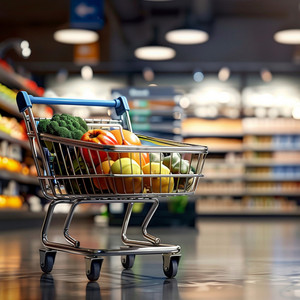
When you go to the fruit or vegetable section of a grocery store, do you sometimes feel like it's fruit or veggie fashion week?
The apples look like models.
So shiny and perfectly shaped.
But wait a second, what about those ugly carrots?
What about the misshapen potatoes?
Don't they need love too?
Well, the answer is yes, they do.
And the aim in China now is to make sure that they get it.
After that, why is a strawberry sweet?
Why is coffee strong and maybe a little bitter?
Science tells us, our perception of the flavor of foods that we eat is influenced by many things, including the shape, color, and texture too.
So now that we know that, AI is getting involved in the topic.
But how and why? Coming to you live from Beijing, this is Roundtable.
I'm Steve, and for today's show, I'm joined by Nia Honglin and Lai Ming.
First on the program.
In an effort to combat food waste and encourage sustainable consumption, Chinese retailers are giving a new lease on life to ugly fruits and vegetables.
Traditionally discarded for being blemished, misshapen, or imperfect in appearance, these produce items are now being marketed with the hope of reducing waste and promoting eco -friendly shopping habits.
The campaign, which involves discounts and creative marketing strategies, aims to reframe public perception of these discarded foods.
So let's dive into how these flawed veggies and fruits are leading the charge in what we can call maybe this tasty revolution.
But don't we agree?
If you're at the grocery store and you see an ugly pear next to a pretty pear, well, then you're probably more likely to buy the pretty pear as opposed to the ugly pear.
Do we agree or do we not agree?
Depends on how ugly it is.
That is a good answer.
But there definitely has been different rounds of perception towards what's considered a good quality of fruit or vegetable.
I believe at the very beginning, of course, we go straight to the very pretty ones, the shiny ones, the ones that almost radiate under perfect light in the market, especially if there's not supermarkets.
It's kind of the fresh food market you go to, you talk to the vendors, you pick the ones that you like from the basket.
Sometimes they'll pick for you.
They'll say, I have a lot of experience.
I know which one's sweeter.
I know which one's better, tastes better.
And later on, people started to think that, oh, maybe the imperfect ones, the ones with wormholes on it, are the ones without any kind of chemical influence.
They are supposed to be healthier.
And then after a little bit of several years, I realized that more and more people started to get their grocery shopping in supermarkets, sometimes online shopping, making it less and less frequent for you to stand in a fresh food market and pick your fruit directly.
So yeah, different situations, but definitely when it comes to the not so appealing kind of the ugly pears or the ugly orange, which actually there is a type of orange that is considered.
Yes, translated as or ugly oranges, famous for being ugly and super sweet.
They are the exception.
But nevertheless, we definitely see the ugly fruits and veggies getting less chosen in supermarkets.
I mean, supermarkets do an incredible job of making the fruits and vegetables look so desirable to us.
A lot of times they'll have that mist flowing.
Looks like a Michael Jackson music video when you're choosing your bananas or avocados.
We're speaking lightly about this, but this is a serious topic.
So let's get into it.
Nyong 'lyn, where are we now?
What's going on in China at the supermarkets and grocery stores with fruits and vegetables?
Well, definitely when it comes to fruits and vegetables, we go think about food waste because between the food being harvested to they actually got onto the shelf.
Actually, the international or the global figure is that 14 percent of these food would go waste in between these two process.
And that is approximately four hundred billion U .S.
dollars. So, yeah, a lot of waste here.
And when it comes to the figure in China, food waste is a growing problem with an estimated 27 percent of food produced, about 340 million tons going uneaten every year.
So that's not only between the harvesting and putting onto the shelf, but also when they're on the table, when they're in the supermarkets not getting picked.
So the situation is quite serious and we're trying to figure out what are some of the reasons I think food being not pretty enough would be one of the reasons.
Yeah. Waste can come, I guess, anywhere along the supply chain.
Right. But part of the problem is the fact that these ugly vegetables or fruits, the misshapen, the blemish, the imperfect ones are not getting chosen.
And I guess traditionally, these vegetables are discarded because they don't meet the high standards.
And we know this, don't we, that that supermarkets here in China, I'm sure, and I know this about Canada and the United States, they have very, very high standards.
And the consumers who are choosing these vegetables and fruits, they have high standards, too.
So to combat this, what are Chinese retailers doing?
Well, Chinese retailers like Fresh Hippo in Chinese He Ma, which is an Alibaba owned supermarket chain, are leading an innovative push to sell the so -called ugly vegetables at a discount.
Fresh Hippo has introduced quirky mascots such as a smiling tomato with a gash and a saucy carrot to make blemished produce more appealing.
A smiling tomato with a gash, it sounds like a horror movie somehow, doesn't it?
Like the Joker or something.
It's only the transparent package with some picture on it.
So yeah, you associate the fruit or veggie with the junoling on the outside of the package.
You're giving a personal image to the vegetables that you're shopping for.
So somehow to evoke the sympathy on the part of the consumers.
I mean, that's natural.
And in addition to Fresh Hippo's efforts, supermarkets in Weyte Market in Nanjing, southeast China, have started selling ugly vegetables such as red fuji apples with skin imperfections, misshapen peppers and wrinkled potatoes.
And this movement to reduce food waste isn't new.
Since 2015, Ma Hongwei has been running a bento box delivery service in Shanghai, sourcing blemished vegetables directly from farmers.
Effective, yeah, that Fresh Hippo campaign that you're talking about, the smiling potato and the saucy carrot, that's helped them save up to four tons of food per week, per week, which is a really impressive number.
If we look at other parts of the world, yes.
And you mentioned it already, this is a global problem.
And I went to the World Wildlife Fund website to see if I could find anything there.
And there's a new report from WWF and Tesco.
It's called Driven to Waste Global Food Loss on Farms.
This is a really recent report.
And what they found was that there's an estimated 2 .5 billion tons of food that goes uneaten around the world each year.
And that is a big problem because that's an increase of approximately 1 .2 billion tons.
They had estimated that the waste would be around 1 .3 billion tons, but they found that it's 2 .5.
So there's the difference of the 1 .2 billion.
And the new estimates also indicate of all the food grown, roughly 40 % goes uneaten around the world.
And that's an increase as well, because previously they thought that that was about 33%.
That's globally. But if we look at different parts of the world, what can we find?
Europe, for example.
The European Commission reports that 30 % of fruits and vegetables that don't meet the beauty standard are either processed, turned into animal feed or discounted.
In France, the situation is even more severe, with the rate rising to 40 % and 10 % of produce going unharvested, according to a Euroactive report referenced by RTBF.
In the U .S., as much as 20 % of the fruits and vegetables harvested on farms are discarded because they don't meet the aesthetic standards of grocery stores.
And here, talking about the situation in Europe, I remember there's an anecdote that Newholing shared with us a few weeks ago coincidentally about how certain fruits and vegetables are supposed to take on very specific shapes before they're allowed to go on show.
This is actually, I feel like, quite famous when it comes to examples of European Union's law that are considered, some of the regulations considered, bureaucratic.
And this is actually adopted.
This is a regulation 1677, and yes, in which the features of cucumbers became part of European law.
The document detailed those characteristics that allowed cucumbers to be classified by grade and category based on their shape, coloring, and the quality of their skin.
Cucumbers aspiring to belong to the extra class had to be practically straight, while the regulation allowed their class one cucumbers in a maximum curvature of 10 millimeters per 10 centimeters at length.
That's so specific.
Very, very specific.
Actually, it was originally suggested by trade associations and the member states' minister of agriculture so that these kinds of cucumbers, when they are put onto shelf, when they're being shipped, when they are packaged, it's easier.
They fit into the relatively more fixed boxes.
And also, you do not have to examine or see the quality of each and every cucumber, because there's the regulation.
Some people have already done it.
But definitely, this has resulted in certain waste in food, which is why actually in 2014, European has introduced this eat the not pretty enough fruit kind of campaign as well.
And they have even invited several of many restaurants to specifically pick the vegetables and fruits that are not being chosen in certain supermarkets or fresh food markets.
They would use those ingredients to cook so that to let people know they taste as good.
So, yeah, two sides of the story.
I mean, what's your response to that?
An EU regulation that says the cucumber needs to be measured and if it doesn't meet the qualifications, it's not making its trip to the grocery store.
Just without too much thought.
What's your response to my initial reaction was to thank New Horning for explaining why there is a regulation in place.
Otherwise, I would suspect that they were with the Europeans were thinking about launching the cucumbers and bananas into space.
If it's rocket science, it has to be very specific.
Otherwise, I mean, if it's going to end up in people's stomach and perhaps in the in the loo, then why would people care?
And my second reaction is that, well, this is perhaps because now the industrial production of fruits and vegetables has developed to a point that it allows us to do that, to have these seemingly unreasonable demands to order the cucumbers to be a particular shape like this, a magic word that people can chant
and turn them into the right shape.
You're joking about this, but actually, this is the actual fact in Shouguan in Shandong Province here in China.
Vegetable powerhouse.
Yes, they're very famous for cultivating different types of vegetables, and they are able, currently able to reduce the amount of, quote unquote, ugly vegetables to less than one percent.
So that's after harvesting, you've already got this pretty looking cucumbers and bananas already.
But we have to say this is not only a problem to the well in the European Union, actually, even here in China, in Yunnan, we have.
Well, this is a relatively long story, but this person, he is a vegetarian and he started a vegetarian well, a vegetarian restaurant.
And he has also cooperated with many local greenhouses and local farms.
And he realized that for the local farmers, sometimes they would one day actually try to sell their vegetables to local fresh markets and supermarkets.
The supermarkets would require their Spanish to be between the length of 16 centimeters to 20 centimeters.
Not too long or too short.
And also with the leaves of the Spanish, you cannot have more than seven wormholes.
Otherwise, it's considered not pretty enough.
And these are too much standards and too much requirements for those farmers.
It does make sense to me, though, and here's why it makes sense to me.
There was a survey done, I believe it was out of the United States.
Maybe pardon me, maybe it was done out of the UK.
They asked people, do you care what the fruits and vegetables look like?
Eighty one percent said yes, they do.
And because of this, supermarkets need to respond.
They can't put ugly carrots and potatoes and they can't put spinach with nine holes as opposed to six wormholes on the shelves, because 81 percent won't buy it.
And this is why we're having regulations that stipulate the pitch of a cucumber, a perfect cucumber on the surface.
It seems ridiculous, but there's a reason for it.
And the reason is they can't sell it.
And here's the thing that maybe we're not thinking about.
Yes, food is wasted at certain points along the production line all the way until it goes into our mouths and including on our tables when we don't eat enough.
And we or we eat too much and there's leftovers and we end up throwing it away.
But there is psychology there.
So if it gets to the supermarket, if they allow that cucumber that doesn't have that certain length or that spinach that has too many holes and it does end up on the shelves of supermarkets, people aren't going to buy it.
And when people don't buy it, it gets wasted, too.
So, oddly, it seems like these regulations are put in place to help protect against further food waste, if that makes sense.
It makes total sense.
And if you think about it, we're only talking about a carrot or a potato.
These are, well, these these are the kind of vegetables that has their own packages.
You can peel them. But if we're talking about, for example, cabbage cabbage, one, you ship the cabbage from, for example, Yunnan province to the high level, high end supermarket in Shanghai.
During the shipping, it will be peeled again and again so that the outside layer of the cabbage look prettier.
So, again, there that tiny little detail would lead to more food waste.
Yeah, exactly. Why why is it that some fruits and some vegetables get to be ugly, if you will?
What's the reason behind that?
Well, some the transportation might be the reason if they are not properly packaged and some dense and and collusion might cause it to have some injuries which will further develop into ugly appearances when they are put on the shelf.
And some might be attributed to the effect of the weather or the environment where it is grown, if it's overexposure to the sun or inadequate exposure to the sun or exposure to extreme weather might cause the fruits to to develop in very regular shapes.
And this could be one of the reasons.
Yeah, climate change, climate crisis, right, changing temperatures.
Because farmers know the perfect conditions that they need to have to produce the perfect vegetable when necessarily if it's a large scale farming industry, then a factory like _____ _____ _____ _____ _____ _____ _____ _____ _____ _____ mentioned earlier, they they should have the infrastructure and the technique
to run a greenhouse.
Whereas if it's an individual farmers, they they only have a patch of land and they tend to the land as they see fit as they they've learned from their former generations.
I mean, there's not much science into it.
Then there there's no means for them to control the environment to a point where the vegetables can grow into the perfect change.
Yes and no. And I'll use all of trees as an example.
This is from CNN from 2023.
Europe in the last couple of years, they had their hottest summer on record.
I think it was 2022 or perhaps it was 2023.
And do you know the world's largest producer of olive oil, by the way?
You would maybe assume that it's Italy, it's Spain.
It's Spain. Spain's the world's largest producer of olive oil and their production plunged to roughly six hundred and twenty thousand metric tons compared to their five -year average of about one point three million metric tons.
And olive trees, they can't handle those hot temperatures.
And what the trees do is they stop producing fruit because what they're trying to do is conserve more water.
So, you know, and we're talking about a country that produces the most olive oil in the world.
And as a result, this snowballs, right?
As a result, we're talking about skyrocketing prices of olive oil.
So what my retort to your to your point, which is not wrong.
It's just that it's not a blanket statement that can cover all farmers and also it's just different in many parts of the world, right?
The productions of different foods.
Well, climate change, obviously, is a more blanket reason to cover the changes to the shapes of vegetables, that's for sure.
But again, in China, I think not every business is large scale.
And I think there's a certain percentage of individual farmers and modern power agriculture workers there.
And that is one reason to explain it.
What can we do then?
Or what are the advantages of making use of ugly vegetables?
I guess there's a lot of different things, right?
Reducing food waste would be number one on the list.
You can make pickles.
Yeah, you can pickle.
Well, well, the first one would be reduces food waste, for sure.
And also it has environmental benefit.
It helps lower the carbon footprint associated with food waste.
And it's cost saving for consumers for sure.
If we can buy ugly fruits in a lower price with the same amount or same level of quality, definitely I would go for it.
And marketing and consumer appeal is another thing.
If we can associate the ugly fruit or buying ugly fruit to saving the planet, hence making people have more willingness to buy it.
Because actually, according to a survey, a previous survey around or more than 30, 73 percent of the millennials said that they're willing to pay for a little bit higher the price if the product is associated with sustainable development.
Oh, that would be interesting then if these ugly vegetables and fruits were suddenly so niche, they became more expensive because Gen Z or the millennials were willing to pay.
But you talk about marketing and consumer appeal, and I guess that's one of the challenges that we're looking at here is consumer perception.
Because a lot of shoppers, we talked about it, right?
Eighty one percent.
They're still hesitant when it comes to buying misshapen produce.
So we have to make people understand that there's nothing wrong with those vegetables, right?
There's nothing wrong with the fruits.
Like of experience with farm work, I think that's one of the reasons.
At least in the example of China, the cities are rapidly urbanizing and the population is urbanizing.
And we're talking about nearly 60 percent.
I think the last time we check is around 60 percent of people live in big cities.
That means only 40 percent, perhaps even much much fewer than that, much smaller percentage of that, have had experience dealing with farm work.
And it takes someone to know the very specifics of farm work, like harvesting grain or harvesting oranges from the tree to know that certain environment might lead vegetables to grow in a particular shape or form.
And that might really that doesn't mean that this is poisonous or it is harmful to eat them.
Yes. And education takes so many shapes and forms, for example, students in Jimmy University of China received an education class on ugly fruits and vegetables.
Some students designed posters and some designed ugly vegetable blind boxes.
And perhaps some of those pictures printed on the transparent package of the vegetables are designed by certain students, knowing that their design would help people understand that these vegetables might be ugly, but they can also be tasty.
Yeah, I think part of the I mean, that's good.
Early education is great, but I think part of the problem, too.
I don't know if you'll agree with me or not.
When I asked that question at the beginning of our chat and I said, if there's a pretty pair next to an ugly pair, which one are you more likely to choose?
Even I, even with all of the knowledge that I've acquired from our discussion today, even if I went to the grocery store right now, I'd still pick the pretty pair.
How about if the ugly pair is 20 percent less pricey than the pretty one?
Or 30 percent? This is what they're doing in France.
This is what they did in France, I should say.
Intermach is a local supermarket giant and back in 2014.
So this is not a new issue, right?
This is this issue has been around for a long time.
Back in 2014, they had a campaign where they sold ugly produce at 30 percent of a lower cost to bring awareness to food, food waste.
And the campaign was so successful.
It reached 13 million in one month and the ugly fruits and veggies sold out, according to a campaign video from from the company.
What I was going to say is that I think if we put the ugly fruits next to the pretty fruits, then people are still going to choose the pretty fruits.
So maybe what we need to do, and that's the point I was.
Well, yeah, potato segregation.
Yeah, it sounds like a joke.
But have a special section of the supermarket instead of putting them right next to each other.
What if we just made it more of a campaign type thing, even within supermarkets, a beauty pageant or diversity?
Yeah, the opposite.
I suppose we can look at the bigger picture, even bigger picture of not wasting food.
Actually, there is an association called the Upcycle Food Association or Upcycle Food Economy.
That is to make sure that for the food that are not currently being used or being fully used, get to be fully used, depending on through different innovative approaches.
And one more thing I think is there needs to be enough expert oversight to assure customers that whatever is ugly on the shelf doesn't mean that they're bad or that they're unhealthy.
So there's there's got to be enough oversight to to rule out ugliness associated with poor quality and pest.
And so that consumers know that even when they when they're buying ugly, they're not buying substandard.
They're not buying substandard.
And if it makes us feel better, too, with all of the statistics we heard about food waste, we know that we're helping the planet when we're buying these vegetables.
And if we can get them at a discount, then all the better.