Get the unmissable news stories of the day This is the Beijing Hour Examining the events that impact and shape China and the rest of the world.
This is the Beijing Hour, one hour of news and information brought to you every weekday Now here's your host, Shane Megum, with you on this Friday, August 15th, 2025.
You're listening to The Beijing Hour, coming to you live from the Chinese capital.
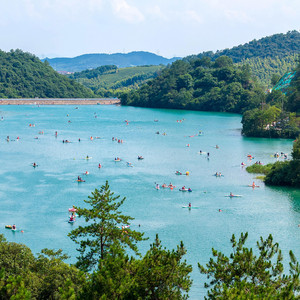
On today's program, China's marking 20 years of its lucid waters and lush mountains green development.
Friday marks the 80th anniversary of Japan's surrender in World War II.
The Russian president suggested Moscow could reach a nuclear arms control deal when he meets his US counterpart in Alaska.
In business, China releases strong economic numbers for July.
And today begin a six-part series called The Unyielding East, China's World War II Relics. bring you stories about the nation that stood its ground against fascism.
Now check in the day's top stories. China's marking 20 years of its vision for green development.
Xi Jinping proposed that lucid waters and lush mountains are invaluable assets.
In 2005, when he served as secretary of the Zhejiang Provincial Committee of the Communist Party of China.
The country has been making efforts to improve the quality of the environment.
Energy consumption per unit of GDP decreased by 11.6% in the first four years. of the 14th five-year planned period that began in 2021.
China's forest coverage exceeded 25%, contributing to a quarter of new global greenery.
Giant pandas, snow leopards, and over 200 other species are increasing in number as a sign of improving biodiversity.
China launched the Kunming Biodiversity Fund last year, which has supported nine projects across 15 developing countries.
The concept of lucid waters and lush mountains are invaluable assets came into being When Xi Jinping visited Yuzhong Village in Zhejiang Province, he praised the decision to close polluting mines and turn to ecotourism.
He then wrote an article explaining that protecting the environment and developing the economy can go together.
The 19th CPC National Congress in 2017 wrote the idea into its report and the party constitution.
The National Conference on Ecological and Environmental Protection the following year named it one of six key principles of Xi Jinping's thought for ecological civilization.
The concept was written into a historic resolution on the party's century-long journey. at a plenary session of the 19th CPC Central Committee in 2021.
Last year, a plenary session of the 20th CPC Central Committee made plans to improve and speed up the systems for putting the principle into practice.
And for more, we're joined now by Luo Jiuqin, a senior fellow at Remen University's Chongyang Institute for Financial Studies.
Thanks for joining us this evening. And first up, what does lucid waters and lush mountains, our invaluable assets, mean for China's environment?
I think this is a very essential condition for China's environment.
As we know, in the past 40 years, China has made a great contribution and also greater cost for the modernization because of the environmental pollution.
So it became the head headache problem for Chinese government and many foreign government and companies also complained that China's environment was damaged by the faster modernization or industrialization.
So the theory and the concept of by President Xi Jinping has really made the greatest contribution for China's environment improvement.
I have to say in this way that Xi Jinping's concept can really be avoided with the Nobel Prize because they made a so great contribution for China's environment in short 10 years.
So we have gone everywhere in the city, in the country.
We see the flowers, beautiful gardens, and clean water, and green mountains.
So many people say always in other different way to say this concept that clean water, green mountain, are valuable than golden and silver mountains.
This is really a very interesting concept. many people understood and supported will continue to make a great effort to make our environment much more modernized and to come back to the best place and country in the world for modernization. latest development.
How has China reduced its energy use per unit of GDP in recent years?
In recent years, we see that China has made a great industrial transformation, especially with the shutdown and closure of many the polluted industries.
Even we have some economic profits lost and there's some in some special areas, especially in the coal mines and also the steel and the publication.
So in this way that China paid the necessary cost to improve its environment.
And as we see that The air quality has already improved greatly.
This is already best recognised by the world community.
And secondly, we see each 10,000 yuan GDP has only there's energy consumption lower than 3.8%.
This is a big achievement. And China has done its best even to pay off the more cost in order to have a better environment.
We don't at that time because we don't care too much about the industrial profit or even some other economic profit at the moment, but we have got a better environment.
The environment will pay back for high return and high gain in order to have a better environment for investment and for modernization.
Okay, thank you. Thank you very much. That was Leo Gerchina, a senior fellow at Remen University's Chongyong Institute for Financial Studies, talking about China's transformation. in environmental and energy landscape in recent years.
The Sahanba area in Hebei Province used to be a windswept wilderness, sending sandstorms toward neighboring Beijing.
It's now the world's largest man-made forest and a symbol of China's ecological civilization.
Huang Yue takes us to see how its success is inspiring efforts to create a greener future at home and abroad.
Sai Hanba covers over 760 square kilometers, the size of over 100,000 soccer fields.
By the late 1950s, centuries of overgrazing, logging, and war had degraded it into desert.
With sand storms threatening the capital and other northern cities, China decided to bring it back to life.
In 1962, the Saihanba Mechanized Forest Farm was founded.
Over half a century, Three generations turned forest cover from 11% to 82%.
In 2017, Sai Hanba won the UN's highest environmental honor, the Champion of the Earth.
So this is a fantastic achievement for the people of Sanbao, for the wider northern China, but also an inspiring example for the rest of the world.
In the same year, Chinese President Xi Jinping praised Saihan Bas foresters for turning the idea that lucid waters and lush mountains are invaluable assets into reality.
And for the first time, he put forward the concept of the Sai Han Ba spirit, which features staying true to the original aspiration being hardworking and enterprising, and pursuing green development.
Now, its experience and advanced techniques have been shared across China as well as with countries including Mongolia, Ethiopia and Sri Lanka.
In 2021, President Xi visited the plantation Among those he met were Liu Jun and his wife Wang Juan, second-generation foresters who have spent over a decade as fire lookouts.
The Sai Han Ba spirit means dedication and selfless contribution.
Working in the forest every day, you have to endure loneliness and be ready to work hard no matter the conditions.
President Xi called on the people of Saihanba to redouble their efforts and carry forward reforestation.
Today, a new generation is taking on new challenges.
Yuan Zhongwei is leading under canopy planting.
See this little sapling? We planted it this spring, spruce and birch growing under the larch. building a mixed forest.
We have a better environment than our fathers and grandfathers.
Our key task now is managing the forest well, so it can grow healthier and sustain high quality development. makes forests are most resilient to fire, pests, and climate change.
Since 2023, Saihanba has made them standard in all its planting projects.
Others are tackling hard forests, steep rocky slopes with thin soil and little rainfall.
We bring in good quality soil by hand. cover it with protective film to retain moisture, and shape the pits like bowls so rainwater stays with the trees.
Now, every such rocky sunny slope in Saihanba has been greened, with survival rates above 98%.
In the whisper of pines and the rustle of birch leaves, Sai Han Ba tells a universal story that with perseverance, science and vision barren lands can become green lifelines that was Huang Yue at Saihanba in northern China.
And coming up, marking 80 years since Japan's unconditional surrender at the end of World War II.
A 3,046-kilometer greenbelt now circles the Taklamakan Desert.
A leafy wall standing between sand and sky. once barren lands are coming alive with trees, birds, and hope.
Each kilometer is a victory against erosion, dust storms, and desertification.
Nature bounces back. when we give us a chance.
Plant a tree. Grow a forest. Stop a desert.
12 minutes past the hour. Friday marks the 80th anniversary of Japan's unconditional surrender in World War II.
Chinese Foreign Minister Wang Yis called on Tokyo to confront its wartime past, saying only by facing history can the country avoid repeating past mistakes.
He was speaking after the Lansing-Mekong cooperation foreign ministers meeting in southwest China.
Wang said certain forces in Japan still attempt to whitewash, deny, distort, and even rewrite history.
He condemned such actions as a challenge to the United Nations Charter and the post-war international order.
China's war of resistance against Japanese aggression was the main eastern battlefield in the global fight against fascism.
China sustained heavy losses, but its victory made significant contributions to the Allied victory in World War II.
Gao Yiming runs us through China's efforts in crucial battles in that 14-year fight.
The hard-won triumph over Japanese fascism came at a dearly cost.
Over 35 million Chinese people lost their lives.
More than 1.5 million Japanese troops were annihilated.
China's direct economic losses exceeded US$100 billion, calculated at prices in 1937.
After the July 7 incident in 1937, Japan launched a full-scale invasion of China.
Two months later, the Japanese army pushed deeper into the northern province of Shanxi.
As it claimed to break through Pingxingguan, A mountain passed along Shanxi's ancient Great Wall, but the troops were met with an ambush by the Eighth Route Army, who halted Japan's advance in a narrow valley and blocked several attacks in local counties.
Despite repeated counter-attacks, the 8th Route Army beat the aggressors.
The Battle of Pingxingguan marked the Chinese military's first major victory since the nationwide resistance began.
China witnessed another fierce battle in March 1938.
Tire draw was a critical choke point on China's Grand Canal.
The Chinese troops led by General Li Zhongren crushed Japan's attacks, wiping out over 10,000 troops.
The months-long Battle of Okan, which also took place in 1938, broke Imperial Japan's attempt to achieve a quick victory.
In the winter of 1939, the Eighth Route Army killed Lieutenant General Norihide Abe, a prominent Japanese military officer in an ambush at Huangtu Lane.
In 1940, the 8th Route Army launched a large-scale offensive against Japanese aggressors.
The offensive killed, wounded or captured over 40,000 Japanese troops, ending with a victory for China.
That was Gao Yiming reporting. 82 years ago, a small unit of Chinese soldiers faced a monumental task to defend their ground against Japanese troops while severely outnumbered.
Their choice of whether to hold on or retreat could mean life or death.
Bi Ren spoke with local official Fu Xingzheng. on history and local records about the Liu-Lao-Chuang battle in Jiangsu province.
82 soldiers, 12 hours. The battle in Liulazhuang back in 1943 stands as a lasting monument in the Chinese people's war of resistance against Japanese aggression.
Its echo still resonates across generations today.
On March 16th, 1943, Over 1000 Japanese invaders launched a sweeping attack in northern Jiangsu.
To protect villagers and the anti-Japanese resistance base, the Force Company of the 19th Regiment, New Fourth Army, held their ground in Liu Langzhuang township.
By March 18, the company of 82 soldiers was completely surrounded.
They fought fiercely, repelled multiple cavalry charges, and destroyed over 170 enemy troops.
More than 1,600 Japanese invaders attacked them with over 100 cannons and grenade launchers.
The force company bravely stopped five enemy charges.
And in the end, they were fighting with their bare hands.
Out of ammunition and isolated, soldiers dismantled weapons. burned documents, buried their comrades, and made a final breakout attempt.
All 82 soldiers died tragically. but have since been revered as heroes.
They knew there was no way out, yet not one of them surrendered.
That was heroism in its purest form. Even in the face of near certain death, What was the source of such indomitable spirit among the soldiers?
It says for the people bravely in sacrifice, the soldiers chose to stay so that the unarmed villagers could be successfully evacuated.
They held a line, gave their comrades time to retreat, and crushed enemy attacks that had been planned for three months.
Most soldiers sacrificed were under 20. Only two letters from Li Yunpeng, the fourth company's instructor, remain today.
Your son is well in body and in life. I am now sturdier and taller than before.
I ask you not to worry. This time I left home, not to repay your kindness, but instead to depart.
This is my wrongdoing. When the wind calms and the waves settle, I shall return with resolve, reunite with the whole family, and thus repay your deep grace.
In 1955, the local government rebuilt the tomb of the 82 martyrs with their own lives.
The martyrs wrote the greatest chapter of loyalty.
That was Bi Ran recounting a decisive battle in China during World War II.
Japanese troops killed more than 300,000 civilians and unarmed soldiers in China during the occupation of Nanjing in 1937.
The Nanjing Massacre remains one of the darkest and most devastating chapters in China's history.
The Japanese public today remains ignorant of the heinous crimes, but the atrocities are well documented in written court verdicts.
Today, it's even more urgent for younger generations to pass on history and memories.
A young girl from Canada has been attending memorials in the eastern Chinese city. and sharing the stories.
We've been spoke with Megan Brady and her family.
The girl singing is Megan Brady. Her great-grandfather was Richard Brady, a surgeon at Drum Tower Hospital in the city of Nanjing.
Back in 1937, when Nanjing fell to Japanese invasion, some foreigners, including Megan's great grandfather, risked their own lives and saved many civilians.
Inside the memorial hall of the Nanjing Massacre victims, a picture of Richard Brady's family was displayed.
The first time that I saw this picture was in 2016.
That was actually the first time that I've ever never seen him before.
I had not met my grandfather. He died when I was two.
I was a little bit too young at the time to really understand the depth and the reality of the entire situation, but being able to come back and have the chance to learn over time as I grew older really helped develop an understanding of what really happened, what his role was, and what he did.
The bravery of Richard Brady and other foreigners, especially Minnie Voltron, who made Jinling College into a refugee shelter saving thousands of lives, inspired Megan to create the song Mercy.
She first sang at the National Memorial Day in 2019.
I think my favorite line is love douse the fire, peace come with the rain, rise from the ashes because the imagery behind that of just washing away such a tragedy to allow Nanjing to be rebuilt into the incredible city that it is today.
The resilience of the Chinese people to overcome such an atrocity. and to still bring such joy and hope into the world is absolutely incredible.
Megan was first brought to China by her father, Stephen Brady.
This time, Stephen brought some pictures showing Richard Brady and his father sitting in front of a dormitory of the hospital.
With the help of the hospital, they found the same building. being able to walk in the same places that he used to work and all of this incredible work was done. it really allows me to connect with him more and see his experience through his eyes.
It's the next generation's opportunity and responsibility.
Because when I grew up, I didn't know anything about it as well, and I think it's important to get the younger generation talking about it.
Over 80 years have passed. Most of the witnesses of that time have passed away and memories are fading.
Megan knows that and wants to join the effort in preserving the memory.
I think as the survivors of the Nanjing Massacre grow older it is important to pass down to the younger generations this responsibility to carry forward the truth and keep their voices alive.
And artistic work like music is Megan's way to pass on the memory to their generation.
She says she prepares to write more music about the history, as there are many more stories worth telling.
That was a report on passing down history of the Nanjing Massacre and World War II.
The National Archives of Japan held a special exhibition of public documents from 80 years ago, but some said the effort is insufficient.
Secretary General Takakagi Fujita of the Association for Inheriting and Propagating the Murayama Statement urged the public to deepen their understanding of of Japan's role in surrender.
The term 80 years since the end of the war is an extremely vague and absurd expression that fails to reveal the truth Japan recklessly launched wars of aggression against China and across Asia, triggering large-scale conflicts only to be completely defeated and forced into unconditional surrender.
The expert said true coexistence with Asia will be impossible unless Japan squarely faces its historical role as an aggressor.
Coming up, Russia suggests the possibility of a nuclear weapons control pact with Washington.
United in purpose during World War II. the Chinese military and people stood as one, fearlessly resisting Japanese fascism.
China's unwavering whole-nation effort forged the pivotal Eastern Front.
Through fierce battles, immense sacrifices, heroic endurance, and decisive support to the allies on the European and Pacific battlefields.
China has helped secure liberation the final victory and the lasting legacy for global peace and human progress resolve and resilience the main eastern battlefield of World War II, only on CGTN.
23 past the hour. Russian President Vladimir Putin says Moscow could reach an agreement with Washington on nuclear arms control at his meeting with U.S.
President Donald Trump in Alaska. The two leaders are set to meet at a military base in Anchorage on Friday to discuss ways to put an end to the Ukraine conflict.
A Kremlin spokesman said he does not expect the presidents to sign any documents.
Trump said the aim of the talks is to set up a second meeting that will include Ukraine.
He wasn't sure if there'll be an immediate ceasefire.
Hendrix I. Brandy previews the meeting from the venue in Anchorage.
Joint Base Elmendorf Richardson sits on the northern edge of Anchorage, Alaska's largest city.
Here on Friday, Trump and Putin will debate what it will take to end the nearly three and a half year long conflict in Ukraine.
The current American administration, Putin said Thursday before departing for Alaska, is making in my opinion quite energetic in sincere efforts to stop the hostilities stop the crisis Also on Thursday, the U.S.
Secretary of State said this. The president said his hope is to interact. and sort of get a sense very quickly and early whether a peace is possible or not.
It could be a steep climb. Since it started in February 2022, the conflict has caused untold number of casualties in Ukraine.
And there are no signs either side is backing down.
Trump says there's a 25% chance the summit will fail.
But he's also suggested if there's headway on Friday, Zelensky could come here to Alaska for a subsequent meeting.
For his part, the Russian president says he'd like to create long-term conditions of peace between the two countries in these talks, as well as in Europe and the world as a whole.
That was a report on what's at stake at the U.S.-Russia summit in Alaska.
British Prime Minister Keir Starmer's office as the meeting between US President Donald Trump and Russian President Vladimir Putin presents a viable chance to make progress on ending the conflict in Ukraine.
Starmer met with Ukrainian President Volodymyr Zelensky, and the two leaders acknowledged the unity and resolve needed to achieve a just and lasting peace in Ukraine.
Zelensky visited London to shore up European support for efforts to prevent an agreement on ending the conflict in Ukraine that'll carve up Ukrainian land.
A young entrepreneur in Shizhong is turning cultural preservation into economic empowerment.
She's inspired women and artisans in the region, also known as Tibet, helping them earn up to 40,000 yuan per month.
Liam Wahan has the story of how one woman's homecoming proved that tradition can thrive when woven with opportunity.
Under five minutes off the tourist trail in Lhasa, you'll discover something special.
This unassuming workshop is changing lives across Cizang by transforming traditional arts and crafts into sustainable income and the women making that happen.
Happen? Joma. Tupelen is more than a store.
It's a bridge between tradition and modernity.
Deep in Xizang's remote pastures and farmlands, JOMA has established workshops training local women in standardized techniques while preserving cultural heritage.
The Everest Workshop is a shining example.
珠峰工坊的这个作品是当前大家看到的手工系列的。 The Everest workshop specializes in handmade pieces featuring Tibetan applique, an intangible cultural heritage craft traditionally used in Tangka paintings.
We adapted it to suit the local artisans' strengths, empowering more women to join the initiative.
The Everest workshop took root three years ago after Joma surveyed 29 villages.
By merging ancestral skills with contemporary design, Drupaline has nurtured over 60 local artisans across three programs. weaving, embroidery, and nomadic crafts, all created during farming off seasons, generating crucial income for families.
Today, Zhoma works in Xizang's farthest corners, but her journey began at Peking University.
A law graduate, she left Beijing's skyscrapers in 2012 to return to Lhasa's winding alleys, bringing back expertise and a mission.
This homecoming hasn't been easy, but moments make it worthwhile, like hearing a heartless child boast about their artisan mother with shining pride.
Gazing ahead, Joma envisions something beautiful, not just preserved traditions, But thriving ones.
我希望通过我们的这个平台,让更多的人看到手艺的力量。 through drop lane i want the world to see the power of craft to honor these artisans Maybe not highly educated, yet deeply rooted in the culture, their resilience, their love for life.
Let Xizan's culture shine through their hands, their wisdom, their philosophy of living. my hope for every farmer and herder to live simply, happily, to return to life's purest joy.
Thanks to Joma's vision, Shizan's traditions aren't just being preserved.
They are empowering a new generation. That was Lil Mohan reporting from Shizan.
Israel says the army is completing preparations for deepening the offensive in Gaza.
The military's chief of staff said the campaign will end after ensuring Israel's victory.
The Security Cabinet's approval of the plan to take over Gaza City has renewed international pressure for an end of the conflict.
Israel also announced a settlement plan for...
The West Bank. We're at 29 past the hour.
Checking the forecast. Beijing's down to 24 this evening.
Thunder showers and 31 for Saturday. Harbin will see heavy rain in 20 overnight, then thundershowers in 25.
Nanchang's down to 29 degrees. That's followed by sunny conditions in 38.
Guiyang's 19 overnight, then moderate rainfall in 28 degrees.
Elsewhere in Asia, Islamabad's down to 24, then a slight rainfall in 31 for Saturday.
BNTN's at 24 this evening, then some rain in 30.
On pens at 24 overnight, then heavy rainfall and 30 degrees.
It's time for a short break. So far this hour, China's marking 20 years of its lucid waters and lush mountains green development.
Today, Friday, China's marking the 80th anniversary of Japan's surrender in the end of World War II.
The Russian president has suggested Moscow could reach a nuclear arms control deal. and he meets his U.S. counterpart in Alaska.
Shane Begumadip, stay with us here on The Beijing Hour.
Listen up. Can you hear the heartbeat of our world?
It's vibrant and pulsating with the essence of life itself.
From the stem of trees. to the gurgle of rivers, from the silent strength of mountains to the icy whispers of glaciers. even the solid ground beneath our feet.
Right there, in the midst of all, beats the heart of humanity.
What if those other heartbeats were to stop?
Would ours keep on ticking? Ever wondered what's actually going on in Africa through the perspective of an African?
How are things really going between China and Africa?
What's the narrative of this relationship?
Well, get a perspective with China Africa Talk.
Hear from African diplomats, entrepreneurs, academics, Chinese natives, and more.
Get on our wavelength every week. To find out what's real with China Africa Talk, find us on your favorite podcast.
We'll see you there. examining the events that impact and shape China and the rest of the world.
This is the Beijing Hour, one hour of news and information brought to you every weekday.
Now here's your host, Shane Bickham, with you on this Friday.
Still to come in business. China releases strong economic numbers for July, and today we begin a six-part series called The Unyielding East, China's World War II Relics. bringing you stories about the nation that stood its ground against fascism.
To contact us, you can email radio at cgtn.com or follow our ex-account at cgtnradio.
And now checking the day's headlines, here's Tianlu.
Thank you, Shane. Chinese Foreign Minister Wang Yi has hosted his counterparts from Cambodia, Laos, Myanmar, Thailand and Vietnam at the Lanzhang-Mekong Cooperation Foreign Ministers' Meeting in southwestern China.
The LMC is an innovative type of regional cooperation system among the six countries featuring collaboration, consultation and shared benefit.
The countries have announced a building of a community with a shared future.
UN Secretary General António Guterres has urged Israel to stop plans for new settlements in the West Bank.
Spokesperson Stefan Dularuk said Israeli settlements in the West Bank, including East Jerusalem, violate international law.
British Foreign Secretary David Lamy has also called on Israel to halt its construction in the West Bank.
He made remarks after Israeli Finance Minister Bezalel Smotrich unveiled plans to construct around 3,500 housing units.
European Union foreign policy chief Kaya Callas said an Israeli settlement plan is not in line with international law.
She called on Israeli authorities not to move ahead with it.
Residents of Washington, D.C. have protested the White House move to deploy National Guard troops and establish 24-7 federal patrols in the city.
Police set up a vehicle checkpoint on 14th Street NW Wednesday night.
Neighbours quickly gather to protest. Ryan Zito lives about one street away.
He called the move unnecessary. My girlfriend and I were sitting in our living room.
We heard a number of sirens. We're about a block away. from where the checkpoint was, and we started getting texts from some friends who live just right here, actually.
No, there. in the building, like right outside the checkpoint area.
Resident Yazima Williams also expressed concerns.
It's concerning. I know that they're supposed to be there for safety reasons, as is said, to reduce the level of crime.
But I feel like it's infringing on just the people who live here and their personal safety, whether they're being questioned for just being in the neighborhood, I don't think it's fair.
Residents are also worried that the increased security will disrupt their neighborhood.
The new human resources chief says US President Donald Trump's administration will likely shed around 300,000 workers this year.
It will amount to a 12.5% decrease in the federal workforce since January.
Office of Personnel Management Director Scott Cooper said 80% of those workers will leave voluntarily and the rest 20% will be fired.
The Trump administration has launched a campaign to downsize the 2.4 million strong federal civilian workforce, citing inefficiency.
And finally, the robot model that danced at the Spring Festival Gala in January has captured the first gold medal at the World Humanoid Robot Games in Beijing, winning the 1500-meter race.
Teams from more than a dozen countries are taking part in the event at the National Speed Skating Oval that hosted Winter Olympic competitions.
Municipal officials in Beijing said the event aims to test the advancements and capabilities of humanoid robots.
And coming up in business, China releases strong economic numbers for July.
Eighty years after the guns fell silent, echoes of China's fight against fascism still resonate.
What can a yellowed newspaper reveal about China's first end in World War II?
What does a blood-soaked vest tell us about the soldiers' final battle?
And what does an old record sing about the power of unity on the Eastern Front?
The Unyielding East, China's World War II relics, brings you the forgotten objects and the unforgettable stories of a nation that stood its ground. discovered China's role in the global fight against fascism and the people whose sacrifices helped secure final victory.
Listen to The Unyielding East, China's World War II relics, wherever you get your podcasts.
36 past the hour. Turning to business now, and first let's check the Chinese mainland markets, which rallied on Friday. the Shanghai Composite Index advanced by nearly 1%, while the Shenzhen Component Index rose 1.6%.
Elsewhere in China, the Hong Kong stock market closed lower, with the Hang Seng index down 0.9%.
In the meantime, the Nikkei in Japan was up by 1.7%.
China's economy maintained steady growth in July, with official data showing gains across the board.
Industrial output rose 5.7% on a yearly basis. while the services production index was up by around 5.8%.
Retail sales of consumer goods increased 3.7% from a year earlier.
And with more, Tianli spoke with Professor Chu Cheng, a fellow of the Belt and Road Research Center at Minzu University of China.
Professor Chu, given the steady July data across industry services and consumption, What do these figures tell us about the current momentum of China's economy?
Well, I think the numbers are showing a very clear picture.
Actually, if you take a look at the production side, the output of the industry is 5.7%. and service sectors as 5.8 percent so i think it's both above five percent So it shows that the expansion on manufacturing and also on service sectors are, you know, are going on together.
So I think that this year, I think the central government is having the target about 5% of the GDP growth.
I mean, if we're having this kind of the gross momentum uh both more than five percent you know serve as a manufacturing i think that can be very good can be a very good sign to guarantee that the whole year's target can be achieved.
And also if I take a look at, you know, in details about the manufacturing industry, You will see that private sectors are first to get more encouragement in their orders and also the –
New orders in export market are also been rising. even though a lot of people are saying the tariff war going on is been jeopardizing the export market.
But on the contrary, we've been seeing actually The export has been increased and on acceleration.
So I think this has been showing that the domestic market are very resilient. and also the outside market also have a very strong demand.
And also if I take a look at the service sectors, I think 5.8% of the gross are higher than the first half of the year, which is about 5.1%.
And I think the reason for that is because in July and in August, we have the summer vacation, we have all kinds of culture, economy, like the concert, like the museum and exhibition and so on that shows that the whole service sectors are you know going upward uh been upgraded towards the higher end of expanding like you know people spend more money in education and culture in tourism instead of just to have some lower end of the service sectors. and also besides the output if I take a look at the demand side.
I think the whole social retail consumption has been increasing by 3.7%, even though it's not as high as we expected.
But I think the increase has already been going on for two months in a row.
And also online shopping is absolutely been increasing faster than the you know, the physical shops.
And also, if I take a look at the numbers, the online shopping has been growing into double digits.
So I think this is kind of the retaliation on consumptions has been going on very very quickly and also Tourism, like I mentioned, the service demand on tourism, on hospitality industry, And all that has been growing very rapidly ever since the 2024.
I think in conclusion, we can say that Bose output and input has on, the same pace has been improved.
Demand and supply are both been repairing.
And especially I think the secondary and tertiary industry has been growing really strong.
So this kind of the double circulation like the government has been mentioned ever since the 2022 has already been showing up a very good sign.
And China's economy has been rallying really steadily and fast.
That was Professor Chu Chong, a fellow of the Belt and Road Research Center at Minzu University of China.
Official data shows China's regional foreign trade maintained steady growth in the first seven months of the year.
In the Yangtze River Delta, trade totaled nearly 9.6 trillion yuan, roughly 1.3 trillion U.S. dollars.
That was up 5.4% on a yearly basis. Growth was driven by surging exports of electric vehicles, high-end equipment and integrated circuits.
The Guangdong, Hong Kong, Macau, Greater Bay Area saw trade hit 5.2 trillion yuan, up 4.7%. while private firms contributed nearly two-thirds of the volume and foreign-invested enterprises expanded quickly.
Meantime, exports from the Beijing, Tianjin, and Hebei region exceeded 120 billion yuan for four straight months, with volume and growth rates hitting annual highs.
Eurozone industrial output fell by 1.3% in June, challenging views that the bloc remains resilient against the fallout from the global trade war.
With trade tensions weighing on growth, the EU continues to work on the finer points of a framework trade agreement with the United States.
William Denslow has more from Brussels. Compared to the second quarter of last year, GDP in the euro area increased by 1.4%. and 1.5% in the broader European Union.
But compared to the first quarter of this year, seasonally adjusted GDP only increased by 0.1% in the Eurozone and 0.2% in the EU respectively.
The past few months have been dominated by uncertainty as the US and EU negotiated a framework for a trade agreement.
Late last month, US President Donald Trump and European Commission President Ursula von der Leyen reached a deal that set a baseline tariff rate for European goods at 15%.
EOfficials say the political agreement provides stability and predictability.
But a joint statement hasn't been signed yet, as Europe continues to push for more tariff exemptions.
The last mile is always the hardest. So, you know, a lot of substances agreed, the vast majority, but those last final tweaks are important This is an important document.
This is our roadmap for where we take things from here and we need it to be right.
Meanwhile, employment growth in Europe remains muted.
In Q2, the employment rate ticked up just 0.1% in both the Eurozone and EU.
A number of industries have been in a holding pattern for months, awaiting news on the trade situation with Washington.
The US and EU account for roughly 43% of global GDP, and disruptions to transatlantic trade flows can have major implications for both American and European businesses.
The EU has long opposed the imposition of tariffs, but officials say this was the best possible deal under the circumstances. and gives European industry a degree of clarity after months of turbulence.
That was William Denzel reporting. U.S. corporate giants are raising their annual cost forecasts amid rising tariffs.
Automaker Ford now expects to spend $2 billion on tariffs this year. up from a previous estimate of $1.5 billion.
The company also lowered its full-year earnings before interest and taxes by $500 million in its latest guidance.
In the meantime, consumer goods maker Procter & Gamble reported a 2% organic sales increase for fiscal 2025, the slowest growth in eight years.
You're listening to The Beijing Hour. Coming up next, we begin a six-part series called The Unyielding East, China's World War II Relics, bringing you stories about the nation that stood its ground against fascism.
Online, on air, and on your phone. Take today wherever you go and stay ahead of what's changing our world. from politics and the economy to business and technology.
Today covers regional and international issues that affect China and the world. with today.
At 45 past the hour, and today we launched that six-part special series, The Unyielding East, China's World War II Relics. a collection of stories about the nation and its people that stood their ground against fascism.
In our first episode, we journey to Tai Lai County, Heilongjiang Province, for one of China's earliest acts of armed resistance against Japanese aggression.
There, we meet a villager who spent years collecting relics from that battle in northeast China.
Through his collection, he tells the story of his hometown. and the unyielding spirit that lit the first sparks of the world's fight against fascism.
Do Hong Yu has more. If you ever find yourself in Zhangqiao, a quiet town in northeast China, you might be struck by how peaceful it all feels.
Rolling grasslands stretch out as far as the eye can see, Herds of cattle and sheep graze lazily on green grass, and waves of cornfields ripple in the wind.
But it wasn't always this calm. It's hard to imagine that this very land witnessed a fierce and pivotal battle in 1931.
It was here that the first shot of China's armed resistance against Japanese aggression was fired. which also marked the start of the world anti-fascist war.
Hello and welcome to the Unyielding East, China's World War II relics, where silent war objects gave voice to the stories of China's fight against fascism.
I'm Do Hongyu. It all began on September 18, 1931.
The Japanese army launched a sudden and brutal invasion of northeast China. the nationalist government at the time chose not to resist.
And within weeks, Japanese troops had taken control of Liaoning and Jilin, two of the three northeastern provinces.
Only one remained, Heilongjiang. That's when Ma Zhanshan, the acting chairman of Heilongjiang and commander-in-chief of the local army, stepped forward.
He knew the Japanese would try to push north, and he wasn't about to hand them the province without a fight.
The only way in was across the Ningjiang River, and that meant the bridge at Jiangqiao.
To prevent the enemy from crossing, Ma ordered his troops to burn the bridge deck and destroy three key sections.
But the Japanese didn't wait long. On November 4, more than 4,000 troops arrived at Zhengqiao.
Backed by planes, artillery and tanks, they moved in to take the bridge by force.
Enma's forces were ready. They fought back with everything they had. bullets flew, explosions echoed across the riverbanks.
It was a fierce, uneven battle, but it became something far greater than a skirmish over a bridge.
It was a symbol of resistance of dignity, of a people who refused to surrender.
Not far from where the battle once raged, we stepped into the home of Zhang Shuming, a local villager.
With great care, he pulled out a sheet of yellowed newspaper carefully laminated in plastic.
This is the Japanese news after the outbreak of the war This is a special edition of Japan's Asahi Shinbu, published right after the battle broke out.
The press quickly reported on this shocking war.
The headline reads, Fierce Battle at Menjiang River.
There are images and news articles of the battle, such as Japanese troops occupying a station and flaunting the ammunition they seized.
Despite being outgunned and outnumbered, the Chinese soldiers stood their ground.
On the northern bank of the Nanjiang River, they fought with crude weapons, using their own bodies to hold the line.
Time and again, they repelled Japanese forces and dealt a heavy blow to their arrogance.
Zhang Shuming emphasized the significance of the battle.
This shattered the myth of the invincible Japanese army.
Jilin and Liaoning fell with barely any resistance.
People across the country were feeling hopeless, saying, we can't beat the Japanese army.
But then, in Heilongjiang, Ma Zhangshan stood up the people of Heilongjiang and the army didn't believe in fate or submission.
They fought back. That's why November 4th is such an important day. it's not just about how many Japanese invaders were killed.
The real impact was it ignited the Chinese spirit of resistance.
Zhang then unfolded a reprinted poster. After the Jiang Chao campaign shocked the world, there was an outpouring of support.
Citizens and students in major cities like Beijing and Shanghai marched in protest. and formed support groups to raise funds and supplies for the army in northeastern China.
Even a tobacco company in Shanghai joined in by launching a cigarette brand named after General Ma Zhanshan.
In the middle of the poster is a half-length portrait of General Ma, with a bold inscription reading, each box includes a 10 yuan donation for the war effort.
Ma had become a symbol, not just of a general who stood his ground, but of the spirit the nation so badly needed.
Yet as the Japanese poured in reinforcements while Chinese forces struggled with outdated weapons and dwindling supplies, The Jiang Chao campaign ended in defeat after over 10 days of fierce fighting.
On November 19th, Heilongjiang's provincial capital fell and the Japanese advanced further north.
By the next February, they took all three northeastern provinces.
Despite the defeat, the flame of resistance was not extinguished.
Many people who were determined to fight began seeking new paths. and eventually this gave rise to the communist-led North-East Anti-Japanese United Army.
During the Jiang Chao campaign, there were already underground Communist Party members embedded in Ma's forces. spread the party's strategy of protracted and guerrilla warfare among the troops, gradually inspiring them to join the anti-Japanese cause.
My father was one of them. He joined the resistance after being enlightened by these underground organizers.
Under the leadership of the Communist Party's Manchuria Provincial Committee, various local militias and guerrilla units gradually united Early resistance battles like the one in Zhengqiao gave people hope and helped foster a sense of unity. laying the ideological and grassroots foundation for the anti-Japanese army.
John recalled that the first time story he ever heard was of his father fighting with the northeast anti-japanese forces The hardships were beyond imagination.
My father said when he first joined, he carried a suitcase.
But after three days of fleeing from the Japanese, he didn't even know when he lost it.
Daytime was okay. But at night, when it rained, they huddled on the trees, shivering from the cold.
They hid in the deep mountains and forests.
Later, the Japanese began a forced relocation by clearing out hunters and woodcutters to cut off the Chinese forces' contact with the outside world.
The resistance had no supply lines. Eventually they ran out of food and bullets. seemed like a dead end.
Thank you. For 14 grueling years, the Northeast anti-Japanese United Army fought with iron will under extremely harsh conditions.
With little food, inadequate clothing and only rudimentary weapons, the novelists made immense contributions to the national resistance.
Operating behind enemy lines, they wage relentless guerrilla warfare, sabotaging transport routes, disrupting communication systems, and attacking military outposts.
Their efforts tied down large numbers of Japanese troops providing critical support to the broader national resistance.
Was your father's experience part of what motivated you to collect these wartime relics?
Yes, my father's stories are what drove me to do this.
When he talked about things, for example, the yellow wool coats the Japanese wore, I later found them and I kept them.
I can feel a connection. Do you plan to pass these relics on to your children and grandchildren?
Not really. Unlike antiques or jade, these can't be passed down like heirlooms.
Eventually, all of them need to go to state museums or memorial halls.
These aren't playthings, but educational materials.
Moreover, my house is small and many items need special preservation conditions, not too hot, not too humid.
In the end they must go to an archive or a museum.
No matter where they end up, I just wanted them to serve their purpose, to share this history with more people.
I want more people to know that the first shot of China's armed resistance against Japanese aggression was fired here.
That's my intention. my source of pride.
From the first shots of China's armed resistance against fascism in Jiangqiao to the 14 long years of hardship endured by the Northeast Anti-Japanese United Army, and to the way ordinary people today cherish and preserve their history,
What we see is the unbreakable spirit and the core of a nation. when the wind brushes over the fields and cattle and sheep roam the pastures.
This land, when scorched by war, now speaks in peace.
It whispers, every sacrifice was made for this moment of calm.
Thank you for listening to this episode of The Unyielding East, China's World War II Relics.
I'm Dou Hongyu. We'll see you in the next one.
That's Zhengqiao campaign first shot in the anti-fascist war.
The first episode of our special series, The Unyielding East, China's World War II Relics.
Join us Monday for a new episode, and you can also listen to the entire series on our CGTN radio podcast, Deep Dive.
57 past the hour, and Beijing's down to 24 Friday evening.
Saturday has thundershowers and 31 degrees.
Harbin has heavy rain overnight and then thundershowers and 25 degrees.
And that's it for this edition of the Beijing Hour.
Making news today, China's marking 20 years of its lucid waters and lush mountains green development.
And Friday marks the 80th anniversary of Japan's surrender in World War II.
On behalf of the staff, this is Shane Biggum in the Chinese capital, hoping you'll join us for the next edition of the Beijing Hour and open a window to the world together.
Find The Beijing Hour at precisely 6 p.m.
Beijing time. We meet you on podcast and on air every weekday.
The Beijing Hour, your window on China and the rest of the world.
He can't live without the Yellow River in his eyes.
The Yellow River is so noble and elegant.
Both my grandpa and dad made the living from the river.
Would you like to move away from the Yellow River?
I don't think I will. I love it so much.
The Yellow River, the second longest river in China, is regarded as a shaping force in the history, economy and culture of northern China.
Today, about 100 million people live within its water basin, making up nearly 9% of the country's population.
How is climate change felt at its headwaters?
And what are the locals doing to cope with it?
What are the descendants of the boatmen doing? what has kept some people from leaving their home village by the river and what has drawn others back.
Could the fading fishing community revive in a time of digital transformation?
From 2021 to 2024, our reporters visited the upper, middle and lower reaches of the Yellow River Talk to the herders, farmers, boatmen, fishermen and eco-activists who share a close bond with the river. and present their stories in pictures, podcasts and videos.
Or in our 12-part series, The Yellow River Mosaic.
Available only on CGTN Radio.