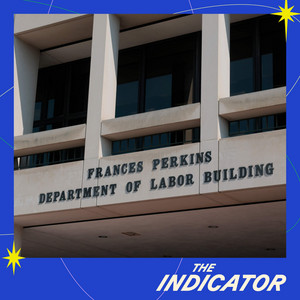
This is The Indicator from Planet Money.
I'm Darian Woods. And I'm Waylon Wong. President Donald Trump said this week that he will soon announce his pick to lead the Bureau of Labor Statistics.
He fired the previous head on Friday after accusing her of manipulating the jobs numbers.
The president presented no evidence that the jobs report was phony.
Neither did Trump's economic advisor, Kevin Hassett, when he went on NBC's Meet the Press this week.
Hassett told host Kristen Welker that the president wants his own people at the BLS.
Is the president planning to fire all 40 people involved in putting these numbers together?
We're going to try to get the numbers so that they're transparent and reliable.
Transparent and reliable data are vital to the economy.
The monthly jobs report moves markets. The Federal Reserve, policymakers and everyday businesses use the information to make decisions that affect all of us.
So the numbers need to be trustworthy. If people don't trust the data, then you might as well not produce it.
That's Erica Groschen, a former BLS commissioner.
She was also part of a committee of outside experts that advised the government on economic data.
The Trump administration disbanded that committee earlier this year.
We talked to Erica then about how we can trust official statistics like the monthly jobs report.
Today on the show, we are re-airing our conversation about the safeguards that are in place and her worries about the future integrity of government data.
This message comes from BetterHelp. With all the talk about mental health and wellness these days, it can feel like there's advice for everything.
But how do you know what actually works for you?
BetterHelp therapists have a 4.9 rating from 1.7 million client reviews.
So you're in good hands with their licensed therapists who can help figure out what's best for you.
Visit BetterHelp.com slash NPR for 10% off your first month.
This message comes from NPR sponsor, U.S.
Bank. With U.S. Bank Business Essentials, you get more than just a bank.
You get a dedicated partner that provides you a powerful combo of checking and card payment processing with quick access to the money you've earned, proving that there is nothing as powerful as the power of us.
Visit usbank.com today to learn more. Member FDIC.
Copyright 2025 U.S. Bank. The jobs report comes from two surveys that the BLS conducts, and they are built on trust.
The people who answer the survey questions trust that their responses will be anonymized and used only for statistical purposes.
And then the people who use that data, from policymakers to investors, trust the quality of that information.
Erica Groschen served as BLS commissioner from 2013 to 2017.
She says the BLS and other statistical agencies have a whole litany of procedures to safeguard this trust.
It's built into the directives on how the statistical agencies operate.
It's built into the law. It's built into this great publication called Principles and Practices for a Statistical Agency.
Sounds exciting. Oh, it's wonderful. Yeah.
So it's front and present all the time, not because you're always fighting an active threat, but because everybody just knows that it's so important.
The same way that people lock the door at night and do other things to make sure that they're warding off threats.
Here are some examples of those safeguards in practice.
Erica says that when she was at the BLS, only staffers tasked with data analysis could be in the rooms where that work took place.
Even the janitors couldn't get into those rooms to empty the trash.
As commissioner, Erica would only see the jobs numbers when they were final.
She also learned early on in her tenure that the report had to be written in the most neutral terms, no spin allowed.
When I gave a talk, I would show the proverbial glass with some water in it and say, what's the BLS answer?
Is this half full or half empty? What's your answer, Darian?
I know the exact answer to this. The BLS wants to say there is 150 milliliters of water here.
Oh, exactly right, Darian. Except, you know, Erica puts it in ounces.
Of course. This is an eight ounce vessel containing four ounces of liquid.
So congrats, Darian. You are qualified to write the monthly jobs report.
You know, the language is boring by design.
It's fine if the releases are boring. What's not fine is if they have a political or policy slant to them.
Erica shared two big worries with us when it comes to the BLS and the integrity of the jobs data.
The first one is manipulation. Basically, who gets access to the information and what they might do with it.
Erica says meddling could show up in different ways.
For example, someone in the government could change the public release schedule, either to bury bad news or announce good news at an opportunistic time.
If this happened, it would be a massive change in how the BLS currently operates.
The agency publishes a schedule of its data releases well in advance.
Everyone gets the numbers at the same time.
And this is important because the jobs report moves the stock market.
Hiccups in this process, even if they're not the result of malfeasance, make headlines.
Like last year, a BLS data release didn't happen as scheduled.
People from a couple investment banks then reportedly called the agency and got someone to tell them the numbers.
This had other people in the market crying foul that some people got the information early and could potentially trade on it.
The BLS said at the time that it was reviewing its procedures to make sure it wouldn't happen again.
Erica also flags another potential kind of manipulation, and that is changing how the BLS calculates the jobs numbers.
I worry about hubris, that some person who feels they're very smart may feel, gee, the BLS shouldn't be doing it that way.
They may have all their explanations for why they do it that way, but I'm smart and I think it should be done this way.
Oh, like I have a better formula for calculating the unemployment rate or something?
Exactly. Right. We've seen how the Commerce Secretary has his own idea about how to calculate GDP.
He wants to take government spending out of the equation.
So between changing the release schedule or the equations, manipulation is one of Erica's big worries about the BLS.
Her second major concern is resources. According to one estimate, the Bureau's budget has shrunk over 10 percent since 2009 when adjusted for inflation.
And it takes a lot of resources, both money and people, to conduct the surveys that feed into the jobs report.
And I've got to think that BLS staffers are taking note of the big cuts to federal workers.
Yeah, fewer people makes the job of collecting and analyzing survey data harder.
And response rates for the surveys have already been declining.
That's a problem because smaller sample sizes could lead to lower quality data with more errors.
Erica says she has faith in the staffers at the BLS, this group of dedicated data nerds who would raise the alarm about interference.
She says vigilance is part of BLS agency culture and the norms that underpin its work.
Still, those norms are vulnerable. They can be undermined.
It's like what parents tell their kids. Trust takes a long time to build up and it can be ruined in an instant.
Erica is co-chair of a group called the Friends of the Bureau of Labor Statistics.
Last week, the group issued a statement asking Congress to investigate Trump's firing of the BLS commissioner.
It also said the president is engaging in, quote, unprecedented attacks on the independence and integrity of the federal statistical system.
Still, economic advisor Kevin Hassett has cast suspicion, with no evidence, on the large downward revisions in the latest jobs report.
Tomorrow, we'll take a look at how BLS revisions work and if the latest revisions were unusually large.
This episode was produced by Julia Ritchie and Angel Correras with engineering by Robert Rodriguez.
It was fact-checked by Sarah Juarez and Tyler Jones.
Kate Kincannon is the show's editor and The Indicator is a production of NPR.
This message comes from Ritual. What makes Ritual Vitamins different?
Ritual Vitamins are made with bioavailable, clinically studied key ingredients, as well as the essence of mint.
Get 25% off your first purchase when you visit ritual.com slash NPR.
This message comes from Ritual. What makes Ritual Vitamins different?
Ritual Vitamins are made with bioavailable, clinically studied key ingredients and a patented nutrient delivery system that aims to help your body use the nutrients you're getting.
Ritual's essential multivitamins are made with you and your body in mind and backed by scientific research, filled with key ingredients as well as the essence of mint so you can enjoy taking your vitamins.
Get 25% off your first purchase when you visit ritual.com slash NPR.