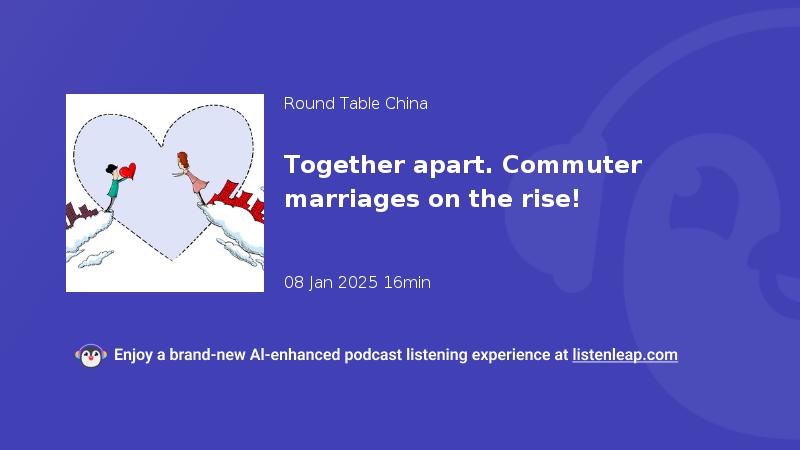
Hello, welcome to roundtable, where we serve up piping hot debates on the issues that sizzle in China and beyond.
I'm you, Hong Lin They say distance makes the heart grow funder.
But for some couples, it also makes the rent cheaper and career growth faster.
Living apart might sound like a romantic subplot from a sitcom.
But for a growing number of young Chinese couples, it's their everyday reality.
The question is, are they living apart for a brighter future together?
Or does this compromise test the very foundations of their marriages?
For today's show, I'm joined by Dinh Hoang and Steve Hatherley.
Now grab your virtual compass and follow us to the heart of the discussion.
In a society where marriage often comes with the unspoken promise of daily companionship, more Chinese couples are choosing to re -write the script by living in different cities.
They are challenging traditional norms, but are they also testing the limits of love and connection?
A new study examines the rise of long -distance commuter marriages in China driven by career and financial goals.
They choose to live apart and only meet on weekends and holidays sometimes.
Will you choose commuter marriages?
What are the challenges faced by these couples?
So let's first talk a little bit about the new report.
What are some key findings?
Well, I feel like now, first of all, when we talk about this term, commuter marriage, I guess it originated in the west, particularly in the United States, where it is used to describe couples maintaining those kinds of long -term or long -distance relationship due to professional commitments due to their
pursuit of their respective career goals ambitions and then with regard to the situation here in China researchers from Xi 'an Jiaotun University recently published a study actually in late december 2024 the study finds that nowadays in China there were actually more couples than the situation in the past
who are living in separate cities to balance careers and family goals.
Women, particularly those who have received a higher level of education, are more likely to choose this kind of arrangements or family structure.
However, this kind of marriage arrangements often comes with You know, emotional challenges.
Emotional strengths.
And unequal agenda roles, etcetera, etcetera.
There was a report from Sixth Friedrich Stone, which is a new portal here in China.
And they were talking about commuter marriages, and what they said was that some of these couples, they'll meet once every couple of weeks or maybe once a week, once every couple of weeks.
That could be the situation for some couples.
Other couples, they might meet once every month or once every several months, and then some couples they might only meet on long holidays and that would imply meeting, I don't know what, maybe twice a year or three times a year and in China the the population mobility has accelerated and as a result,
this arrangement has become increasingly common among urban youth.
It is not unique to China, it's not unique to America.
It's not unique to Canada or the UK.
It's happening all over the world.
Yes, actually I found some stats.
Currently we see approximately 3 .5 million couples in the United States are in commuter marriages.
This is a figure that has more than doubled since 1990, and a study indicated that long distance commuter couples in Sweden experienced about a 40 % higher rate of separation compared to couples living together, which is something something we're going to discuss a little bit later about the challenges
faced by the commuter marriage holders, it's a strange term.
Japan has seen only minor increases in the percentage of child born outside of a marriage, yet another thing for Japan is that there is a notable trend towards cohabitation without marriage.
It's another issue but I just want to provide that element in this whole marriage map we're trying to paint here.
commuter marriages are also reported in, like Steve said, a lot of different places including Japan, Israel, regions like Hong Kong were similar trends are observed to do to economic demands and career opportunities for both parents.
Yeah, there was a BBC report from 2019 that talked about the fact that 7 % of Canadian couples aged 20 and up including 31 % of 20 to 24 year olds are living apart together.
That's how they phrased it, which I thought was quite clever, living apart together.
You mentioned the numbers from the United States also England and Wales, 785 ,000 people in that area of the planet are living apart from their spouses.
But there they said it was unclear how much of that was related to work, being apart for work related reasons.
So, why are people choosing this way of living nowadays, apart from one thing, that is nowadays with the development of the society actually getting together is much, much, much easier than previous times.
If we talk about the situation in China.
That is previously, if for example, you have to travel from let's say, from Beijing to Guangdong Province which is in the southern part of the country it takes almost more than a day to do that.
Yet now if you're traveling for example on air with a plane, then maybe it's just a half day a journey so it's easier making the situation or making the choice an easier to make choice that is one reason I can think of.
Yeah infrastructure development especially transportation, the convenience, that's a major factor giving rise to this phenomenon these social phenomenon, that's undeniable.
example, it used to be the case, I can share one of my personal certain observations, but it used to be the case that traveling from my hometown, a small city in the Eastern province of Jurjiang, to Hangzhou, which is the provincial capital city.
10 years ago it would take you two hours of driving nowadays with high -speed railway trains it takes only half an hour 40 minutes five 15 minutes so indeed I have a friend an old classmate of mine who is making a living in Hangzhou from Monday to Friday and but his wife and his daughter is living in the in my home
town this small city emergency, and they meet on weekends.
Either his wife takes their daughter to Hangzhou, or my friends comes back to the hometown from Hangzhou.
Yes. I think the transportation system is making this choice possible.
But at the same time, why are couples making the choice or making the decision of living a part together?
That's, I think in a bigger picture sense, we are talking about say making choices.
I'm not sure whether we can phrase it as rational choice.
Some people's may describe it as rational, but some people may have their own reservation, but it is a choice driven by career ambition, financial issues, sometimes financial instability, and a desire for long -term family security.
I guess, for many couples living apart, is not a passive compromise, but an active decision that has to be made to maximize opportunities in a very competitive and complex labor market.
I think there's no one answer to that question, because there might be many different things taken into consideration.
I think why you use the term perhaps rational choice Meaning perhaps it's a decision made by logic, right?
if you can handle the emotional aspects of it and use the logic of well if you live in this city and you have this much of a monthly income and I can live in that city perhaps for five days a week, like your friend is doing, and then come back on the weekend, and have that much income, then we can have more
stability financially in our family, we can take care of our parents, if that is a priority for the couple, there's that.
Then there's also the ambition of career.
And I found this interesting, this is from the United States from a researcher, a sociologist, is called Danielle Lindemann at Lehi University in America.
And what Dr. Lindemann suggested is that the more educated you are, then that might place constraints on the location where you work.
So for example, if Ding -Hung has a PhD in psychology and that allows him a career opportunity in, I don't know, Macau at a university there, and his wife has a PhD in economics, and that allows her an opportunity to teach at, you know, a prestigious Beijing university.
Well, then those are very niche degrees, so therefore you're almost limited in your opportunities, even though it would seem like it's presenting more opportunities.
If that makes sense, it's kind of counterintuitive but Dr.
Lindivan suggests that the more educated both members of the couple are, then the opportunity to live apart almost increases.
And she also stated that in the field of education specifically if you're becoming a scholar, it's almost expected that you and your partner will be living apart because the opportunities to work in the same community are pretty limited.
Yes, it makes a lot of sense.
And one, I'm not really sure if it's a specific situation about China, is that in a lot of companies, especially if you're working in major big companies companies, then when you are looking at a promotion, they require the specific employee to have certain level experience in working in local companies,
subcompanies or substations so that they understand how the entire company work as a, for example, a company with a scale that has a lot of stations and bureaus in different parts of the country, which means they would send this person to a local station to work for a year or two.
So, this is only one type of situation, but when you are creating a better position for yourself in the workplace, it's really possible to meet different opportunities.
Whether or not to take the opportunity and separate from your family, for a while, is the choice a lot of people face.
Sure. In the past, it might have been more common, perhaps, for the husband, maybe more commonly, I'm not sure about the situation in the past in China, but more so, perhaps, for the wife to just accompany the husband, right?
And say, okay, I'll follow you.
That's changing. These days they say women are more highly educated than they were before.
I think we've talked about that on Roundtable.
And with that comes their own career aspirations and well, I'm working here and I'm pursuing my own career goals.
Let's just live separately in different towns or different cities.
will work on ourselves while maintaining our relationship too yes and I have a confession to make actually I am currently in a commuter marriage it I just describe your relationship little bit that's why I do it a little because for me I currently where um my job is definitely focused in Beijing I work
in Beijing though I do have certain business trip opportunities yes yet to the core is in Beijing and the studio with Round Table and all of you listening, which makes me very, very happy, yet my husband's current career center is in Gansu province.
He comes back every...
I'm sorry, how far away is that?
This is something hard to describe because when we say, this person lives let's say, in a different province, actually it depends on the actual location because for example, for him, he needs to work in a county there, which means he has to travel for around eight hours from precisely my home to his office
there. So that would make the transportation not that convenient if you really think about it.
Yes, still, one day is something we can bear and that is why I only see him every, let's say, week or two weeks, depending on how busy his work there is.
And the thing is because we have been knowing each other and being together for almost fourteen, 15 years and our marriage has been lasting for five years and two of those years, two of those marriage years were actually this commuter marriage style.
And the thing is, I realized when you're in different stage of your life, of your relationship.
And even though the situation continues to be, for example, long distance.
Actually your quote unquote complaints, the challenges your face are different.
Say when you're a young couple, you love each other, you want to share every little detail with each other every day.
Your major complaints would be we're not together, it can only WeChat video chats you everyday which what we actually do.
And that is more of an emotional needs kind of perspective.
Now what I'm complaining about is the transition period.
So I am used to when he's not around for several weeks.
And I am used to when he is around, living in the family together for let's say several days because of his condition.
I think it's the same for a lot of couples.
That is, when you're together, it can be together for more than just a weekend.
Sometimes it's longer than that.
But those transitioning period is a little bit rough.
You mean that time from when he arrives home for the next maybe 48, 48 hours I was going to say.
Because probably because your routine is disrupted.
There's another physical human being in your space that wasn't there before.
And of course when he leaves, yes.
Yeah, then the same adjustment.
Yes, so constantly making adjustments.
Indeed that represents a visible, noticeable challenges to your daily life.
And when we talk about this idea that nowadays women are increasingly refusing to be a companion to their husband rather than choosing their own career ambitions.
Now, common sense would tell us that this is predictive of the choices or way more choices that are available for women and of course, shading lights on women's independence and improving status.
Oh, I'm talking about a male perspective.
That's exactly the point I'm trying to make.
Talking from a male's perspective, maybe...
I feel like I don't have too much authority to give my opinion on this I think I feel like a female colleague of mine have way more authority to talk about this It's not that easy.
It's not. Yeah, like this kind of independence this idea that you're not On your husband's side.
So that's you're independent No, if you are taking care of the children and your husband can only can just focus on his work It's no, it's not fair.
Yeah, just because you're taking care of your