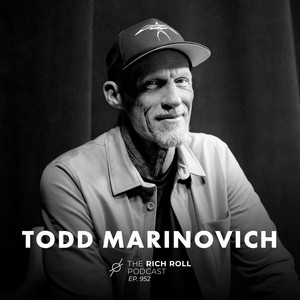
My experience with addiction, I was on a different frequency.
I couldn't stand me or what I did.
I wanted so out.
Oh, it was just, it felt so fake.
It's my duty, what I've lived through to share my experience.
And, you know, I hope I can connect with one, you know, because I do know what it's like.
Yeah, you happen to be in my general age range, then there's a chance that, like me, you grew up following the life trajectory of today's guest.
One of my generation's most promising professional athletes who befell a fall from grace of such astonishing proportions.
His life became synonymous with a cautionary tale about perfectionism and performance, poor parenting and generational trauma.
From his first breath, Todd Morenovich was raised to be the world's greatest quarterback.
Beginning well before Pop Warner, throughout high school and during his early years at USC, this dream, at least on a surface level, seemed to be unfolding beautifully.
Courtesy of a dad, I think it's fair to say, was far too invested in it becoming reality.
A former football player himself.
Marv Marinovich had taken USC to a national championship in 1962, but his career in the NFL with the Raiders was cut short due to overtraining.
This in turn prompted Marv to develop this obsession with understanding training techniques, this investigation, this journey that he went on that led him to studying Soviet and Eastern Bloc conditioning philosophies.
Learnings that at the time he was well ahead of his time.
He then put to work in his own home by raising his son as if in a lab.
A lab designed to optimize every single facet of Todd's young life, and a lab Marv oversaw pretty much with authoritarian rule.
Ever eager to win over his dad's approval?
Todd basically did everything he could to live up to his father's expectations and public expectations, exceeding them at times by doing all kinds of things, breaking high school records, taking USC to a Rose Bowl victory in his freshman year, which marked the first time that a USC freshman had started at quarterback since before World War II.
But things were not all as they seemed behind closed doors.
Todd is a kid who began self-medicating with marijuana in high school and using alcohol to relieve himself of the burdensome expectations being placed upon him everywhere he looked.
Nonetheless, the kid continued to win, often in stunning fashion, and eventually took his talents to his father's beloved Raiders as a first-round NFL draft pick.
But he was hanging on by a thread by that time, and his life would soon fall completely apart.
And I'm going to let Todd share the rest.
But suffice it to say that addiction took hold of Todd to such a depraved extent he would end up in the darkest and most desperate of places, gambling with his life for a needle to the neck, without a care of dying.
It's truly an extraordinary story, one you might have seen told years back in the ESPN 30 for 30 documentary about his life.
But now Todd shares all of it in his own words and from his point of view in this conversation and in his newly released memoir Marinovich.
Look, I've put my skin through a lot over the years, decades in chlorinated pools, way too much Southern California sun basically zero thought about skincare.
And it wasn't really until I hit my mid-50s that I finally kind of woke up and started taking care of my body's largest organ for the first time, which began with Bon Charge and their amazing, award-winning Red Light Face Mask.
The science here is pretty fascinating.
It's equipped with optimal wavelengths of red light at 630 nanometers and near infrared at 850 nanometers, that work at the cellular level to help promote youthful, glowing skin, smoother skin texture and more even-looking skin.
And the best part?
The red light face mask fits right into everyday life.
Just 10 to 20 minutes a day, totally portable, suitable for all skin types and backed by a one-year manufacturer's warranty.
But Boncharge isn't just about your face.
Their sauna blanket has been great for recovery.
It's like having your own personal sauna that folds up when you're done.
So go to Boncharge.com and use coupon code RICHROLL20 to save 20%.
That's Boncharge.com, code RICHROLL20 for 20% off.
I got news for you.
The holidays are coming.
And with them, all these questions kind of start swirling in our minds about what we're going to give people that we care about.
And honestly, it's really hard because most gifts just end up forgotten somewhere.
But the gifts that actually do get used are the ones that make someone want to use them.
And Ahn does exactly that with their incredible line of high quality running and hiking gear.
Shoes like the Cloud Ultra for trails, the Cloud Runner 2 for roads, the Club Hoodie for recovery days, hiking stuff for exploring nature and the mountains, and even accessories like performance socks caps, hydration packs, backpacks and travel bags that work as amazing stocking stuffers.
So here's the thing.
The real gift isn't the gear.
It's what becomes possible when the gear gets out of the way.
Those early morning runs where your mind just clears that trail you've been meaning to hike, that runner's high, or that silence at the summit when everything just clicks.
Movement changes things.
And sometimes all someone needs is the right gear to make movement more fun, more stylish and more accessible.
So move yourself on over to on.com slash richroll to explore my picks for holiday gifts.
So this is a classic what it was like, what happened and what it's like now episode in which Todd reflects on the trauma he suffered at the hands of his father, the career that never was, the things about him that are misunderstood due to the press misrepresenting him, how he survived one of the most bone-chilling bouts with drug addiction that I've ever heard, and how he pursues life today as an artist, as a father intent upon not imposing the trauma he experienced on his kids and as just a sober person trying to live one day at a time.
There's so much in Todd's story.
And as someone who is privy to thousands of stories like this, Todd stands out just because of the sheer extremity of it all.
You can hear his pain.
The struggle for him is still very real and ongoing.
That's pretty evident and undeniable.
But there's also a sense that he has made peace with his past.
And so I guess the main thing I hope that you get out of listening to this is that, no matter how far down you have fallen, no matter how dire or desperate your circumstances, Todd's testimony is that hope is a decision.
And when you make the decision to be hopeful, life becomes possible.
Well, Todd, it's absolutely a pleasure to have you here.
I'm looking forward to marinating in the Marinovich experience.
Cool.
Thanks for having me, Rich.
I think the best way to go about this is to do an old school what it was like, what happened and what it's like now.
Wow.
Are you up for that?
Sure.
But I think the best place to begin, first off, before we get into anything, how are you doing... right now where are you at right now with your sobriety with how you feel about your life before we look into the rearview mirror i just want to get a a gut check on the present moment for you present moment is um good really good i am in the area seeing family and that's always important and enjoying the time here while i'm here but i'll be back in hawaii very shortly relationship with the kids is good yes you're on steady ground with your sobriety right now you know and it's something that's it's day to day i can't uh knowing that no matter what I do today has really no bearing on tomorrow and so I just try to live in the moment yeah and and be of service that's kind of what I try to do what are your non-negotiables to make sure that you're keeping on track just not being where I'm not supposed to be.
There's just, ask myself, what am I there really for?
And concerts can be a little bit sticky, but I always take somebody.
I don't do that shit alone, yeah.
Are you tapped into the program of recovery or are you on your own kind of protocol?
Kind of just on protocol at the moment.
Yeah.
Yeah.
Living in Hawaii.
Yeah.
Away from the noise.
Right.
Away from all of the preconceived notions of who you are and who you're supposed to be.
Is that part of it?
It just feels right.
Yeah.
Yeah.
Yeah. let's take it back to the beginning here.
There'll be a lot of people watching or listening who are familiar with your story or at least think that they're familiar with your story.
And that's part of the reason, I'm sure, why you decided to write this book, to tell your story in your own words, because I think there's a lot of misconceptions floating out there around who you are and how you became the person that you are.
So I wanna hear your version of it but let's begin at the beginning.
You're this kid growing up in Orange County.
You're kind of a artistic surfer kid, a shy kid, but you have this very interesting father figure who looms large in your story.
How do you set the stage when people ask you who you are and how it all began?
Well, at that age, Marv was a giant a giant of a man, because I'm growing up always looking up at him.
But he was a big dude, 6'3", 270 when he played.
And I got to know firsthand what defensive linemen were like in the NFL early on.
He showed me throughout my career, whole young life uh, and it was.
It was scary because that's exactly who he was.
Yeah yeah, yeah.
So marv your dad uh, he correct me if i'm wrong he led usc to a national championship in 1962, got it?
So usc guy goes on to play for the raiders and ultimately ends up not realizing his potential because he over-trained correct, correct.
And so his professional football career gets cut short.
And then he becomes obsessed with training techniques like why did i over train?
How could i have done it differently?
And he starts to steep himself in all these different philosophies of training eastern block, russian.
You know modalities, etc.
And you know you could make a strong argument that he was way ahead of the curve.
Like he figured out some stuff well in advance of what everyone else was doing.
But then you come along, he's got a son and he sort of realizes well, this is the ultimate opportunity to apply everything that he's learned onto your young self.
And he asked himself this question like what would happen if you could control the environment of a young athlete and raise somebody to be a champion?
I mean, is that fair?
Was that his like operating philosophy?
You nailed it, except that I came along right at the start of his career, so to speak, with the Raiders.
He was a strength and conditioning coach.
Yeah, but that was his focus.
I mean, he coached positions throughout his coaching career But he was all about he was a scientist, basically.
Yeah.
A demanding one.
To say the least.
Yes.
Yeah.
You know, the narrative that's been out there, we're the same age, essentially.
So I've lived with your story, you know in real time, throughout the course of your life and very familiar you know with who you are and what you were doing when you were doing it because of our you know similarity in age.
And there was this narrative as you started to develop as an athlete in high school, that he was this overbearing personality who forced you to play football.
And all of the articles that were written were about this robotic QB who was incubated in a lab, who's never eaten McDonald's and is just this absolute killer, purebred.
And in the 30 for 30 that you did with ESPN, I think that was in 2011.
And in your book, you're telling a very different story about who this person is or was.
Yeah, I mean some of it was accurate, but it was mainly the diet that was blown, so out of proportion.
And at the time being, like 15 years old when, i think, people magazine interviewed me um, i was like well, i can't say uh, tell the truth about my diet, even though i was sneaking, you know, on the side uh, even through my mother and her side of the family uh, so i said no, you know, i've never had that.
And then it was such big headlines that it was like a runaway train.
And then they did it.
It was just an onslaught.
And it seemed like at that time I was getting attention for that rather than my skills on the field.
Yeah.
And rather than being recognized for what you were doing as an athlete, everything was about this like laboratory kind of aspect of your life.
That was a little out of whack and not for nothing, you didn't want any of this.
I mean you love football, but and that gets missed also because there's this idea that your dad was making you play football.
You're pretty clear that like, you'd love the game, but that you're this really shy kid.
Like you weren't seeking out the spotlight.
You're getting all this attention and all this media.
And you know that that kind of materializes later into magazine covers and the like, but you weren't really about that and that made you deeply uncomfortable from the beginning.
So this narrative is getting spun out in the world that feels out of your control.
Yes, that doesn't necessarily or realistically reflect who you are, and so from the very outset of your athletic career or your young life, there's almost this identity crisis that's happening, like you're being cast as this character in the world that isn't really you.
And even before drugs enter the picture, there's a double life happening.
So that's a confusing experience for a young man to navigate.
Absolutely.
And now having kids that are in their teenage years, it's just a trip.
In what way?
In a way that is soberingly serious, of just about there's no such thing as experimental drug use today.
You just wind up dead.
That's super scary.
But it's just a different world, yeah, that they're growing.
I couldn't imagine going through my high school experience with Instagram or something.
How do you talk to your kids about, Your past and drugs and alcohol.
I'm just honest with them.
Yeah.
I am.
And what is their reaction to that, or their relationship to substances like being, you know, young people in the world where that's around?
We'll find out, you know.
It's ongoing.
They're young.
And I definitely don't have the answers other than, you know... suit up and show up and be honest.
And when I say I'm gonna be there, I did the best to my ability to be there.
But one thing I think you've learned is that trying to control them is probably not gonna work out.
You think?
Yes, and it's been passed on the gene too of just defiance.
And I think that's in every teen that, you know, you're not gonna tell me what to do.
Yeah, I mean, differentiating, like they gotta see who they are by testing the boundaries.
Like part of that's good, you know, it can go too far easily.
You're a test case in that.
But when I think of your life, it's just all about all these dualities.
You know the athlete and the addict, the kind of sensitive artist, and then the superhuman guy on the field.
And this crisis of identity that I think is like at the crux of your whole life story, that I feel like, on some level, the book is an attempt for you to resolve for yourself.
Like who is this guy?
Like you've been programmed from day one to be this champion and you go out and you fulfill that on some level for yourself, but really for your dad and for coaches and teammates, et cetera.
You never really had a normal childhood.
You never really had the opportunity to decide for yourself like who you are and what's important to you.
Yeah.
And so it's like the most predictable thing ever that you would, you know, find yourself, you know, moving towards drugs and alcohol as a as a way to salve, like that.
When you're young, you don't.
You don't understand what that confusion is all about, or that that that that feeling of unease that accompanies you wherever you go?
So you know, to me, like I understand that, like I can, it just makes perfect sense that that's where you would end up.
And most do, you know, and especially, um, you know, at that age, like you say.
So your dad, you know, for better or worse is controlling your environment.
For sure.
He cares a lot about your development as an athlete.
Yeah.
There's a lot of love there, but it's delivered in harsh tones.
Yeah.
Right.
Like some of the stories are crazy, like making you run eight mile is like you know if you didn't perform well, like you know what you had to do to make sure that he was okay.
Like he was quite the taskmaster and to this day still sort of stands out in culture as this cautionary tale about the overbearing dad.
Like even in.
I recently rewatched Friday Night Lights like the entire like show, like all five seasons of it, or whatever.
And there is an arc.
I don't know, have you watched that show before?
There's an arc where suddenly, this new young quarterback shows up with a dad that I can't help but think was modeled somewhat on your dad.
And he's sort of a threat to the current quarterback.
And there's a lot of friction with the coach, etc.
It's undeniable that this kid is like by far the most talented kid, and he's been raised from day one to be this champion.
And it just, it's so evocative of your story.
I can't imagine that that would have been built into that television show short of your story.
So the narrative that was out in the world was, this guy is an absolute beast.
But what's confusing is that there was a lot of love there too.
For sure, for sure.
And I think that in like I rewatched the 30 for 30 and in reading your book, I feel like you're still trying to make sense of how you feel about the whole thing.
It was a definite one of a kind experience.
And the best and the hardest part was toward the end of his life.
It was something that I never could have expected him getting sick with dementia, that it was just enjoying the moment with him.
And we had some amazing moments amongst the craziness.
But I was just super, super stoked and grateful that I suited up and showed up.
Yeah.
I mean, that's what you get to do in sobriety.
For sure.
And in his case his Alzheimer's showed up in a way where he was able to just be present and all of the judgment and all of that was gone right.
So you could just be with him.
Yes.
But even before that, you had really mended the relationship.
I mean, you guys were like sculpting together.
At the end of the 30 for 30, there's that incredible wood sculpture that the two of you worked on for like 18 months, right?
That's really an exquisite piece of art that, to me, symbolizes some healing between you, because you worked on it symbiotically.
There wasn't like a hierarchy of who was in charge or who was telling who what to do.
Right, which was amazing. to experience when he's always had been up there throughout my whole life.
And then he stepped off that and it was just effortless.
And that's the way we do best when we're not fighting.
But it took a long time to get there.
A lifetime.
Just so the audience kind of understands where we're at, Marv is raising you in a very specific way in this ultimate performance environment.
And you basically shoulder the assignment and you end up at modern day as a freshman in high school, which is this powerhouse high school football program.
And you're starting, like this is unprecedented.
Not only are you starting, you're killing it.
And your parents get divorced and you end up transferring to a different high school Kep's, Toronto Valley right.
And you end up like breaking all the record.
Like you become essentially by the time you're a senior in high school.
Like you know, the ultimate college football prospect
Like you're the most recruited guy in the country.
You are the superstar football player in the United States.
And pretending to be.
Yeah, well, I mean-
You were, yeah, like the identity crisis is about to, you know, emerge in full bloom.
But at this point you know you're dabbling a little bit, but you know, it seems like it's under control.
So I don't think you were pretending like when you were on the field, you know, I think that you I mean tell me if I'm wrong like you were happy to be on the field.
It was all the pressure and the expectations and this misconstrued sense of who you were that was creating the confusion.
Like yeah, on the field, things were simple.
You were able under, especially under pressure, to execute yeah completely, and the pressure i was my.
You know i was putting it on myself, were you though?
Yeah, i loaded, you know, i i took it.
That's the way i perceived it is.
If i could, like you said, if i can perform, then everything I'm gonna get the love.
I'm gonna get everything that I want.
And the reason you were putting the pressure on yourself was because the pressure had been placed upon you.
And the equation was like, you have to do well in order to feel okay.
And at the same time, I don't know how much you thought about this, but there's a real unhealthy transference here.
Like you were responsible for making sure that your father felt okay.
Yeah, I know.
And that's a heavy burden.
And more than that, that mom felt okay.
If I performed, then their relationship seemed to be a lot more mellow.
So their marriage was your responsibility also.
So not only did you have to break records on the field, you had to keep your parents together and you had to make sure that your dad was okay, your parents were okay.
And your mom was like the softy, right?
Like she was the safe place for you.
Yes, yeah.
It's a lot.
Yeah.
When I rewatched the 30 for 30, the thing that stood out for me the most, and it's just kind of a moment that passes really quickly.
There's a moment where your dad has asked is there anything you would have done differently?
Basically asking him to reflect on the choices that he made about how he raised you.
Yeah.
And he says, well, I suppose I could have done a better job keeping him away from the drugs.
Really?
He says that, which is fine, but to me, he's missing the whole point.
It's like, all right, well, The drugs were the symptom of the problem, not the problem.
He still wasn't able to identify his role in everything that led up to you making those choices which, for me, if I was watching that and I was you, I'd be like that would be painful for me.
I got to the point where I fully felt and believed that he was doing the best he could with the information that he had at the time.
Yeah, yeah, yeah.
I mean, that's the only way to move forward, right?
To find forgiveness and love.
It was easy to with him because I fully believed that he had my best interest always and gave me so much confidence.
Without him, I wouldn't have believed I could have done this things that i did on the field.
And then when i stopped playing, he was always there, and that's just what more do you want in a human?
So the holidays are awesome i think we can all agree on that but uh, you know, not without their irresistible temptations cookies everywhere high, at every gathering, the sugary fruit thing your aunt made, and listen, you know i'm not immune, but neither is your gut, meaning your microbiome is absolutely paying attention to what's going on.
All of which is why ag-1 matters.
During this extended two-month stretch, you need something to anchor you, and one scoop of ag-1 consolidates your multivitamin, your superfoods, your antioxidants.
This daily health drink takes 30 seconds.
Easy peasy.
And the NextGen formula is clinically shown to fill nutrient gaps, which is huge when your diet goes sideways for a handful of weeks here and there.
I keep all four flavors around, original, citrus, berry, and tropical.
Cold water first thing in the morning.
Just one baseline thing locked in before everything gets away from me.
And right now, AG1 has their best offer ever at drinkag1.com slash richroll.
You get a welcome kit, a flavor sampler, plus $126 in free gifts at drinkag1.com slash richroll.
This podcast is brought to you by Squarespace.
When it comes to the infinite scroll of our digital world, There's an important distinction I like to draw, which is that there is a difference between consuming content mindlessly and, on the other hand, using our computers with creativity and intention as a tool to build something meaningful, whether that's a coaching practice, for example, a store or a portfolio for your photography.
What you need and deserve is a high-quality experience, highly designed platform that reflects your personality without compromising functionality.
And now Squarespace is even more powerful, courtesy of something they call Blueprint AI, which asks you to answer a few questions about your goals and your style.
And then it generates this completely custom website that looks professionally crafted, without any tech skills on your part, even nominally required.
Their analytics show you what's actually working, where your audience comes from, what content resonates.
Real data instead of guessing.
So head on over to squarespacecom.
Slash richroll to save 10 off your first purchase of a website or domain using the code richroll.
It's hard, I would imagine, for people to really realize that you are rich, a shy and introverted guy.
You know cause you were such a larger than life figure on the field.
And you know, you demonstrated your exuberance on the field too.
So anybody who's watching you would think, oh, this guy's a showman, right?
So that's the other duality.
Not only are you performing athletically, but you're performing to the crowd also.
Whereas at the same time, you're this guy who wants to go paint and be left alone.
But it's the game that brings that out of me.
Yeah.
Yeah, it's not really... I'm not seeking that, but it just happens playing football.
It's great.
That's what I just love.
It's never over until it's over.
But that shyness and that introversion finally gets introduced to drugs and alcohol when you're in high school, right.
Did it start at modern day?
Yeah.
So you were like a sophomore, sophomore in high school.
Yeah.
How did it start?
Well, it started with alcohol long before then, just you know, stealing drinks from the parties of the family, having you know, but in high school going after games to keggers, doing that whole bit.
And I liked the effects produced by alcohol for sure.
Do you remember the first time, like the feeling of relief?
The best one was marijuana smoking a joint at that age.
It just was instantaneously, everything's gonna be okay.
Right, all of that tension that you didn't even know that you were holding is suddenly gone.
Yes, so it was a spiritual experience for sure.
Mm-hmm.
Because it was like, what?
I have been seeking this for a long time.
And I didn't really get that with the alcohol, but I did with weed.
And you're like, this is it, man.
This is it.
This is the secret.
Yeah.
In your case, there's a lot of hand-wringing over whether or not marijuana is a gateway drug.
But I think in your case, it's pretty clear that maybe it was.
Yeah.
I can't argue with that.
Yeah.
And this was something maybe your classmates knew you were doing obviously, but you were keeping it from the folks and everybody else.
So this was like a secret.
Yeah.
Until... You know what I'm talking about?
Until Mar finds out?
Well, there was a crowd chant.
Yeah.
Yes.
Yes.
And if I could have crawled in a hole.
Yeah.
Can you explain?
Can you just can you share what we're talking about for just playing basketball on the free throw line?
And so different than football, because you can scream all you want at the football field.
We can't hear anything.
But in a basketball gym and playing in the opposing, playing on the road.
There it got quiet and quiet.
The whole football team's up in the crowd chanting Marijuana Vitch.
And I just it was unmistakable that they're yelling that at me with my family, my grandmother and grandfather.
You know, it was definitely.
That's how the family found out.
Yeah.
Yeah.
We were chatting before the podcast and I was just saying, you know, that we're the same age.
And so I remember when that happened and that became news and everyone was just calling you marijuana-vich.
Right.
Like that followed you for a long time.
It sure did.
For good reason.
Yeah.
You know.
But you know listen, the addict is always gonna find their drug of choice, you know, to help them feel okay in the world.
And it's just.
I think what gets missed by the average person who isn't an addict or isn't familiar with this disease is they don't understand the intense degree of discomfort.
And it's not a choice.
It's like, it's a survival mechanism.
On some level, you had to find your way to these things in order to make it through.
Had you not?
Have you ever thought about what would have happened or what you would have done if you couldn't find a coping mechanism to deal with the unique set of circumstances that you found yourself in?
I mean, not.
I've thought that it's kept me on the planet for sure.
As bad as they are, they work. until they don't.
Do you have a sense of when in your life it stopped working?
In my case, it has always worked.
It's just the consequences keep coming.
It does the job.
It's just that there's a lot of chaos.
And it doesn't do the job like it used to do the job, let's be clear, but it's not the same.
It's a chase.
Yeah.
It's an illusion.
So you figure out how you're going to spin all of these plates and keep it together, and- It's a juggling act.
Double down on this double life that you're leading.
Yeah.
You graduate from high school. and in very celebrated fashion, end up at USC.
We were chatting about like, what would have happened?
Because you thought about going to Stanford, right?
More than a thought.
Yeah, we were like, well, we would have definitely partied together.
But you go to USC, it is kind of a foregone conclusion though.
Like the family legacy.
The family legacy was so strong there that had you decided to go to Stanford.
I mean, your story is very much one of a rebellion.
So maybe that would have been an act of rebellion for you to do that.
But you're at USC and this is such a storied football program and you show up with lots of expectations being placed upon you.
And once again, you live up to them.
I mean, you start as quarterback, as a freshman, And this is something that had not happened at USC since World War II.
No freshmen had been a starting quarterback.
Is that right?
But I also got a full year or a red shirt year.
You had a red shirt year.
So you were a freshman.
I see.
And that year was a huge And my success was that I got to practice against one of the best defenses of every day in practice.
And they didn't...
Even though I did have a different color jersey, they didn't treat me like I had a different color jersey.
They were like body slamming me.
So you had a development ear.
Yes, a humbling development ear.
Yeah.
It was really cool.
And I got to travel with the team also, but knew I wasn't gonna play.
So it was a good experience.
Without the pressure to perform.
Yeah, it was key.
That must've been nice actually.
It was nice.
To be a little anonymous.
Yeah. on the team.
And how did your relationship with, with partying change once you got to USC?
Well, me and my cousin would go up to SC while we were still in high school, maybe once or twice after a football game or before a football game.
So we knew we wanted to graduate from our high schools.
Then obviously really turn the party up at SC.
And it was, we were looking forward to it and it changed.
The big change was the big party was Thursday night for some reason.
That's not the best timing.
When did other drugs start to enter the picture like cocaine?
SC.
At SC, yeah.
Right away or?
Pretty much right away.
And what was the experience of doing that for the first time?
It's just so much talkative energy.
And then I was with a buddy that had so much energy that was scary because he was a big man.
And, uh, the mixture without alcohol I found to be, um, more fun at that time.
I couldn't imagine doing it just by itself, the cocaine, which I then tried and I was right.
You should do them together.
It was a little much, but, uh, Yeah, I really never done a drug I didn't like.
I'm one of those that I enjoy them all, some more than others.
Is China White at the top of the list though?
It's up there.
Yeah.
Yeah.
Black tar second.
Yeah, it's not even.
In the hierarchy, no.
So like break it down, China White, like what's at the top?
Well, there's some good pharmaceuticals, even though I'm not really a pharmaceutical guy.
But I have messed around with Dilaudid and Denron.
They're good.
But the combination of the China, what almost killed me was the China white cocaine combination.
Yeah, I was chasing that one.
That was when I was in Canada playing up in the Canadian Football League.
The book opens with this really harrowing story of you being in a warehouse in East L.A.
You no longer have any more veins available for shooting up.
You're on the precipice of getting dope sick and you got to make it happen.
And you end up filing down this, this needle that's too large for shooting purpose, and deciding that the only way you're going to prevent yourself from getting dope sick is by injecting yourself with this needle into your jugular vein in your neck.
That's a bad place to be.
Yeah.
Knowing this could be the end, you know, and still making that decision to do it.
And I think that story is.
You know, it's terrifying for anybody to read, especially for anybody who isn't familiar with the dark throes of addiction right, but it evokes like the desperation like you'll go to any lengths uh, to to do it, and this is where it it takes you.
And it's so shocking because the contrast between this celebrated aspect of your, your story, and this you know other life that you were living, like it's hard for people to understand, like how you could end up in a place like that.
Right, And that's the thing with addiction.
It is not in any way prejudice at all.
And then I'm asking myself the same thing, because I didn't grow up trying to be this.
I was just trying to survive at that time, stay alive.
And I wasn't thinking about, because you said dying, that's not on the mind, it's just to get well at that stage of the game and it's just a fuck place to be.
Yeah, yeah.
So you're at USC, you're killing it.
You take the team to the Rose Bowl.
You know you have this epic game.
You win the Rose Bowl like you're I mean, you're just, you're like firing on all cylinders and you're keeping it together like partying, Firing on all cylinders.
On the field, on the field.
You're living up to the hype, right?
You're living up to the hype for the most part.
And I'm curious around the ego piece like this idea of of knowing that you're living a double life.
And when you're young and you can, you can kind of get away with stuff you know at that age right.
This idea of not only am I superhuman on the field, I can also like be the last guy to leave the party.
I can do both and, and still, you know, show up for practice and do all of those things.
Like there's a insanity to that, but it's very you know, it's a very ego-driven kind of- It's grandiose.
Yeah, there's a, yeah, grandiosity, exactly.
For sure.
For sure.
Yeah.
But in a sense, you need that athletically.
And so that's where the duality of that is so dangerous.
The only way that I can really compete at that high level is to believe I can do that every time I go out.
Realistically, I can't do that every time I go out.
But I gotta believe it or it's gonna be really bad.
Yeah, that confidence or that sense of being bulletproof, being this superpower but also an Achilles heel, because you're gonna put yourself in situations you should be in and thinking you're gonna be able to get away with it.
You have this clash with the coach at USC.
You guys just never should have been coach athlete together.
This is just not the right recipe for you.
Is he aware of like prior to the sugar bowl and all that stuff that happened like?
At what point is he aware that maybe you're going off the rails in your social life?
Well, he was getting stories.
The stories were coming back to him about my antics off the field.
So he brought me in and was doing the pen.
He said, follow the pen.
So he had questions really early on of that second season.
He was just the authority figure.
It was Marv.
I was at that.
I was at my peak rebellious phase at that point.
And I don't know how I would have even handled me at that.
And he just came from a different part of the country and it was Midwestern football.
And with that mentality of the old Woody Hayes or whatever, Bo Schembechler years.
It was just three yards in a cloud of dust and fundamentals.
Not that I was against fundamentals or anything.
I just didn't want to be told what to do, and that's what his job is.
And so I was in the wrong.
It's a unique case, though, because...
Yeah, I mean, the team's not going to work if you're not taking direction from the coach, of course.
You can't just be out freewheeling it and doing what you want.
And yet at the same time, you're a generational talent.
And you know there's an argument to be made that you had a better feel for the game and what needed to get done than he did.
And yet you don't have the agency to make those calls about, which plays to you know, etc.
But there were moments where the team was up against it and it was like well, let's let you decide.
I think on some level he recognized that you did have a better sense than he did and probably considered that a threat.
And his only way to deal with that threat was to come at you hard.
Quite possibly.
And we had a good backup.
So he just felt like maybe we can pull a few off if I can teach a ton of lesson here.
Yeah so yeah yeah, so he's benching you here and there.
Yeah uh, he makes the decision, your sophomore year to go to the sugar bowl, which you wanted the sun ball.
Sorry, i said the sugar bowl earlier, i meant the sun, but it's ironic because it's snowing.
Yeah uh, this is not where you wanted to be no, and uh, or any of us like you're just you're off the rails at this point.
I mean, you show up for the game, like hungover, you don't wanna play, like this is not going well.
Cracks are starting to show, buddy.
No, it was early in the week, Rich, but I did get, me and tequila never do well.
And I was definitely alcohol poisoning midweek.
Practice was just painful.
And I couldn't even imagine.
I was looking down at my buddies who are linebackers and they're actually doing tackling drills, which I couldn't even imagine with the headache that I had.
And I was really stoked to be a quarterback in those moments where I didn't have to hit anybody.
But by the time the game rolled around, I was feeling all right.
What are your teammates saying to you during this time?
They still have your back, or are they starting to think, you know, this guy showing up half cocked.
No, they, a lot of them were there right there with me.
So it wasn't just to work hard, play hard.
Yeah.
Five.
Yeah.
Yeah.
Yeah.
The best ones do.
That was, that's what we thought.
Right, right, right.
Yeah.
So there's this, epic battle between you and the coach at the Sun Bowl.
And this was the fight that was kind of heard across the world, where you guys finally come to loggerheads.
Right.
What happened?
He just lost it when he asked if I was gonna go back into the game.
If we got the ball back in it, we didn't even get the ball back.
He had taken you out.
Yeah.
And he was considering putting you back in.
And he was fuming.
I could feel the heat coming off him.
He wanted an answer if I'd go back in.
And I pointed to the whole offense that was sitting together, waiting the lineman and everybody.
I'll go back in for them and that just meaning like i'm not doing it for you, i'm doing it for my guys.
Yeah yeah, and that.
That that lit them off.
Yeah, and it was over.
There was a little lip reading that was done on on television because no one could hear what you said but uh, it was pretty clear what you said, which was some version of, like this i'm out of here yeah um, and that was it.
Like you were, you were done at usc yeah, and it sucked.
I was bummed.
There's no thought of transfer.
Like today guys jump all over.
There wasn't even a thought of it.
I couldn't imagine playing for another college.
So what did you think at that moment was gonna happen with your future?
I didn't know.
Did you think your career with football might be over?
No. something would come up yeah yeah and that's where marv came in he stepped right in right so marv back to marv's not gonna let this you know it's like he's invested too much at this point right all right today's episode is brought to you by roca you know it's funny we don't often think of eyewear as performance gear until it starts to get in the way.
And if you're like me, somebody who has contended with eyesight impairment my entire life, it's a very real thing without a real solution for athletes.
I cannot tell you how many times I've been mid-run, constantly shoving my glasses back up my nose, tripping on roots and rocks because I couldn't see them, or my glasses had fogged up, or what about out on the bike where the treachery is obviously... far more intense.
Well, this is why Roka has been a godsend for me, approaching prescription eyewear from a performance perspective first, but not at the cost of fashion, I should say, helping not only people like me but all kinds of athletes, including Tour de France cyclists and Ironman champions, with everyday frames.
Their secret is their proprietary Gecko technology patented nose and temple pads that grip even more securely when you sweat.
No slipping, no distractions, and they're insanely lightweight.
Most frames weigh less than a pencil, super light, even with prescription lenses.
Beyond the function, the craftsmanship is next level.
Razor-sharp optics, durable construction and a design that actually is beautiful and keeps up with you.
So put them on, feel the difference, and wear without limits.
Unlock 20% off your order with the code RICHROLL at roca.com.
That's R-O-K-A.com.
So he calls up his buddies at the Raiders organization and starts to take their temperature about where you might land if you elected to be drafted.
And that's what happened, right?
And at that time, you were the first sophomore to ever elect to go into the NFL draft?
Yeah, I guess.
I didn't know it.
Is that more, that's probably more commonplace now, right?
Probably.
I know he was in basketball, right?
But I don't know.
I thought, I'm a big fan back in the day of Bernie, Bernie Kosar.
I thought he left early, but I think he was just, had one more year.
I think he was a junior, yeah.
You mentioned basketball.
We sort of glossed over basketball.
Like you could have been a pro basketball player.
Like in my head.
I mean, wasn't George Raveling trying to get you to- George was, yeah.
George has been on the show, rest in peace, George.
He passed away recently, but he was a remarkable person, but he took an interest in you, yeah.
Yeah, it was flattering for sure.
My plate was super full.
But I would have loved to, you know.
Probably would have been good for me if I had.
I don't know.
Kept me busy.
I mean, that's a whole, it's a, you know, similar but different culture too.
Yeah.
Who knows what would have happened.
Right.
Anyway, you go into the draft and you go in the first round of the Raiders.
I mean, come on, dude.
Right.
First round, draft pick, Raiders.
And then...
They were predicting 10th.
Oh, were they?
Well, at the beginning, yes.
Then it got closer and closer and closer, like right before.
He could go in the third.
It got as high as the third, yeah.
It's crazy, man.
When you look back on all of this, is it just surreal?
Like your life is so different now.
Like what is your relationship to football and all of that insanity?
Then?
When you think back being who you are right now and you reflect back on, like this period of your life.
It's really when I think back about it I'm thinking back about it because I'm around others that I did it with.
And then it's really about the relationships.
I'm not thinking about any really victorious moments.
It was just the guys that I did it with.
And usually when I'm thinking about that, I'm laughing with them about it.
Because it was some really, really good times.
Yeah.
Yeah.
I know that with the book, this has put you back into the world in a way that you haven't been in a while.
And it's allowed you to, come face to face with so many other guys that you played with.
Yeah.
Seeing your old teammates and buddies.
Yeah.
It's been good.
Yeah, it's been really good.
It's probably be really awkward without them doing a few of these book signings.
Yeah.
When you're just meeting the general public.
Yeah.
Yeah.
Is that it's awkward for you?
A little bit still.
Always.
What do people ask you when they get to the front of the line and they want their book signed?
What are the typical questions?
Well, they're either Trojan fans or Raider fans, sometimes both.
But they're just asking to personalize it.
And then they'll have a story maybe, which is cool.
Some connection that I've... Because I played a long time ago, so...
Whatever.
It's cool to hear about what's stuck with them all this time.
You know, all this time that they motivate them to come out and do this.
So, yeah, it's cool to be present with them because I've been running from it for a long time.
Right, right.
You cannot run your past.
That's bad, man.
You know?
No, you're getting older, too, and I can't run at all.
When it comes back around, you can either continue to try to run away from it or you can confront it, you know, and sobriety is about confronting it, finding a way to embrace it.
And I'm sure whatever in your mind you know you were imagining about what it would be like to see those guys.
I'm sure it ended up being, you know, a good experience, like whatever fear or weird emotions you had around it were probably dissipated quickly.
Right.
Cause it was a long time ago, you know?
A long time ago.
And you were so young.
Yeah, that's a trip.
Because when I went back to SC for the Salute to Troy kickoff this season and they pick a year and it was our 90th year and went back
But you get to see the players without all the armor on, the current players.
And it was just astounding.
Because you're like, oh, you guys are babies.
Yeah.
Yeah, yeah.
You know, because when you see them, of course on Saturday, and they look like warriors, you know, with all their gear.
But when you see them stripped of it, it's like I was, like I really blew me away that I was just a kid in a big arena.
Yeah.
So you end up you end up at the Raiders.
This is just. gasoline on the fire, right?
Like the bad boy culture, the whole thing, you slide right into that.
And it almost gives you permission to be, to really, you know, put your foot down on the accelerator with all the crazy behavior.
Yeah.
Yeah.
Cause all my friends at SC are 20 miles away.
I'm in Manhattan beach practicing right, you know, in El Segundo right there.
And Saturdays the Trojans are playing and then Sundays I'm playing.
It was just a, it was a huge party.
Yeah, so the volume gets turned up on the drugs pretty quickly.
And you, you know, because of proximity to Hollywood you start finding yourself in, you know, unique situations, like you're hanging out with Charlie Sheen at his house.
They usually came from, because probably my most enjoyable thing to do at that time, and still, is go to shows and music concerts.
Yeah, you were in a band in high school, right?
Well, no, later, after the Raiders.
Oh, yeah, that's right.
Scurvy.
That's right, yeah.
Yeah, saw that footage, dude.
Yeah.
So I went to a lot of concerts and a lot of backstages.
Because doors are swinging wide open at this point.
Yeah.
But I really enjoy seeing live music.
And I met a lot of people at these live music venues.
Yeah.
So it was quite the experience for sure.
Have you watched the Charlie Sheen Netflix documentary?
No, should I?
Yeah, I think you should watch it.
Yeah.
I mean, it's basically, you know, his version of your story and he's sort of telling it.
I mean, he's very different from you, but he's pretty transparent about, like everything that happened.
And since you were there with him, I don't know, I thought maybe you'd take an interest in it.
I don't know.
But you're also hanging out with Flea.
He's not a partier.
Oh no, he's a basketball player.
And so we played.
So you weren't without some, Good influences.
Yeah, no, no.
Flea was just a bro, fine.
Was there anyone around you who is trying to you know, giving you the hard feedback and trying to reel you in?
Oh, throughout for sure.
But nobody who could penetrate your thick skull?
No, no.
I know Marcus Allen tried, right?
Yep, Howie and those guys.
You just couldn't hear it.
No, there was no hearing it.
I was on a different frequency.
And did the, you know, the consequences are starting to, you know, rack up a little bit.
Is that weighing on you or do you not care?
It didn't matter.
I was welcoming the hammer coming down.
Yeah, this is the self-destructive streak.
On some level, like you wanted it.
To all cave in on you.
Because you wanted out.
Yeah, I didn't want to quit.
Yeah, you didn't want to quit, but you desperately wanted to get out of this situation.
Yeah.
Through success, you created this insane prison that you locked yourself in, right?
Because at the height of it, I couldn't stand it.
I couldn't stand me or what I did.
I wanted so out.
Tell me more about that.
Oh, it was just, it felt so fake, you know?
Because you were playing a character?
Yeah.
And the payoff wasn't there because I was only, what is it, on a Sunday.
You're only out there for an hour and a half or something.
Yeah, Howie makes that point in the 30 for 30.
He's like you know people think of.
They look at these athletes and they think their whole, like they just see them perform and they think that's their whole life.
And it's like you know, your life, your football life, is this big and your life-life is this right.
And yeah, most of your life is happening, you know, like off camera.
But where is the love of the game in all of this?
Had you lost that or were you still able to hold onto that in the midst of wanting out so badly?
Oh, I always will love it.
You still love it?
Yes, yeah, I do.
Even times when I don't want to like it or love it.
Because what it's taken from people.
Because of CTE?
100%, yeah.
Because that's real.
How many of your teammates suffer from that?
Well, I've lost more than five often. my USC team.
Yeah.
And closest, closest friend.
Five guys.
Yeah.
Played with the USC college football.
I've passed away.
What about the Raiders guys?
The numbers are, uh, people just don't know, you know, they don't want to broadcast that.
Yeah.
So it was um Having this going on in my life, losing friends and my son wanting to play tackle football.
Life is rigged.
God's like, all right, here you go.
What are you going to do with this one?
All you want to do is get away from football and your son just can't wait to play.
Yeah.
Yeah, it was hard, but I just said you're not playing until high school tackle.
You know, because I had a great flag experience of my own and he ended up having one of his own too, which was cool.
But I was unsure about this no contact thing and how would he respond to it, not having the experience?
And he's doing fine.
Yeah, How old is he now?
16.
Yeah, he's a sophomore.
So he's right in the middle of it.
But letting him have a childhood.
Yeah.
Yeah.
Because, you know, as much as football has given me, it's taken me literally around the world.
Yeah.
It's violent as fuck.
And people are dying.
What is the difference between how we perceive it watching it on television and what it's like when you're on the field?
Like what does the average person like myself not understand about?
Like how insane or intense it is when you're i'm, adrenaline is like coursing through my veins, like i'm in a fight every saturday or like friday wherever, whatever day you're playing, and it's a feeling like it's life or death And that is exciting, but it's scary as hell too.
And knowing that for me in my experience, that every 11 guys, their whole objective is to knock me out of the game.
And they're all faster than me.
You're a big guy, but you're not big like those guys.
No.
When people do see me, they think, God, you look small.
You looked smaller because I was around huge, huge men, but when they're not around, I'm a pretty big dude.
When you were there, what was the culture around like performance enhancing drugs?
I mean, obviously we know somebody gets injured, they go into the locker room, they go to get cortisone shot and who knows what else.
But was that going on also when you were there?
The in-game shots?
Just performance enhancing drugs in general, like steroid use, you know, like that.
Oh yeah, that was going on.
Yeah, that's going on all over the place, right?
It's like drugs were going on, but they had their substance abuse policy.
Right, there's the lip service and then there's the reality.
Right.
Right.
Is it still that way?
I don't know.
What is your connection to like professional football now?
Like, do you watch it?
Are you... connected to any of the players or the coaches.
You're living in Hawaii, living your best life.
It's when I come back here, I'll watch.
But I'm a college football guy.
I always have been.
And my dad told me that when I asked him, you know, what was... He said, college football.
And I didn't know then why until I had my experience.
And that was my experience.
It's just more...
Because it's a little more pure.
Yeah.
Because in pro, these guys are getting transferred all the time.
They're worried about job security.
Like the fans are more allegiant to the team than the players are.
A lot of the time.
Because it's a job, right?
Yeah.
And very few guys stay with one team their whole career.
Right.
So you're on the Raiders.
And to me, the most important part of this experience is...
The 1992 Giants game.
This is, you know, the inflection point, as far as I can see it, in terms of your relationship with football.
Because your father had always joked that.
You know well, it's not like you're playing the Giants like your whole life.
It's not like you're playing the Giants.
This was a recurring like joke, right?
Right.
And then you call him and you're like, guess what?
We're playing the Giants.
Which...
It's like you're like the whole dream realized, right?
Like the arc of this whole experience with Marv, your dad, you know, had come to fruition.
And here you are, and you were going to be the starting quarterback for the Raiders going up against the New York Giants.
But looking back on it when he was saying that to me, it did make me feel a little bit better, knowing I wasn't playing the New York Giants.
Right.
It kind of, But then at the same time it makes the Giants seem like they're the absolute apex of the whole thing.
Because they had LT still.
LT was playing back then.
Yes.
And I got to have him on my left side because most quarterbacks are right-handed.
They want him on their blind side.
Me being left.
I got to see him all the way back.
Not that you want to keep an eye on them, but you definitely want to keep an eye on them.
Yeah.
So you win this game.
Yeah.
Yeah.
You win this game.
Yeah.
And here's what I'm getting at.
Your dad finally gives it up for you.
And he's like, I'm so proud of you.
Like you finally get The one thing that you've wanted your entire life, which is just for your dad to look you in the eye and say I'm proud of you.
And mean it.
And mean it.
Yeah.
Right?
And you've exceeded all my expectations.
And I just.
And you got it.
Yeah.
And once you got it, you're done.
Right.
Like football's over.
There's no mountain higher to climb.
It wouldn't matter if you won the Super Bowl five times in a row, because that's not what was motivating you.
Your entire motivation was premised upon getting your father's approval.
And most people who have, you know, like that archetype of a father figure never get it.
Right.
Like you did get it.
Right.
But as soon as you got it, you like mentally tapped out.
Yeah.
You know, a switch was flicked at that point.
And yeah, you know like, so that was it for you and the Raiders.
But you know you dabble here and there in football, you know over the coming years, but you know it's not the same.
No.
Because that was your source of motivation all along.
Right.
When you say, oh, I was internally motivated or I had a championship mindset.
I'm sure you did on some level, but the foundation of the entire thing was literally just to get your dad to acknowledge that he loved you.
You know?
Which is insane.
That is the human condition.
Right.
The whole deal.
That's the whole bag.
Who could relate with that, Rich?
Right.
A lot.
Yeah, so this is where I think everybody, or a lot of people, can find their way into your story, because they may not know what it's like to be a championship athlete, but a lot of people out there are operating out in the world unconscious of just how many of the decisions they're making are based upon like just getting that kind of validation or approval, whether from a parent or somebody else in their life.
And all of that wiring gets formed when you're a young child, right?
And it just gets locked in.
And to me you can't talk about your addiction story without addressing.
It was trauma.
It was early childhood trauma that you suffered from.
And that's a loaded word that maybe might be challenging for you to hear, because there is so much love for your dad.
But it is true that your dad raised you in a certain way that wired you in that way.
And, you know, set the stage for this identity crisis of like not really knowing who you were and really operating entirely for the purpose of like getting his approval, you know, and then getting it and like just the tap out.
You know, it's amazing that you kept kind of going back to the well in the AFL and, like you know, all these other kind of like iterations of professional football, some of which were motivated by just getting a paycheck but you couldn't quite cut the ties.
You know you probably should have just like back then being like okay, I'm gonna become a painter now.
Yeah, I definitely didn't jump into, you know what sparked that was my son Barron being born.
I had this fire just ignite inside me that I need to provide.
And I was scrubbing the bottom of boats in the harbor.
I was doing whatever I could and Barron's mom said well, you love to paint.
That's when it started.
And I knew.
I mean, I only took one semester of painting in college, but I had been doodling and creating my whole life.
And I didn't even know it was possible to actually- Be like a professional artist.
Yeah, yeah.
Until I met a friend who was And shattered that belief.
You know, because my dad was an amazing artist.
Well, this is the other interesting wrinkle is that your dad is, you know, at heart an artist also.
Yeah.
And grew up in a time when maybe it just that was just never a possibility for a guy like that, especially if you had prowess in these other areas.
Yeah, yeah, yeah, yeah.
And that becomes, you know, this way of reconnecting with him later in life.
It is really, you know, it's this beautiful kind of full circle thing.
Yeah.
But I think short of Marvin football, like, yeah, you love sports.
Yeah, you're good at it.
But you are this like sensitive artistic kid.
You always have that.
At the core, yeah.
Yeah.
And that's why playing that role as a quarterback and a leader, it felt so, it was so hard.
Because you're like, I'm living somebody else's life.
Like I can do this because I'm talented and I trained really hard and I was raised to do it.
But it's so crazy because it was never who you were and you still were better at it than everyone else.
Right?
Because I really rather just have been a receiver, not open my mouth ever, maybe catch a couple of touchdowns here and there, win a game.
Yeah, that's the shyness.
You like the game, but not the attention.
Yes, but I'd love to compete.
What is your relationship with competitiveness now?
It's changed.
I had to look at it.
I said, is it worth not even being able to finish a pickup basketball game with my friends?
No.
And really, is it really good for me?
No.
I have to keep saying into my head when I'm doing things no matter what it is, what game it is Rich, I'm saying, it doesn't matter who wins.
It doesn't matter who wins.
So can you play pickup basketball and just enjoy it?
Yes, completely.
But there was a time where I had to win.
But that came from somewhere else.
I don't know if I had this competitive drive.
Like naturally.
Yeah, is it genetic?
I think some of it is, but it was definitely environmental for me.
There was only one way.
And then as an artist, are you competitive with yourself?
Like what is the internal drive?
Is it just the joy of, of rendering a creative idea into reality or what motivates you in that role?
Paint is the way that I normally express myself, but it could be with any music and what have you.
But with painting, I knew 16 years ago when I started this project deal that I had to do it.
There was no shortcuts.
I got to do it every day.
And I did it for the first five years.
I did it every day.
And you can't spend the time.
So the message is you can't spend the time that it takes if you don't love it or you're passionate about it.
There's just no way.
So let's pick what we're passionate about and do it, because it's There's no shortcuts, and the more I do it, the more I learn and I can paint, and paint, and paint.
I'm addicted to color today.
I'm blown away by it.
The more I see, the more art I see, the better.
I'm inspired by other artists, and it's who I am and who I've always been as an artist.
Who are the artists that inspire you?
Kids.
Kids?
I see it in early pre-kindergarten, kindergarten age.
It's just before the internal self-judgment kicks in.
Exactly.
And that's what I deal with on a regular basis is the critic.
Right.
Oh my God.
Well, the critic ruined so many good ideas.
Yeah.
You can just get back to that childlike wonder where you're not judging yourself.
You can be free.
Like this is all a journey towards trying to find freedom for yourself.
Yeah.
You know, unburdened by expectations and all of the things that other people have layered on top of you.
You know, like people that don't understand addiction might be confused as to why.
After you got your dad's approval, you know it's like it's all good right, you keep using, like you can't stop using.
It gets worse and worse and worse.
How many times did you go to rehab?
How many times did you try to get sober?
How many times have you been arrested?
Uh, and you know, rather than like figuring it out, you're like riding around on a skateboard in Newport Beach and everyone's staring at you like what the fuck is wrong with this guy.
Like what happened?
Like he blew it.
He had the golden opportunity that anybody would dream of and he just threw it away.
And they can't understand the internal conflict that you're trying to work out, which is that, like you, didn't want any of this to begin with and you're trying to figure out who you are, and nobody will let you do that.
And while you're doing this inelegantly, you're getting locked up in, like all kinds of chaos is happening.
You have to deal with the added burden of everybody judging you like in a mean spirited way.
Like people looking at like you say in the documentary.
They looked at you with a level of disgust that they wouldn't, that they wouldn't if it was just a homeless person, right.
There's this added layer of like, because you had so much and you decided to do what you did.
It's unforgivable.
And so the shame and the guilt that you're also trying to like work out for yourself like it's, it's in the public eye the entire time.
I can't imagine how painful that must have been for you.
I think about it like for my mom.
Yes, and family and friends.
It's just added the cherry on top of like, how does it get any worse?
Well, it gets worse when everybody knows, I guess.
Meaning?
The headlines or what have you and really looking and seeing and hearing, and being in so many situations with people that are trying to change their life.
It's the same, even though everybody not even everybody knows just because it's on the news or the paper about me.
The feeling that I have is the exact same as this person.
It's the hopelessness.
That's just piling on.
The damage is really The brunt of the feel.
If you've already felt all the added stuff is just stuff, if that makes any sense.
Yeah, but the baggage is stacked high.
Oh, yeah.
Was there...
A rock bottom moment?
There is still not one that stands out.
Yeah, there isn't one specific one.
I mean, your story of recovery is one of relapse, and that comes with its own kind of recipe for shame and self-defeatism.
Like, how many times can you do this and say this time it's gonna be different, only to fail and have to go.
You know, i mean each successive relapse becoming more of a psychic burden than the one that preceded it that that inevitably ends in some level of of like hopelessness, like maybe you're never going to be able to crack the code and figure this out right.
And i i completely feel that because of my experience with uh, getting knocked down, like really getting knocked down and just getting back up.
That's what I do.
I continue to keep trying.
From my perspective, really what else can I do?
I'm not going to just lay down and just take it.
Yeah.
But that sets up the conflict between self-will and surrender, right?
Because the key to this prison that you locked yourself in is in your front pocket all along.
And the freedom, the liberation, the childlike wonder you know, liberated from all of the noise, is available to you.
You just have to make this decision to let go of it all.
But as a very willful person who understands hard work and discipline and knows that when you apply yourself to a certain task or goal, that you're gonna be able to achieve it.
That's a foreign language.
I pulled up, I was watching John John Florence with you and it was surrender.
And he talked about letting go.
It's so counterintuitive, especially for someone like you said.
I don't like the word programmed, but been taught.
You know the harder we just push harder.
Yeah.
That's how we make things happen.
But in all reality, it's the opposite.
And I know it more than anything through sports and through art, which is beautiful to me, because the best things and my best experiences are when I'm not thinking about, I'm not overthinking, I'm just locked into what's going on and I'm operating from here.
I can't go wrong when I'm doing that.
Yeah, there is some shared DNA between art and athleticism in that when you're painting you know a big part of it is getting out of the way.
Yes.
So that you can be this open channel.
Fucking all of it.
And when you're, you know when you take the snap.
If you're thinking about what you're gonna do, you're toast right.
Like you have to be in the moment.
And, you know, like when John John's talking about, you know, how do I wanna feel in this moment?
So I can just, I can express myself the best on this wave.
It's about getting out of the way.
He's like, I know how to, I was like, I don't have to think about it.
If I start to have think about it like, and if you're thinking about like where are my receivers?
Or what am I doing with my feet?
You know you're not gonna be able to execute, but you do need to be able to put in the work to get to that point right.
So it is this yin, yang kind of balance.
But the painting is like the portal into this recovery mindset, because you do have to let go.
It's different, like you can't force a painting.
I've tried.
You train like you wanna be good at your craft.
But because it's such a gentle and fragile form of expression, the only way you're gonna be able to do your best work is to kind of surrender over to something greater than yourself.
And to me, that feels instructive for your, relationship with sobriety.
And also not being tied to the outcome.
Cause I like to do action.
And it's subjective.
It's not, there's no scorecard, you know what I mean?
It's like, you know, it's in the eye of the beholder.
So your relationship with like did you do a good job or is it successful?
Is completely different than it is in sports.
But I'm also still battling with performing at times.
Is this a true expression of you or is this a performance?
Oh, that's interesting.
And a lot of it's performance, of course, where I come from.
Because I want to get to that place that you're talking about that isn't affected.
Because I know it's there, because it comes out in little, So meaning I want to be a great artist.
And the only way to be a great artist is to create great works of art.
But at the same time, like I want everybody to know that I'm an artist and that I'm good at this.
Right.
So I can have the gallery show and have people show up and and and recognize that I'm not just a football player.
Well, I'm dealing with like a lot of.
Very successful master artist back in the day warned against having all your eggs in one basket, meaning having your way of making a living is dangerous.
Yeah.
And I see why.
Completely.
Yeah.
Because then you're going to make artistic decisions based upon economics.
Yeah.
Uh-huh.
Are you making a living as an artist?
Is that you are?
I mean, that's incredible.
Like it is very few people can say that.
Right.
My goal, you know, I've got goals in my life.
And a big one, is not have to rely on my art because I just wouldn't see what happens, because I feel there's
It's back to the freedom.
Yeah.
Being, you know, trying to find a way to be free.
Right.
Yeah.
Because that's where I want to try to get to.
The opening quote of the book.
You say this book is an act of self-love after decades of self-defiance.
Which is, I mean, you're kind of dropping the hammer before anyone even gets into it.
You can stop right after that, I think.
It kind of says it all.
Yeah.
Because you've gotta find a way to love yourself in order to find freedom and peace.
And you had outsourced your source of love to all of these externalities, these performance, like metrics.
And then you had to endure the lack of love from the public.
And find your way forward.
Find out who you are, what you stand for, what you care about, what your values are.
You know, who is Todd Marinovich?
And how can you love this person who, like all humans, is flawed and has made mistakes that you know people have a lot of opinions about?
Can you feel that?
I mean, do you feel... Are you able to have compassion for yourself?
I'm getting...
There's progress for sure.
I'm still a long way to go.
Yeah.
What just came up in your mind?
Because the first... I was hearing the... Hearing people say, be gentle with yourself.
And that one just was like, what the... Like enraging?
Yeah, what?
And I...
I can do that in spurts, you know.
But at first, holy shit, I didn't realize how unkind and violent.
You know I had been to me, you know.
What does that internal monologue sound like?
Oh.
You had to, like, say it out loud.
Shit.
It's just on trying to bring doubt and that's this.
Doubt is a uh doubt creeps in, it's crept in my whole life through my playing to art.
Um, i think it's part of learning to deal with that, because i think it's all will always be something that can rear its head man.
That can be debilitating, But you can find those moments of giving yourself that grace.
Yeah.
Yeah.
And it's through countless hours and days lost to beating oneself up.
Yeah.
You know, I know you've done it.
And any person struggling with any kind of addiction has done it.
Yeah.
Yeah.
I don't know if this is helpful, but when I look at you and I think about your story, I just see this little kid who wants to be loved and wants his dad to love him and is gonna do all these things to get it.
This sensitive artistic who wants to be on the beach and paint and run around, who happens to be gifted and has the ability to kind of live up to his father's expectations but suffered mightily only because nobody ever taught him how to love himself.
He didn't have his emotional needs met as a young person.
Don't you think that his suffering is a consequence of that?
And when I think of you as a young boy, like maybe that's a pathway into you know, finding a way to be softer with yourself.
Like you did everything you had to do to survive and you did survive an insane situation.
And at the same time, with maintaining long-term sobriety.
Somebody can say to you like you have to be, like you're just a garden variety drug addict and alcoholic.
Like, you have to be a worker among workers.
And most people, most addicts, would be like well, you don't understand how complicated my life is and my problems are unique.
But in your case, they kind of fucking are.
Like, you're like, cause your life is so different, right?
So it's very easy for you to say You don't understand, you know, and obviously that works as a that becomes a barrier to being able to like hear what you need to hear.
Yeah.
To grab onto the solution.
I've heard that.
Yeah.
That's maybe you're not ready.
Right.
Well, yeah, you go and do a little more research.
Yeah.
How's the research going?
Yeah.
No, thank you.
Yeah.
Do you have a. like a circle of sober people that you count on that keep you in check.
Yes.
That's good.
Yeah.
Without... Call you on your bullshit.
Yeah, I gotta see people.
Yeah.
They gotta know what I'm doing.
Otherwise, it's all isolation.
And that's the thing, what's tricky, painting for a living.
Yeah.
It's pretty...
Isolation is not the friend of the addict and the alcoholic.
So I'd be lying if I didn't say that concerns me a little bit about you living in the middle of nowhere, Hawaii.
You know what I mean?
Like, is this an alcoholic decision or is this a way of finding yourself?
And maybe it's both.
It's been an amazing journey so far.
That's good.
Yeah.
The other thing I think about when I think about your story is the juxtaposition of it on our current culture, which seems to have an obsession with self-optimization.
Right now, whether it's wearable devices or morning routines or certain – types of fitness protocol, like everybody's trying to dial shit up, you know, and crack the code to how to be like a perfect human in every regard and uh, this is something you know a little bit about.
You know, and you're reporting back from the front lines to say yeah maybe, maybe this isn't the way to go.
Like, do you notice that?
Like I don't know what your relationship is with like the internet and, like you know, like Instagram and podcasting and stuff like that.
But there's like a whole culture out there of like you know, this is, you know if you take these supplements or you eat this certain way, or here is the you know perfect workout routine.
And here's how you should start your day.
Like, this is your entire childhood, right?
Like you've done the research here.
And there's more to this whole game of life.
So what do you want to say to the self-optimization obsessed person?
Well, mine was more directed at the health side.
Yeah.
Also, it was being imposed upon you.
Right.
I was just following along, taking orders.
Yeah.
Completely.
But I was seeing results.
That's why it became easier to see them show up every day, because I was getting actual good things started happening, you know, in my life.
It's not that any of those things aren't in somebody's self-interest to you know, figure out and practice.
It's the out of balance relationship with all of it.
Yes.
Yeah.
Yeah.
And I'm seeking balance.
You hit it on the head, Rich.
I mean, I'm so...
All or nothing and shit's burning up back here.
Are you seeking balance?
Are you trying to achieve balance or are you trying to figure out how to make peace with your extreme disposition?
You know what I mean?
No, because I think about this a lot.
Okay.
You know, like this aspiration to have everything in your life in balance is kind of...
I think, you know, the idea that you're one day going to achieve that.
I mean, obviously you have to have things in check.
Yeah, but not.
But also, you know, if you're in search of like your true self, like you are wired to be extreme.
It's just that.
How do you reel that in or channel it in the direction of healthy things, and with a level of self-understanding?
You know what I mean?
You're never gonna be a guy who's just balanced.
It's just not gonna happen.
Sorry.
You're right.
But you gotta work with what you have and not be hard on yourself, because you can't be as balanced as your buddy, who has a very different history.
True.
Yeah, I'm definitely wired for excitement, we'll call it, adrenaline.
Sure.
Because that was flooding through the veins early.
It's a juggling act.
Owning your own business, which is my art, and kids, relationships.
See, I'm learning this whole thing with relationships.
I had no real...
Instruction on that.
So I'm still learning.
Yeah, how's that going?
You know, I'm not in a relationship at the moment and I'm enjoying that.
What I found through recovery is I really love people.
And I'm a fear of people, you know.
I'm in fear most of the time.
When you put this book out, Were you afraid of how people would receive you?
No, I was over that because I went through a long bout with just people are gonna say what they're gonna say.
I did it for me, yeah.
In this extreme life that you've lived.
What are the lessons that you've come away with?
You want people who read your book or who are listening or watching right now to understand.
Like, what have you learned about life that you want to share?
That we're all the same.
And because of my experience, it just proves to me it's like glaring that sports helped me with doesn't matter the skin color i, i didn't see it in sports.
There was no, it was just if you're gonna, you know, do your be my guy, it doesn't matter.
And so without that i couldn't have gotten uh, to the point of.
And then my experience with addiction uh, it doesn't matter the alcoholic or the freaking heroin at, there's no difference there and in everything we do, we're trying to pull apart, pull apart and be grouped, grouped to create the differences.
And it's the, we are all, you know, the same.
And people I felt I always felt uncomfortable in the situations of autographs and make it seem like I'm different, because you're seeking this and and people are caught up in the whole celebrity thing.
And it's.
There's no difference in any of it, because I can share.
When I understand that and can feel that, then I can be authentic with everybody.
I'm not trying to trying to gain anything, you know, with people and my life is good like that right now.
I just it's simple.
It's a real simple.
I live a simple life.
What can you say about perfectionism?
Oh, my goodness.
You know what I heard growing up?
Not practice makes perfect.
Perfect practice makes perfect.
And that is just so insane.
Say more.
Did you just hear what I said, though?
Isn't that just, it's taking something and just, and Marv just loved that quote.
And that's just not okay.
Perfection is a mirage.
It's impossible.
And practice is where you're supposed to work on your weaknesses and try things.
It's intended for imperfection.
Right.
Because what I've learned, especially in art, is my mistakes are my best shit sometimes.
Surprising.
I didn't intend for that to happen.
And in athletics, the losses, I learned stuff in those losses.
The wins, it was the losses.
It was the pain.
It was what I didn't want to experience again that got me hyper-focused.
And I think, perfectionism also.
You know, if you're an artist or a creative person, that clenches you up, prevents you from ever completing work or showing it, because you're so caught up in how it's going to be perceived.
I mean, you kind of got over that.
You're like done with how you're perceived.
Like you lived a whole life of that, which puts you in a position to create a little bit more freely, without the you know the chorus of whatever people are going to think about what you're creating.
Yeah, I don't know if I'm... Is that true?
I just projected that on you.
Yeah, I'm not there yet.
Oh, you're still human?
Uh-huh.
One of the other lessons that you talk about near the end of the book is this idea that discipline without compassion is cruelty.
Yeah, I... you know what, I am not a disciplinarian.
And I found that through my experience with my dogs that I've had and my children.
I need work in that area.
Well, it's a reaction to being over-disciplined as a young person, right?
Your pendulum, it just has to swing the other way.
It has to, yeah.
Does that make you soft with your kids too?
I guess, yeah.
I don't know.
I don't try to, you know, we have all these things.
What am I supposed to, how is the dad supposed to act in this?
But I just, yeah, I had a hard time disciplining, still disciplining them, you know.
It's not my greatest suit.
And life will do that for them.
The other big one is realizing that vulnerability is strength.
As this quarterback, superstar athlete going out on the field, you can't show any vulnerability.
You gotta take your punches and never evoke any kind of weakness.
And yet with the most important things in life, including sobriety, the only way to get and maintain sobriety is by having an open relationship with vulnerability, letting people in being honest.
Which isn't easy.
I think that's why I get to practice these things, because otherwise I just don't show up and I'm vulnerable.
But I found real connection like true what I'm seeking.
Cause that's really what I'm seeking all these years is a connection.
I mean, that's all humans want that.
But I think the addict in particular, like that's what they're.
They're just, they're looking for it in the wrong places, but ultimately they feel disconnected.
They're trying to feel connected.
They're using substances to do it, but it's really that sense of Me too.
Feeling other than or whatever, where you feel like you're not, you know you're not.
A part of that is driving that compulsion and finding a way to connect with people.
Obviously is, you know, the antidote to that, or part of the antidote, but hard when you're a shy kid.
Super hard.
Like my head screaming at me, put down your hand.
Don't, you know, but I've gotten better.
And there's progress here.
I don't know if you've ever gone back and watched that 30 for 30.
Oh, I have.
Oh, you have.
So that was like 15 years ago, right?
15 years ago.
So I can't help but wonder like, when you look back at you then, sharing your story, Was that guy being honest?
Have you evolved or changed since then?
If you had to do it again, what is he saying?
He's full of shit there.
Is he painting a rosy picture?
What is the difference between you now and that guy 15 years ago telling the story?
Because there's a lot of miles on the chassis.
And you know what?
We've been shooting this whole time.
Oh, really?
So there's going to be, there's another one?
Mm-hmm.
Oh, wow.
Yeah, 12 years in the making.
Like a documentary or a 30, like what, in what form?
Episodial.
Oh, wow.
Yeah.
Like a limited series.
Yeah.
That's interesting.
Because that's when I met Sean was...
Right when I finished the 30 for 30 and he started filming right after that.
That's wild.
Yeah.
So what is the like if you had to put your finger on Todd now versus Todd, like when you see that guy 15 years ago sharing a story like what, what comes up for you or what's changed?
I'm getting old.
Yeah.
Well, other than the obvious dude, come on.
Like were you, were you being honest then?
Yeah.
Yeah.
Yeah.
As honest as I knew.
I mean, it felt like it.
Yeah.
You know, it felt like it.
You weren't done yet, though.
No.
Yeah.
No.
Gosh, it has just begun, this recovery.
It's just ongoing.
Yeah.
Because, you know, my whole life I've trained for a season or an event, right?
It's always, I'm getting ready for... There's a destination.
Yeah.
Yeah.
And with recovery, I've always... It's not a race, Todd.
And I come out just, you know, wanting to get well.
And nothing's wrong with that, but my pattern has been...
It's what you, you know, a marathon or three marathons.
It's more than I can even.
No, you're never not running.
You're like.
You know it's like, it's there is no, it's not a race, but you know you're still in it and it's never over.
Yeah.
Like, right.
Right.
That's I haven't heard that.
That's nails it.
What is it that you're working on now that's coming up for you like in your, in your recovery program?
When things get busy, like they are, I start believing that I know best.
You're in control.
Yeah.
And it's so, God, I know I'm not.
I mean, that's, that's an intoxicant.
Yeah.
And so these are, it's dangerous when I'm getting a, Any type of that-a-boys.
You know?
Yeah.
For real.
So what do you do to make sure that you're not letting that go to your ego too much?
Help somebody.
And there's so much to do where I live.
It's endless in that area.
Is that part of the appeal for you?
The area?
Yeah.
The people and the opportunity for you to be of service.
Yeah, it's just I've fallen in love with the people and where they come from.
I'm a lifer there.
What is the message that you want to share to the person out there who is struggling is in it right now, like in the throes.
There's a way out.
It feels stuck.
That's the cool thing about it.
There is a way out, you know?
But you're not going to like it.
Yeah.
But that's the deal.
There is a way out.
What's the first step?
What's the suggestion?
It's the surrender.
It's I can't do it.
I can't do this.
And I've been at that.
I've been there.
And it's a beautiful thing when you're out of ideas.
Because that's where everything goes wrong.
I come up with an idea.
In between the years.
Yeah.
Yeah.
Yeah.
And so, you know, I have, like you said, do I have people in my life?
Yes, I do.
And I bounce things off them.
How does this sound?
And it's... Check your decisions.
It's really important for me to do that.
Because it sounds good in here until I say it.
And then I even go, whoa.
I'm trying to imagine what it's like inside your head.
Because that's what I've lost.
So I'm thinking...
Oh well, when this guy's on the football field.
Granted, long time ago, but you're a guy who could trust your instincts.
Like your instincts were spot on, right?
And nobody had instincts like you.
The coach didn't even have the instincts that you had.
And so that's gonna obviously like fuel your ego.
Like I'm in charge, I know what to do.
But then later in life, life's off the rails, like maybe my instincts aren't so good.
You know, I've made all these bad choices.
Can I trust my thinking?
Can I trust my decisions?
And the contrast between having this insane instinct for what to do as an athlete versus your inability to have the right instinct when it comes to making like life decisions.
You know.
Yes.
A hundred percent.
All of which you can then use to form the argument that you're different than everyone else and nobody understands your problems, right?
Right.
This is the pretzel of the mind when it comes to the mental gymnastics of trying to get your head around the tools of recovery.
And I saw a bumper sticker once that said, a living nightmare is believing what you think.
I just went, whoa, whoa.
Because I do that.
Just because I think it, I think it's true.
That's not always true.
Most of the time it's not.
There is help out there.
There is hope.
Yeah.
Sure, you get people messaging you on social media.
Hey, what do I do?
My answer is always the same.
And it's like, go to a meeting.
It's like isn't it the obvious that like, why don't you?
Well, why don't you go to an AA meeting?
And you know like, take that aside, whatever your ideas are.
And it's like has this never occurred to this person, or they may.
They just need somebody to like tell them to do it.
I don't know.
You know?
And especially uh well, since I've been in Hawaii, a lot of people don't even know that it even exists, which which is crazy to me, because I was forced to go when I was 21.
Um, but yeah, even Even in today's world, people don't know.
Recovery exists, which I'm here to say yes, it exists all over the world.
That's why I think your message is vital and so important.
It's the extreme aspects of your life that make it titillating or interesting to people.
But the core message of what you're trying to convey is that there is help available.
And no matter how far down the path, you've gone, that there is another way and there is help.
I mean by opening the book with you injecting your jugular vein with like.
I mean it's like that's the most extreme case of drug addiction you're gonna come across.
It's incredibly powerful.
And if you could come back from that and build a life and have a relationship with your kids and pursue a career doing something that you love like?
That's incredibly inspirational, and it has nothing to do with football or being an athlete.
And it's cool, man.
I'm glad you wrote the book.
It's an act of public service.
You know, there are a lot of people out there suffering in silence.
So I'm always trying to, you know, model a path out of that.
And that's why I've chosen to be so open in how I speak about these issues, because you know, shame is part of the disease and it keeps us stuck and quiet, right and small and uh, it's pernicious man.
You know shame's at the root of all of it and you know, i know shame is is something you're deeply acquainted with and it's a killer absolutely as much as i um sometimes cringe at uh, either doing an interview or speaking.
I've, you know, spoken in a lot of high schools over the years.
It's my duty from what I've lived through to share my experience, 100%.
And, you know, I hope I can connect with one, you know, because I do know what it's like.
It's a very human and relatable story in that you're essentially trying to find yourself.
And I'm still trying.
Yeah, like we're all doing.
You're in the ultra marathon, right?
And you know we live in an insane world and we're all trying to reclaim our humanity.
You know, amidst all of these distortions that lead us astray and hijack our decision making and, you know, distract us and addict us in various ways,
And you know, because your story is so palpable, it has the power to really impact people in a potent way.
And so thanks for writing it.
And thanks for being here today, dude.
Thanks for having me.
I appreciate it, man.
I enjoyed it.
All right, everybody, that's it for today.
Thank you so much for listening.
I really do hope that you enjoyed the conversation.
To learn more about today's guest, including links and resources related to everything discussed today, visit today's episode page at richrollcom, where you will find the entire podcast archive, as well as my books Finding Ultra, The Voicing Change Series and The Plant Power Way.
If you'd like to support the podcast, the easiest and most impactful thing you can do is free.
Actually, all you got to do is subscribe to the show on Apple podcasts, on Spotify and on YouTube and leave a review or drop a comment.
Sharing your show or your favorite episode with friends or on social media is, of course, awesome as well, and extremely helpful.
So thank you in advance for that.
In addition, I'd like to thank all of our amazing sponsors.
Without whom, this show just would not be possible, or at least, you know, not free.
To check out all their amazing product offerings and listener discounts, head to richrollcom slash sponsors.
And finally, for podcast updates, special offers on books and other subjects, please subscribe to our newsletter, which you can find on the footer of any page at richrollcom.
Today's show is produced and engineered by Jason Camiolo, along with associate producer Desmond Lowe.
The video edition of the podcast was created by Blake Curtis and Morgan McRae with assistance from our creative director, Dan Drake.
Content management by Shana Savoy, copywriting by Ben Pryor.
And, of course, our theme music, as always, was created all the way back in 2012 by my stepsons Tyler and Trapper Pyatt, along with her cousin Harry Mathis.
Appreciate the love, love the support, and I'll see you back here soon.