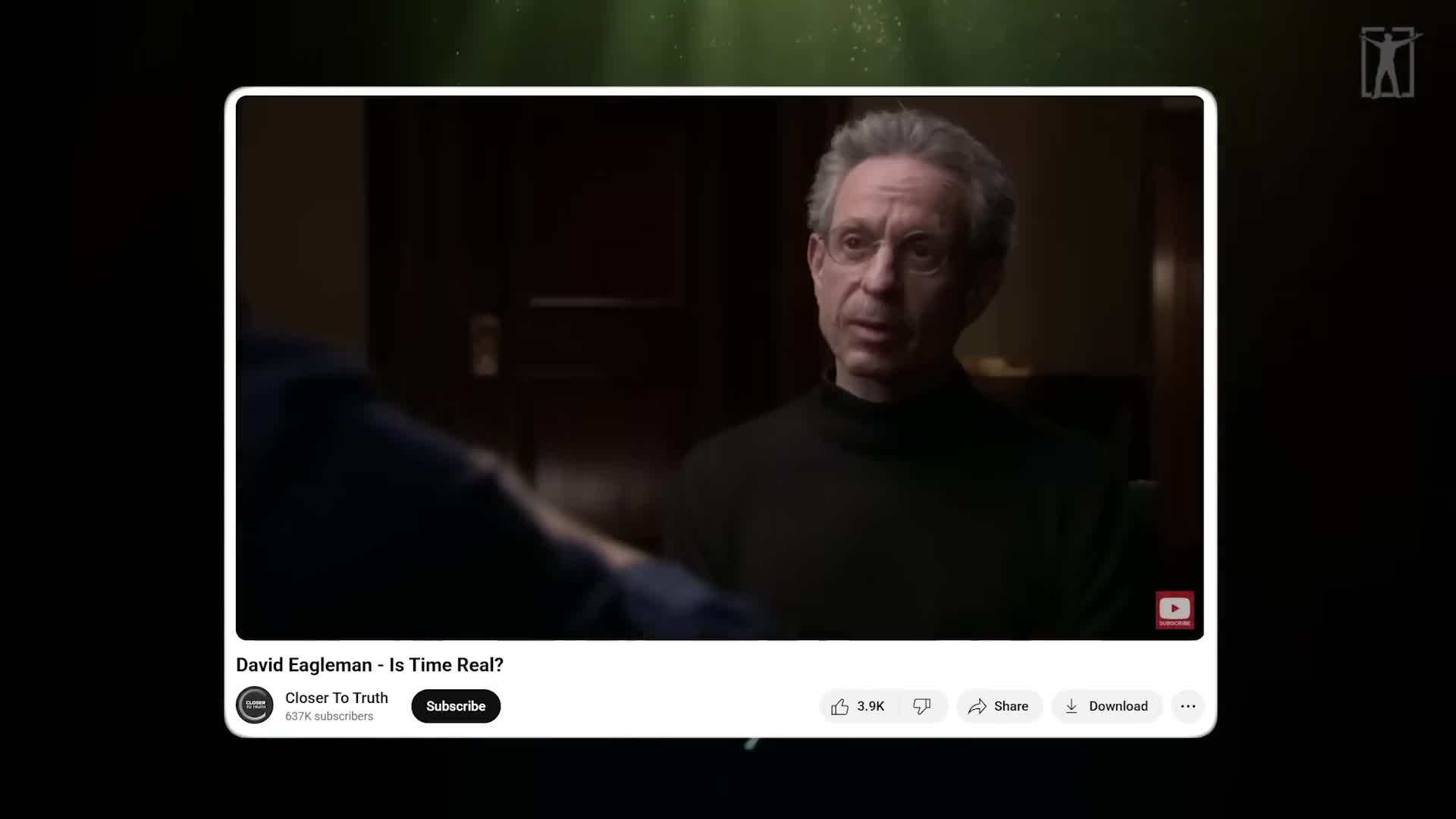
I'm living in the past.
When I think the moment now occurs, it's already happened a long time ago actually, probably about half a second ago.
So one thing that's very clear is that, even though we feel like we're experiencing things as they happen, we're not
And it's about 100 milliseconds, a tenth of a second.
So something happening within a tenth of a second after an event can make you change what you thought that event was.
Precisely.
Your entire experience is delayed, edited and here's the kicker.
Your sense of free will might just be part of the illusion.
What you call reality might just be the best approximation your brain can offer.
Everything you see, hear and feel has already happened by the time you're aware of it.
Your brain isn't giving you reality live.
It's giving you a version that's delayed, processed and smoothed out for clarity.
Here's what's happening under the surface.
Signals from your eyes, ears and body take time to reach the brain.
But instead of reacting instantly, your brain waits a moment, around half a second, and collects more data.
Then it edits everything together into what feels like now.
Stay with me.
What comes next will change how you see the whole thing.
Time is not Newton's time, where it's the t in the equation that just moves forward and then everything else can be hung on that.
So Einstein, of course, came after Newton and said look, depending on your frame of reference, things can get stretched or squished, depending on how fast you're going.
But it's a lot worse than that.
There's a neural relativity going on.
So what does it tell us about outside objective time?
Well It's hard to say.
At minimum, it means that it can run differently than subjective time.
At most, it means that maybe the whole thing is illusory.
Maybe the whole thing is a construction of the brain.
Maybe the brain constructs.
Your brain averages the last few seconds of visual input up to 15 in some experiments before presenting you a stable image.
You're not seeing the exact present.
You're seeing a polished version of the recent past.
This process is called temporal integration, and it's not optional.
If your brain didn't do this, the world would look like a flickering mess of motion blur, light shifts and asynchronous sound.
Instead, you get a reality that flows.
But that flow is fake.
It's edited.
This doesn't just apply to sight, touch, sound, even your awareness of yourself, all delayed.
And because the brain is the one handling the stitching, you don't notice the lag.
It feels seamless, natural, real.
Most people have no idea this is happening, but now that you do, ask yourself this.
If your entire sensory world is a filtered playback, what does real time even mean?
We tend to believe our consciousness is the captain experiencing and reacting to events as they happen.
But the truth is you're reacting to a world that already moved on, a world that's half a second ahead of your awareness.
So every time you think you're catching a moment as it unfolds, your brain has already processed it, adjusted it and delivered the version it thinks you can handle.
And if reality is delayed by default, it means the now you trust never actually existed.
If your brain is always behind, how do you catch a fast moving ball?
How do you react to danger in time?
The answer is simple and completely mind bending.
You're not reacting.
You're predicting.
Your brain doesn't just process the past.
It actively forecasts what's about to happen next and shows you that instead,
This is called predictive processing.
Based on your past experiences, current context and sensory patterns, your brain creates a model of what should be happening right now and that's what you perceive.
You're living in a mental simulation that runs just ahead of the raw data.
Now, imagine being a brain.
You're locked inside a bony skull, trying to figure out what's out there in the world.
There's no light inside the skull, there's no sound either.
All you've got to go on are streams of electrical impulses which are only indirectly related to things in the world, whatever they may be.
So perception, figuring out what's there has to be a process of informed guesswork in which the brain combines these sensory signals with its prior expectations or beliefs about the way the world is to form its best guess of what caused those signals.
The brain doesn't hear sound or see light.
What we perceive is its best guess of what's out there in the world.
When a tennis player returns a 130 miles per hour serve, their body moves before their conscious mind even registers the ball.
The brain anticipated the movement based on trajectory, muscle memory, and experience.
And in most cases, it's right.
You're doing this every second while walking, talking, driving.
Your brain is predicting the next step, the next word, the next brake light.
And most of the time, the prediction is so accurate, you never notice it's a guess.
Stay with me because this next part changes everything.
When the brain's prediction is off, when something unexpected happens, you don't just see an error, you feel surprise, confusion or even fear.
That emotional jolt, it's your brain correcting its forecast.
This means perception isn't passive, it's an active construction, a guess refined in real time, based on what your brain thinks should be happening.
So when you look around right now, what you see isn't the real world.
It's your brain's best guess about the world, seconds before it confirms it.
And that leads to a bigger question.
If you're seeing what your brain expects to see and not what's actually there, how much of your life is just prediction, pretending to be perception?
If your brain predicts what you'll see, it might also just predict what you'll do.
And the idea that we consciously choose our actions?
Science says otherwise.
In the early 1980s, neuroscientist Benjamin Libet ran a series of now famous experiments.
He asked participants to move their hand whenever they felt like it and to note the exact moment they made the decision.
What brain scans revealed changed everything.
The brain showed signs of preparing the movement almost half a second before participants said they made the choice.
That unconscious buildup is called the readiness potential.
The brain initiates the action and only afterward does the conscious mind register the decision.
The brain activity bringing about movement started before the individual willed anything to happen.
Some people think this is proof that free will is an illusion, that our conscious decisions are more like reports on what is already happening than the causes of our action.
It didn't stop there.
More recent experiments using fMRI have predicted a person's decision up to seven seconds before they report making it.
That means your brain may have already chosen before you even show up.
This doesn't mean you're a robot.
You can still veto pause reflect, but it calls into question whether conscious will is the starting point or just the narrator arriving late.
Many neuroscientists now argue that free will, as we usually imagine it, is a convincing illusion.
We act, and then the mind explains the action retroactively as a choice.
That sense of agency, the feeling that you decided, is built on delay and prediction, just like your perception of the outside world.
The process begins before you're aware of it, and your brain fills in the backstory.
So when you say I decided to turn left or I chose to speak up, your conscious mind might just be rationalizing something that was already set in motion seconds earlier.
And that leads to an uncomfortable but unavoidable idea.
The person you think is in charge might just be watching things unfold and calling it intention.
You wake up, grab your phone, scroll, stand up, walk to the bathroom.
At what point did you actually decide to do any of that?
Much of your day unfolds in patterns, habits, muscle memory, instinctive responses.
You react to messages, noises, even people's facial expressions without pausing to think.
The decisions seem automatic because They are.
Neuroscientists have studied this loop.
The conscious mind often claims responsibility after the fact.
You feel like you chose to speak move click, but the action already started deep in the brain before you were aware of it.
In many cases, consciousness is simply explaining what's already happened is that we are the conscious source of our thoughts and actions.
Your experience of wanting to do something is, in fact, the proximate cause of your doing that something.
You feel that you want to move, and then you move.
Okay, you are doing you the conscious witness of your life.
Now unfortunately, we know that both of these assumptions are just untrue.
The first problem is that we live in a world of cause and effect, and there's no way of thinking about cause and effect that allows us to say that the buck stops here.
You don't choose your thoughts before you have them.
They arise.
You don't select your emotional reactions like items on a menu.
They hit you.
The idea that you are steering the ship starts to fade when you notice how much is happening on autopilot.
Your brain reacts to cues before you're aware they even existed.
The decision to flinch, speak, smile or freeze doesn't begin in your conscious mind.
It starts deeper in regions wired for speed, instinct and survival.
Think about deja vu or when you say, I don't know why I just said that.
All those moments where your body does something, move, turn, before your thoughts catch up.
That's the unconscious taking control while you, you identify with, scrambles to catch up.
The sense of self we all feel, coherent, decisive, continuous, may just be a clever story.
A narrator that steps in after the events and says, I chose that.
But the real decisions happen in silence, before the story begins.
And the more we learn from neuroscience, the more it looks like consciousness is not the commander, but the commentator.
And if most of what you think, feel and do is running on autopilot, that doesn't mean it has to stay that way.
According to cell biologist Dr Bruce Lipton, up to 95 of your actions, reactions and habits are driven by subconscious programs, most of them formed in childhood.
These patterns aren't fixed, they can be rewritten.
And one of the simplest ways to do it?
Audio reprogramming.
Your brain is most receptive to suggestions in the minutes before sleep, when it slips into theta state.
That's when the subconscious is open.
By listening to carefully designed audio tracks during this window, you can start installing new patterns confidence, financial mindset, emotional balance, freedom from addiction, deeper focus or even rewiring how you respond to stress.
You don't need to try to change anything.
You just need to press play consistently.
No willpower, no overthinking, just repetition done at the right time.
I'll drop a link below.
Try one tonight, don't force anything, just listen.
You might be surprised by what starts to shift in the background.
So far we've talked about perception, memory, choice.
But there's one experiment, famous, misunderstood and deeply unsettling, that goes even further.
It doesn't just question what you think.
It questions whether the act of knowing changes the world itself.
The double slit experiment.
Here's the setup.
Physicists fire particles, tiny bits of matter, at a barrier with two slits.
On the other side, there's a screen that shows where the particles land.
You'd expect them to go through one slit or the other like tiny bullets, but they don't.
When no one is observing, the particles behave like waves.
They pass through both slits simultaneously, interfere with themselves and create a complex pattern on the screen, something that should only happen with waves, not particles.
But when someone measures which slit, the particle goes through.
When we observe the act, everything changes.
The wave collapses, the interference disappears, and now the particles act like particles.
They go through just one slit, no more interference pattern.
But why do we care about all this?
Well, the point is that before we measure our system, it's in a blend of all possible states.
But as soon as we measure it, it collapses into just one of these states, randomly.
This idea is known as the collapse of the wave function.
We have no way of predicting exactly which state our system will collapse into.
Think about that.
Just by observing something, the outcome changes.
It's as if the universe behaves differently when it knows it's being watched.
This isn't pseudoscience.
It's quantum mechanics tested peer-reviewed repeatable, and it forces a question that physicists still debate today.
What role does consciousness play in reality?
Some interpretations suggest that reality exists in a cloud of possibilities and only solidifies into one version when observed.
In other words, observation doesn't just reveal reality, it participates in creating it.
If your perception alters behaviour on a subatomic level, if your awareness can collapse infinite outcomes into one physical result, then where does the boundary lie between you and the world?
You're not just looking at reality, you're involved in shaping it, passively or not.
This fits everything we've explored so far.
You don't experience the world directly.
You experience a version your brain creates.
Your choices may not come from willpower, but from processes already in motion.
And now, even physical reality appears to respond to your attention.
It doesn't mean you control the universe, but it does mean you're not separate from it.
And if even the physical world responds to how you look at it, then maybe it's time to ask the final question.
What is reality really?
So far, we've seen that your brain delays what you see, edits what you feel and makes decisions before you even think.
But what if the world around you isn't even what it looks like?
Cognitive scientist Donald Hoffman has a surprising idea.
Evolution didn't shape us to see the truth.
It shaped us to see what helps us survive.
Think of your computer screen.
You see simple icons, folders, trash bins, windows.
They're easy to understand and use, but they're not real.
They're symbols that hide the complicated systems underneath.
You don't need to know what the code looks like to use the computer.
Hoffman says your senses work the same way.
What you see, hear and feel isn't reality.
It's your brain's user interface, a simple version of the world that helps you make quick decisions, avoid danger and stay alive.
How can not perceiving reality as it is be useful?
Well, fortunately we have a very helpful metaphor, the desktop interface on your computer.
So the idea is that evolution has given us an interface that hides reality and guides adaptive behavior.
Space and time, as you perceive them right now, are your desktop.
Physical objects are simply icons in that desktop.
Let's break it down.
You don't see color.
Your brain adds it in.
You don't hear sound.
Your brain translates air pressure.
Even your sense of time, your feeling of now, is built after the fact.
So what you call reality is actually a custom-made version built by your brain to be helpful, not accurate.
This idea matches everything we've seen so far.
You live in the past, but it feels like the present.
You act before you decide, but it feels like free will.
You predict the world around you, but it feels like you're seeing it live.
And now we know, you don't even see the world as it is.
You see what your brain wants you to see.
This doesn't mean nothing matters.
It means that what you experience is a limited version of something much bigger.
And if that's true, what else might be hiding behind the interface?