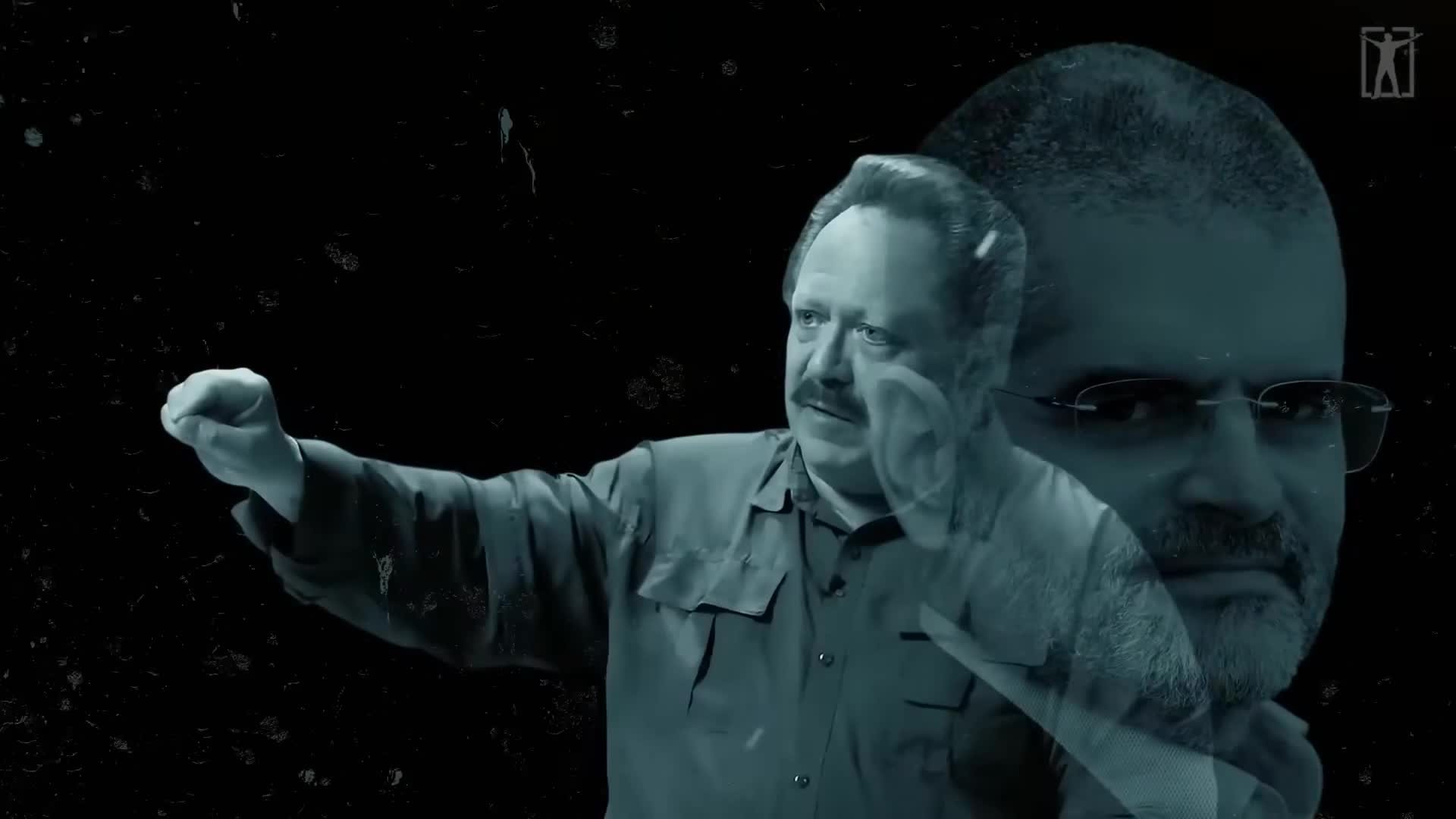
This video features three of the most brilliant minds alive Federico Faggin, Bernardo Kastrup, Chris Langen.
Each of them has decoded reality in a completely different way, but they all shake your understanding of reality.
By the end, even the most obvious things might start to feel strange, so please pay close attention.
You will persist after you die.
You're telling me i'm going somewhere.
Yes, god is outside of time and space.
God distributes over time and space and there's some left over.
Time and space is static.
It's a display.
Imagine you're a little homunculus inside a computer display like the Matrix, for example, okay?
God not only distributes over that, but there's a whole other domain where God exists.
And that's the processing domain.
That's the non-terminal domain.
We're living in the display of that simulation.
In addition to the display, there is also a processing aspect.
Okay?
And God captures both of those things.
He captures both the display and the process.
What is reality?
Is reality just stuff out there?
No.
Reality has a mental aspect.
And I'm saying that consciousness exists in every part of the universe, because those are the quantum.
No, that's what I'm asking.
Are you telling me that this table is conscious?
In that sense, yes.
Generically conscious.
Are angels and demons real?
Yes.
God is real, angels are real, demons are real.
Is the devil real?
Oh yes.
Let me tell you something very important about the man you just saw, Chris Langan.
Renowned for his extraordinary intellect, with an IQ estimated to be between 195 and 210.
He developed the CTMU, a revolutionary theory about reality.
Let me briefly explain what it means.
The CTMU, or Cognitive Theoretic Model of the Universe, suggests that everything in reality, from consciousness to physics, to God, is interconnected within a system that operates like a self-aware computer, processing and displaying information.
Now, let's hear Chris Langan explain this in his own words.
If we're talking about a theory of everything, the first question we have to establish does God exist?
Yes.
Simple as that.
The reality has an identity, okay?
The identity is that as which something exists.
Matter of fact, when you say the word reality, you're naming an identity.
That is, you're identifying something.
This, that's what the CTMU says.
It just comes up with the mathematical structure that you need to build a reality out of that.
You see,
So you come up with that identity and then you search it for its properties.
You see, once you've built the preliminary framework, then you start deducing the properties of this identity and you find out that those properties match those of God as described in most of the world's major religions.
You can deny the existence of God, or are its properties such that God definitely has to exist?
And the answer is God exists.
Properties of the central substance and central principle of reality.
Those properties are attributed to God including, of course, things like you have, the three O's omniscience, omnipotence and omnipresence.
But then you've also got consciousness.
God has to be sentient.
We're not just defining God out of existence.
Sometimes you'll hear people say God exists, but they'll give God such a weak and shallow definition that the God that they're describing has no relation to the God that we conceive of.
You're saying, no, God himself is conscious and therefore personal?
Yes, you can establish a personal relationship with god.
We're images of god.
You know what an image is.
It's basically the product of a mapping god maps himself into each human being.
Is your claim a pantheistic claim that god is the universe or the universe is god and that's that or no?
Or is god outside of the universe and created?
God is greater than well.
What is the universe?
Reality has an identity that can be studied like anything else that exists.
When we examine it, we find three main features complete knowledge, ultimate power and presence everywhere.
These exactly match what religions say about God.
This isn't just a theory.
God is conscious and aware, creating direct connections with humans by putting part of himself into each person.
This means we can have real relationships with God, not just believe in him as an idea.
The mathematical structure behind this shows that God must exist because reality needs him to work properly.
He's not just the concept we created, but the central force that makes everything possible and keeps it working.
This leads to a crucial question about how God relates to our universe.
Is God the same thing as the universe?
Or is God something bigger that includes but isn't limited to the universe?
To answer this, we need to look at modern theories about how our universe works, particularly the simulation hypothesis.
You ever hear of the simulation hypothesis?
Yes.
Okay well, the simulation hypothesis is basically the idea that the reality we see around us, physical reality, is simulated on some sort of an automaton or a computer.
God, it's more panentheistic.
The idea is that you've got the physical universe that you see around you, but God is not confined to the physical universe.
Okay.
See, there's an ordinary...
Every pantheist thinks, assumes that God is somehow confined to the universe.
That there is just what we see around us and God is in every piece of it.
God is distributed over it.
But it's a little bit more complex than that.
Because this part of the universe that we see around us cannot exist just by itself.
Yeah.
Okay?
There are certain things that it entails.
And when you go into those entailments, that's how you get to God.
That's how you get to the identity of reality.
But to get back to the simulation hypothesis, that we're living in the display of that simulation.
In addition to the display, there is also a processing aspect.
And God captures both of those things.
He captures both the display and the processor.
What do you mean?
I hate to put it in the... Well, I mean, okay, here's the display.
You realize the display contains states.
Yep.
Okay, you see things, the objects contain states.
States are static.
That's why they're called states.
Static.
How do they change?
Well, they have to be processed.
Something has to be processed.
And in the calculus, for example, those are tiny little infinitesimal intervals.
But they're not actually contained in the states themselves.
They have a neighborhood, a little tangent space or what have you, where you can sort of draw little vectors that suggest that some kind of processing is going on.
But the idea of being a state and being a process.
Those are two different things to the ordinary way of looking at it.
It turns out that you can't properly describe reality and causation at all, unless you put those things together somehow.
And that's what it takes God to do.
God provides the processing functionality for your state.
The universe works in a way similar to a complex computer system, with two main parts.
What we can see and experience, the display.
And what makes everything work behind the scenes, the processor.
This idea comes from the simulation hypothesis, which suggests our reality might be like a sophisticated simulation.
But God isn't just part of this system.
He's bigger than it and controls both aspects.
What makes this understanding unique is that everything we see exists in different states, like frozen moments in time.
These states need something to make them change and move forward, and that's where God's role becomes crucial.
He provides the processing power that makes everything work together, not just maintaining the universe, but actively participating in its operation.
This understanding of how reality works leads us to a deeper question about consciousness.
How do we, as conscious beings, fit into this complex system of display and processing?
The answer involves something called quantum mechanics and identity operators.
Now, how do i, how do i make sense of consciousness?
Well Ordinarily, quantum mechanics.
You know what quantization is.
You know, I know the word.
Well, you decide what the ultimate irreducible objects are.
It turns out that in order to quantize that theory that I was talking about, that theory of identity, where you've got the display and you've got the processor and it's handling both, it turns out that in order to handle both of those things, you need a certain kind of quantum.
That quantum is called an identity operator.
God is the identity.
So obviously these little quanta they have to be, they're doing things, they're processing, so we can call them operators, right?
They are identity operators, okay?
The identity operator has.
Basically, it takes input from the outside world, recognizes it or accepts it using syntax, processes it and then returns it to the world as external state.
No, that's what I'm asking.
Are you telling me that this table is conscious?
In that sense, yes.
Generically conscious.
It's relying on our consciousness to do it.
There's levels of quantum.
These are tertiary quantum.
They're all put together using physical localistic forces, right?
But those are underdeterminative.
They don't fully determine what happens.
Why?
The Heisenberg uncertainty principle, for example.
It tells you that the quantum rules, they're probabilistic.
Consciousness works through a system of identity operators, special elements that take information from the world, process it and return it back.
This isn't just about human consciousness.
Everything has some level of awareness, even simple objects like tables.
The difference is in the levels.
Humans have a more complex form of consciousness, while objects have a simpler version.
What makes this understanding revolutionary is how it connects to quantum mechanics, where things aren't completely determined, but work on probability.
This means consciousness isn't just observing reality, it's actively participating in it.
The way we process and interact with reality affects how it manifests.
This understanding of consciousness naturally raises questions about free will.
If everything has some level of consciousness and nothing is fully determined, what does this mean for our ability to make choices?
Now you've mentioned two things that raise a new question for me, which is?
You mentioned this idea of simulation, just the simulation or self-simulation and you've mentioned us doing things.
So then, it would seem to me we have to tackle the question do we really do much of anything at all, in the sense, do we have free will?
Yes, we do.
I'm glad to hear it.
I always thought we did.
Well, yes, we have to have free will.
I was discussing with you earlier the idea of a fixed array.
Yeah, yeah.
All right, now modern physics.
No, basically what you've got is you've got a bunch of quantum fields and superposition, and then those fields consist of little fluctuations, little quantum fluctuations, right?
Reality is actually generative, okay?
It's not a fixed manifold.
Everything is being created all the time, not just our states.
Our states are being recreated, right?
When I look at you, I'm seeing Michael Knowles, okay?
I'm seeing you sitting there.
But that means that I'm seeing your boundary.
I'm seeing what distinguishes you from the external environment.
Right, right.
Well, it's sort of like a little baby, right?
Has trouble recognizing the limits of things and recognizing what some individual object might be from.
You know the glass on the table.
They have trouble distinguishing those.
Precisely.
The baby has to learn to distinguish those boundaries.
And it has to receive the right visual cues at the right age so that it can actually learn how to do that.
The concept of free will is explained through modern physics and quantum mechanics.
Unlike a fixed, predetermined universe, our reality is constantly being created and recreated.
When we observe something like looking at another person, we're not just passively seeing them, but actively participating in creating reality by recognizing boundaries and distinctions.
What makes this understanding powerful is how it connects to quantum fields and fluctuations.
Reality isn't like a movie playing out in a predetermined way.
It's more like a continuous process of creation where we actively participate.
This explains why babies must learn to distinguish objects and boundaries.
They're learning to participate in this creative process of reality.
This view of reality as an active creative process where we have genuine free will leads us to question what happens when we die.
So, speaking of this non-terminal domain in a really basic question, I'm not going to ask you if I'm going to go to heaven or hell, but will I go to either heaven or hell?
You will persist after you die, okay?
Where you go depends on who Michael Knowles really is.
But you're telling me I'm going somewhere.
Yes.
You're confident of that.
I don't just evaporate.
I don't just turn into oblivion.
Well, you can.
If you displease God, that's exactly what's going to happen to you.
God is going to cut you off, and he's going to say, I can't see him anymore.
He's going to turn away from you, and then you won't be able to reunite.
Salvation will be impossible for you, because salvation means that God has got to pull you back into himself.
Right.
But God doesn't want to see you anymore.
He doesn't even know you exist.
He knows your physical body is there, but he's not interested anymore because you hate him.
You deny his existence.
You offend him, so he's not going to look at you, right?
So now what happens?
Well, okay, you're dead.
You still want to live.
There's something in you that still desperately wants to live, so it's still going to be there.
What happens now?
Well, you try to create your own world for yourself, but if you're a bad person and you're an evil person, what kind of world is that going to be?
It's going to be an evil world, and that's what we call hell.
If we are active participants in creating reality, does this participation continue after death?
The afterlife isn't just a matter of belief.
It's presented as a logical continuation of consciousness after death.
Our existence continues.
But where we go depends entirely on our relationship with God.
This relationship isn't just about following rules.
It's about maintaining a connection with the source of reality itself.
What makes this understanding unique is how it explains hell.
It's not a place of punishment, but a natural consequence of separation from God.
When someone rejects God, They try to create their own reality, but without connection to the source of all reality.
This self-created world reflects their internal state.
If that state is evil, their reality becomes hellish.
This concept of separation from God and the creation of alternative realities leads to question about other spiritual beings and the nature of evil itself.
So, we've gotten through death, judgment, heaven and hell, free will and God.
Are angels and demons real?
Yes.
God is real, angels are real, demons are real.
Is the devil real?
Oh, yes.
Yes.
Well, it has to be.
You know we were talking about Michael Knowles being surrounded by the medium and you know you've got a boundary.
Well, God has a boundary, too.
He's got a very tight boundary.
He's perfect.
He can't take anything resembling imperfection, right?
He can't take it into himself because that would be a contradiction.
Okay?
So God needs an antithesis in order to be properly defined.
What is that antithesis?
Anti-God or Satan.
So it definitely exists.
Now, Satan isn't coherent. because he basically hates existence.
Nevertheless, he gains coherence through human beings, through secondary telos as they're called in the CTMU.
In other words, Satan can nucleate power structures, for example, things like corporations and governments, where you've got people in there that can be acquired as resources and there's a kind of skeleton a corporate organization, a governmental organization that's holding them together, holding them in place that can be exploited.
The spiritual realm includes beings like angels and demons but, most importantly, it explains the necessity of evil through the concept of boundaries.
God, being perfect, has absolute boundaries.
He cannot contain imperfection.
This necessity for boundaries creates the possibility of an opposite force represented by Satan.
What's fascinating is how evil operates.
Satan isn't powerful on his own, but gains strength through human structures and choices.
Unlike God, who is complete in himself, evil needs human participation to function, often working through organized systems like corporations or governments.
This explains why evil often appears systematic and structured rather than just random or chaotic.
This understanding brings us full circle to the original question of God's existence, showing how the entire structure of reality, including both good and evil, requires a perfect being at its center.
It took me 30 years to figure out.
I can explain what physicists in a hundred years have not understood.
Nobody can understand why quantum computers work, because their actual operation cannot occur in space-time.
There is a deeper reality where the feelings and the fields exist.
The meaning of information exists.
And from that world you have this world.
That is a classical world where you can get classical information.
And we think that the only world that exists is this world, but this world we have constructed with our bodies.
What you're about to hear might completely rewire how you see yourself, your body, your mind, even your place in the universe.
Federico Faggin isn't just any scientist.
He's the man who invented the microprocessor.
See, in every computer, each switch, a bit, is either on or off.
That's it.
Zero or one.
But your body?
Every single one of your 50 trillion cells contains the entire blueprint of who you are.
Every cell is a miniature reflection of the whole.
That's not mechanical.
That's holographic.
We as human beings, we are fields which are part whole or one, the totality of what exists.
Same pattern repeated at different scales.
And here's where it gets even more interesting.
He says, each of these cells doesn't just hold information.
It's connected to the whole body through something deeper, quantum fields.
This means your body isn't just a system of parts working in isolation.
It's a field of intelligence, a constantly adapting self-aware network.
And this isn't speculation.
This is backed by the foundations of quantum physics.
Now let's unpack that.
In classical physics, we treat matter like isolated, measurable stuff.
But quantum physics shattered that idea.
Particles aren't objects.
They're states of a field.
You can't separate the wave from the ocean.
Likewise, you can't separate a cell from the field it emerges from.
So when we ask, What are we really?
We're not bags of chemicals reacting predictably.
We are dynamic, indeterminate systems woven into fields that respond to intention, attention and maybe even consciousness.
And if that's true, then the way we've modeled consciousness like it's a side effect of the brain, chemistry isn't just incomplete.
It's fundamentally flawed.
Stay with me because what comes next dives even deeper.
You're about to see why classical science has been missing the most important part of the picture.
For over a century, science has operated under a simple rule.
If you can't measure it, it doesn't exist.
That's how we ended up reducing life to chemical reactions and neurons firing in the brain, because that's what we could observe, record and replicate.
But here's a problem.
That method, powerful as it is, can only describe half the picture the visible half, the measurable half.
What it misses are the invisible connections, the quantum fields that hold everything together.
And ironically, quantum physics has been telling us this for decades.
Particles which we once believed to be tiny building blocks of matter turned out to be not particles at all.
They're not little marbles bouncing around.
They're states of a field.
Temporary ripples in something much deeper.
They come and go.
They aren't permanent and they aren't separate.
This changes everything, especially when it comes to understanding life, because your body, every cell in it, is made of these quantum states.
And these states aren't isolated.
They're entangled.
Which means the idea of you being a self-contained machine, it was never true.
Particles are not objects.
Particles are states of a field.
They cannot be taken away from the fields.
They are not separable from the fields.
So why has modern science clung so tightly to the machine model?
Because it's predictable, it's controllable, and it gives the illusion of certainty.
In a classical world, things follow rules.
They can be mapped, built, and manipulated.
And that's attractive, not just to scientists, but to industries built around control.
But in a quantum classical world, things behave differently.
They adapt, they self-organize, they evolve in ways that can't always be predicted.
That's a lot harder to monetize, and much harder to dominate.
And here's where it gets even deeper.
If the classical model strips away, meaning treating consciousness like a byproduct of brain chemistry, then the quantum model does the opposite.
It puts consciousness at the foundation.
Not an accident, not an output, but the starting point of reality itself.
And if that's true, then everything from artificial intelligence to neuroscience has been built on a dangerously incomplete understanding of what it means to be alive.
If you've Ever wondered why consciousness still remains one of the greatest mysteries in science,
It comes down to this.
We've been trying to explain it using tools that simply aren't built for the job.
In the classical world, the world of computers and equations, information is static.
You can copy it, move it, and process it through algorithms.
That's what your phone does every second of the day.
A bit is either zero or one.
And those values can be duplicated perfectly.
But quantum information plays by completely different rules.
You can't copy it.
You can't even fully observe it without disturbing it.
The moment you try to measure a quantum bit, what's called a qubit, you collapse it.
The infinite possibilities it holds shrink down to just one, zero or one, based on probability.
And once that collapse happens, the original state is lost.
The maximum information that you can get from a quantum bit is a classical bit.
The quantum bit cannot be known.
The not cloning theorem says that you cannot clone even a quantum bit.
Quantum information cannot be reproduced.
Classical information can be reproduced.
This means quantum information is private.
It cannot be separated from the system that holds it.
And here's the mind-bending part.
This kind of information behaves more like experience than data.
What do you feel right now?
Your inner world can't be downloaded, cloned or transferred.
It's real, it exists, but only within you.
And that leads to a radical idea.
Maybe consciousness isn't produced by the brain.
Maybe the brain is a translator, a filter for a deeper quantum field that already contains awareness.
So when we try to explain consciousness using algorithms, we hit a wall, because algorithms can't produce meaning, They can only simulate structure.
A machine might generate a sentence, but it doesn't feel the meaning of that sentence.
Even if AI gives you a good idea, AI doesn't know that it is a good idea.
You recognize the good idea of AI. your understanding with your comprehension in this view consciousness and free will aren't emergent they're foundational and everything else from biology to technology emerges from them this flips the scientific model upside down because if what we feel can't be measured copied or simulated then it may be quantum information tied to a field that science still barely understands There's a moment in quantum physics that no one can fully explain.
A moment where potential becomes actual.
It's called the collapse of the wave function, and it's one of the most mysterious transitions in all of science.
The collapse of the wave function is just a way of saying that we don't know.
At the quantum level, particles don't exist in one place.
They exist in multiple states at once until we observe them.
Then suddenly everything changes.
The field collapses and a single outcome appears.
But here's the catch.
Physics can't explain how that collapse happens.
There's no formula, no mechanism.
It's not a gradual process.
It's instantaneous, unpredictable, and completely outside the bounds of classical cause and effect.
And this is where it gets really strange.
What if that collapse doesn't happen to us?
But... through us.
What if observation itself, the act of conscious awareness, is what finalizes reality?
Think about it.
A particle only chooses a state when it's observed.
But what does observed mean?
A camera?
A sensor?
Or something with the capacity to experience?
This idea that consciousness plays a role in shaping reality isn't just philosophical speculation.
It's built into the math of quantum mechanics and it suggests something profound that you're not just witnessing the world, you're participating in its creation.
Quantum information is the representation of inner experience and the collapse of the wave function is the representation of the free will.
This isn't about magical thinking.
It's about revisiting the assumptions we've made about how matter and mind interact and realizing that they were never truly separate to begin with.
Because if quantum states collapse only when measured and measurement requires a reference point then consciousness may be that reference point, not an observer in the background, but an active agent embedded in the field itself.
In fact, every act of awareness could be a moment of creation, where infinite possibilities collapse into a single lived experience, one that's only meaningful because you are the one experiencing it.
This may be the clearest explanation yet for something science has danced around for decades, why you can't fully describe reality without including the observer.
And if that's true, then your attention, your awareness isn't just a passive process.
It might be the very mechanism that turns potential into reality.
When you think about information, what comes to mind?
A message?
A number?
A word on a screen?
But that kind of information, what physics calls classical, has no meaning on its own.
It can be copied, moved, analyzed, but it doesn't feel like anything.
In classical systems, a meaning is stripped away.
A zero is just a zero.
A one is just a one.
The system doesn't care what it means.
It just runs the program.
But consciousness doesn't work like that.
There's a kind of information we rarely talk about.
You don't just know it.
You feel it.
The warmth of sunlight.
The sound of your name.
The sense that something is beautiful or true.
These are not just inputs.
They are experiences.
And experiences cannot be reduced to numbers.
What we feel is only within the field.
That's how we know the meaning is within us, is within the field.
It's not in the information.
This is where the idea of quantum information becomes essential, because quantum information, unlike classical bits, cannot be copied or cloned.
It exists as a unique, invisible state, one that collapses the moment it's observed, it's measured.
Just like a personal experience, it can be represented, but never reproduced.
And this leads to a startling realization maybe feelings, conscious experiences, are themselves quantum phenomena.
Maybe your inner world is not something generated by the brain, but something expressed through it.
We've built entire civilizations around the idea that meaning comes from the outside world.
But what if it's the opposite?
What if meaning is generated from the inside and everything else is just the map, not the territory?
A theory of reality is not reality okay.
So what you feel, only you feel, not body, you feel, can actually know, and you know inside.
And what you can say about what you feel is a small part of what you feel.
Olivo's theorem, one bit per quantum bit.
This flips the script on neuroscience, philosophy, even technology.
Because if meaning can't be measured or shared in the traditional sense, then no machine, no matter how powerful, can replicate what it's like to be you.
This isn't just about consciousness, it's about reality itself.
Because when you realize that the universe doesn't contain meaning, but that you're the source of it, then suddenly you're not a passenger in this world.
You're a creator.
We like to think of the world as something out there, separate from us, something we can study manipulate, even control.
But this idea rests on a deep assumption that the observer and the observed are two different things.
Quantum physics says otherwise.
At its deepest level, reality is holistic.
It's not built from separate parts.
It's made of relationships, fields and interactions.
You can't pull something out of context and still understand what it is, because the moment you isolate it, you destroy what made it meaningful in the first place.
There is no clear boundary between classical and quantum.
In other words, we again want to put things into boxes.
That's the first mistake.
There are no separate boxes.
One is holistic.
The reality, deeper reality is holistic, means it's not made of separable parts.
This isn't just theory.
It shows up everywhere.
In a quantum system.
You can't fully describe a particle without including the system that observes it.
You can't separate the dancer from the dance.
The act of observation is part of the process.
But in classical science we've spent centuries trying to reduce everything to pieces, to break nature down into smaller and smaller parts.
Why?
Because parts can be measured.
Parts can be controlled.
But fields relationships, those don't fit neatly into equations.
So we started simplifying.
We took the infinite and made it binary.
True or false, right or wrong, zero or one.
It made things easier to work with.
But in doing so we began mistaking the map for the territory.
Even true or false is a approximation of reality valid under certain conditions.
And that's a problem.
The world we've built.
The science, the logic, the technology is based on simplifications that break down the moment we go deep enough.
It's like trying to describe a symphony using only two notes.
At some point the system becomes incoherent, not because it's wrong, but because reality is more than logic.
It's dynamic, it's alive.
And it includes you.
The paradox?
We've built machines that simulate intelligence, but we still don't understand the very intelligence that built them.
Because we've been asking the wrong question.
Not how does it work, but what is it that knows?
And the deeper you go into that question, the more the answers start pointing inward.
We've all wondered at some point what happens after death.
Let's hear what Federico has to say about it.
Imagine that you control a drone.
You know we are a body that controls a drone that is in Afghanistan.
You know, watching around and semi-autonomous, so I don't have to worry about I, only have to express where I wanted to go.
So now the drone looks at that reality where it is, sends me information and I get the conscious experience of what the drone is seeing.
That conscious experience is not in my body, it's in my consciousness.
And based on that, and based on my free will, I'll tell the drone what to do.
The drone doesn't know anything.
You know you were so focused on that drone that you only saw what the drone was seeing, because you were piloting it and you were concentrated.
Then, when the drone doesn't send you any signal, you look around and you say oh my God, there is another world here.
You see?
That's the same thing the ego.
When the body dies, it doesn't look at the signals of the body anymore and it looks around and says, oh shit wow, look at this.
If consciousness doesn't come from the body, but only uses the body, then death isn't the end, it's just a disconnection.
Like a drone going dark, while the operator remains intact, simply shifting awareness back to its original source.
And when that drone goes offline, when the body dies, consciousness doesn't disappear, it simply loses its local connection.
This isn't just speculation.
Thousands of near-death experiences around the world describe the same thing separation from the body, awareness of surroundings and a shift into something vaster, more peaceful, more real than anything physical.
People report seeing their own surgery from above.
They recount conversations that occurred while their brain showed no measurable activity and in some cases they meet people relatives, friends they didn't even know had passed until they returned and learn the truth.
They are clinically dead.
They're not dead clearly, if they are resuscitated but but they are for all practical purposes dead.
Okay, and they have an experience in the hospital.
They see themselves in the operating table.
They later tell what's going on.
While the brain has no electrical signal, the brain is not functioning.
So how can you be outside of the body looking down at your body in the operating table?
This challenge was everything we thought we knew.
If the brain stops functioning and yet awareness persists, then consciousness cannot be a product of the brain.
It must be something deeper, something already existing before the brain and continuing after it.
Even more fascinating is the idea that the physical world we experience is filtered limited, like a narrow frequency band tuned by the senses.
But outside that band, a broader, richer spectrum of reality may be constantly unfolding, one we simply don't perceive through biological eyes.
Bachian compares it to vision.
You see a tiny slice of light, but the electromagnetic field holds infinitely more.
Swap your eyes for a cell phone antenna and suddenly you'd see thousands of conversations happening all around you.
So what happens when the filter drops away?
When the body is gone and consciousness is no longer tethered to a narrow stream of data?
Maybe you don't go anywhere. because maybe you were never really in the body to begin with.
There's a moment instant, silent and complete, when consciousness becomes aware of itself, not just aware of the world around it or of a body moving through space, but of its own existence.
That moment isn't gradual, it doesn't build, it flashes.
And in that flash, something extraordinary happens, the creation of a self.
The moment that one knows itself, It has to know completely itself, because it's not made of parts.
It cannot know a part of itself.
It has to know the totality of itself.
This is how individuality begins, not as a separation, but as a reflection.
Consciousness looking at itself from one unique angle among infinite possible directions.
Each angle creates a new heart hole.
A new expression of the same unified feel.
Not a copy, not a fragment, but a whole.
Seen from a different perspective.
It's like shining light through a crystal.
Every beam is unique, but the source is the same.
In this model, life isn't random.
It's not a side effect of chemistry.
It's the result of awareness folding in on itself, generating complexity through recognition.
That's why each conscious being feels like an eye, because each one is a distinct viewpoint within the greater whole.
And here's where it goes even deeper.
According to this view, everything that exists comes from this process.
The universe doesn't just exist.
It knows it exists and because of that it creates new layers of experience, new dimensions of expression, not through programming, not through design, but through the sheer act of self-awareness.
This isn't metaphor.
It's a model that explains why life can't be copied, why consciousness can't be simulated and why true intelligence is always rooted in experience, not in data.
So when we talk about identity, we're not talking about a label or a role or a body.
We're talking about the field's way of knowing itself through you.
Once you understand that awareness is not a byproduct of the brain, but the source of everything, those beliefs fall apart.
Consciousness is beyond matter, beyond this space, and time is the tool for knowing, infinitely more powerful than any instrument that we have ever built.
In this view, intelligence isn't about calculating faster.
It's about knowing meaning, feeling truth, recognizing beauty things no algorithm can replicate, no matter how advanced.
Even if artificial intelligence generates a brilliant idea, it doesn't know that it's brilliant, it doesn't feel it.
It can't understand what it means.
Only you can do that.
This is the line no machine will ever cross, the ability to know what it is like to be.
That's why self-awareness matters.
It's not just a spiritual luxury, it's a survival mechanism, because when you truly understand who you are, when you experience yourself as part of a larger whole, you stop competing You start cooperating, not because someone told you to, but because it's the only thing that makes sense.
And that might be the most important shift of all, because we live in a world driven by fragmentation, divided by belief, identity and fear.
But those divisions aren't real, they're the result of forgetting what we are.
We're not machines.
We're not separate.
We are fields of consciousness, each one a unique way the universe sees itself.
And if enough of us remember that something changes not just in theory but in how we treat each other, in how we build, in how we live.
Because the future doesn't belong to the fastest system.
It belongs to the deepest awareness.
This is for today's video.
If you made it this far, thank you.
I hope this left you with new questions, new perspectives and maybe even a deeper sense of yourself.
Share this video with someone who's ready to hear it, someone who's been asking the same questions we all have, but never quite found the language for them.
When there are no living beings looking around, There is no matter.
Matter is always, in all cases, without exception, without a single exception.
Matter is always what mind looks like.
You know, if I hold this glass and feel its solidity and weight, these are mental qualities.
Solidity and weight are qualities in my conscious states.
God is not this mass.
God is immanent in the mass.
In other words, the mass is the appearance of God.
Some people think of free will as libertarian free will.
And what that means is whatever I do, I could have done otherwise.
That is probably incoherent.
Nobody in the universe can possibly know what choices you're going to make.
Not you, not God, nothing.
Because the universe is computationally irreducible.
The only way to know exactly what the choices are going to be is to let the universe play itself out until the choice is actually made.
There is no shortcut.
God itself cannot anticipate what we are going to choose, what it is going to choose.
The man you saw is Dr Bernardo Kastrup, a former CERN scientist and one of the world's leading voices in the philosophy of mind.
What he says about reality might quietly change the way you see everything.
What he's about to explain doesn't demand belief, but it may quietly rewrite what you thought was real.
Listen closely.
Everything is inherently mental.
That's the basic starting point of analytic idealism.
For most people, the world feels simple.
There's an outside reality and there's an inner world.
Science over the last few centuries has been built on this separation.
It assumes that what we observe out there exists independently of us, that we are passive witnesses of a universe running on its own.
Kastrup challenges this model with logic.
When we examine closely what we call the physical world has only ever arrived through sensation light sound, touch.
And all of those sensations are experienced within consciousness.
The implications are quiet, but far-reaching.
Instead of dismissing the inner world as subjective noise, Kastrup proposes that it might be the only thing we've ever truly had access to.
That the outside might not be outside at all, but a structured experience emerging from within, something more fundamental.
He calls this framework analytic idealism, and while it shares a name with older forms of philosophical idealism, Kastrup's version is sharper.
It doesn't ask you to believe.
It asks you to observe carefully and notice what's always been in front of you.
But he doesn't stop at theory.
Kastrup offers a model, one that connects perception, neuroscience and metaphysics through a single insight.
What we think of as matter may be nothing more than a specific way.
Mental activity appears under certain conditions.
To make sense of that, we need to explore a metaphor he uses often.
A metaphor that's unsettlingly accurate once you understand it.
Let's talk about the dashboard.
You are in an airplane.
The airplane has sensors.
It makes measurements of the sky, the clouds outside, and those measurements are presented to the pilot in the form of dial indications on a dashboard.
If the plane is not flying around the sky, there are no dashboard representations.
But the sky is still there, right?
So under analytic idealism, matter is a dashboard representation.
When there are no planes flying around, in other words, when there are no living beings looking around, there is no matter.
Because matter is a dashboard representation.
You need a dashboard to have a dashboard representation.
But the thing that is represented, the sky, the clouds, that is always there.
Whether you're flying around in a plane or not, whether there is a dashboard or not.
That's how Bernardo Kastrup describes our relationship with reality.
We don't interact with the world directly.
We interface with readings, signals, representations.
Our senses act like instruments.
They report data shapes colors sounds, textures but that data is already processed by the time we become aware of it.
From the very beginning, everything we know has arrived through a kind of internal dashboard.
We assume we're seeing the world, but what we're really seeing is an organized stream of impressions filtered, structured and delivered into awareness.
This model becomes even more interesting when we look at the brain.
To an outside observer, the brain appears as matter neurons firing regions activating, but to the person living within it, those same processes are thoughts memories, emotions.
The inner and the outer are two sides of the same event, but from radically different angles.
Kastrup's insight is that this logic doesn't stop at the brain.
It extends outward, to everything.
What we call matter is just how mental activity appears when observed from a different perspective.
The dashboard view.
This changes how we think about science.
Science has been incredibly effective at finding patterns in how the dials behave.
It tells us how temperature affects pressure, how motion affects space, but it doesn't tell us why the dashboard exists or what powers the plane.
That's where Castrip's model opens a new door.
The dashboard only lights up when someone is there to read it.
Without awareness, the instruments stay dark.
But the sky, the deeper reality, remains, even when no one is watching.
Matter, then, is not the source.
It's a response.
A reading.
And if everything we know is filtered through that interface, then maybe what we call the physical world is just the visible face of something much deeper.
Next we'll look at the surface more closely, because the closer we examine matter, the more it starts to behave like a message.
The brain is simply what mental activity looks like when observed from the outside.
So you don't even get to, oh, then mental activity creates the brain.
Well, in a sense, yes, but it's not deliberate.
It's not an act of creation.
It's a spontaneous thing.
The brain is what mental processes look like.
It's the appearance of it.
We're taught to think of matter as solid independent real, in a way that thoughts or emotions are not.
But if we pause and investigate, that solidity starts to unravel.
At the quantum level, particles behave more like possibilities than things.
They don't have definite positions until measured.
They aren't stable building blocks.
They're fluctuations in a field.
Events, not objects.
That alone should make us question what matter really is.
Now, take the human brain.
To an outside observer, it's a physical structure.
But to the one living it, it's not grey tissue.
It's a theater of emotion, memory, imagination.
These aren't two separate things.
They're two appearances of the same process seen from different perspectives.
Your mental inner life looks like a brain.
From the perspective of someone else,
So, behind this very concrete materiality, we know that, at least in the case of The nervous system of human beings behind that underlying that concrete materiality, is just mental states.
Your sorrows, your desires, your regrets, your feeling of hunger, the redness of a strawberry, the sweetness of the strawberry when you eat it.
And that all appears to others in the form of very concrete matter.
But here's the key, that principle doesn't stop with the brain.
If we follow it honestly, it leads us to a larger idea, one that touches every object in the universe.
Matter is not the source of consciousness.
It's the appearance of consciousness shaped by perspective, conditioned by dissociation and rendered into a form that can be observed.
In this view, the material world isn't a fundamental layer.
It's a secondary effect, a visible representation of processes that are, at their core, mental.
But these mental processes aren't inside your head.
They're not yours in isolation.
They're local expressions, like ripples on a larger surface.
So when you hold a glass of water, what you're actually holding is a stable, shared representation of a deeper mental dynamic.
Its weight, its coolness, its transparency, all arise within experience.
But the structure itself, the glassness of it, belongs to a broader field, one that isn't material in nature.
This is where things start to shift, because if everything we touch is actually a translation, an appearance, then the hard edge of materialism begins to dissolve, not into mystery, but into something more precise.
The recognition that what we call stuff is the outside view of something thinking.
And what we see as physical form may be consciousness seen from the wrong side of the mirror.
Appearances arise when there is a boundary between the observer and the observed.
If they are not distinct, there are no appearances, because appearances are what something looks like from the outside.
For there to be an outside, there has to be a division, a boundary between the inside and the outside.
So the observer looks from the outside and the observed exists in the inside.
Pay close attention to this, because it's one of the most important shifts in the entire model.
We usually think of ourselves as separate minds, moving through the world, enclosed in bodies.
But what if that sense of separation is a kind of illusion?
A useful one, yes, but still an illusion.
According to this framework, there is only one mind, one universal field of consciousness.
The reason we feel separate from one another isn't because our minds are split, but because they are dissociated.
Dissociation is a psychological process where one mind divides, creating seemingly distinct centers of experience.
In psychiatry, it shows up in conditions like dissociative identity disorder.
But here, the idea is expanded.
Nature itself is undergoing dissociation.
Each of us is a localized version of the whole, appearing separate but rooted in the same field.
You are not isolated from the rest of reality.
You are reality, observing itself from one unique point of view.
So that one mind in nature is universal consciousness, which undergoes dissociation to form these little altars we call living organisms.
And what remains outside those little altars is what we call mind at large.
So consciousness with big C would be mind at large plus all altars.
In other words, universal consciousness.
This boundary between me and you, between subject and object, is what gives rise to appearances.
Without that split, there's no distinction.
Just unity.
Just being.
It's why your internal life is full of colors, memories and emotions, but looks like tissue and neurons to someone else.
From the inside, it's alive.
From the outside, it's structured.
The brain is what your thoughts look like when they're not yours.
And the same applies to everything around you.
The world appears because consciousness folds in on itself, forming boundaries, creating contrast, generating the illusion of form.
But behind every object, every person, every story is the same field looking at itself from a different angle.
And once you understand that, your sense of self begins to shift.
You're not a fragment, you're a facet.
Science often asks the following question.
How does the brain generate consciousness?
Should we not instead ask, how does consciousness or mind generate the brain?
There are three hypotheses here.
One is the brain creates the mind.
Nobody could ever explain how this could happen, not even in principle.
The mind creates the brain or the mind and the brain are both created by a third thing.
In all three cases, you have the correlation, right?
Under analytic idealism, you don't even come to this question.
It's not like there is a deliberate creation by one party of the other party.
One is just what the other looks like.
The brain is simply what mental activity looks like when observed from the outside.
So you don't even get to, oh, then mental activity creates the brain.
Well, in a sense, yes, but it's not deliberate.
It's not an act of creation.
It's a spontaneous thing.
The brain is what mental processes look like.
It's the appearance of it.
It's like asking, does combustion create flames?
Well, flames are what combustion looks like.
Stay with me because this is the moment everything flips.
When you light a match, flames appear, but the flames aren't causing the combustion.
They're what combustion looks like.
In the same way, perhaps the brain isn't creating consciousness.
Perhaps it's what conscious activity looks like when viewed from the outside.
This isn't a rejection of neuroscience, it's a reinterpretation.
All the data still holds up, but instead of the brain producing your inner world, it becomes the appearance of that world when it's observed across a boundary.
That's why changing the brain changes the mind.
Not because the brain causes thought, but because it reflects it.
Like how altering the dials on a dashboard changes the readings, but not the sky outside.
You taking a pill that messes up with your conscious inner life, like an antidepressant or a psychedelic?
All these material processes are the appearances of causal mental chains from mind to mind, because mind is all that exists under analytic idealism.
This model explains why medical interventions work, why surgery, medication and trauma affect perception, because these interventions are targeting the representation, not the source.
But here's the trap.
If we mistake the representation for the thing itself.
We build our entire scientific understanding on an image, a reflection, and then we try to replicate that image in machines, in algorithms, in systems that calculate but never feel.
This is why, despite all our technological advances, we're no closer to building true artificial consciousness, because we're modeling the dashboard, not the awareness behind it.
And as long as we stay inside that framework, we'll keep solving surface-level problems without ever understanding what experience truly is.
That's the risk of asking the wrong question and mistaking the image for the origin.
Do you believe in God?
As an analytic idealist, I believe that there is a mind that is omniscient, omnipresent and omnipotent.
And by the way, it's the only thing that exists.
And it's you and it's me, and it's the cat, and it's the amoeba, and it's the moons and the black holes and the stars, the whole shebang.
What we call individuals are not separate minds, but dissociated parts of a single whole.
The boundary between you and the world, that's structural, not fundamental.
It's like a ripple mistaking itself for the ocean.
This is where the question of God naturally arises.
In traditional theology, God is described as omnipresent, omniscient, and omnipotent.
Kastrup says if that's the definition, then yes, this universal consciousness qualifies because it is the only thing that exists.
Every object, every life form, every experience is a movement within it.
But there's a crucial difference.
This mind is not necessarily personal.
It doesn't deliberate.
It doesn't plan.
It's not sitting outside time making decisions like a cosmic engineer.
The universal consciousness is all there is.
There is nothing except it.
Everything else can be explained in terms of its excitations, its patterns of excitation and configurations.
And therefore it's omnipresent by definition.
If it's all there is, then it's omnipresent.
We're not talking about a being who watches from above.
We're talking about a field of awareness, spontaneously unfolding.
And you, as a conscious being, are not separate from it.
You are it, localized, dissociated, experiencing itself from one angle.
This leads to something surprisingly grounding.
The sacred is not somewhere else.
It's here.
It's what you are.
It's what everything is.
And that dissolves the need for belief.
It's no longer about faith in something external, but recognizing what's already present.
Not a creator with a blueprint, but a mind exploring itself through form.
From stars to insects, from pain to wonder, everything is part of this dynamic unfolding.
And once you see that even the most ordinary moment begins to shimmer because you're not observing the universe from outside, you are inside it as it right now.
I think Panentheism is much more likely to be correct, because it would be supremely unlikely that we monkeys have evolved a perceptual system that picks up everything that is salient about the environment around us.
We tend to believe that what we see, hear, and measure is everything there is.
But the truth is, our perception is limited by what evolution gave us.
We didn't evolve to understand the full nature of reality, we evolved to survive.
That means we picked up only what's useful.
Sounds in a certain range, light in a narrow spectrum, pressure, temperature, pain.
We're like filters, not windows.
The parts of reality we don't detect are still there, but invisible to us.
In that sense, they're transcendent.
Bernardo compares us to bacteria, because they only sense what's in direct contact with them, chemicals that reach their surface.
Anything just a few centimeters away might as well not exist.
It's not that it's unreal, it's just beyond reach.
Now, scale that idea up to humans.
We might be surrounded by aspects of reality that we're not even built to recognize.
Not because they're abstract or mystical, but because they don't interact with our limited senses.
This brings us to the idea of panentheism.
Pantheism says the universe itself is divine, that everything you see is God.
But panentheism adds something else.
It says what we see is only part of the divine.
The rest goes beyond perception.
The divine includes the universe, but isn't limited to it.
Under analytic idealism, this makes sense.
If everything we perceive is the appearance of mind, then that appearance is already a reduction.
It's what fits into our internal dashboard.
But the mind behind the image?
That extends further than we can measure or even imagine.
This doesn't mean we're wrong about the world.
It means we're looking at just one part of it, like seeing only the tip of a mountain poking through the clouds.
And it reminds us that science, for all its power, studies the part of reality that shows up.
The part that gets rendered into form.
But some things, by their nature, don't render.
They don't fit into our senses.
They don't show up on the dashboard.
But they're still part of what is.
That's what transcendence means here.
Not supernatural, just out of frame.
Under analytic idealism, it's not incoherent to think that telepathy can happen.
Because dissociation, like any process in nature, is bound to not happen.
So under analytic idealism it's conceivable, even plausible, that under extraordinary circumstances such as emotional upheaval, you could have telepathy going on between people who are effectively very connected to one another.
The idea is simple.
If all reality is mental and if individual minds are just local dissociations of a universal consciousness, then it makes sense that those boundaries aren't always perfect.
They're stable, but not absolute.
This means that under certain conditions strong emotion trauma, deep connection those boundaries might loosen.
And when they do, information might slip across.
This is how analytic idealism creates space for things like telepathy.
Not as magic, not as pseudoscience, but as a possible effect of a natural process that isn't airtight.
In ordinary life, we think of ourselves as closed systems.
My thoughts are in my head and yours are in yours.
But if both minds are just parts of a greater whole, then that separation is already an illusion.
The only thing keeping experiences apart is the strength of the dissociation.
And like everything else in nature, dissociation may vary in intensity.
This opens the door, not just for telepathy, but for many kinds of anomalous experiences.
People who claim to sense events before they happen or feel things at a distance or perceive something beyond the five senses might not be imagining anything.
They might just be touching a layer of reality we usually block out.
But that doesn't mean every strange claim is real.
Analytic idealism doesn't say these things must happen.
It just says they're no longer impossible.
It removes the hard boundary that materialism places on experience.
Instead of saying that can't happen because the brain is closed, it says if the mind is fundamental and if dissociation is imperfect, then some degree of crosstalk is to be expected.
Of course, these moments are rare, unpredictable, and hard to measure.
But that doesn't make them meaningless.
It just makes them difficult to explain from within the dashboard.
Some people report these things in moments of crisis, others through meditation or altered states.
And if their accounts seem confusing, it might be because we lack the language or the tools to make sense of them.
They don't fit our instruments, but maybe the world is bigger than our instruments allow.
Now, in reality, we have every reason to think that time and space exist only here.
We create time and space as a sort of a filing system for information about the world.
Time is not fundamental as an emergent property of more fundamental structures in reality.
We treat time like a constant, a flowing line from past to present to future.
But if everything is mental and the mind works differently than a clock or a ruler, then maybe time isn't what we think it is.
According to this model, time is not out there.
It's something we generate, internally, so that we can organize experience.
It helps us sort events.
It gives structure to change.
But it's not fundamental.
It's not built into the fabric of reality itself.
Kastrup describes reality as a kind of structure, a web of meaning, not a sequence of events but a network of relationships.
And what we call time is just one way of navigating that structure.
It's like looking through a narrow slit in a fence.
We see one thing after another, and we assume that's how the world works.
But the world behind the fence doesn't change just because we're only seeing a small piece.
This view has deep consequences for how we understand birth and death.
If time isn't fundamental, then beginnings and endings aren't either.
They're perspectives, ways of marking change, not absolute truths.
Our lives feel like journeys with a clear starting point and an eventual end.
But from outside the time-bound view, there may be no start and no stop, just the ongoing presence of consciousness flowing through different expressions.
That also means that birth isn't the beginning of consciousness, and death may not be the end.
These are transitions in appearance, not in essence.
Kastrup uses the phrase the crystal of eternity to describe reality as it is in itself, outside time and space.
In this model, what we call events are shadows projected into time from that larger structure.
They're real, but only from a particular angle.
What changes is not the substance, but the way it appears to itself.
So, when we think about who we are and when we began, it may be more accurate to say we didn't begin.
We became visible.
You do make that choice.
In that sense, you have free will, in the sense that you have agency.
But your choice is determined by that which you are. and you can't be other than what you are.
And therefore there is no could have been.
So yes, we all make choices, but that may not be libertarian in the sense that we like to think that we could have made other choices.
Maybe no, maybe we couldn't.
When people hear that everything is mind, they often ask, what about free will?
If consciousness is one field playing out through patterns and appearances, does that mean we're just following a script?
The answer is more subtle.
Yes, we make choices, but those choices come from who we are in that moment.
From our structure, our memories, our patterns, our internal conditions.
We don't act randomly and we don't always act freely in the way we imagine.
The common view of free will says I could have done otherwise, but in reality our choices reflect exactly who we are.
They're not outside of us, they are us.
Kastrup explains that, while our decisions may be determined by what we are, they still carry meaning, because every choice reveals something.
It shows how consciousness unfolds through a particular experience, how it navigates a situation, how it encounters itself.
He goes further to say even God, even the universal mind, doesn't know in advance what choices will be made.
The universe is computationally irreducible.
That means the only way to know what will happen is to let it play out.
There are no shortcuts.
Nobody in the universe can possibly know what choices you are going to make.
Not you, not God, nothing. because the universe is computationally irreducible.
The only way to know exactly what the choices are going to be is to let the universe play itself out.
This brings an important shift.
Meaning comes from discovery.
Each decision isn't just an outcome.
It's a moment of self-realization.
A reflection of what consciousness is, as it expresses itself through you.
So even if we couldn't have chosen differently, the choice still matters.
Because through it, something is learned.
Something becomes clear.
And that may be the most powerful idea of all.
You're not here to control reality.
You're here to reveal it.
Not through perfection or prediction, but through participation.
One moment, one decision, one unfolding at a time.
In this model, free will doesn't mean total control.
It means being an active expression of what reality is discovering, through you.
If you're here, still listening, that already says something.
Maybe you didn't choose this video by accident.
Maybe something in you, something beyond the surface, wanted to remember.
If this spoke to you, subscribe.
Not because you have to, but because you can.
Thanks for watching.