Discussion keeps the world turning.
This is Roundtable.
You're listening to Roundtable.
I'm Niu Honglin, joined by Steve and Lai Ming.
In the age of calendar reminders, pop-up assignments and endless micro rewards, a silent crisis is unfolding.
Our collective capacity for sustained, meaningful work is deteriorating.
Even as productivity tools multiply, people report feeling less productive, less thoughtful and less able to immerse themselves in complex tasks.
Today, we invite you to examine how attention one of the rarest currencies of the digital age is slipping through our fingers and what it means for growth, creativity and work efficiency.
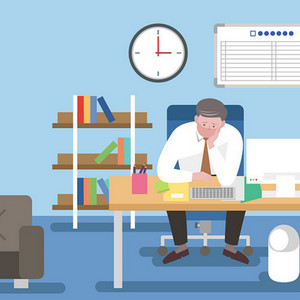
You know that weird feeling of being busy all the time but still unsure what you actually accomplished.
Or that moment when you sit down to work and somehow end up browsing before you even realize it?
You are not alone.
More and more people are realizing that the problem isn't effort, it's the loss of deep work work, and that loss is shaping not only how we work but who we become.
So i have to ask this question to both of you do you ever feel constantly busy but not necessarily productive?
I'm curious to know what you say first.
Lightning um, i think we have.
You guys are above me on the uh hierarchical, uh managerial list we're.
I'll listen to your answers first.
Sadder when it comes to having multiple tasks, having to manage everything together without a super brain.
But I agree with you.
I want to ask Liming as well.
Yes, I do.
The simplest answer is yes, I do.
But then again, I think it really depends on how you define productive.
If you ask me, do I...
Am I as productive in hosting the shows, in coming up with good contributions to a specific program?
No, I don't feel productive.
I'm not on as many shows as I used to.
So that was the simplest observation.
But then the reasons can be multifold.
Number one, I have more balls to juggle.
That's for sure.
And then number two, I'm getting older.
Nobody's getting younger.
So...
Once we're older than when this show started.
Yeah, that's true.
Right.
So that's another issue.
And then I think the role of technology really plays a part in getting us distracted.
That is definitely a multifold answer.
And I agree with him when he said we have a lot of different tasks altogether and we're not getting.
Not, we're getting wiser, but maybe not smarter and faster.
But, that being said, I do miss the feeling that I can spend hours concentrating on one show or one script, or just this product.
I can immerse myself in working in it.
I was curious, how would you define personally or professionally define deep work?
And do you think it matters these days?
Well, let's start with the definition from Cal Newport.
He's an author.
He put a book out called Deep Work Rules for Focused Success in a Distracted World.
Sounds like something I'll never read.
Anyway, what he says is that professional activities performed in a state of distraction-free concentration that push your cognitive capabilities to their limit is the pure definition of deep work.
That sounds beautiful.
It does.
It sounds poetic.
And it also sounds almost unrealistic in 2025, doesn't it?
Considering the fact that many people with their jobs are not just assigned to one particular thing.
A production line worker has one task perhaps, perhaps this is just an example one task and that task repeats itself.
One million times.
Yeah, so the opportunity to feel productive might be really easily defined, because finish one, move on to the next, finish that, move on to the next.
But with modern day workplaces, I think people have their toes or their fingers in many different activities or projects all the time.
So maybe that's where the challenge of feeling productive comes from is that you're constantly contributing to something, but that something constantly changes.
I think that definitely is a good point, but at the same time, i think if you ask anybody, they would say they miss the feeling of working on or concentrating on only one thing they miss being able to being not disrupted by maybe sometimes that is a sudden assignment that they didn't anticipate for the day, but maybe sometimes it's their very own urgent to start browsing the WeChat moment or looking at or watching short videos on the internet.
I think these are different distractions, but they all exist.
And another possibility is that while you're working, You feel like you're doing a lot of things.
But after a while you started to feel that you're not productive, in the sense that you cannot finish the things that you started.
So for for the purpose of not being lately diagnosed with this.
Is there anything that can help us to you know, find the early signs that maybe we are losing our deep work ability?
Maybe we're, you know, not doing as well as we anticipated or aimed at?
Well, there are many signs.
Number one.
If you find yourself constantly distracted for instance, in my case, often when I'm working on my desktop I sometimes ask myself that question what am I doing?
What am I up to?
That's just memory loss.
I think it's a different thing.
That's an even more serious problem.
So that's one of the signals.
Another way is to only having very simplistic or superficial thoughts, meaning you can't afford or you haven't spent enough time thinking about a question that might require you some attention, even deeper level of thinking imagine yourself reporting to your boss about a situation and all of a sudden, you get cornered by him or her about a very specific aspect of the issue, something that you should have thought about and you should have considered and come up with a solution for, but then you just missed it.
You didn't think, you didn't spend time about it, it fell through the cracks.
So another One more signal is to be constantly obsessed with giving real-time feedback.
There are examples, for instance, a chore one requires only five minutes of attention.
Chore two requires, for instance, 20 minutes of deep research and thinking.
And if you were like me, who is prone to, you know, starting everything together to cross off something from the to-do list, and you enjoy doing that, removing things, getting things done, that makes you feel productive, doesn't it right?
It does.
But then the thing is um, that may not be the most productive thing, the the greatest contribution you can make to the job that you are hired for.
There was a study.
I forget the specific number, but It was around 20 minutes, was the answer.
The question was how long does it take people to refocus after they're distracted from a piece of work or a project that they're working on?
And again, the answer was about 20 minutes.
And what that means is if I'm working on something and then Liming sends me a text message and I have to stop and I have to reply to that, or Hongling comes over to my desk and says wants to have a brief chat about something.
It might take only 30 seconds.
But to get back to that deep work takes 20 minutes of time.
Is that surprising to you?
Yes.
You think you could just So?
Do you feel like when you get distracted from something which happens almost all day, every day, right?
Particularly for you two, so many people rely on both of you.
Do you feel you can return to the task at hand with 100% focus, no problem?
No, and that's one of the major source of my anxiety and sense of frustration.
Oh, my answer is it depends on the nature of the task that you're focusing on.
If it's the simple task that only requires the kind of concentration, or it doesn't need you to be in the flow, you know the flow, then it's fine.
But I agree, for the kind of work that requires you to be in the state of mind to be able to get all the resources in your back, in the back of your head, you have to pull them out, then it takes longer.
But at the same time, we also have theory that 25 minutes focus sprints with short breaks is considered something that is most productive, meaning that if you, if the things that you're doing is possible to be broken into relatively shorter periods, then 25 minutes of real deep focus would be a ideal period that is good for your cognitive ability.
And that is why people are also encouraging others to Take 25 minutes for each task.
If the task requires you to I don't know spend 30 or 35 minutes, try to shorten it into 25 minutes and then take a short break and start another one.
So this has been a method recommended to people, to you know, solve the can no longer do deep work problem.
Any other suggestions?
I see we are moving on to the area of solutions to the problems we are facing.
Yeah.
One of my solutions to the problems is to use tools such as mind map to guide thinking.
I mean, this has been a very effective tool for me for many years.
And I found that whenever things pile up and whenever I find myself straying onto other issues, having a pen and a piece of paper and a mind map really helps me navigate the myriad of thoughts that I have to entertain in my tiny little brain.
That really helps.
I have one for Steve.
That is, you should put up a sign of deep working.
Do not interrupt unless the building is collapsing or there's a fire breaking out.
So I won't talk to you while you're deep working.
Did you take that personally before?
That was simply an example.
No, no, no.
I was just saying everybody should have a sign like that, because other people do not know whether or not you're focusing on something that important and that requires that level of concentration.
It's not fair to say nobody talks to me all the time, but it's also also not fair to sacrificing your concentration level because of the environment we're working in.
So have a sign.
I am so easily distracted that I'm not sure if I see it as a serious issue.
I understand the mind mapping tool and the idea behind really keeping yourself well organized.
But I also find somehow it charming or romantic to have things slip your mind easily and then remember a little bit later.
I'll start washing the dishes at home and then I'll notice, oh, the plants need water.
And I'll just leave the dishes and go and water the plants.
And while I'm watering the plants, I'll see some dust and, oh, I really should vacuum.
I'll stop watering the plants, which is also not completed, just like the dishes weren't completed.
I do.
And then, yeah, it's a cycle, but eventually I'll circle back to the dishes and finish them.
And that's kind of the way I work.
Sometimes not all the time, but on occasion I'll start something and then I'll kind of forget about it and start something else.
And I think this is probably true for many people.
We've just really kind of adjusted to that style of getting things done these days.
And I'm not entirely sure there's anything wrong with it.
Yeah, I think I should ask this question at the very beginning of the conversation, but let's do it now.
That is.
Do you think it's necessarily a bad thing that you cannot really quote unquote?
Concentrate on one thing and do quote unquote deep work.
Is that ability that necessary in today's day and age?
It really depends on what you do, because if we are only talking about making shows, recording them and impressing and entertaining our audience, then I think people in the creative industry they can afford to be a little scattershot in the way they organize their stuff.
But if you are working with a team and there are people down the stream waiting for you to respond, then that could be an issue.
Like a surgeon.
Scalpel.
I don't want my surgeon to be easily distracted.
Yeah, you don't want your assistant to wander off and having to wait for somebody else to pass you the scalpel.
Yeah, exactly.
Pilot, stay on task, please.
Well, I think after our conversation today, my feeling is that it's not that important.
If it does not bother you, maybe it's fine for you.
Or if it doesn't bother anyone else that Depends on you to get certain things done.
Of course, yes.
But if it does bother you a little bit, another thing that you can try.
That is not necessarily only for your work.
It's an advice that I heard recently and I was applying it and it helped me a little.
Hopefully doing constantly continue doing it would help me a lot.
That is.
Instead of trying all these methods on your work, that is, to put yourself in a relatively isolated environment, putting your headset on and put up the sign of don't talk to me, talk to the hand and concentrating on your work.
Another thing you can do is leave your cell phone at another place and go to a room and have a deep, long conversation with someone that you think are worth learning from.
That deep conversation, without the interruption from any cell phone messages and any text messages, any outside distractions, and just having a face-to-face conversation with this one person and ask about the things you want to know about this person.
That would help you find that state of deep thinking, of really concentrating on not only the conversation but, more importantly, your thoughts.
Yeah, I think, another good tip if you are that person who feels like hmm, I get distracted too easily and I go from task to task, I'd rather stay on one.
Make a list and prioritize things.
What's the most important thing that you need to get done?
That's number one on the list.
Two, three, four, five, six being the least important.
Don't move on to number two until number one is done.
Don't go to number three until number two is done.
Practice that enough times and maybe that'll just become a regular part of your routine.
Yes.
Let us know whether or not these tips help you and let us know whether it bothers you to not being able to focus or to do deep work as well as you did previously.
That brings us to the end of today's Roundtable.
Thank you so much for listening.
Anything you want to tell us, please leave a comment or send us an email to roundtablepodcast at qqcom.
I'm Miao Honglin with Steve and Lai Ming.
Thank you for listening.
Bye-bye.