McDonald's meets the Minecraft universe with one of six collectables and your choice of a Big Mac or ten piece McNuggets with spicy nether flame sauce.
Now available with a Minecraft movie meal.
At participating McDonald's for a limited time, a Minecraft movie only in theaters.
I was never really a runner.
The way I see running is a gift, especially when you have stage four cancer.
I'm Ann. I'm running the Boston Marathon presented by Bank of America.
I run for Dana -Farber Cancer Institute to give people like me a chance to thrive in life, even with cancer.
Join Bank of America in helping Anne's cause.
Give if you can at b of a dot com slash supportAnne.
What would you like the power to do?
References to charitable organizations is not an endorsement by Bank of America Corporation.
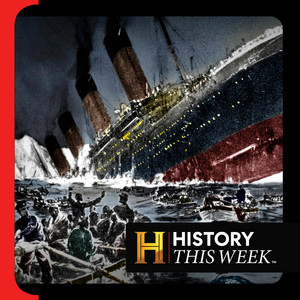
Copyright 2025. The History Channel Original Podcast. History This Week, April 10, 1912.
I'm Sally Helm. It's hard to tell the story of the Titanic from the beginning because it has such a dramatic end.
On this day, in 1912, the ship sits in her berth on the south coast of England, ready to set sail.
And picturing it, the passengers unpacking their fur coats and their hat boxes, crowds of people waving their handkerchiefs from the pier as the Titanic pulls away on her maiden voyage.
It's like you can already see the distress flares.
You picture those fur coats and those hat boxes on the ocean floor.
You almost can't help but imagine the iceberg, floating out there beyond all those waving handkerchiefs, waiting to bring this ship down.
Everything looks like a sign.
As the RMS Titanic pulls away from the crowded Southampton port, It almost crashes.
The ship is huge enough that it displaces a ton of water when it moves.
So much so that a nearby boat breaks free of its mooring cables.
A passenger reports that they snapped like a thread.
That ship drifts towards the Titanic, sucked in by its powerful propellers.
The crowds watching from the pier climb aboard railway trucks to get a better view.
The ships get within four feet of each other.
But, at the last minute, the Titanic stops its engines.
Tugboats are able to nudge the smaller ship out of the way.
A serious disaster was narrowly avoided, the newspaper reports, cheerfully the next day.
Four days later, of course, a serious disaster will not be avoided.
The Titanic's first voyage will be her last. But during her brief life, the vessel is a microcosm of the gilded world around her, a world that has important parallels to our own.
We're probably living through something fairly similar for the first time since the early 1900s.
It is a warning against the costs of human hubris.
Today, the Titanic, a technological marvel that ran into the harsh laws of nature.
How did this opulent luxury liner come to exist?
And how did it foretell the dangers of wealth, technology, and arrogance that shaped the world around it and the world we live in now?
Ryan Reynolds here from Mint Mobile.
I don't know if you knew this, but anyone can get the same premium wireless for $15 a month plan that I've been enjoying.
It's not just for celebrities, so do like I did, and have one of your assistants' assistants switch you to Mint Mobile today.
I'm told it's super easy to do at mintmobile .com slash switch. up -front payment of $45 for three -month plan, equivalent of $15 per month required.
Intro rate first three months only, then full price plan options available.
Taxes and fees extra.
Fee full terms at mintmobile .com.
This is a message from sponsor Intuit TurboTax.
Taxes was getting frustrated by your forms. Now taxes is uploading your forms with a snap and a TurboTax expert will do your taxes for you, one who's backed by the latest tech, which cross checks millions of data points for absolute accuracy, all of which makes it easy for you to get the most money back, guaranteed.
Get an expert now at TurboTax .com.
Only available with TurboTax Live Full Service, see guaranteed details at TurboTax .com slash guarantees.
The writer Gareth Russell grew up on Northern Ireland's east coast near the city of Belfast, which is the same city where the Titanic first came to be.
We sort of grew out with the shadow of the Titanic on our It was just omnipresent growing up.
Russell's great -grandpa worked in the shipyards as a kid, delivering coal.
He was alive when Russell was born, and he told stories of the Titanic, stories that helped inform Russell's recent book on the subject, The Ship of Dreams. When his great -grandfather was carting coal around Belfast, he was performing an important function.
The whole city smelled of coal.
It was an industrial center.
There were behemoths like rope factories, tobacco factories and linen factories, but the city's main industry was shipbuilding.
Which was powered by lots of young Belfast men who got hired to build for a prestigious English shipping company called White Star Lines.
Trying to one -up their corporate rivals, in 1907, White Star starts building three huge new ships, each one and a half times larger than its nearest competitor.
the length of about six modern -day commercial airplanes, as tall as an 11 -story building.
They are the Olympic, the Britannic, and the Titanic.
Tens of thousands of men are hired to help put these ships together.
It's tough work, 12 -hour days, cold, damp conditions, danger from climbing up the high scaffolding.
There's stories of quite a lot of men going deaf because of how loud it was.
Wow. From just like the sounds of clinking metal or...?
If you were assigned to hammering the rivets in, and particularly if you were underneath the ship, you were essentially in an echo chamber and you were hammering in metal on metal, day after day.
To keep time as they hammered and pass the time as they worked, they'd sing songs.
I was lucky enough to hear my great -grandfather could remember some of the songs.
But in the same way if you go into an office today, people are often playing music or whatever, because it lifts the mood.
Back in 1910, 1911, you had to make your own.
The men spend years putting these ships together.
Watching them grow from a skeleton on a gantry up into being these enormous, completed luxury liners.
Overseeing that transformation is a man named Thomas Andrews.
At the shipyard, he's in charge.
He was a meticulous genius.
You know, he could remember if a colleague beneath him, sort of in the chain of command hadn't taken the requisite number of days off.
You know, and he would write to them and say, by the way, you're still owed three days, you should really be taking this.
Andrews himself came from the upper class.
He was one of the first people in town to own his own car.
He lived in a red brick mansion with four servants.
You know, maids to light the fires, and parlour maids, and a valet and gardener.
Susie Miller leads Titanic tours around modern Belfast. She stops at Thomas Andrews' home.
It would have an orchard and a tennis court and a beautiful staircase with a lovely stained glass window at the top of it.
Miller's great -grandfather worked at the shipyard too.
He started as a carpenter and worked his way up to engineer.
As the Titanic got closer and closer to launch, he saw an opportunity.
He moved over to the White Star company so that he could work aboard the Titanic as it sailed and use its maiden voyage to immigrate to America.
According to family lore, when he needed a letter of reference to get the job, he asked Thomas Andrews.
I used to joke with the Andrews family that it's their fault, you know.
That if Mr. Andrews had written him a bad reference, he never would have got himself onto Titanic.
There are a lot of dark jokes in Belfast about this time, when the ship is getting ready to launch on its fateful voyage.
Workers who have spent years on this project are putting the finishing touches on the Titanic.
of coal has given way to new smells.
Varnish and wood shavings and freshly laid linoleum.
There's quite an interesting dark Belfast humor story about the grand staircase which is that one of the carpenters accidentally chipped and broke one of the panels.
He and a friend manage well enough to put it back together.
But they're worried someone will notice.
Like the meticulous genius Thomas Andrews, who's going around making last -minute notes.
He's not pleased with the efficiency of plumbing in the second -class lavatories.
The furniture in the Parisian cafe is the wrong shade of green.
The hat hooks in the first -class cabins are unsightly.
No notes about the grand staircase, though.
The construction worker gets away with it.
On the day when it sank, the friend who helped him cover it up said, well, don't worry, they'll never find out.
Most of the workers stay behind in Belfast when the ship heads out, but Susie Miller's great -grandfather is on board. Her family continues to pass down the coins he gave to his sons right before he left. He gave them each two 1912 pennies and said, don't spend those until we're all together again.
And then my grandfather talks about how that evening when Titanic was pulling out of Belfast Loch he was standing on the beach, and he watched as the ship sailed away out of sight.
He said he couldn't understand why everybody was cheering because for him it was a very sad day and he said that he had his two pennies clutched so tightly in his hand that the date of 1912 was nearly burnt into his pan.
The Titanic leaves Belfast on April 2 of that year.
Also onboard is Thomas Andrews.
He's going to ride along for the ship's first trip just to make sure everything goes smoothly.
He has a lot to do, what with the plumbing, the hat hooks, the Parisian café.
It's all in preparation for the passengers, who board the ship mostly in England, and set out just after noon on April 10th on their journey across the Atlantic.
The passengers are the type who might actually notice such things as unsightly hat hooks.
It's sort of who's who off the East Coast, American upper -class.
You have railway tycoons like John Thayer, Colonel John Jacob Astor IV, who belongs to the famous Astor family that owns so much of Manhattan that they're nicknamed the landlords of New York.
There's a Guggenheim onboard, a Countess heading to meet her husband to celebrate their anniversary.
There's a confidante to President Taft, some famous writers, One of the early pioneers of sci -fi.
You can't forget Dorothy Gibson.
One of, if not the highest paid movie star in the United States.
Or a famous British fashion designer, Lady Duff Gordon.
If you talk to a historian of fashion, they will always say that Lady Duff Gordon was one of the major influences responsible for ending the popularity of the corset.
There was a lot of wealth on board the Titanic.
And off it. This is the Gilded Age in the United States, the Edwardian era in England.
both marked by massive income inequality.
By the time Titanic set sail, there is growing discomfort, probably too mild a word. There is growing fear and resentment over the amount of capital that can be disposed of and utilized by the super wealthy.
White Star Line itself was owned by JP Morgan, a wealthy American banker.
Just a few years before the Titanic's launch, he'd been able to help prevent economic collapse with his own private wealth.
It's very difficult to fully appreciate just how wealthy they were.
I mean, their wealth would easily have drowned out of the wealthiest courtier at Versailles before the French Revolution.
I mean, they were just stratospherically wealthy.
And, as reflected on board the Titanic, it's not just countesses who have that kind of money.
It's also railway tycoons.
With the onset of industrialization, there has been a huge boom in new technologies and new ways to make money.
The nature of privilege is fracturing, changing, and evolving.
They are not asking for your family tree before they give you a ticket, they're asking for your check.
A first class suite aboard the Titanic could cost as much as over $100 ,000 in today's money.
Even the second -class passengers were still dropping the modern equivalent of nearly $2 ,000.
People do take it to represent haves and have -nots when in fact you know what a Titanic Third Class could cost the equivalent of second on other ships.
Right, it's like the haves and the have a little less.
Right, exactly. That's the perfect way to describe it.
Riding in second class.
There's a Haitian gentleman called Joseph Laroche.
His uncle had just been elected president of Haiti.
There's a Cambridge University graduate named Laurence Beazley.
He loved American history, and he wanted to go and see some of those places that he'd only been able to read off before.
Third -class writers on the Titanic were people like Swedish journalist August Vennerström, who'd made some enemies criticizing the monarchy and needed to emigrate.
Or a young Irish farmer, Daniel Buckley, who was moving to America to make some money.
They stayed in cabins.
Sure, on bunk beds, but not in communal dormitories the way they would have in other ships.
Still, There were very strict laws in place by US immigration at the time, that there was to be no mixing between third class and any of the other classes.
The rationale for this was that third -class passengers would be processed at Ellis Island when they disembarked and they'd be subject to a medical screening.
If first or second -class passengers associated with them, they'd be subject to that screening too.
And this was partly in response to a cholera epidemic that had happened in 1892, but it did mean that the layout of the ship was strongly designed to discourage any possibility of interaction between the classes.
That meant that if third -class passengers wanted music, they had to sing, because the band couldn't come to them.
Meanwhile, first and second -class passengers each receive a songbook listing all the pieces of music the ship's band knew, each with a number attached.
So if the band stops and says any request, you say number 34.
And we still today, this little number goes out to...
We still call songs numbers because of that tradition at sea.
First class passengers got that list of songs and also a list of their fellow passengers.
So you could see who else was on board, maybe you're on a social climbing mission and you want to accidentally bump into an astronaut.
At afternoon tea or coffee in the lounge or dinner.
The meals took up a large chunk of the day as to changing your clothes because you really weren't supposed to be in the same clothes throughout the whole day.
When they weren't eating or picking out new frocks and coats, the first -class passengers played cards or wrote letters, visited the squash courts or the Turkish baths, took bets on how many miles the ship had traveled in the past day.
Thomas Andrews is watching the ship's progress too, and schmoozing with this crowd.
Though he's not all that forthcoming.
A New York socialite later described Andrews joining them at dinner.
— He mustn't have talked about his work very much because she says, you know, he had something to do with the Titanic.
— He confides more in members of the crew.
He befriends a stewardess from Belfast and tells her how homesick he is.
He worried about his mother's health, his father's health, his wife and child back home.
One particular night, Sunday, April 14, Andrews goes to dinner in the dining room, as usual.
He was planning, perhaps, to join some of his dining companions for coffee or tea after, but the companions lingered so long over the putting course that he decides to go back to his cabin three decks up and get back to work.
Going over the blueprints, going over his journals and his notebooks to see what he wants to tackle tomorrow.
Up on the deck, it's gotten quite cold.
Some of the passengers later describe a new chill in the air.
The ship is navigating off the coast of Newfoundland, and around 11 .40 p .m., that looming iceberg finally appears.
One of the most interesting things about the moment of impact is it's so slight that a lot of first class passengers sleep through.
The Countess of Rothers says that she felt her bed lift slightly, she woke up slightly groggily and then rolled over and went back to sleep.
One passenger later notes that the vibration of the engines got duller.
Another describes a lurch and a creaking.
Andrews is in his cabin at the time, maybe wrapping up some work, maybe already asleep for the night.
The captain sends for him and says, I would like you to perform a diagnosis of the ship to see how bad the damage is.
He leaves his cabin and goes down from A deck to G deck.
That's where the luggage and mailrooms were.
I imagine the first moment when he begins to have a real internal shudder is when he sees water beginning to come into the first class luggage room.
In the mail room, he finds clerks hurriedly moving sacks of letters out of the freezing cold seawater that's streaming in.
He goes down even further to the boiler rooms. they're flooding rapidly, so he rushes back upstairs to report to the Captain.
We do know from one eye -witness the movie star Dorothy Gibson, who saw him as he came up the stairs, and she said he looked green, his face looked green.
Andrews does some quick math.
Based on the amount of water flooding in, and what he knows about the ship that he himself designed.
He tells Captain Smith that based on his calculations the Titanic had about an hour and 30 minutes to live.
The night the Titanic hits an iceberg, Captain Smith had been speeding, even though there had been repeated warnings about ice.
Gareth Russell says in his research he came across telling Smith made years before the Titanic was built.
Knowing what happens, it does strike a chill.
There are at least two occasions where he more or less says it's impossible for there to be a terrible shipwreck given modern technology.
The Titanic itself had been touted in Shipbuilder magazine as practically unsinkable.
Both Captain Smith and Thomas Andrews are said to have assured passengers that if the ship was cut into three pieces, each piece would still float.
Back in Belfast, though, among the workers who had poured years of their lives into building this ship, this sort of idea of it being unsinkable was something that never really caught on.
I mean, I think if there's a container and you fill it with enough water it'll sink.
Right, these are shipbuilders.
They would know that.
Right. You know, I think they were sort of slightly jaded to the hyperbola of the trade journals and the press that were obviously trying to sell things to people who didn't know a lot about ships.
But many of the passengers and members of the crew had bought into that idea.
And that's part of what's going to make it so hard to get them off the sinking ship.
It's just before midnight when Thomas Andrews tells the captain the Titanic is going down.
At this stage, he has done his job to inform the captain of the danger the ship is in.
Thomas Andrews was always someone who wanted to do things, who needed to be useful.
And so he starts going along the corridors checking empty rooms, encouraging sturges and stewardesses to take out blankets to put them in lifeboats to keep people warm.
But Captain Smith still hasn't told the crew how serious the collision was.
So the crew thinks no reason to alarm the passengers.
They do begin to rouse people from their cabins, telling them to dress warmly and come up to the deck.
They knew they'd hit an iceberg, But it was more or less implied that this was a precaution.
In fact... If you were to design a series of signals that communicated that there was nothing to worry about, that pretty much was what was done with first class.
The purser decides, let's open up the first class lounge.
Get inside off this freezing cold deck.
Someone said later it was like a fancy dress ball at Dante's Inferno. know, the electric heaters are put back on, the band arrives, the little bars open up so people are ordering like cocoa or brandies.
Crew members are directing women and children to the lifeboats, but without much urgency.
So many aren't all that keen to put down their cocoa's.
And really, Russell says, who can blame them?
I mean, if I was somewhere, and it was below freezing outside, and the authority figures had opened up, you know, a room base in Versailles and started an impromptu concert.
I don't know if I would necessarily feel a sense of urgency.
I think everything that was done in that early stage suffocated a sense of panic and momentum in the first -class passengers.
People are dawdling.
Some try to retrieve their jewels from the purser's safe.
John Jacob Astor decides it's better for his pregnant wife to remain comfortable in the lounge rather than be lowered 70 feet in a small wooden lifeboat into the freezing Atlantic.
He took her into the first class gymnasium and tried to calm her down and distract her by taking out his penknife and opening up a life jacket to show her the cork inside that made it buoyant.
The first lifeboat, number seven, is lowered at 12 .45 AM, about an hour after the iceberg strike.
The boat had space for 65, but held only 28.
If you look at the lifeboats that left sometimes well under half full, they were the ones that went in the early stages of the evacuation when officers were asking people to get in, and they wouldn't.
One of those who does go in that first boat is a Manhattan socialite who brought along her Pomeranian dog, Bibbe.
Another is the actress Dorothy Gibson.
She'd seen that green look on Thomas Andrews' face, and heard the rumor circulating that the first -class squash courts had flooded, and she thinks, this is serious.
She's early to that thought.
Her lifeboat is lowered at 1245 a .m. That's over an hour before the last boat is lowered, at 2 .05 a .m., just before the Titanic finally sinks.
In between, there's no one moment where everyone realizes how dire the situation is.
For some passengers, it's seeing the distress rockets fired, or seeing crew members coming up from below deck drenched.
For one, it's seeing pajama legs poking beneath the trousers of the managing director's suit because he's usually so fastidiously well -dressed.
The last people to realize how bad things have gotten are the third class passengers.
They're sequestered in their separate accommodations, below deck, while others are being evacuated.
There's a set of stairs with a waist high gate at the top, connecting the third class to the first and second class decks.
Which is where the lifeboats are.
So you have a ship that is not designed to make it easy for them to get up there, being run by people who have not been told there's any reason for them to get up there.
The young Irish farmer Daniel Buckley watches as another third -class passenger goes up that set of stairs, connecting their deck to the rest of the ship.
But a crew member who doesn't realize how bad things are sees this as a violation of those US immigration laws, the ones that require third class to be kept separate from the others.
So the crew member locks the gate at the top of those stairs.
People have to climb over it to get out until someone finally breaks it down.
This ship is not designed to help third -class passengers escape.
On top of that, there is a language barrier between the crew and many of the third -class passengers, and in the rush to launch the ship, the emergency information notices had been left behind.
In their place, empty frames hang on the back door of each cabin.
In the end, 75 % of the third -class passengers don't make it into a lifeboat.
Neither does Thomas Andrews.
Someone spots him late at night when it's becoming clear that the casualties are going to be massive.
Andrews is standing alone and bereft of the smoking room as he realized there wasn't a rescue ship near enough by.
But that is not He actually then gathered himself, went up on deck and started throwing deck chairs overboard so that people would have something to cling on to after the ship disappeared.
So this is someone who, from the moment he is called on to inspect the damage until, you know, he loses his life not long afterwards, is trying his best to do his last service to the Titanic and its people.
Lifeboats are being lowered, one every five minutes or so.
They're still not all full.
At 1 .45 a .m., John Jacob Astor does bring his pregnant wife to a lifeboat.
He asks if he can join her, but he's told no. Women and children only.
Before the night is up John Jacob Astor will be dead.
The Titanic stays lit up until a few minutes before it finally sinks.
There are very few points of firm agreement from the eyewitness testimonies, except on the noise, there is near unanimous agreement that none of them can shake the sound of the screaming.
There's a series of roars and explosions as the ship splits apart.
They're in a lifeboat watching a skyscraper sink in front of them, and after the ship disappears and there's about these few minutes of people screaming in the water.
And then the silence that settles, as hypothermia claims most of the people who had been on the Titanic at the moment it disappeared.
It is the point of similarity in the eyewitness testimonies from survivors, the screaming.
And then the silence.
The survivors, most from first -class, some from second or third, are left to drift and wait.
The Countess of Rothas, who had a few days earlier demanded a more suitable first -class cabin, now finds herself rowing a lifeboat for six hours in the dark.
She talks about this horrible moment when the sun rises after the sinking, and it shines light over these cathedrals of ice around them.
and she realizes how all encompassing the ice field is.
It fills her with despair.
But she didn't want to let anyone know that she was in despair because she thought it would break peoples' spirits in the lifeboats.
So she leads them in singalongs of hymns until the Carpathia, the rescue ship arrives.
And then the minute her feet touch the deck and her task is over, she fails.
The rescue ship pulls into New York on April 18th, but the story of the Titanic has beat it there.
It has become one of the first great mass media -covered events in history.
Journalists hired tugboats in New York Harbor to take them out in the hope that they could try to jump on board the rescue ship and get the first interviews with the survivors.
It was really a game of whispering that was going on.
Who had survived? What happened that night?
For male survivors, judgment was harsh.
How had they gotten out despite the policy of women and children first?
A rumor emerges about the fashion designer Lady Duff -Gordon and her husband.
The story is that they bribed the crew either to take them or, according to some accounts, to not go back to pick up the survivors.
Russell says the rumor is unlikely to be true.
But stories like it take on an almost mythical quality in the days and weeks after the Titanic's sinking.
It's like a sort of Aesop's fable at sea.
You can attach so many different morality lessons to the sinking of the Titanic.
About the dangers of arrogance, calling your ship unsinkable.
About how you shouldn't ignore obvious warnings and pridefully think they won't apply to you.
And about wealth and power.
People are using it as a sort of a symbol of what they see as the egregious injustices of the period.
The first -class passengers get off and the third -class passengers are left to drown.
All that new technology, high -speed ships and railroads and bridges and factories, which had brought about previously unfathomable wealth and innovation, it hadn't been enough to prevent disaster.
The sinking of the Titanic was a sort of jolt out of that confidence that technology was always going to get better.
Like it was always going to make people's lives better because of that.
And that as a result, people had less and less to fear from nature, from the world around them, because of the strength and superiority of progress.
Russell said as he was researching the story, he kept being struck by a sense of recognition.
We are, again, grappling with, you know, concerns over nature and also concerns over technology.
So it's an eternal story, and it's one that taps into a lot of concerns in 1912 and in 2022.
— For some, the Titanic grows to epitomize the end of an era.
The following year would bring about the income tax in America— rolling back some of that boundless wealth that new technology could bring.
The year after that comes World War I.
Just one battle would leave many more dead than the sinking of the Titanic.
Jack Thayer, who survived the sinking, would write that it not only made the world rub its eyes in a wait, but woke it with a start.
The Titanic was a tragedy around the world, but it was a special tragedy back in Belfast. Russell's great -grandfather remembered that when the news arrived, people broke down in the streets and wept.
The workers mourn the loss of the ship they had poured their labor into, and they mourn the people, including Thomas Andrews.
One of the things I found out was that they memorialize Thomas Andrews and other members of the shipyard staff who ended up losing their life on the Titanic.
They do it in song.
We don't have the music for it, but I find the lyrics.
So they call him a Queensland Trojan who worked the last very proudly.
are all of him here in Belfast. Our working men knew him as one of the best. He stuck to his duty and God gave him rest. Thanks for listening to History This Week.
For more moments throughout history that are also worth watching, check your local TV listings to find out what's on the History Channel today.
If you wanna get in touch, please shoot us an email at our email address.
History this week at history .com, or you can leave us a voicemail, 212 -351 -0410.
Special thanks to our guests.
Gareth Russell, author of The Ship of Dreams, The Sinking of the Titanic and the End of the Edwardian Era and, to Susie Miller.
Thanks also to Hugh Brewster, author of Gilded Lives, Fateful Voyage, the Titanic's first -class passengers and their world.
This episode was produced by Julia Press.
It was story edited by Roxandra Guidi and sound designed by Bryan Flood.
History This Week is also produced by Julie McGregor, Ben Dickstein, and me, Sallie Helm.
Our associate producer is Emma Fredericks.
Our supervising producer is Mikami Lin, and our executive producer is Jesse Katz.
Don't forget to subscribe, rate, and review History This Week wherever you get your podcasts, and we'll see you next week.