This message comes from NPR sponsor Capella University.
Interested in a quality online education?
Capella is accredited by the Higher Learning Commission.
A different future is closer than you think with Capella University.
Learn more at capella.edu.
Hollywood loves a story about a man on the run.
There's the fugitive, North by Northwest, and, all right, the running man.
The Stephen King novel was made into an Arnold Schwarzenegger movie in the 1980s, but now it's back.
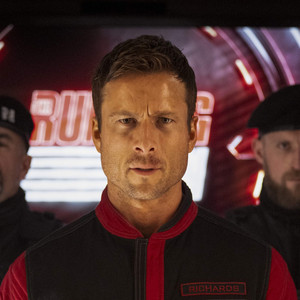
Directed by Edgar Wright, the new dystopian thriller stars the ubiquitous Glenn Powell as a man so desperate for money to care for his family that he volunteers to run for his life from professionals and amateurs, both to try to win a huge cash prize.
I'm Linda Holmes, and today we're talking about The Running Man on Pop Culture Happy Hour from NPR.
Joining me today is Ronald Young Jr.
He's the host of the film and television review podcast Leaving the Theater.
Hello, Ronald.
Hello, Linda.
And also with us is freelance music and culture journalist Rihanna Cruz.
Hi, Rihanna.
Howdy, Linda.
All right, so The Running Man is based on a 1982 Stephen King novel, one of a number of early works he originally released under the pen name Richard Bachman.
The story is set in a grim future of authoritarian rule and violent, exploitative entertainment.
A man named Ben Richards, played here by Glenn Powell, is one of many people living in poverty and despair.
Desperate to take care of his wife and young daughter, he volunteers for a TV game show called The Running Man.
The show is operated by an all-powerful corporation called The Network, and it's spearheaded by an executive named Dan Killian, played by Josh Brolin.
It sends Richards out into the world to try to survive for 30 days, while he's hunted by a group of highly skilled assassins and by his fellow citizens.
They can earn money for turning him in or even killing him themselves.
But if Ben can survive for a month, he'll win unbelievable riches.
Literally unbelievable, given that no contestant has ever made it.
Unlike the 1987 adaptation starring Arnold Schwarzenegger as the hero and Richard Dawson as the villain, this film sticks pretty close to King's original story, and director Edgar Wright brings in a cast that also includes Lee Pace.
Coleman Domingo, William H. Macy, and Michael Cera to support Powell's central performance.
The Running Man is in theaters now.
Ronald, I'm going to start with you.
I sat next to you watching this movie, so I have some sense of what you thought.
Where did you come down on Running Man?
So I only recently watched the original Running Man a few weeks ago, just to get ready for this coming out.
I think that this is better than the original Running Man.
I did not read the book.
And I imagine, if it stays closer to the book, this certainly makes me interested in the book as someone who has enjoyed Stephen King in the past.
I also think this movie has a perspective that fits better for 2025, meaning that, walking into this in a theater right now, when I walk out, I'm going to be thinking about where we are now as a society and how this film fits into that vision of society, which is important, because a lot of books and movies that were written in the 70s and 80s had a vision of the future that is attached to, a future that may or may not have happened, but this one feels a little bit more accurate.
With that being said, Most of the social justice things, most of the revolutionary aspects of this movie feel fumbled to me in a very specific way.
And the more that I think about them, the more they make me not really want to watch the film again.
But I think it's a fine movie for just going in and watching a movie, if that makes sense.
It does.
I get that.
All right, Rihanna, what did you think?
Yeah, I'm inclined to agree.
I think if you've seen the original, this version is a marked improvement.
I'll start with the good.
I loved everything about like the actual chase of the game.
I love a gameplay.
There's also some really captivating sequences in here.
There were parts of the movie where I was on the edge of my seat.
I adored nearly all of the side characters.
Shout out Coleman Domingo.
And I thought the world building was really spectacular, honestly.
I liked little details in there like fun twink cereal, the various dystopian television shows like the hamster wheel trivia competition, fake Kardashians.
Those are shows that I think could actually exist in a world of beast games.
You know that we have in 2025.
Yes.
Squid Game, the challenge.
Yes.
Yeah, exactly.
I think there's two things here that I had issue with that cast a shadow over the movie overall for me, one of which is like the ham-fisted social justice messaging.
I think that really bogs down the film, especially in the latter half.
And then second.
This might be controversial, but I think Glenn Powell shouldn't have been cast.
Frankly,
I think he's a little too damn charming to sell the anger that that the script needs, and particularly the anger that Ben Richards needs when he's not doing the action star chase thing.
He kind of loses me on the more sentimental scenes.
So...
I come very in the middle of the road on this movie, you know?
That's fair.
Yeah.
I think I liked this significantly better than both of you did.
I ultimately enjoyed this.
And I do come from a place of having read not just this book but a lot of early Stephen King slash, Richard Bachman and – really valuing in some ways the kind of grimier And as bleak as this movie is in places.
It's not as bleak as the book.
And I think one thing that happened in the Schwarzenegger movie is that they really shifted it away from that kind of bleak outlook to much more of a kind of shiny, bright lights game show approach.
I think I was probably glad enough to see that they were following the threads of the story that I do think are interesting more closely.
Some of the weaknesses in it probably didn't bother me as much.
I do think that there is something here to the way that this guy is so desperate and nobody has money and nobody has access to money and nobody has jobs that he winds up volunteering to do this.
I'm glad to see that theme coming back.
For me, Glenn Powell, I like that kid.
I will say, I don't know whether he's exactly the right person for this, but I bought him angry.
I think the moments when he's supposed to be the most angry, I believed he was angry.
I think his general kind of affability and his sort of His slickness helps to bring a little bit of leavening to kind of the middle parts of the movie where he's in disguise and stuff like that, you know, help to kind of bring a tonal balance to it, as did the appearance of Michael Cera, which I really enjoyed.
The sequence of Michael Cera.
That is much more an Edgar Wright invention than anything anything from the book, which is not surprising.
I mean, I think if you see the movie you'll be like I bet Edgar Wright is responsible for that whole Michael Cera business.
I kind of want to hear more from you guys about the stuff that you felt was kind of ham fisted and not effective.
Is it the anti-capitalist stuff?
I think that if you're going to make a film like this and you're going to be anti-capitalist, especially when you know that capitalism is the bad guy in this film, when you know that you can't stop short of naming it and turning everyone towards that being the bad guy
I felt like the ending in a lot of ways was a cop-out to that regard.
I expected to see more of an awakening, I would say, that I didn't necessarily get.
And it was kind of the same issue that I had with Good Fortune, where I think we have a good movie up to a point, but then we don't really talk about collaboration, which I think also gets kind of sidesteps in movies like this.
Because if you watch this movie again, he really didn't accomplish anything as an individual.
Everything he accomplished was with help from someone else.
Yet, it still posits that as an individual, he will spark the revolution.
And as an individual, he has one singular focus of getting back to his own family.
But the movie doesn't really grapple with the idea of individual and meritocracy and what that means versus what happens when we work in collective action.
And they had an opportunity to do it here and they just didn't do it which, to me, says then maybe you shouldn't be making movies like this.
And again, this is criticism of the ideas that are written in this movie more than it is of the execution of the movie which again, everything y'all said that's good about the movie, I think, works.
But when I think about anger and I think about Glenn Powell, the affability and the likability makes it harder to sell everything that I'm saying that this movie shouldn't be selling.
So I would have liked someone to be a little bit angrier in this.
I agree.
I mean, I think that is part of why the messaging didn't really land for me, because I don't trust it coming from Glenn Powell.
Michael Cera is this revolutionary character in the movie.
We see that, you Right.
Yeah.
And I do think another aspect of it is perhaps that, like this year, from a lot of like big budget directors, we've seen the same messages played out.
You know, I'm thinking of one battle after another.
And that I think.
The long walk.
Exactly.
The long walk. does these messages so effectively.
These pro-revolutionary messages are put forward through the film in such an effective and moving fashion that I think anything else I watched this year that has the same tone is not going to land as well.
And I think when I was watching The Running Man I was like okay, we're gesturing at something worthwhile here in what you're trying to say.
And granted, it's like focusing on the news and the media and propaganda and things like that.
And I think they make some good points, but I think They just stopped short of fully realizing the ideas that they set out to establish.
I think a perfect encapsulation of this is the fat person running on a hamster wheel game.
That was my favorite part of the movie.
I feel like I've seen that before.
Yeah.
Yes.
Well, it's in Black Mirror.
It's in that episode where you have this disdain towards fat people specifically.
And I remember watching it here, outside of it happening and us knowing that something like this could probably happen.
I'm looking at you, the biggest loser, Celebrity Fit Club.
We know that stuff like this has happened, but they kind of point to it and say- wow, that's wild.
And then it's never kind of like addressed specifically again, like fat phobia is not really addressed.
And then I think race is kind of absent from the film in a significant way, meaning that there are black people, but I want to know what they think about being black in this situation.
And so I feel like if you present an idea point at it and say man, this is kind of wild, but then you don't actually grapple with it more or have a point there.
To me it ends up landing kind of like civil war where they're just like civil war.
Would be crazy if it happened in this country.
Right.
But then you don't actually like talk about the size or what that means or what's actually at cost.
And I think that's where I kind of struggle the most here.
Yeah, I think, in some ways, the ending that both of you are advocating for is the ending of the book, which has a really different When you told me it, Linda.
Yes, I agree with you.
It has a really different relationship between kind of the gravity of the circumstances and It's a very weird comparison but it tends to happen both in Stephen King books and with John Grisham books is that when they get adapted for film and television, those are both writers who often write about some kind of sacrifice to do the right thing.
And very often what happens is Whatever's going to happen to the person.
That's bad gets softened for the film, because what people expect from a film ending is something a little bit neater.
The endings are a little harder in the books than they are in.
What you tend to get out of a film adaptation, especially in this one.
I think there was definitely, I think a moment of truth about are we going to do this ending or aren't we going to do this ending.
Probably for me as somebody who processed the whole story through the lens of knowing that Ending and like being familiar with it.
It's almost like, even if it doesn't happen, my brain fills it in, you know, and sort of still processes that as part of the story.
If there's a certain like hollowness to the narrative that they're trying to put together, I'm probably still like reading in some of my understanding of the original story.
For me.
I'm wondering if that accounts for my relatively soft touch about the fact that ultimately, you're never going to get a truly anti-capitalist film made in this system at this scale.
I think that's probably true.
The only thing I'd say is then don't pantomime it.
It feels like they're like they're like pointing to something.
And to be clear, again, just as a regular movie walking in in the fall, it's November.
It's cold.
You want to go inside, be warm and enjoy a movie.
You will enjoy this movie.
Yeah, I think Rihanna got it right in their take that like the movie is really fun as a chase movie.
And I do want to say I firmly agree.
There's like a chase and a kind of a flop house that I thought was super fun.
The sort of final sequence which and they show this in the trailer, but the final sequence which involves a plane,
Yes.
Is I think really fun and well done.
And there are some of those, like when you've seen the way Edgar Wright manipulates like action sequences.
There are a few action sequences where I just thought this is just him having so much fun with how he likes to shoot, chasing and and action and jumping and running.
And i do think that what i most wanted, not in the philosophical stuff, but just as a movie experience listen, it's the running man.
Let's have him like run a lot, you know, like let's hit the gas, let's not pause for a lot of slow stuff in the middle.
I thought they did a pretty good job of that.
It's a better like action hang than it is a sociological statement.
Yeah, I think like what it really comes down to is a corniness problem.
I think the first half of the movie, you know, it's establishing the stakes.
It's establishing the gameplay.
And I was locked in.
You know, and I think the second half for me it begins to drag when you introduce all of this messaging.
And I think it's inherent to the story.
You have to address it at some point.
But at the end of the movie, I was kind of just sitting there and I was like...
It feels like a deflated balloon.
But at the end I was like OK, like I feel kind of let down by the inevitable endpoint of what they're trying to set up.
And I know the ending of the book.
And I think that would have been a much better way to end, as we've been talking about, and kind of tie up all these knots.
But.
There were a lot of points in this movie where I was sitting there and I looked at my partner and I was like damn, that's kind of corny huh.
Well, it's interesting to me, too, because I agree that the movie drags in the last third.
The reason I think it drags in the last third is not the messaging.
The reason I think it drags in the last third is that I also think the book drags at exactly the same point, which is where he picks up this woman and starts like kind of toting her around.
She's played here by Amelia Jones, who was in Coda, an actress that I like.
She sort of becomes somebody who's kind of involuntarily taken along with him as he's running.
And I thought the same thing in the book.
I was like, this character's boring.
They don't know what they're doing with this character.
This is the part that I would have just lost the whole thing.
I don't think you need it.
I would love...
Yes, Linda.
Yes.
What is happening?
You know, when you're moving from these characters who are played by, there's Coleman Domingo.
He's fun.
There's William H. Macy, he's fun.
There's Michael Cera, he's fun.
And then you get this woman and she's kind of a wet noodle.
Kind of a drag.
Yeah.
She has a function, but I think that's my weak point in the script.
I think it appears corny, because it's forced, because they don't support it with other stuff that I suspect was supposed to be in there.
And if you take out the foundation of a relationship like that and you just keep in the emotional moments, then the emotional moments feel forced and they're much more likely to feel corny.
So yeah, I think that character didn't like her in the book, didn't like her in the movie.
No redemption.
I think she's supposed to be a foil for moderate thinking.
I think so.
But again, it wasn't overt enough for me to say that.
Because there's several times in this film where you're like this could mean this, this could mean this.
But if you're not writing it with intention to mean that, then it could come off messy and looking half-baked in a lot of ways.
Yeah, I definitely think you know you guys have made some good points about some reservations that you have.
Also, I think we all think that it's often a good time.
So, you know, a mixed bag.
Tell us what you think about The Running Man.
Find us on Facebook at facebookcom slash pchh.
And on Letterboxd at letterboxdcom slash nprpopculture.
We'll have a link in our episode description.
Up next, what's making us happy this week?
This message comes from AT&T.
America's first network is also its fastest and most reliable.
Based on RootMetrics, United States Root Score Report 1H2025, tested with best commercially available smartphones on three national mobile networks across all available network types.
Your experiences may vary.
RootMetrics rankings are not an endorsement of AT&T.
When you compare, there's no comparison.
AT&T.
This message comes from Dell Technologies.
It's time for Black Friday, Dell Technology's biggest sale of the year for gift-worthy accessories and select PCs like the Dell 16 Plus featuring Intel Core Ultra processors.
Shop now at dell.com slash deals.
This message comes from NPR sponsor Adobe.
Introducing the all new Adobe Acrobat Studio, now with AI powered PDF spaces.
Need to turn 100 pages of market research into five insights with a click?
Templates for a sales proposal that'll close that deal?
Or an AI specialist to tailor the tone of your market report?
You can do all that with the all new Adobe Acrobat Studio.
Learn more at adobe.com slash do that with Acrobat.
Support for NPR and the following message come from Warby Parker, the one-stop shop for all your vision needs.
They offer expertly crafted prescription eyewear, plus contacts, eye exams, and more.
For everything you need to see, visit your nearest Warby Parker store or head to warbyparker.com.
Support for this podcast and the following message come from Lisa.
Lisa isn't just about sleep.
It's about impact.
They donate thousands of mattresses each year to those in need, while also partnering with organizations like Clean Hub to help remove harmful plastic waste from oceans.
Visit Lisa.com for 25% off mattresses, plus get an extra $50 off with promo code NPR.
That's L-E-E-S-A.com, promo code NPR.
Now it's time for our favorite segment of this week and every week.
What's making us happy this week?
Ronald Young Jr., what is making you happy this week?
There is a show on Netflix called Physical 100.
I love Physical 100.
On theme, really on theme today.
Yes.
I love Physical 100.
I've watched two seasons of that show and I was so excited.
And all of a sudden I'm just randomly clicking around Netflix and I see a show called Physical Asia.
And I remember looking at it and being like, now I know this ain't what I think it is.
And I opened it, and sure enough, because the first two seasons were all Korean, focus of Korean athletes, with a smattering of other nationalities in there.
Whereas this one is straight up the Olympics for physical, the game.
For those that don't know physical, it's about a bunch of different athletes with all different body types coming together.
They're faced with all these different challenges.
There's some reality show gameplay.
But what makes this very interesting is that Again, there's eight different teams and they've all optimized their team for the country.
So there's a Korean team.
There's a Japanese team.
There's a Mongolian team.
There's a Thailand team.
All of them there going against each other.
I love the series, the first two seasons.
I think sometimes they're a little overdramatic and the editing can stretch things that don't need to be stretched.
Oh, you do, you think?
Yeah.
But overall, this is an easy show to watch.
Thank me later.
Physical Asia, which is now available on Netflix, but also the first two seasons of Physical 100.
Love it.
Love that show.
Love the fact that they put in all kinds of different challenges.
You got to be lithe.
You got to be – sometimes you got to be big.
Sometimes you got to be – flexible.
Sometimes you got to have balance.
I love that.
I love that show.
What a great pick.
Thank you very much, Ronald.
Yes, no problem.
All right.
Rihanna Cruz, what is making you happy this week?
All right.
So it's end of the year list season in music land.
And I've been thinking and pondering about the records that have sat well with me this year.
And, I think, the number one grower on me this year.
It might be sacrilege, you know I live in Los Angeles, but it's the Drake Party Next Door.
Record Some Sexy Songs For You.
How dare you?
I know, I know.
It's an interesting pick.
It's 21 songs.
It's an hour, 13 minutes.
There's songs on this record.
I'm thinking like CN Tower.
I'm thinking something about you.
They have melodies and lines that kind of burrow their way into your brain.
I didn't expect... to like it so much.
But now I'm at a point where I'm like, this might be one of my favorite records of the year.
And I find it quite surprising.
You know, it's like my taste surprises me sometimes.
You know what, Rihanna?
We talk about everyday bravery.
This is the most courageous thing I've ever heard anyone do on this show.
Yeah, I know.
You're standing for Drake.
I hate it, but I respect it.
I hate to say it.
This is out of line with my character, but I do want to say that Broken Clock is right twice a day.
Twice a day.
Some sexy songs for you is one of those times.
I got to tell you, you must check it out.
There's some funny songs on here, but there's also some of the best melodies that I have heard this entire 2025.
I support it.
Absolutely love it.
I love this for you.
Thank you very much, Rihanna.
You're welcome.
Talks about the fact that in 2016, he was hired for, like it was the age of like awkwardly named news startups going to be sort of like the Huffington Post.
And it was started by this guy who was, you know, talked about coming from a coal industry.
And so he was incredibly wealthy and he hired people, including this host, who's a journalist, and hired all these people.
And it became clear that there was no money and they were never going to get paid.
And they never got paid.
And it was a complete scam and he disappeared.
But later they discover that he's put together a whole new thing, which is that he's running like a catering company.
He's working on weddings.
And it turns out that he's scamming a bunch of people out of their wedding money.
So this is when he becomes the wedding scammer.
What I loved about this show, what I find fascinating about it is it is the most interesting example of like what happens when you are really trying to make a scammer story more than it is.
You know, it's all shades of gray.
Like, I don't know if this guy is really a bad guy.
And like even after being scammed by him, this host is still trying to figure out how.
Maybe he's just like a very interesting person.
And this podcast, the original run of episodes is a couple years old, but there was a recent update.
That I, as a person who listened to that show with that in mind, found immensely satisfying.
And I'm not saying this to be mean to the dude, because the dude got scammed and I feel bad for him and bad for everybody.
Obviously, all the journalists who got scammed.
But I got to tell you, sometimes a scammer is not a fascinating person.
Sometimes the scammer is just a crook.
The whole journey is so satisfying.
So again, it's called The Wedding Scammer.
I absolutely recommend it.
It was what made me happy this week.
I listened to it on a road trip.
Absolutely appreciated its company, so very, very much that it is indeed what is making me happy this week.
If you want links for what we recommended, plus some more recommendations, sign up for our newsletter.
It's at npr.org slash pop culture newsletter.
And that brings us to the end of our show.
Ronald Young Jr., Rihanna Cruz.
Thank you so much for being here.
Thanks for having me.
Thanks for having us.
Thanks for having us.
Yeah, I mean listen, if you want to just be glad I had you.
You know buddy, what are you going to do anyway.
Marietta made me look bad.
No, not at all.
Not at all.
This episode is produced by Liz Metzger, Carly Rubin and Mike Katzeff, and it was edited by our showrunner, Jessica Rady.
Hello, Come In provides our theme music.
Thank you for listening to Pop Culture Happy Hour from NPR.
I'm Linda Holmes, and we'll see you all next week.
This message comes from Carvana.
Buy a car 100% online at carvana.com with financing to fit your budget.
Enjoy 7 days to return if it's not a fit.
Limitations and exclusions may apply.
This message comes from NetSuite.
What does the future hold for business?
Can someone invent a crystal ball?
Until then, over 42000 businesses have future-proofed their business with NetSuite by Oracle, the number one cloud ERP, bringing accounting, financial management, inventory and HR into one platform.
With real-time insights and forecasting, you're able to peer into the future and seize new opportunities.
Download the CFO's Guide to AI and Machine Learning for free at netsuite.com slash story.
This message comes from NPR sponsor Rosetta Stone, an expert in language learning for 30 years.
Right now, NPR listeners can get Rosetta Stone's lifetime membership to 25 different languages for 50 off.
Learn more at rosettastone.com slash NPR.