This is Planet Money from NPR.
About a year ago, Larissa Vargas was sitting at her desk at the headquarters of the largest bank in Honduras.
She was watching this flow of money come in from overseas, and it was picking up.
It was gradual.
It was gradual.
Then over the next weeks, then months, that flow of money from overseas into Honduras continued to intensify.
She was like, what is going on here?
She was surprised.
I mean, this keeps going.
Larissa works at Banco Ficosa.
She is the remittance manager.
She's been working in that department for 20 years.
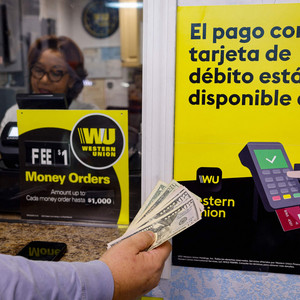
She handles the more than a billion dollars that come into bank accounts from other countries, mostly the US, through all kinds of channels like Western Union and MoneyGram.
In her years at the bank, she's seen some changes.
Like as more Hondurans have moved to the United States, remittances have grown a lot.
As technology has gotten better, it's gotten easier to send money across borders and to track it.
What has been happening this year?
Well, this year, actually, it's been quite the year.
We have had a growth of 26% increase. which is not typical.
So that's a lot, Erica.
I mean... 26% growth in remittances since last year.
Whew!
It's definitely been a rowdy year.
Remittances, in case you're not familiar, are the money people who have migrated to another country send back to their countries of origin.
They work, send some of what they earn back to support their families or maybe to build a house or open a business back in their hometowns.
Migrants abroad tend to send remittances on a regular basis, like every couple weeks or every month.
So the change that Larissa first noticed last fall in the amount of dollars people were sending monthly.
It was pretty small at first.
Like, for example, you know, there was like 280.
It was the average, you know, amount.
And now we were seeing 290, 300.
So we were like, oh, okay.
That change, that was the first clue that something big was happening.
Then in like January, she started to see much bigger deposits.
I think they're sending all like their life savings too.
How did you notice it?
Yeah, we've seen, like you know, remittances for 7000 10000, that we know that they're not very common.
And so when you're seeing inflows of 7000 10000, you know that they're sending way more money and that they definitely had it saved up somewhere else.
Were you like, why is there so much money coming in?
Yeah, definitely.
I mean, yeah, no, you know, we have... constant communication with our remittance companies.
And so, you know, we're like, hey, are you guys seeing this on your end?
What do you think is happening?
And Larissa in her office at the bank in Tegucigalpa, and her colleagues at the money transfer offices weren't the only ones noticing this.
Everybody wants a little piece of, you know, the remnants here, at least here in Honduras, because it's such an important part in our economy.
So yeah, she says it seems like every business she sees is trying to get in on some of that remittance action.
Like, hey, come pick up your remittances here.
We'll cash it out for you.
And of course, we'll collect the transaction fee and you'll spend some of the money you receive at our business.
So like supermarkets are saying, come in and get your remittance and use it toward your groceries.
Or a bank is like, deposit your remittances with us and we'll put you in a raffle for a new car.
Come and claim your remittance and you can win a medical checkup.
A medical checkup?
Yeah.
Yeah, yeah, yeah.
Like you see different things.
Yeah, different, different than what we normally would have seen in prior years.
And this isn't just happening in Honduras.
The same sudden surge of remittances is showing up in places like El Salvador Guatemala Nicaragua Haiti, Ecuador.
Do you feel kind of like a detective in all of this?
Oh, yeah, definitely.
I mean, I feel like a detective because I have to, you know, start asking questions to everybody.
And everybody's like, we don't know.
And like, there's a lot of theories and but really nobody has the answers.
It's a remittance mystery.
Hello and welcome to Planet Money.
I'm Erika Barris.
And I'm Greg Rosalski.
The US has been, for decades, the single biggest source of remittances in the world.
But we are in the middle of a big, loud and very public crackdown on immigrants who are here without legal papers.
And the number of immigrants coming to the U.S. has plummeted.
And yet Larissa Vargas she's seeing all this new money flowing into accounts at her bank in Honduras.
Today on the show, the remittance mystery.
We try to figure out why remittances are surging in some countries, but not others.
And we learn why the surge in money inspires joy, but also fear.
This message comes from BetterHelp as a dad.
BetterHelp president Fernando Madeira, relates to needing flexibility when it comes to scheduling therapy.
I have kids under 18, so time is very limited.
That's why, at BetterHelp, our therapists try to have sessions, sometimes at night, depending on the therapist, or during the weekend.
I think that's what we need to tell the parents.
You're not alone.
We can help you out.
If a flexible schedule would help you visit BetterHelpcom.
Slash NPR for 10 off your first month of online therapy.
So people who have come to the US from a handful of countries, especially from Central America, they've been sending more money back to their countries of origin.
And it's a bit of a puzzle because you might think the opposite would be the case, that right now they'd be sending less.
For lots of reasons.
Like for one, maybe they don't have extra money right now.
We heard it from Central American immigrants who told us themselves, like a Honduran man in California who's been in the country for about 20 years.
I talked to him while he was at home writing up estimates for upcoming jobs.
He said, OK, he could take a break to talk.
By the way, he asked us not to use his full name because he doesn't have legal status and he fears he'll get deported.
All the migrants we spoke to for the story asked for that anonymity, so we're calling them by their first initials.
H told us he used to send money home every month, but not this year.
He says the economy for him has been a little ugly recently.
He does construction for a living.
He says he fixes houses and builds houses, but recently he's had more trouble getting enough work.
So he and his wife and their four-year-old son are living on what he makes.
They haven't had money to save or to send home.
Instead, they've been trying to cut costs, like canceling some streaming services.
H is trying to save money on groceries.
He's buying fewer toys and clothes for his son.
And there's another reason immigrants right now might have less money to send home.
Some are afraid to go to work because of ICE, as in Immigration and Customs Enforcement.
Over the summer, Congress approved a threefold increase to ICE's annual spending budget.
In a press release this week, the Department of Homeland Security said more than 527000 people have been deported so far this year.
And there's sort of a shock and awe to the way ICE is operating that's creating intense fear.
Masked agents are making aggressive and sometimes violent arrests.
And there are videos of those arrests all over social media.
Elle, a woman from El Salvador who lives in New Jersey, has seen them.
You feel a lot of incertidumbre, uncertainty, she says.
The truth is, Elle told us, when you leave your house to go to work, you don't know if you'll make it home.
Another woman from Guatemala in Pennsylvania told us she's actually been taking on less work, only cleaning houses for tried and true clients, because she's scared of working for strangers and ending up detained.
Many businesses are reporting their employees aren't showing up to work.
The Federal Reserve recently cited immigration policies as a potential cause of labor shortages, particularly in industries migrants tend to work in.
So yes, there are some intuitive reasons to think that remittances would be going down.
And yet what Honduras and Guatemala and El Salvador and other countries are seeing is this increase in the amount of money immigrants are managing to send back to their countries, which surprised a remittance researcher named Manuel Orozco as much as it did Larissa and her colleagues at Honduras' biggest bank.
Yes.
I mean, I didn't expect it, because what I was expecting is rather a contraction of in the amount sent, given the increase in deportations.
Manuel researches, migration and remittances at a think tank in DC called the Inter-American Dialogue.
He's been studying remittances for decades. testified about them before Congress.
He even helped write a federal rule that protected people sending remittances from unfair fees and fraud.
Is it safe to say that you are like Mr. Remittance?
That's what people say.
It is?
Do people actually call you Mr. Remittance?
Don't put that.
They used to call me the Remittance Rockstars.
You know I talked him into letting us use that.
Yeah.
When Manuel started seeing remittance rates go higher and higher in some countries, he also started investigating.
The increase at this level of more than 20%, it's...
I've been monitoring data systematically month to month since 2002, basically.
And I haven't seen such an increase.
Now the usual cause of a bump in remittances is there are more migrants entering the US.
But Manuel knew migration to the US from Honduras and other nearby countries is down.
So he started calling people he knew at central banks in Central America.
So if no migration was happening, how would you explain the increase?
Another cause of more remittances can be a booming economy or surging wages.
But Manuel wasn't seeing that in the data either.
Now, it is easier to send money than it has ever been before.
A couple decades ago, if you were sending money, you had to physically go into a money transfer place like a Western Union storefront.
You would give them your cash or have them cash a check and They wire the money for a fee.
Now you still have to pay a fee to send money, but you can do it all through your phone.
Elle, the woman from El Salvador, told us she uses a popular app called Remitly.
She says you just enter your name, your address, your phone number and bank account.
Passport number.
And just like that, she can send money to support her kids in El Salvador.
But that ease of sending money, it's come pretty gradually.
It's not something that's brand new.
So it also can't be the root cause of this sudden upswing in remittances.
So, okay, you cannot explain the surge by how easy it's become to send money.
You can't point to more migrants coming to the US because over the past year fewer have been coming.
And Manuel says you can't explain it by a booming labor market.
But there are some big changes we've seen over the past year that people told us might be driving this uptick in remittances.
First, a less obvious one, a new remittance tax.
Earlier this year, the Trump administration proposed a 5% tax on remittances.
Congress ultimately opted for a 1 tax on some international transfers and that's set to take effect in January.
Some of our sources say some immigrants might be trying to transfer their cash before the new tax kicks in.
Now, there's another big change that is likely driving migrants to send more money.
And everyone we spoke to really stressed this factor.
It's a growing fear of deportation.
The same fear that has driven some people to stay home from work might also be driving immigrants to send more money to their origin countries.
Here's Manuel again.
Now it's the fear of deportation that is triggering people to send as much as they can in case they are deported.
So it's sort of a precaution.
H, the construction worker who has been trying to save money this year.
He told us yeah, fear of ICE is driving a lot of decisions he's making these days.
Like, no way will he fly to Vegas for a fun weekend like he used to.
He doesn't want to put himself at risk, find himself in the hands of an ICE agent.
I asked him, were you worried about that before?
No, no.
He said he did not have that worry before.
But now he says he's afraid to even set foot in an airport.
And that same fear, he says, is also leading him to start planning for a future back in Honduras.
He says he and his wife are talking about how to prepare, how they can send money back to Honduras.
He told me he'd like to have a house there and some savings, because it's so difficult to find work in Honduras.
H is not yet part of the big uptick in remittances but he plans to be as soon as he can pull more money together.
Ideally, he said he and his wife would start sending around $500 a month.
And just this week, he said he started looking at how to open up a bank account there.
He's trying to figure out which bank is the best, which one he can trust.
That hope he has to send money to a savings account, not just transfer it to family or friends.
That's been one of the most surprising trends Larissa has seen emerging on her computer screen back at Banco Ficosa.
She says she and her colleagues have all been talking about it.
Like, hey, look, the banking accounts are growing.
In the past.
Larissa says when remittances came into the country they mostly went to relatives so they could pay for groceries and new shoes and dental care.
But this year, she's seen a notable shift as to where the money is going.
Like those $7,000 or $10,000 money transfers she's been seeing come in?
Instead of going to family, more of that money has been going directly to savings accounts.
That's another clue that led us on to what was happening.
We determined that they're sending more of their savings because of the fear of being deported.
We've heard this theory from people in the US and Honduras that migrants are sending more money than usual because they're scared of ice.
But fear can't fully explain the whole picture, because remittances are only surging to some countries and very notably not to Mexico.
Mexico is actually the number one destination for remittances from the US, and their remittances have actually been falling in recent months.
Our remittance rock star Manuel, he's done the math to try to explain this.
First of all, Mexican immigrants on average have been in the US much longer than immigrants from Central America.
And Manuel says that means they're less likely to be sending large chunks of their paychecks back to Mexico.
The longer you are living in the United States, the less likely you will be to continue sending money.
Because there is a life cycle in the number of years sending money, and that's 30 years and that's the top.
Mexicans have been on average over 25 years in the United States.
For remittances to Mexico to keep growing, more immigrants need to come in and replenish the remittance funnel.
But immigration to the US is falling.
Meanwhile, he says, many of the Mexican immigrants who did arrive more recently came through guest worker programs and are here legally.
So maybe they're less scared of being deported and they're not racing to send money back to Mexico.
The picture is different for immigrants from Central America.
They are more likely to have been here for a shorter time.
Many came after 2018.
And Manuel says many of them have more tenuous legal status.
They may have come here illegally or, some of them, with temporary protected status, which has allowed migrants from certain countries to stay in the US temporarily after major disasters or political unrest in their countries.
But now the Trump administration has removed that status for some countries and scheduled an end for others.
So yeah, it makes sense why many Central Americans would be fearful about their future in America and send more money back to their countries of origin.
Manuel says, even if they're just sending 60 extra dollars every few weeks for Honduras, it adds up to a lot.
It means an increase in GDP and economic activity.
There's increased consumption.
For people who run these countries' finances, for the moment, it's good news.
What is the reaction from the central banks in El Salvador and Nicaragua and Guatemala and Honduras?
Well, the reaction was sort of celebratory.
The people receiving remittances are spending more.
They're buying more shoes, more meat.
It's great for the economy.
And local banks and businesses all over Central America are doing everything they can to seize the moment.
You see it on the streets with the advertisements of where to collect the remittances signs of companies like Western Union MoneyGram Remitly, etc.
In bank agencies.
In one ad for a bank that's trying to get people to deposit remittances.
There you see two women gossiping about someone who got liposuction with her remittance money.
But these ladies are talking about where they should save their remittance money.
And a savings account.
There's just one big problem with this remittance frenzy.
One asterisk to all this celebration.
And it's that all this money coming in now, it's very likely a temporary blip.
Remittances are very likely to decline and maybe decline substantially in the near future.
And that, Manuel says, will be a major challenge for a country like Honduras.
If there is no growth in remittances next year, your economic activity in the entire country is going to be affected.
That seems very dangerous for an economy.
It's always dangerous to be dependent on one commodity.
When we come back, we hear just how important remittances are to the Honduran economy.
In this year, 2025, the remittances is almost 25% of GDP.
So high.
That is so high.
It's so high, yes, yes.
And what could happen if the Remittance River becomes a creek?
This message comes from NPR sponsor, US Bank.
With US Bank Business Essentials, you get more than just a bank.
You get a dedicated partner that provides you a powerful combo of checking and card payment processing with quick access to the money you've earned, proving that there is nothing as powerful as the power of us.
Visit usbank.com today to learn more.
Member FDIC.
Copyright 2025 US Bank.
You can automate millions of repetitive tasks in every corner of your business.
IT, HR, and more. so your people can focus on the work that they want to do.
That's putting AI agents to work for people.
It's your turn.
Get started at servicenow.com slash AI dash agents.
This message comes from NPR sponsor Adobe.
Introducing the all new Adobe Acrobat Studio, now with AI powered PDF spaces.
Need to turn 100 pages of market research into five insights with a click?
Templates for a sales proposal that'll close that deal.
Or an AI specialist to tailor the tone of your market report.
You can do all that with the all-new Adobe Acrobat Studio.
Learn more at adobe.com slash do that with Acrobat.
As of September of this year, Honduras had already received almost as much in remittances as it did all last year almost 10 billion.
Even before the most recent surge, remittances were around a quarter of the nation's GDP.
To give you a sense of just how big that is.
In the US, for example, the entire construction industry is less than 5 of our GDP.
Remittances are just like a huge deal in Honduras.
Remittances are such a huge part of the Honduran economy that if you go to the Honduran Central Bank's homepage, among the six indicators they share prominently, next to inflation and interest rates, is the grand total in dollars of remittances they've logged so far this year.
Dean Yang is an economist who has done a ton of research on remittances.
And by the way, he says his own education is actually a product of them.
He grew up in the Philippines.
His dad went to work in Hong Kong and sent money to his family so Dean and his sisters could go to school.
My dad being an international labor migrant, it was very direct in our family.
Dean was able to attend an international school in Manila.
From there he went to Harvard and now he's a professor at the University of Michigan.
And Dean's research finds that remittances do more than provide financial stability to families and lift people out of poverty.
They helped develop the economies of whole regions.
For example, Dean has looked at the effect of remittances on the development of the provinces of the Philippines.
And he's found that areas that got more remittances did way better.
We found home populations invested in education.
In addition, remittances came in and stimulated the local economy, expanding the local economy.
And two decades down the line, We find that these economies are richer, people have higher incomes and the economies have modernized.
They've transitioned more from agriculture to the modern sectors of industry and services.
But when remittances get to be too much of a nation's economy, some economists worry they can create a kind of dependency on foreign countries and even become like a resource curse.
A curse, because remittances could, for example, make citizens more complacent with their political leaders and put up with their bad decision making.
Like sure they're making bad decisions, but hey, I'm getting the economic security I need from my family member working in the United States.
Or remittances could be a curse because they open up the risks that, I don't know, spitballing here, developed nations turn against immigration and pull the economic rug from under them.
And remittances could actually be bad for a country's export sector.
One of the most negative consequences of inflows and remittances is what economists refer to as Dutch disease.
Dutch disease.
It's named after what happened to the Netherlands after they discovered natural gas around 1959.
Basically, a ton of money came pouring into the country and that pushed up the value of the country's currency.
That was bad news for exporters, like those in manufacturing, because Dutch-made goods all of a sudden became more expensive to foreigners.
And yeah, exports are really important for developing nations to grow.
So depending too much on remittances might stunt a country's macroeconomic development by making their export sector less competitive.
Either way, whether you're looking at how remittances are good for an economy or how they're potentially problematic if they suddenly disappear like poof, like one big sector of the economy gone.
That's gonna be painful.
Right now, new immigration to the United States is freezing up and more people are being deported.
So there are a lot of reasons to believe that this surge of remittances to Central America we're seeing now it's going to disappear.
One economist told me if immigration continues to slow and the deportations continue, he projects remittances could fall by 10 to 13 over the next year and a half.
In a place like Honduras, that's the equivalent of like suddenly losing 2 to 4% of your GDP.
These gloomy forecasts.
They are definitely casting a shadow over all the remittance celebrations in places like Honduras.
Economic leaders there are very worried about the future.
Hugo Noy Pino is an economist in Honduras.
He used to run the country's central bank.
Also, at one point, he was the country's finance minister.
So you are very qualified to talk money with us right now.
Yeah, in some sense.
In some sense.
Hugo is now the first vice president of the Congress in Honduras.
And when we talked he was actually in between sessions at the annual meetings of the World Bank and IMF in Washington DC.
What have you all been talking about?
Today, we have a meeting about Central America and Dominican Republic and Panama.
That meeting was in part about remittances.
The discussion that we have this morning was about you have to prepare, Because in two, three or four years the amount of remittances are going to reduce in your countries and you have to prepare the economy for this change.
And preparing is hard because his perspective is the country has depended too much on remittances.
62 of the population lives in poverty, so people most often use remittance money on their daily essential needs.
So, yes, they have helped lift people out of poverty.
But he says the government hasn't been able to foster long-term economic growth.
The problem is that in the past, there has not been the structural changes that the country needs in order to to have a path of sustainable growth.
And I would say that the remittances has helped families at the micro level but has not had a big impact in macro level, like it's an investment that gives you the base in order to have economic growth in the future years.
Hugo says, going forward the biggest challenge for Honduras.
The country needs to create more employment opportunities for all the people who might be returning from the US.
H, the construction worker from Honduras, he wants to see that kind of opportunity in Honduras, too.
And if he ends up back there, he's worried it'll be hard to find work.
H first came to the U.S. when he was 17.
Over the years, H estimates he has sent more than $60,000 back to Honduras.
And he says it's mostly gone to relatives to pay their bills.
Now he's 38 years old and he has a four-year-old kid who's an American citizen.
If ICE agents appear at his door... If ICE agents appear at his door...
If they grab him, he says, or if they go after his wife and child, it'll be a big problem.
So he's in a sort of limbo, trying to continue the life he's built here in the US while also preparing for a future in Honduras.
Thank you to everyone who has tested the Planet Money board game prototype.
Huge help.
We've already got an updated version of the game and we're going live on Zoom to talk about it and take your questions with Alon Lee of Exploding Kittens this Saturday, November 1st, at 3 pm.
Eastern.
To register, click the link in the show notes or head to planetmoneygame.com.
And if you have no idea what we're talking about, scroll back up in the feed and check out our board game episodes.
The short of it all, Planet Money is making a board game. updates to come at planetmoneygame.com.
This episode was produced by Luis Gallo with help from Sam Yellow Horse Kessler.
It was edited by Marianne McCune with fact-checking help from Sierra Juarez.
It was engineered by Patrick Murray.
Alex Goldmark is our executive producer.
Special thanks to the economist Marcelo Esteveau.
I'm Greg Rosalski.
I'm Erica Barris.
This is NPR.
Thanks for listening.