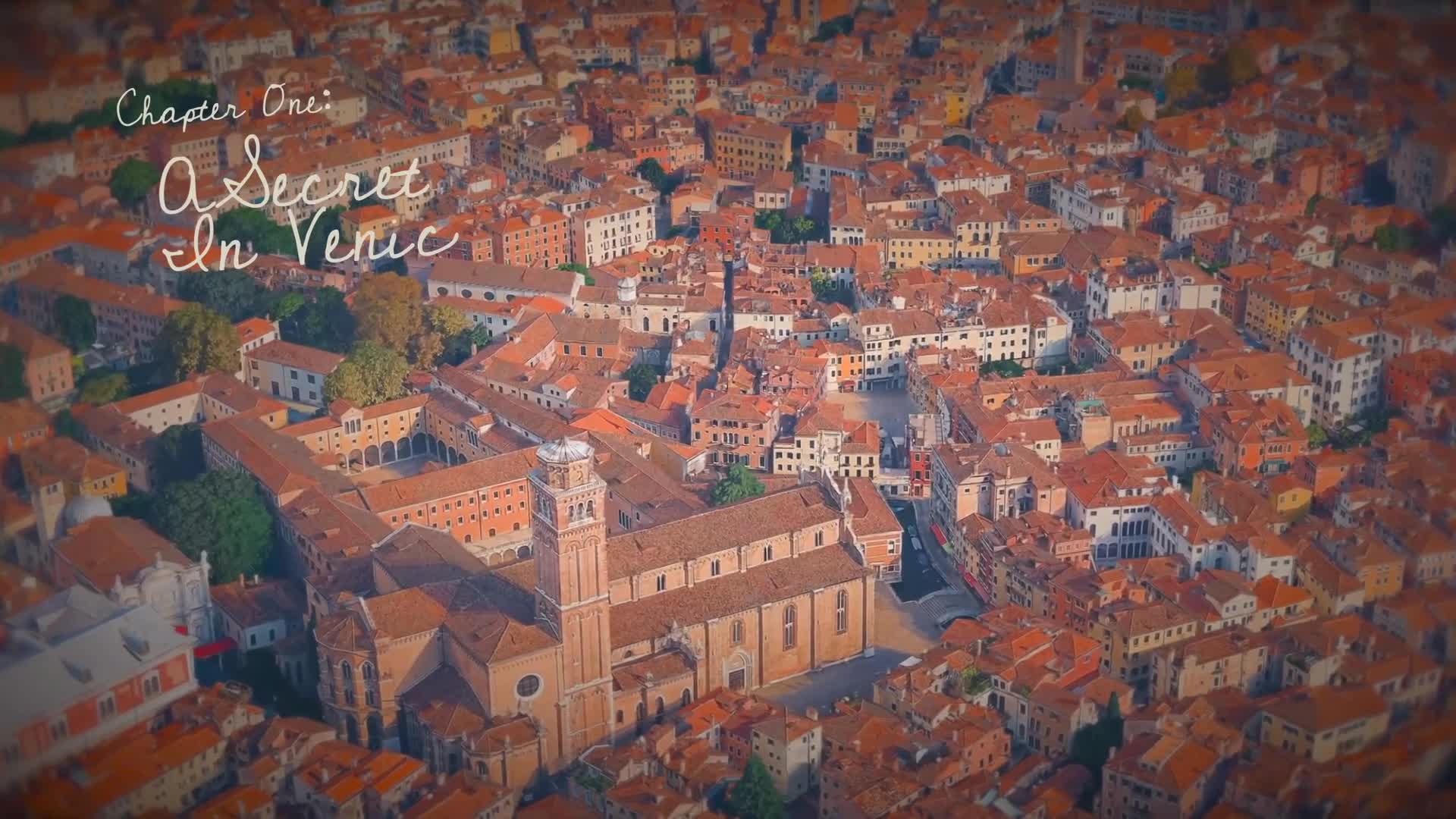
For 250 years, there was a Japanese secret hiding deep in the state archives of Venice, Italy.
A secret not a single person in Japan knew about.
A secret contained in these two letters.
They were found in 1873 during the Iwakura Embassy, a Japanese diplomatic mission that traveled through the US and Europe to study the West's political and economic systems.
You see, Japan had only recently emerged from centuries of self-imposed isolation.
Now it wanted to modernize, so it sent off a delegation to learn how the rest of the world was doing that.
Two years into that mission, they arrived in Venice and found something they didn't expect.
At half past nine, we boarded a boat and went to the library at the city archives.
The library contains two letters sent by Otomo of our country.
They were both written in Latin on Western paper and at the end they bore handwritten signatures written in pen.
Ambassador Iwakura bade me make copies of them, and they are appended below.
Okay, what is so important about these letters?
Well, two things.
One, their dates, and two, the person who wrote them.
In his diary, Kume Kunetake identifies that person as an emissary of this man, Otomo Surin, a Japanese feudal lord of the Bungo province in Kyushu.
That's... this region here.
In 1578, Cyrene converted to Christianity and later sponsored a mission that would send four Japanese teenagers halfway across the world to meet the Pope in Rome.
That mission came to be known as the Tensho Embassy, and it was the first ever Japanese delegation to visit Europe.
As far as Kume or anyone knew, the Tencho Embassy was the only mission from Japan to Europe before the country's recent reopening, so the letters simply had to be from them.
There was only one problem.
The dates don't match.
Now, Kume sees this 30-year discrepancy, but he doesn't really know what to make of it.
His confusion centers around the mysterious man identified in the signature he copied, a man named Hasakura Rokamon.
This Hasakura may have been one of Otomo's followers with a particularly strong faith.
Some say he was a retainer of Date Masamune of Sendai, but there seems to be some doubt as to whether Date was even in contact with the West.
I record merely what we've heard and leave the matter to the consideration of historians.
You can't blame Kume for not solving this mystery.
In 1873, there was likely no one on planet Earth who knew why Hasakura Rokeyaman was in Venice in 1615.
To understand why that is, you have to understand what was happening in Japan in the early 1600s.
Now, there are three periods of Japanese history relevant to this story.
The Sengoku period, the Edo period, and the Meiji era.
Now, I'll try to keep this brief.
The Sengoku period from 1467 to 1603 was a time of almost constant civil war between regional Japanese lords vying for dominance.
In 1600, one of those lords, Tokugawa Ieyasu, finally achieved that dominance at the famous Battle of Sekigahara, and three years later he united the country and established the Tokugawa Shogunate, which ruled Japan in a time of relative peace for over 250 years.
That's the Edo period.
Finally, in 1868, the Shogunate was overthrown in the name of the Emperor Meiji, launching Japan into a period of rapid modernization, and that period is called the Meiji Era.
Okay, now let's put the events of our story onto this timeline.
The Iwakura embassy takes place between 1871 and 1873 during the Meiji era.
That's when the letters are found.
The Tencho embassy with those four teenagers happens between 1582 and 1590, near the end of the Sengoku period, and Hasakura Rokeyaman writes his letters in 1615 and 1616 respectively, almost a decade into the Edo period.
Why did Kume know about the Tensho embassy, but not about Hasakura?
It doesn't become clear until you add one more historical period to this Japanese timeline.
In 1549, Christianity arrived in Japan with the coming of Francis Xavier, a Spanish priest and co-founder of the Jesuit Order.
Of course, the Portuguese had already been in the country for six years by then, and no doubt they were Christian, but Xavier was the first major missionary to arrive in Japan.
He inaugurated what is sometimes called Japan's Christian Century, though in reality it wasn't quite as long as that.
Since Japan in the Sengoku period, with all those warring states lacked a central authority, Christian missionaries like Xavier were able to make inroads in a number of regions, primarily southern ones, with even a handful of regional lords converting to this new faith, lords like Otomo Surin, the sponsor of the Tencho embassy.
Some of those conversions were genuine, while others, well, they were opportunistic.
A number of Japanese lords welcomed, or at least tolerated, the missionaries as a way to secure good trading relationships with Europe, particularly the Portuguese.
As is often the case, the spiritual was entwined with the economic, and both the Jesuits and the Japanese used that fact to their advantage.
A perfect example of that is the Tencho embassy.
For the Jesuits, parading baptized Japanese teenagers through the streets of Rome, showed that the mission in Japan was a fruitful one, worthy of more resources.
For Cyrene and the Japanese lords who sponsored it.
The embassy strengthened trade ties, promising more wealth and weapons.
It was a good deal while it lasted.
I said before that Tokugawa Ieyasu unified the country, but he was really the last of three great unifiers.
The first of these, Oda Nobunaga, was generally welcoming to the missionaries, but the second, Toyotomi Hideyoshi, came to distrust them and viewed the impact of their work as destabilizing to the social fabric.
In 1587, he issued an edict to expel all missionaries.
It wasn't rigorously enforced, but it was a harbinger of things to come.
In 1596, a Spanish galleon shipwrecked on the coast of Kochi and its pilot intimated to Japanese officials that Christian missionaries were a vanguard for a future military conquest.
Whether this was true or not, it was the wrong thing to say.
In response, Hideyoshi ordered 26 Catholics to be crucified on a hill in Nagasaki.
Almost all of those 26 were in fact not Jesuit, but Franciscan.
In the 1890s, this rival Catholic order launched their own mission in Japan, and they were less discreet than the Jesuits, more openly evangelical, which was a dangerous thing to be in Hideyoshi's later years.
Luckily for all the missionaries, Tokugawa Ieyasu, the third and final great unifier, was more tolerant of Christianity than his predecessor, at least for a while.
It was during this period of tolerance in 1602 that a certain Franciscan friar arrived in Japan.
His name was Luis Sotelo, and he is the first main character of our story.
In her great book on this subject, A Japanese Mission to Seventeenth-Century Rome, Catherine M Lucchesi draws a fascinating portrait of Sotelo.
Born to a prominent family in Sevilla, he studied philosophy and theology at the University of Salamanca before becoming a Franciscan priest with a passion for missionary work.
He was first sent to Manila, but longed to go to Japan, so much so that he taught himself the language while still in the Philippines, and even translated the catechism into Japanese.
Despite repeated warnings of danger and persecution, Sotelo finally made it to Japan in 1602 and in short order erected four convents in four cities.
He opened hospitals for the sick and leper colonies and made the acquaintance of powerful people, including the new shogun Tokugawa Ieyasu.
But it was a chance meeting with another Japanese lord that would change Sotelo's life forever.
In 1611, Date Masamune, remember that name from Kume's diary?
Date was in Edo, looking for a place to treat his sick European concubine, and he found Luis Sotelo's hospital.
After healing the concubine, Date and Sotelo hit it off.
Not long after Sotelo traveled to Date's domain in Oshu and preached the gospel to this powerful Japanese lord.
Up here in this northeastern province, far from the Jesuit power center in Nagasaki, Sotelo saw a great opportunity for the Franciscans the chance to establish a new diocese maybe, who knows, with himself as the bishop.
For that, however, he would need the approval of the Pope.
It's unclear how deep Date's interest in Christianity actually was, but he was certainly interested in increasing the power and influence of his domain.
One way to do that was to establish his own relationship with the European empires, particularly Sotelo's native Spain.
Perhaps a trading port to rival those in the south, perhaps one in his backyard?
You can see that the interests of these two enterprising men, though not quite the same, were aligned.
So a plan was hatched, a ship was built, a new embassy was created.
All Date Masamune needed was someone to lead this mission alongside Father Sotelo, a loyal vassal, a representative, a samurai by the name of Hasekura Rokeyama.
Hey everybody, thank you so much for watching.
This episode was brought to you by Squarespace, the all-in-one website platform for entrepreneurs to stand out and succeed online.
To get started, you can use Blueprint AI, Squarespace's AI enhanced website builder, to get a fully customized site in just a few steps, or choose from their library of professionally designed templates that are sleek and engaging.
Every website you make will be optimized for SEO, so you'll show up more often in search results.
And you can do so much within Squarespace, like creating members-only content videos blogs courses, creative work that you can monetize via one-time payments or subscriptions.
The bottom line is that Squarespace is going to make a home for your products or your work that looks and feels professional, something that will impress your customers and fans.
Head over to squarespace.com for a free trial.
And when you're ready to launch, go to squarespacecom.
Slash nerdwriter for 10 off your first purchase.
Thanks guys.
I'll see you next time.