This is Planet Money from NPR.
So Jeff, last year I stumbled across a kind of mystery that you and I have been talking a lot about.
Oh, yeah.
Alex, you have been obsessed with this.
It is about this website called Milk.com.
Actually, let's just pull it up.
Right.
So I'm going to type in Milk.com.
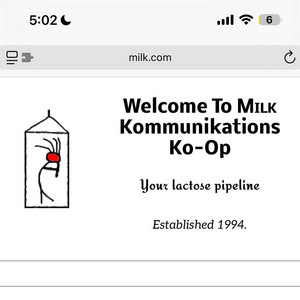
And it's pretty basic looking.
It's black and white, not many images, mostly text.
And the homepage says something about a lactose pipeline.
Yeah, apparently this is just a personal website run by a guy named Dan Bornstein.
He's got his resume up there and also a page where he puts up his favorite recipes.
Like he seems to be a fan of a dessert called cornmeal froggies.
Whatever those might be.
But my favorite part of the site is the FAQ.
Oh.
Oh, yes.
Right, right, right.
So, like, question.
Is Milk.com a commercial internet service provider?
Answer.
Moo.
Question.
How much does an ad cost on Milk.com?
Answer.
Moo.
Does Milk.com have any ties to the dairy industry whatsoever?
Answer.
Moo.
Moo.
Like you knew what was coming.
The answer to every question.
We had many questions.
The answer was always moo.
Moo all the way down.
Right.
And so the big question, the big mystery here is that this guy Dan, seems to be sitting on some pretty valuable internet real estate.
You look at other domain names like chocolate.com.
In 2019, that apparently sold for over a million dollars.
Or even bagels.com.
That sold for $500,000 last year.
Exactly.
This is why I've been so obsessed.
When I see milk.com, it feels like walking through downtown Manhattan.
There are skyscrapers everywhere, corporate headquarters here, Gucci store over there.
And then I see a little shack.
Milk.com is that shack.
What is the deal with Milk.com?
Why didn't a developer buy that shack, demolish it, and build a high-rise?
Hello and welcome to Planet Money.
I'm Jeff Guo.
And I'm Alex Mayassi.
So if chocolate.com and bagels.com are worth so much, why is milk.com just sitting there?
Why is someone using something so valuable to post his resume and favorite recipes?
Today on the show, we dive into the world of internet real estate, where investors gamble on the value of everyday words.
And we chase down the owner of Milkcom to find out in this day and age, what is a domain name actually worth?
This message comes from Capital One with the Venture X card.
Earn unlimited double miles on everything you buy.
Plus, get premium benefits at a collection of hotels when booking through Capital One Travel.
What's in your wallet?
Terms apply.
Details at CapitalOne.com. for this podcast and the following message come from Indeed.
Speed up your hiring right now with Indeed and get a 75 sponsored job credit to get your jobs more visibility at Indeedcom slash money.
Terms and conditions apply.
Hiring?
Indeed is all you need.
To understand the world of domain names, we called up Rob Schutz.
He's like a real estate agent, but for domain names.
And he says a lot of his clients are surprised at how much they can go for.
So you'll have really smart, really accomplished people who have done a lot.
And then they come into this world and they're like, I will pay $50,000 for this thing.
You're like, that's a $10 million domain name.
And they're like, what?
They're like, what are you talking about?
Rob works with companies to find the right home on the internet for their businesses.
He's helped his clients buy more than a thousand domains in the last couple years.
And Rob says if you want a premium domain name, you are going to have to pay up.
I'm not kidding.
There are massive deals that happen behind the scenes.
Voice.com sold for $30 million a few years ago.
Rocket Mortgage bought Rocket.com within the last 12 months, I think, for $16 million.
So these are incredibly valuable assets.
To be clear, most domain names are not that valuable.
You can go register one for under like a hundred bucks.
For instance, Alex, you are currently writing the Planet Money book coming out next spring.
And I just checked, planetmoneythebook.com is still available.
Okay.
Okay.
Interesting.
Okay.
But like you get the point, right?
In theory, there are an infinite number of domain names out there.
Over the years we've also created all these alternatives to the plain old com like biz and ai and even horse.
Okay, but Rob says mostly the people coming to him really want a .com.
And the really valuable .coms, they fall into two categories.
The first one, it comes from the early days of the internet.
There's keyword domain names.
So someone's like buyshoesonline.com, right?
That's something that traditionally you could build a really solid SEO presence around.
You could rank highly on for Google.
Someone types in buyshoesonline, you might show up first and you get a lot of free traffic.
Rob says a great keyword domain name can fetch like six or even seven figures these days.
But the market is changing.
Yeah, today people use the internet by opening apps or searching on Google or asking AI.
And they're not usually Googling buy shoes online.
They're just going to Nike.com.
There's a shift that has started right with the way that people are searching for things, where you're seeing less demand on keyword domains than you may have in the past.
Instead, there's now more and more demand for what are called brandable domains.
Like some of Rob's clients are new startups, so new that they might not have a name yet.
And they come to him looking for a short and memorable domain that they can build their business around.
So something you could call your company, zoom.com, you know, apple.com, oracle.com.
Those are increasing in value.
It just has to be a good word.
But there are a limited number of good words out there.
We talk about the radio test too.
Like if you set the domain on the radio and you say visit philcom.
You know, for all of your needs, visit philcom.
How's that spelled?
Is it F-I-L?
Is that P-H-I-L?
Rob says sometimes the right domain name, believe it or not, can make your company.
There is this story that people in the business like to tell.
It's about this struggling startup called DoorBot.
They went on Shark Tank, raised zero dollars.
But then, with the last of their money, they bought this super short, super premium domain name, paid a million dollars for it, made it the new name of their company.
You have probably heard of this company.
They make video doorbells.
Their website is Ring.com.
In 2018, Amazon bought Ring for nearly a billion dollars.
And, okay, how much did the Ring.com name really matter for that?
The founder of the company, at least, has said that it was a really important part of the turnaround.
And a lot of companies that Rob works with, they are looking for their own Ring.com story.
They are looking for a domain name that sounds like the name of a billion-dollar company.
Other companies come to Rob looking to upgrade their domain name.
He recently helped a banking startup called Slash.
They were using the website JoinSlash.com.
He helped them buy Slash.com.
And it can seem like unimportant.
I think if you're looking from the outside, you're like, why does that really matter?
Right.
Joint slash versus slash.
Does that really make a difference?
You talk to some founders and they think it makes a tremendous difference.
Right.
From a legitimacy, reputation standpoint.
If you have that one word dot com, you're a real company.
And, okay, maybe some of this is also just vanity.
But there is a reason beyond vanity that a company might want to drop millions of dollars on a domain name.
Yeah, in economics, the term for this is costly signaling.
It's like when you see a Super Bowl ad.
You assume that company must be pretty successful if they can pay for Super Bowl ads, you know?
Owning a super expensive domain name does the same thing.
So we asked Rob how valuable he thought Milk.com might be.
Like, is Milk.com one of those coveted, brandable domain names?
He says, yeah, it is.
It's four characters.
It's pronounceable.
It passes the radio tests.
It has positive connotation.
Rob says there could be real demand for this domain name and not just from the dairy industry.
For instance, Bread.com, it's not owned by Wonder Bread.
It was bought by a finance company.
And a word like milk has a lot of potential.
There's a million companies that use milk or just are called milk already, or Milk Street, or Milk Movement, or Milk and Honey, that like would want to consolidate down to just milk.
So there are lots of people that would want this, right?
It's just a matter of, do their budgets align with what the seller's expectations are?
Rob says he could easily see Milk.com selling for hundreds of thousands of dollars, even a million.
But instead, it's just some guy's personal website.
And the internet is actually full of examples like this.
Try going to Happy.com or TV.com.
These really premium internet addresses are just sitting vacant.
Rob is often reaching out to the owners of these valuable domain names, trying to make them an offer.
I've sent people whiskey.
I've sent Wilman flowers before.
Just trying ways to get in front of people.
I did get a response finally from this woman on name after I sent her a bouquet of flowers.
She's still not interested in selling, but she was very thankful.
Rob says that when he tracks down an owner, they usually fit into one of three categories.
Sometimes it's a big company.
For instance, Procter & Gamble has a lot of domains that it's not really doing anything with, like dry.com or cent.com.
But those big companies almost never sell.
Sometimes it's a random individual or a small business who might be interested in selling, or they might be too emotionally attached.
And then you have domain investors people who buy domain names so they can resell them for a profit.
We called up one of the biggest domain investors.
My name is Rick Schwartz, and I'm also known as the Domain King.
Rick was one of the first to make a name for himself, buying up and investing in domain names.
So people started calling me the Domain King.
And then one day I said, gee, maybe I should register that domain name.
Before he was the domain king, Rick owned kind of the precursor to domain names, 1-800 numbers.
People would call, enter their credit card info, and pay by the minute.
They were semi-adult in nature.
They were more like chat lines, like 1-800-SIR-LOVE, 1-800-MAKEOUT.
Yeah.
And in the 90s, people were telling Rick that he had to check out this thing called the Internet.
It's supposed to be the next big thing.
So Rick started buying up some keyword domains.
He started with ones that were, let's just say, not safe for work.
I bought horny.com, okay?
Am I allowed to say that?
But I bought that domain, horny.com, for $40,000.
Very quickly.
Rick made a lot of money by redirecting traffic from his domains to other people's adult websites, basically renting them out.
And in 2003, he sold one of his domains.
My first big sale was men.com.
You literally owned men.com.
I owned men.com.
And then I sold men.com for $1.32 million.
And it was big news.
I mean, it was on CNN.
It was on outlets all over the world and newspapers.
It was a big, big deal at that time.
Over the years, Rick has made millions selling and renting domain names.
Right now, he owns about 7,000.
He thinks of them like an investment portfolio.
And his portfolio isn't just adult-themed domains.
He owns domains like banker.com and tradeshows.com and delivering.com.
Most of these domains are just empty.
Rick gets offers for them all the time, but he rejects almost all of them.
Let me tell you something.
The most important, the most powerful word in this whole English language or any other language is two letters.
It's called no.
No.
No.
No.
You have to learn how to say no.
When's the last time you said no to like a really big offer?
I think I got one last week for seven figures on something, but I, you know, it wasn't even something to consider.
Yeah.
Someone offered Rick $1 million for one of his domains and Rick didn't even consider it.
Why are you just holding on to it?
Why aren't you selling it?
Because I'm not going to undervalue my own stuff.
Listen, if you have 100 Ferraris in your garage, are you going to sell them for $1,000 each?
Or are you going to wait for the guy that says, oh, I'm a guy that loves Ferraris.
I know the value of a Ferrari, and that's the guy I'm going to meet.
Rick is the type of domain investor who is waiting for a whale of an offer.
And in a perfectly functioning market, you probably wouldn't see so many Ricks out there sitting on undeveloped pieces of prime internet real estate.
But the market for domain names is kind of weird.
For one, it doesn't cost very much to hold on to a domain name.
You just have to pay the renewal fees, which are around $10 to $100 a year.
So people like Rick.
They are happy to sit back and wait for years for the perfect buyer to come along and offer the right price.
And it might take a long time for that to happen.
The market is kind of thin.
For instance, a domain like bestcom could be worth a million dollars or, who knows, it could be worth 25 million in the hands of that perfect buyer.
Many investors are willing to speculate, to bet that holding out for that big sale will pay off.
In the meantime, domains like best.com just sit empty.
And, to be fair to Rick, he sometimes sells or rents his domains to people that don't have a lot of money.
He thinks of himself kind of like a venture capitalist.
He wants startups and entrepreneurs to pitch him a great business plan for one of his domains.
If they can't afford the domain today, Rick will lease it to them until they can.
Okay, so that maybe helps explain why there are so many vacant domains out there.
But what specifically is going on with Milk.com?
After the break we track down the owner of Milkcom and we find out why he prefers making dairy jokes to making a million dollars.
This message comes from Vanguard.
Capturing value in the bond market is not easy.
See the record at Vanguard.com slash audio.
That's Vanguard.com slash audio.
All investing is subject to risk.
Vanguard Marketing Corporation, distributor.
This message comes from NPR sponsor, Odoo.
Some describe Odoo like a magic beanstalk because it scales with you and is magically affordable.
Odoo, exactly what a business needs.
Sign up at Odoo.com.
That's O-D-O-O dot com.
Okay, so we are talking to what I would consider an internet celebrity.
Yeah.
I can't believe we're actually talking to you.
Maybe a B-list celebrity at best.
Yeah.
This is Dan Bornstein.
He's a computer programmer in San Francisco, and he's basically Milk.com, the website, come to life.
He is that person who created an FAQ where every answer was moo.
Moo!
And okay, here's the story of how Dan ended up owning Milk.com.
Kind of a futuristic idea at the time.
I had no personal email address.
Personal email addresses like almost weren't a thing.
No Gmail.
Yeah, no Gmail.
Right.
But this is probably even pre-Yahoo, pre-Hotmail.
We could only dream of Hotmail back in 1994.
Yeah, yeah, yeah, yeah, yeah.
So back then, if you wanted your own email, you had to get your own domain name.
This was fairly early, so...
I could have gotten dan.com or daniel.com or- What?
Yeah, probably.
Almost certainly.
Almost certainly.
It was a green field.
But Dan didn't want his email to be dan at dan.com.
So instead he chose a domain name, kind of the same way that I chose my AIM screen name back in elementary school.
Yeah, this whole thing, it is based on a nickname that some guy at work had given him.
He gave everybody a nickname.
And he loved calling people by that nickname, whether they liked it or not.
And he knew that I happened to like chocolate milk.
And so he started calling me Milk Boy.
It was like, okay.
He's like, hey, Milk Boy, how's it going?
Milk Boy.
Yeah, Milk Boy.
I resented it a little bit, but then I sort of decided, OK, I'm just going to own it.
So that's it.
That is how Dan decided on Milk.com.
And at the time, all Dan had to do was apply for it.
Right.
This was so early.
The domain names were free.
Back then, the Internet had different rules.
There was an organization managing domain names and Dan had to write a paragraph explaining to them why he wanted Milkcom.
I basically gave a very short version of the fact that I had gotten this nickname, Milk Boy, and I thought it would just be fun.
Okay, so you told the anonymous bureaucrat, you know that annoying guy in the office?
He gave me a nickname.
I didn't say it that way, but yes.
Okay.
And with that, Dan became the proud new owner of Milk.com.
He used it to create his personal email address.
He also made a website, put up some of his favorite recipes, his projects, his resume.
It basically looks the same today as it did 30 years ago.
And over the years, Dan has gotten a lot of emails from people offering to buy Milk.com.
So many offers that he eventually put up a page on his site that says, Milk, not for sale.
If you're not offering $10 million, I'm not interested.
Which is kind of a contradiction.
So we asked Dan, is it for sale or not?
There's a link on your website that says you will sell it if someone shows up with $10 million.
I mean, are you just waiting for a big enough bag of money?
You know, that is what a lot of people have.
It's a reasonable question.
There is a price, but it's like, I'm not trying to get it.
I just want to live my life.
Dan doesn't seem to have some kind of secret plan for Milk.com.
He just likes being Milk Boy and enjoys having his website at Milkcom and having his email address at Milkcom.
A few years ago, he got an offer for around $100,000.
He said no, but he is open to offers.
So what I'll say is that $100,000 offer, definitely lowball.
$10 million offer, definitely take.
Between the two?
I don't know.
Do you think you'd be more swayed if someone sent you a letter or email talking about all the reasons they would really love to own milkcom?
Uh no, I would be.
I would be more swayed by evidence of an escrow account with the right amount of money in it.
Oh, okay.
Okay.
After talking to Dan, I felt a bit torn.
There's probably somebody out there who could be putting milkcom to better use, like for the economy.
But if one day I visit Milkcom and it's full of Got Milk ads or it's the website of a tech startup, I will be sad.
I love DanceMilk.com.
I find it delightful.
It feels like this relic of the 90s when the internet was a quirky neighborhood.
There were art projects and niche blogs and personal websites like Dance.
And over time, the internet grew.
And they were replaced by gleaming skyscrapers and corporate high-rises.
Hotels.com, Facebook, Netflix.
But DansMilkcom is still there, like a historically preserved building from the internet's early days.
That's right.
You heard correctly.
Planet Money is coming out with a book.
Alex Bayasi, you are writing it?
Yes, it is coming out next spring.
We have been working so hard on it and are very, very excited to share it with all of you.
You can sign up at the link in the show notes to hear about pre-sale special gifts and book tour events.
This episode was produced by Willow Rubin and edited by Jess Jang.
It was fact-checked by Sierra Juarez and engineered by James Willits.
Alex Goldmark is our executive producer.
Special thanks to Dave Evanson and to the Hustle newsletter where I first reported on Milk.com.
I'm Alex Mayasi.
And I'm Jeff Guo.
This is NPR.
Thanks for listening.
This message comes from NPR sponsor Capella university.
Learning doesn't have to get in the way of life with Capella's game changing flex path learning format.
You can set your own deadlines and learn on your own schedule.
That means you don't have to put your life on hold to earn your degree.
Instead, enjoy learning your way and pursue your educational and career goals without missing a beat.
A different future is closer than you think with Capella University.
Learn more at capella.edu.