This message comes from NPR sponsor Capella University.
Interested in a quality online education?
Capella is accredited by the Higher Learning Commission.
A different future is closer than you think with Capella University.
Learn more at capella.edu.
Hey, before we get to the show, these days a lot of listeners are asking how they can support the show.
There is a super easy, totally free thing you can do and it takes literally two minutes.
Go into the podcast app where you're listening right now, right now, and rate and review this show.
That's it.
Doing that helps other people find Pop Culture Happy Hour.
Everybody tells you that because it is true and that helps keep us going.
Thank you.
Whether you watched Reservation Dogs or just kept hearing from folks like us that it was one of the best things on TV, you'll want to know that its creator has a great new show.
The Lowdown is a modern-day western noir comedy.
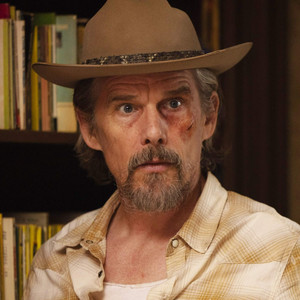
Ethan Hawke plays a freelance investigative reporter with a knack for sticking his nose where it doesn't belong and getting that nose punched.
He gets drawn into the seedy goings-on of one of Tulsa's most prominent families by following a trail of breadcrumbs.
Breadcrumbs in the form of notes left by one member of that family, whose death raises more questions than it answers.
I'm Linda Holmes.
And I'm Glenn Weldon.
This is NPR's Pop Culture Happy Hour.
And today we're talking about FX's The Lowdown.
Is the American dream a scam?
Alligator Tears, a new memoir by Edgar Gomez, tackles that question.
Who are the people who are benefiting the most from this idea that we need to keep working, that we need to keep our heads low, that we need to keep going out and risking our lives?
You can hear more about that on Code Switch from NPR, wherever you get your podcasts.
For world-renowned cellist Joshua Roman, long COVID caused an identity crisis.
That was probably the lowest point.
No confidence in my ability to recover.
Crisis of faith about what music meant.
On the TED Radio Hour, how he found his way back to music and a new sense of self.
Listen on the NPR app or wherever you get your podcasts.
Joining us today is Soraya Nadia McDonald.
She's a cultural critic, journalist, and the senior criticism editor for The Rumpus.
Welcome back, Soraya.
Thank you for having me.
Glad to be here.
Glad to have you.
Let's get to it.
On the lowdown.
Ethan Hawke plays Lee, a grungy, self-styled Tulsa truth-storian who runs a used bookstore.
His side hustle though, is muckraking, publishing exposés of the city's corrupt business owners and politicians.
I read stuff.
I research stuff.
I drive around and I find stuff.
And then I write about stuff.
Some people care, some people don't.
I'm chronically unemployed, always broke.
Let's just say that I am obsessed with the truth.
One creep he's investigating is a gubernatorial candidate, played by Kyle MacLachlan, who's carrying on with his dead brother's wife, played by Jean Triplehorn.
Lee also gets help from a mysterious figure who at least seems to have his interests at heart.
He's played by Keith David.
Yay.
Imagine if Elmore Leonard or Carl Hyasson wrote about the modern West.
That's pretty much the vibe.
The Lowdown is airing on FX and streaming on Hulu.
Linda, we've talked about this show before.
I know you like it.
Why?
Yeah, I really love this.
I find it such a kind of an affable show to hang out with.
I think that, in addition to having a mystery that I find pretty compelling, you know, it starts off with the death of this character.
You know you wouldn't expect to see very much of him, since he dies at the beginning, but he's played by Tim Blake Nelson and he does continue to make appearances as sort of a visionary.
And in that Tim Blake Nelson way kind of gives – imparts wisdom to Ethan Hawke, and that part I really like.
I'm prepared to acknowledge that Ethan Hawke is my favorite actor right now.
And I think he is so incredibly tuned in to who this guy is.
It could so easily just turn you against him.
But you realize that he really does mean it.
He gets himself in trouble constantly, but he really is trying to get the truth out about various things.
And his entrance in this, the first time you see him, he's kind of walking down the sidewalk.
He's got a vape pen.
He's got his cowboy hat immediately.
I just felt so confident that I understood this guy.
And I think Ethan Hawke understands him too.
There's a chunk of the second episode that he spends sort of in disguise because he's been in a fight and he's trying to keep people from finding out that he's in a fight.
And he goes into a convenience store and says to the young woman who's working there.
I'll give you a thousand dollars for those shades, this hat, and a brief makeup tutorial.
So he ends up spending a good chunk of that episode in a trucker hat that says Big Rig, a pair of blingy hexagonal sunglasses.
Okay.
And it's so funny to me just every time I look at them.
I took both, like, I think story pleasure, but also a lot of just the vibe of this.
I think vibe is going to be a very... Vibe pleasure, yes.
Yes.
Vibe is going to be a very big word with this show, but that's just because the vibe of it is so good.
Soraya, you're nodding along to the word vibe.
Tell me more.
Say more.
Oh, yes.
Ethan Hawke is tremendously responsible with the way he fills out this character.
I really like seeing him in these kind of scruffy roles where he's getting himself into dubious situations.
And also, I think, the roles that sort of allow him to dig into fatherhood are lately, I think, have just been a pleasure to watch him and to sort of move with him through these stories.
But the other thing that I really liked about The Lowdown is just the world that Sterling Harjo has created in Oklahoma.
That's the showrunner, yep.
It feels very complete the way he's using mise-en-scene, the way that feels almost like a very literary television show, not in a pretentious way.
I love that you mentioned Elmore Leonard, because I think one of the names that I had written down was Larry McMurtry.
But also the Coen brothers, Fargo, it kind of has all those elements together.
And I love it just has an abundance of memorable lines and phrases that you just kind of want to steep in.
Like you can't help but giggle.
You know, there's one character who's a real estate agent, who someone refers to as a cooch mouse.
And I think that Keith David and Killer Mike, because Killer Mike is also in this.
Yes.
I think Keith David and Killer Mike maybe both say the thing about there's nothing worse than a white man who cares.
Oh, yes.
Yeah.
So it's not self-serious.
You can feel the way that I think Sterling thinks of Oklahoma as a home.
And all of the weird, eclectic characters that emerge in a place that feels like a small town.
And honestly, you know, in some cases, it feels kind of desolate.
The way he has the pilot, in particular, structured.
That allows you to get lost in this story that is clearly set in modern day America, right.
But it doesn't have that Glossiness.
Very much rooted in what is happening around this guy, in the environment, around this guy and this collection of characters that you have, all these wonderful actors, just making a meal of.
They feel like character actors.
It's not primed for Instagram, if that makes any sense.
It's gritty, but it's funny.
And I think all of those things just come together really well.
Sterling Harjo, who created this show, he was the co-creator of Reservation Dogs with Taika Waititi.
He has said in interviews that Reservation Dogs was his love letter to rural Oklahoma where he grew up.
And this show is his love letter to Tulsa where he lives now.
I would not describe this love letter as particularly besotted.
You know what I mean?
This is not a – I wouldn't want to get this love letter.
I mean, I love this show.
I love the tone of it, as we've all talked about, the cast, which we will talk about.
But that grittiness that you talked about, Soraya, the kind of sun-baked grunge of it all.
You know, I like the look of this series.
I don't think the Tulsa Taurus board does, because it's just so – flat and brown and dry and unrelentingly bright.
You keep wanting to tell these characters to put on sunblock.
I mean, my God.
Yeah.
But there are people who like when they look at this, they're going to be like that's the only place I want to be.
I want to be in a place where that's what the people are like.
And that's what the places that you drink beer are like.
And in that sense, it is, you know, I think loving.
It's home.
It's loving.
We've talked a lot about Hawk.
Let's talk some more.
I mean, his take on this guy is what makes the show.
Like, Lee obviously thinks he's the coolest guy in the room, and everyone knows he thinks that.
And everyone knows he's also light years from being the coolest guy in the room.
At one point, a character describes him as peacocking.
He is desperation made flesh.
He is like, what if vaping were a person?
He's a raw nerve and that's always compelling.
But it didn't click for me for a while.
I was like, there's something I'm missing about this character.
And then episode five, he makes a David Foster Wallace reference.
And I was like, click.
There it is.
Oh, I know this guy.
Of course.
Well, I mean, he has a bookstore.
He deals in rare books.
So, you know, he's a book guy.
Also a truth story.
Also a truth story.
The reason I mentioned Elmore Leonard at the top is that this kind of slides neatly into the mode.
Of the criminals here are very, very dumb.
But that doesn't make them harmless.
That makes them even more dangerous.
It makes them a lot more unpredictable and a lot volatile.
There is occasionally to the show, a quirkiness to some of the characters that we meet, including some caviar farmers.
And that kind of quirkiness.
Depending on the show that surrounds it, it can come off as kind of precious and twee, which is why I like this show immensely, goes as hard as it does and is as gritty as it is, because there's nothing precious about this show.
Nothing twee.
It's one of those shows, and I think Reservation Dogs was like this too.
That is very well serialized, right.
Particularly regarding this longer story about the family that he's investigating and all that stuff.
But they're also very good at making an episode that stands as an.
You know, there's an episode a little bit later where Peter Dinklage shows up as like an old friend of his.
And by the end of that episode, they have built such a rich relationship between those two guys.
Oh, yeah.
Wow.
Yeah.
Yeah, if the caviar farmers recurred, you know, over the course of the entire thing you might find it to be a little too cute.
Whereas stuff like there are two guys that Lee hires to be security who sit outside his store and they're terrible at it and they're not security at all.
But the fact that they don't show up very often is I think what makes that gag work.
You only see them occasionally, and practically every time you see them it's because he's saying to them what are you doing?
Like you're supposed to be security and I got kidnapped off the street next to my own van.
And I think because they're not in it that much, the kind of quirkiness of it doesn't grate.
And he's also so wonderfully hapless.
And he's surrounded by people who don't allow him to take himself too seriously.
That's important.
You've got a line, like You know, when he's talking about this expose that he's published you know to someone and he's like it's a real page turner.
It's only two pages.
I write him a lot of great dialogue in this.
Or, you know, he writes for a long form magazine and then somebody says, you mean the zine?
And he's like, he takes leverage at that.
And he's very sensitive about like, it's not a newspaper.
It's a long form magazine.
This is a guy who walks down the street, right?
He always looks like he smells.
Definitely.
I think it's important to me with this character that, as goofy as he is and as hapless as he is, I think they also very convincingly demonstrate that he loves his daughter very much.
He's not somebody who is constantly, you know, disappointing and ignoring his kid, and she loves him anyway.
And that's the sad thing about it.
He really loves his kid.
She sort of wants to be part of what he's doing a little bit.
And, you know, she's sort of fascinated by him.
They have a good relationship that he really means.
And I think that helps a lot.
Do you ever get scared?
Yeah, of course.
All the time.
Some things are scary.
Usually only important things.
What are you scared of?
Oh, come on.
You're not worried about me.
I think that is one of the more interesting things about the show, one of the more nuanced things about the show, which I did not expect, because the stuff with the daughter Frances, who's played by Ryan Kira Armstrong, she's great.
I was fully prepared to check my phone during those scenes because I am a cynical person and I always believe that you put family stuff into action shows and movies because you're trying to make the main character more believable, to give them something they care about, to be a potential hostage.
That's kind of what – that's my take.
Yeah.
Fair point.
But I think the relationship is so fascinating because Lee is an obsessive who really loves Frances but he's not equipped to deal with her because he is so self-righteously driven by what he sees as his big purpose that people he loves keep getting tossed aside.
Not because he tosses them aside, but because his drive causes things to happen to him, like getting thrown in car trunks.
Right.
And what I like about the show.
My favorite thing actually about the show and this surprised me is that fully imagines what that would do to a kid.
Frances has had to learn that she can't count on her dad for emotional stuff, but she can count on him for fun adventure.
That's how they bond.
Now, she is meeting him on his terms, right?
He's not extending himself very much.
He's still trapped in his obsession, but she's grown up fast.
And she knows that if she wants a relationship with him, she's going to have to meet him where he is.
That is just way more interesting.
It's much better writing than if she were just the sweet loving kid you mentioned Lindish, because now she's a real person.
Now she's not just a plot point, just a potential hostage, but she's something he bounces off of.
And she's also, I think this character, clearly like very smart, right?
Like I think you can see what Lee sees of himself in her as well.
Astuteness, thinking on your feet, observational skills, right?
That she's clearly like, picked up from hanging out with him, that are also starting to emerge and show up.
In her own habits and her own personality.
Mm-hmm.
Killer Mike and Tim Blake Nelson and Tracy Letts, who shows up very early in a meeting.
And you're like, is that racist, Tracy Letts?
And it is.
There are so many moments in this where I like the performances so much.
They just keep surrounding him with such interesting people.
There's a performance I really like from Michael Hitchcock.
Yes.
If Michael Hitchcock doesn't immediately sound like somebody you know, when you see him you'll go.
Oh right yes, I do know him.
Playing kind of a rival antiques dealer, because because Lee sells and deals in rare books, so he's got this relationship with this guy.
I can give you $1,500.
Okay, but sell it to a super cool gallery, like one of the nice ones.
Don't sell it to these cheesy white guys.
Believe me, I'll have all the good stuff whenever they come.
I'm so sorry.
Either that or I tell them that it was previously owned by a drag queen.
I'm so happy to be seeing Jean Triplehorn and stuff again.
She's really good in this.
She gets a lot to do.
She's one of those people where you don't really know exactly how to take her and who she is.
And you don't know exactly where they're going with who she is, which is exactly what you want.
I feel like every time you poke your head out, there are new interesting people, which is a real compliment to a show where I think the central performances are this strong.
You know, I think certain moments, absolutely, the performance as Lee is a big performance, right?
There's a moment early in the show where he kind of escapes danger and comes bounding out of an enclosed space.
He looks very wild and it's very over the top and funny, right?
But there are other times when it is like Ethan Hawke acting, right?
It's a great central performance.
And so just a lot of people, I think, to be really happy to see Killer Mike's really funny in this.
Yeah.
I mean, I was surprised to see Tisha Campbell pop up.
Yeah, right?
It really makes use of this wonderful sort of collection of actors.
The women in this show, they're age-appropriate.
Like the actresses themselves, you know which.
Again, I was like going back to that sort of lack of glossiness and embracing people as people, people you would.
You feel like you would actually run into in Tulsa.
It's got...
That quality about it, I think, that also made Claws, you know, like a fun show.
But wrapped in that knowledge and familiarity that Sterling has because he's actually from the place.
The tempo of it, the tone of it, the vibe, right?
The vibe.
I feel like we should mention, too, you know, we've talked about a lot of influences, your Coen brothers and your Elmore Leonard and Carl Hyson and stuff like that.
There is one episode where Walter Mosley has a writing credit, right?
That is another one that makes perfect sense to me as an influence.
Like, that sounds right, you know.
I think there's just a lot of good DNA in the writing of this that I am delighted to see.
Yeah.
And like that Dinklage, it's not just the performance.
It's the writing of that Dinklage character.
That is what the guest appearance in a comedy Emmy category is for.
We're going to see his name.
Oh, yeah.
Again, they're going to put this in as a comedy, right?
It can't be a drama.
It's got to be a comedy.
No, I don't know.
This is FX.
You know what they did with the bear.
That's true.
And yet this one is an hour long instead of a half hour.
Yeah, it really is.
Oh, man, it's up in the air.
That is an interesting question.
Watch this space.
I will say, like every time Keith David is in a scene I feel like you know my back just kind of straightens up a little bit as soon as you hear his voice.
Like you just can't help yourself.
You just got to lean in a little more.
Our sweetest songs are those that tell of the saddest thought.
If nothing else, you think, this show has a good casting director.
At least they know what they're doing.
Absolutely.
Well, it's pretty unanimous.
You probably picked up on that, but we want to know what you think about The Lowdown.
We're on Facebook, which is kind of a long-form magazine, if you think about it.
And that brings us to the end of our show.
Soraya Nadi-McDonald, Linda Holmes, thanks so much for being here.
Thank you, bud.
Thank you.
Always a pleasure.
And just a reminder that signing up for Pop Culture Happy Hour Plus is a great way to support our show and public radio, and you get to listen to all of our episodes sponsor-free.
So please go find out more at plus.npr.org or visit the link in our show notes.
This episode was produced by Liz Metzger, Carly Rubin and Mike Katz and edited by our showrunner, Jessica Reedy, and Hello Come In provides our theme music.
Thank you for listening to Pop Culture Happy Hour from NPR.
I'm Glenn Weldon, and we'll see you all next time.