This podcast is supported by Pure Leaf Iced Tea.
Time for a pure leaf.
Love now and always.
Did you fall in love last night?
Love was stronger than anything else.
And I love you more than anything.
There's still love.
Hey everyone, it's Anna.
Listen, you know how our show works.
Every week we bring you a story or conversation inspired by the Modern Love column.
We explore all the complicated, messy ways human beings relate to one another, and we try to learn something from it.
This week, I want to play you a conversation that I definitely learned a lot from.
And honestly, I am so envious I didn't get to have it myself.
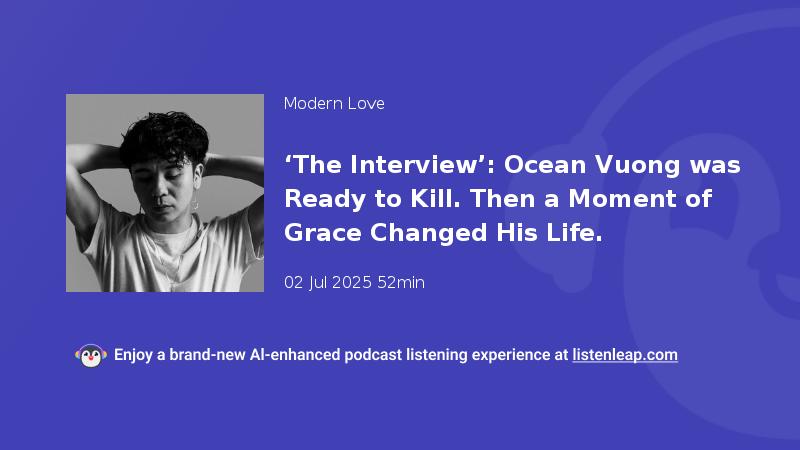
It's from Another Time's podcast called The Interview, and it's a conversation between host David Marchese and the author and poet Ocean Vuong.
There is so much I could say about this interview, but I don't want to spoil it, so I'll just say this.
This conversation is a masterclass in compassion on both Ocean and David's part.
It feels deeply authentic and human, and we over here at Modern Love thought it would feel right at home in our feed.
I'll leave it at that and just drop you right into it.
Here's David. From The New York Times, this is The Interview.
I'm David Marchese.
In a lot of ways, Ocean Vuong's life makes for a classic American success story.
He and his mother came to this country as refugees from Vietnam in 1990 when he was just a small child.
They landed in Hartford, Connecticut and pretty quickly fell into a hardscrabble existence ruled by low -paying work and low expectations.
computations. Until that is, Ocean discovered literature and his own gift for writing.
Vuong is now one of the country's most esteemed poets, winner of a prestigious MacArthur Fellowship, also known as a Genius Grant, and he's a professor in the creative writing department at New York University.
His debut novel, On Earth We're Briefly Gorgeous, came out in 2019 and became a bestseller and a bona fide millennial classic.
All this and he's still only 36 years old.
But there's another side to Vuong's story and that's about the flip side of success and the lingering pain of his mixed -up youth It's that part of his story the one that doesn't resolve so neatly that lies at the heart of his new novel The Emperor of Gladness It's a bigger book in every respect than his first I'll say too that the book was a launching pad for what turned out to be one of the most emotionally intense interviews I think I've ever done Here's my conversation with Ocean Vuong Thank you for taking the time to do this.
I appreciate it. Thank you, David.
Pleasure. So, Emperor of Gladness, your new novel, is based, at least in part, on your experiences working at fast food restaurants in small -town Connecticut.
So where did you work and what were the jobs?
I worked at a place called Boston Market in a place called Panera.
And I was living in HUD housing.
It's a one -bedroom apartment with my mother and my brother.
It was this kind of situation where if your family income surpassed, then you can't live there anymore.
But the next housing opportunity would be unaffordable to us.
So my mother literally said, you know, when you get a job, just work at McDonald's to stay under.
It was, you know, McDonald's, $7 .15 an hour, which is minimum wage.
In the summers, I worked on a tobacco farm, which was 9 .50, cash, no Uncle Sam involved.
So you confront, as a teenager, immediately this kind of like antithesis of like American prosperity and upward mobility, where it's like, don't make too much money or we'll be homeless.
But a lot of people had that predicament.
So I went to Boston Market, which is now like a very eye -opening experience of American life, I think.
Yeah. What did you learn about people?
from working at Boston Market and Panera Bread?
Well, first of all, I learned that everything is about deception, right?
We didn't cook anything.
The entire thing was a series of microwaves in various, you know, it's taking frozen sacks of food in giant plastic bags, reheating it, and then presenting wholesome home -cooked meals.
But what I learned was, you know, we have this idea of American life being the nuclear family.
But I think a huge portion of how this country is formed is through circumstantial family.
Labor. This arbitrary cobbling of strangers thrown together.
And then we have to kind of sacrifice relationships with our own family in order to be here.
And yet, intimacies arise despite that because human beings, no matter where they are, will find bonding relationships.
And a month in, you'll start to know whose cough belongs to who.
You'll know when Joe's drugstore deodorant will wear off at which hour.
I'm like, we're at the third hour.
I'm going to start to smell his BO underneath the deodorant.
And there's nothing more intimate than that.
But you also, you're so dependent on each other.
You know, I'm not a soldier, so I would never compare it to war.
But it's just kind of like going through a battle sometimes, especially when, you know, you're about to close and a purple bus pulls up and it's a bunch of Catholic school kids after their prom and you're slammed.
And you have to depend on each other.
And there's a kindness that arises out of that.
There's also a deep frustration.
What frustration? concentration?
That underneath it all, every employee kind of knows that this is not it.
This is not the way out.
And it's kind of the elephant in the room.
And the manager is paid just a little more than us.
I think at that time they were paid maybe 13 to 15.
We were paid 715. So, you know, almost double.
But the suffering that they went through showed us it wasn't enough.
I watched someone get promoted and then turn it down.
It was like we had this ceremony.
We're promoting somebody and it was a grand thing where the manager came out.
We closed the store and said, all right, you know, we're going to promote Jennifer today and welcome Jennifer.
And she's just like, I don't want it.
She didn't want the responsibility.
Yeah. It's a slightly different setting, but I worked as a waiter for a catering company.
Yeah. And so much of what you just said paralleled exactly my experience of that, the way you're just sort of thrown in with this group of disparate people.
Somehow you make it work.
You know, people get on your nerves.
There's other people you like.
There's people you can rely on.
There's people you can't rely on.
But at the end of the night, everyone has done their jobs.
But I will say we worked a lot of bar mitzvahs and weddings and the parties for that, you know, anniversaries, retirement parties.
And that's what I realized, like, you learn so much about people from the way they treat their presumed subordinates.
Yeah, yeah. I think it's interesting because the fast food restaurant, in a way, obfuscates the worker's humanity because everyone's in a uniform.
You're just hands. Your most valuable asset are your hands, not your personhood.
And I think there's, what I'm interested in this novel and in my life in general is when humanity breaches these moments.
To this day, I think it's almost 20 years ago now, but till the end of my life, I will remember this one moment.
I was being trained by this man named Ruben.
One day we were cleaning the freezer and I don't know what to do with this fact, but it's just, I didn't put it in the book because it's too dramatic.
You know, sometimes life is like both cornier and more dramatic than any fiction you can do.
But it's been haunting me for forever.
I'm 19, and we have our backs together.
It's like maybe like six foot wide, and it's almost touching, and we're just cleaning.
And we're talking about family, and he stops and he says this thing, he has his back to me.
and he says, you know, it's something I can never tell my wife.
I was like, oh, my God.
And he says, I have three sons, and I only love one of them.
And all I know how to do is just give affirmative.
Like I don't know how to receive this, you know?
And I said, oh, okay, all right.
Why, you know? And he just says, you know, there's nothing.
I have no real connection with the son that I love.
And the others do right by me.
I do right by them.
I don't understand it.
But I knew it early on.
And he's like, just watch out in life.
That's going to happen.
You're supposed to love people, but you're going to find out that God chooses these things for you.
And to this day, I don't know what it means, but I thought it was just such an incredible...
Did that ever come up again?
No. And I was like, why did that happen?
Why in a freezer in East Hartford, Connecticut?
Does a man tell me something that I think has only been uttered in that freezer to this day?
Yeah. Well, you know, that story and your book and the experience you described of working at a fast food restaurant really connect for me to a larger question I have about the country and how we understand each other.
The Emperor of Gladness is set in this small town in Connecticut, and it's a town where it seems like there are not great job prospects.
You know, there's a lot of poverty.
What do you understand about places like East Hartford that maybe doesn't get communicated widely enough?
You know, I think as a culture, we always want this sort of grand arc, rags to riches, gets the girl, gets the guy.
We know where the body is.
We know who the killer is.
It's like the Scooby -Doo effect.
You always get the unmasking.
And there's a payoff.
And I just wondered if I could write a book that didn't have improvement arcs, you know, because it also aligned with, like, my observation of my communities.
My brother has worked at Dick's Sporting Goods his whole life.
My stepdad works at this auto parts company called Stanadyne.
are still both in Connecticut they're both in Connecticut for 25 years he worked from 3 p .m. to 12 a .m. I never saw him I came home from school at 4 I only saw him on the weekends he would sleep in I saw like a tuft of hair poking out of the blanket in his room that was it and so I just thought we want stories of change we believe in it we buy it and yet yet, American life, even at its best, is often static.
You drive the same car, I know people who live in the same apartment, but it doesn't mean that their lives are worthless, that it's meaningless, that they failed, right?
So I'm interested in like re -identifying the idea of the loser or loserdom, like economic losers, the left behind.
In my first book, it's a queer story about someone who never leaves, you know, because the queer story is always ameliorated when you go to the city.
I'm like, some of us can't afford to.
Some of us have elders to care.
Some of us need to be gay in the cornfield because there's nowhere else to go.
And so this book, it's not a spoiler to say that nobody gets a better job, no one gets a raise.
So what happens? You get people.
And what I've been really interested in is this idea of kindness without hope.
scope and what I saw working in the fast food growing up in in Hartford County was that people are kind even when they know it won't matter what is that where does that come from you know like you know that whatever you're going to do is not going to help someone materially jumping their car I watched co -workers get together and dig each other out of blizzards before anyone can go home They could just dig themselves out and leave, go home sooner, hug their families.
But they all stayed, and they dug each other out.
The generosity that my neighbors had.
Growing up in a black and brown community, we were invited into Baptist church. We knew no English.
They gave us free bread.
And I just said, what is kindness that is exhibited knowing there's no payoff?
Where do you think it comes from?
I don't know. No, I, I, I write, you know, David, I, I've been really interested in kindness as an intrinsic thing and goodness as an intrinsic thing.
Like my brother just has it.
He came with kindness.
I never had it. I had a desire to understand goodness, but I never had it the way like my brother does.
And I know because I raised him.
When my parents were at the factories in the nail salon were 10 years apart.
So I was holding a little baby in my arms as a 10 -year -old feeding him milk.
So I'm like, I raised him.
I didn't give him that.
He had it. And I'm just interested in that because I don't, it's strange to me.
I don't know it. It doesn't come natural to me.
And I've been in dicey situations in my life where I realized that very early on, I just don't have of it were you exhibited cruelty i i don't know if it would be cruelty but i think certain anger certain rage certain desires that i think would have never exhibited in someone like my brother and there was a moment when i was 15 that i think i've been trying to articulate this for so long and your question is now putting me down the slippery slope i've been trying to articulate it because I think it's important but I've been really ashamed of it because people ask me you know why did you become
a writer and I give the the answer that I think makes sense I went to Pace I tried business school because I wanted to help my mother and I couldn't do it and I went to Brooklyn and then I went to the English department then I became a writer that's not untrue I don't know if it's honest you know and your question is now bringing me to this idea of cruelty and And goodness, I would say that there was this one event when I was 15 that I do think altered the course of my life, although at that time it was not an epiphanic moment.
Like I didn't say, oh, you know, but I would say that the desire to be a writer probably started with the desire to commit myself to understanding suffering.
What was the moment?
I'm trying to be eloquent with this I don't know if I will be When I was 15 I'll say it first and I'll describe it When I was 15 I decided to kill somebody Oh my god I didn't do it Oh my god i was working on the tobacco farm every summer and i rode my bike every day i didn't have a car i didn't have a license it was about five miles out you wake up like at six in the morning i rode my bike and i went to work mostly with migrant farmers you get paid under the table and if you show up every day you get a one thousand dollar bonus at the end of the season And it was this hot July evening.
I was in my room and I look out the window and I see that someone has stolen my bike.
And it was someone I knew in a neighborhood who was a drug dealer.
And it was like 2002, 2003.
So everybody's outside.
There's no indoor kids, at least not in my neighborhood.
So you would put your bike outside in the stoop when you're running in and out.
and this guy was known to just grab your bike and he would never give it back to you.
It was just very, you know, there's nothing you could do about it.
He was like a sloppy thief, basically.
Yeah, yeah, but he kind of knew, like he just didn't, the idea wasn't to steal.
It was kind of like power.
Right, he was showing you he could take your bike.
Yeah, yeah, and whenever he needed it, he'll just grab a kid's bike and you were under the mercy of it.
So it was a chronic thing.
thing um but i just snapped that day you know like i just saw him and i was so angry because i knew i knew i knew i'm like i'm not gonna get this back i'm gonna lose my thousand dollars and for context like when i end up doing my mom's taxes she made thirteen thousand dollars right and what i did was he's riding around there's people you know and i go out and i said just just give me back my bike, you know.
And essentially, he just said, F off.
And I knew that, that's the vibe.
But I just, I think that day I lost it, you know.
I was on drugs at the time.
You know, I had my first cigarette when I was 14.
Two weeks later, I'm doing lines of coke in the high school dugout in the baseball.
But I was sober that day, right.
It got worse in the farm because the migrant workers were using it too.
too. You take a bump to do the work, to get through the day.
And they loved that I did it, because I was a kid, and they kind of took me under, it was kind of really toxic, you know.
But that day I was clear, and I went across the street, diagonal, to my friend Big Joe's house.
I knocked on his window.
I remember putting both of my hands on the windowsill, and I have no shirt on, I'm just sweating, I'm so angry.
And I just told him, I said, please let me borrow your gun.
I'm so sorry. You don't have to finish the story.
Okay. Can I give you a hug?
It's okay. I really appreciate that you're being honest, but if it's too much, we can just stop.
So you just tell me, okay?
Okay. But I think what I'm trying to get at is that I didn't become an author just to, like, my goal was not to, like, have a photo in the back of a book and be, like, an author.
Writing became a medium for me to try to understand, like, what goodness is.
Because when I was begging my friend, I said, please give me your gun.
And I know that gun because we used it.
We would shoot it. He would take me to the woods and we would just shoot.
And I just, I'm like, please just get up real quick.
And I had it in my head.
I imagined it in my head.
And he says, I'm not going to do that.
He's at ocean. He said, I'm not going to do that.
You need to go home.
And I think what was really so touching to me is that And I was not responsible for that.
Someone else's better sense saved me.
And in Buddhism, we have this idea called Satori.
Explain what that is.
Satori is kind of enlightenment, but it's enlightenment in life.
These kind of brief moments of illumination.
And you've probably experienced it.
Like, you know, I'm laying in bed at night.
I can't sleep. And then all of a sudden, you realize, Oh, I need to be a better partner.
I'm going to wake up.
I'm going to be a better brother.
I got to be more patient.
I got to stop being petty.
Like these moments, right?
And then you wake up and then life happens.
You get a bad work email.
Someone's being annoying.
And then you lose sight of all that.
So satori is like a brief window.
And the idea for Buddhists is to then allow the understanding in that brief window to then alter your life.
And monks, some monks widen that window probably for the rest of their life.
That window is their life's width.
For me, I get little brief moments, and I think I was spared that horrible outcome because of Big Joe Satori.
and any other day he would have done it right but he saw that it's not going to be good and it was his wisdom and you know you you tell yourself you can control your life and all that but moments like that happen and you're just like how i i i don't know it was up to me that i got here it was somebody else a week after that i went to the public library because i would take my grandmother to the library and she was schizophrenic so she was kind of like a thousand Asian grandmas in one right so she kept making altars all over the house and she would go to library and she would steal pictures of Buddha and frame
it for her altars and I would just sit there and she would just sit there and just cut out book you know and put it in a folder and then I started to like I'm like what is this book you know let me just read this what was the book i would just start reading buddhism books but then i end up in the buddhism religion section right and i would go back by myself and i was deeply interested in like understanding this suffering and buddhism was so enticing for me serendipitously because the four noble truth is that life is suffering and i was like oh my god god yes yeah i'm i'm on i'm in there right
and it's like you you are not your past you can alter your life right you don't have to wait for anybody you don't have to negotiate with a higher being because buddhism is all about action it's all about your conduct and i was trying to find a way out and i went to my guidance counselor and i told him i said there's a university called university of the west where you can study a liberal arts degree become a monk.
I said, I want to help me, help me get there.
And he said, I would love to get you there, but it's not accredited.
And I think if you want to go to school, you should have a real degree and then you could still be a monk.
So he persuaded me to go to community college.
My first class there, the syllabus was Baldwin, Annie Dillard, Foucault.
Then I realized writing Writing was not like writing a good, respectable email to get a job.
It was a medium of understanding suffering.
That's when it changed.
We'll be right back.
Do you own a business that's ready to thrive?
It's time to let Intuit QuickBooks take things like unpaid invoices and tracking expenses off your plate so you can take things to the next level.
QuickBooks is an all -in -one business solution that can help with those day -to -day tasks like invoicing and expenses.
Manage and grow your business all in one place.
Intuit QuickBooks, your way to money.
Get 90 % off for three months.
Limited time only. Terms and conditions apply.
You know, as we move forward, you should definitely just feel free to tell me if you need a break or if anything feels too intense because I'm looking at my questions.
We're not going to get easier.
I didn't think I would be here this quick either.
But I realize in the way I've described the novel, I've elided one of the most important aspects of the story, and that's the central relationship of the novel is between a young Vietnamese immigrant character named Hai and an 82 -year -old Lithuanian woman whose name is Gretzina.
Gretzina, yeah. And Hai winds up through sort of a series of twists and turns becoming a caregiver for Gretzina who has dementia.
And the novel is dedicated to a real -life Gretzina.
Can you tell me about who she was and what your relationship with her was?
She's my partner's grandmother.
I wanted to dedicate the book to her.
I wanted to use her name to honor her as a real person.
But long story short, after I dropped out of Pace University, I lost housing.
Then I applied to Brooklyn College.
I got in, but I didn't have a place to live.
I was couch surfing.
That quickly ran out.
And I hesitate to call myself homeless because it was just two and a half weeks.
I stayed in Penn Station for two and a half weeks.
But it was not the way you'd think.
I was a student at Brooklyn College.
I had a library. I had a computer.
But I would go to sleep in Penn Station in the Long Island Railroad sector underneath Madison Square Garden.
It's very warm. And what I would do is I would print out a fake ticket.
And that would get you into the Red Hat area where it's much more comfortable.
Sort of a waiting lounge.
Yeah, yeah, yeah, yeah.
Yeah, so I would do that until like 5 .30.
Then I would wake up and I would take the 1 and 2 down to Flatbush, go to the library in the corner and sleep until my first class at 9 or 10.
It's one day where my partner, we were dating at the time, and he was living in Queens, but he was going home that day to Long Island.
And I got to Penn State and he's like, I'm going to Seaford. Where are you going?
going i was like um i'm here you know it was kind of sweet but very strange in a way um and he was like oh my god you know and i was like all right well he's that's you know he's he was jarred and we left i'm just sorry just whatever you wouldn't have to talk again this is really weird i'll text you and then the next day he called me he says you know um i talked to to my mom my grandmother she was actually 84 at the time uh she lives in richmond hill she thought she will not go anywhere you know she's an immigrant it's her first american home she raised two kids there her husband's gone she won't
go but she has some illness i didn't know i just thought i was going to help someone take medic medic like like vitamins you know and i ended up living there for two and a half years while i was studying and helping take care Take care of her.
Take care of her. Yeah.
I mean, I just, I was 20, 21.
But what was interesting was that we kind of started like a family, you know, like, because I was living in this row house, right next to the train, the A train, and then my partner, Peter, would start visiting more.
And I'm like, are we dating?
Are we not? Like, what is happening?
I'm living with your grandmother.
But it was kind of beautiful and that we didn't name it.
We just came over - Just what was happening?
Yeah. He's like, I think, I'm like, I think we're just together, right?
Let's just, let's just try it out.
And I lived in his mother's childhood room down the hall from her.
And it was a foundational experience in my life.
So you had the experience of being a caregiver for her.
And I think also for your mom when your mom was dying from cancer.
What did you learn about caregiving or what did it teach you?
Because I think until we've gone through it, we can look at it almost as like a penalty or something that's solely to be endured without any other positive qualities.
But what was your experience?
It certainly requires endurance because you are in a heightened place of selflessness and giving with no determinate end.
And so there's a kind of faith of the act itself.
Like I'm like, I'm just going to be here for as long as it takes.
but it's in a way it's really sad because it should also be what is possible without illness you know giving your loved one your best self but then only in when death nears do we truly do it maybe because it's unsustainable otherwise it's not a world away from the idea you said earlier of kindness without hope yeah yeah i think so yeah yeah that's god that's good because there is no hope you just want to almost merge with them like when i'm on my mother's deathbed i said mom anything anything and often she just she's very politico you know she just kept saying like raise me up and i'm that we
have this hospice bed i'm pushing i'm like mom it's the highest it can can go she's like yeah but keep raising me up I'm like you know and I just like and then as a poet all I could think about is the metaphor I'm like raise you up where you know are you going up there and and so it was it changed everything for me you know everyone says that but I think death becomes it's just always here do you think it changed the kind of writer you are i i don't know yet this is the first book i wrote from start to finish without her being alive and i told myself like any young writer that i was this avant
-garde counter -formalist and i saw myself on this kind of high horse and i thought i'd write whatever i want and i was very proud of that but i realized after my mother passed that i was actually just trying to do well in the world so that I could take care of my mom.
Like everything was kind of a strategic, right?
It's like, Oh, I got to get this job.
I got to be a professor.
I got to get tenure now.
I got to do service work.
And I just secure my family because, you know, I have one salary.
It's a good one. But even now there's nine Vietnamese refugees who I take care of.
It's a blessing. I don't see it as a burden.
You mean who you support financially?
I support Poor financially, yeah.
But I was always strategic.
And when my mom died, I was like, that was it.
Everything was for her.
I have a job. I have a living.
And ultimately, I got to ask a question I didn't want to ask yet, but I had to, which was that what would I write for myself?
And this is the toughest book I wrote.
And not, like, formally, but just existentially.
It's like, okay, now what?
just write a book to say some things.
And I felt that for a long time.
And I told my agent, I said, I think I'm sorry I had a time.
I think this is my slump book.
You know, I just - New one.
Yeah, I felt that way.
I just, and I still feel that way.
I just, cause I don't know, the culture will decide, you know, but I just felt like - What did you feel like you weren't accomplishing?
It wasn't clear to me why anyone should read it.
You know, like, and I think that's part of like the question of, oh, if I wrote for myself, then I'm like, well, I don't think anyone should read it if I wrote for myself whereas if I wrote to support my family it was very clear right it was like here's a book from a son to a mother who can't read that's wham you know let's go take off right but writing for yourself seemed selfish or hollow it felt just very neutral yeah you know it just felt very um limp where I'm like oh yeah I'm excited I it's a creative work but when I lost that that myth and it is a myth right i made that myth up i made the myth
of like i need to go it's that quintessential oldest immigrant son myth except that other people said i'm going to be a doctor a lawyer but i said i'm going to be a writer the best writer i can be to take care of my family and i was like even as i i tried to betray that asian stereotype of like the immigrant making making good and i thought i would be like this radical writer i end up doing it i you took a different path but you did it it was the same thing it's the same goal and so when i finally got to do what i thought i was doing this whole time which is like writing on my own terms it felt
really empty to me but i'm not um i don't um fetishize an identity of writer to me this what what we're doing is the same work.
My teaching is the same work.
When I give a talk at a university in front of people, it's the same thing.
How do you characterize that work?
A kind of sincerity of figuring this out.
I think that's it. In the Buddhist sutra, it says, engage the phenomena of the world with earnestness.
And I've always valued that.
I just didn't know that our culture often values cynicism as a form of intelligence.
And earnestness is kind of frowned upon because it almost means that you've been duped.
It's like, oh, you believe in this too much?
You clearly haven't thought deeply about it.
Well, also, it just, you know, for better or worse, it turns out that cynicism wins a lot of the time.
Earnestness isn't always rewarded.
I know the point is not to be rewarded for earnestness, but it is easy to be skeptical about it when you see how the spoils are divided?
Yeah, and earnestness and sincerity is overcommitting, right?
Because you have to go all in.
You have to have hope, optimism.
But the Senate gets to stay in the neutral line and judge the ones who go forward. So it's an easier position to be in, and there's very low risk of it.
After the break, I talked to Ocean again, And he tells me how falling in love with literature was sometimes a wedge between him and his family.
Where I'm from, reading itself is almost a betrayal.
It's a class betrayal.
It was kind of seen as like, oh, you're too good for us.
You're trying to read to go to college.
You're trying too hard to get out.
This podcast is supported by Pure Leaf Iced Tea.
Take a real break with Pure Leaf Zero Sugar Iced Tea.
All the flavor, all the sweetness, zero calories.
Finally, an iced tea without compromise.
Refreshingly bold and sweet, but with zero trade -offs.
Time for a tea break.
Time for Pure Leaf.
Hi, Ocean. How are you?
Hi again. Good to see you.
Good to see you. Glad to talk to you again.
I must say, before we start, there is some drilling happening in my New York apartment.
So if you hear whining, painful sound, I promise it's not coming from my voice.
Are you ready for some more lighthearted questions about you and your work?
I'm ready. I'm ready, always.
always. So I know that your mom had a sense of your accomplishments as a writer.
I think, you know, I read maybe an interview you gave or a piece you wrote where you talked about how she came to readings of yours and sort of enjoyed the fact that a bunch of white people were sitting and listening respectfully to her son.
But do you know if anyone ever, I mean, your work to her?
Or did she have responses to the content of your work, not just the reception of it?
No, you know, I tried to kind of like break down a poem for her.
I tried to even talk to her about books I want to write.
And I think it was hard for her ultimately to be in proximity of my reading and writing because it was almost like I was evidence of what she could have done if she had a normal life untouched by war and when I realized that very early on I stopped reading in front of her because it was almost like this mocking it's like I'm proud of my son but gosh he's in a world I'll never access success.
And I put the books away after I realized that.
Because also, where I'm from, reading itself is almost a betrayal.
It's a class betrayal.
It was kind of seen as like, oh, you're too good for us.
You're trying to read to go to college.
You're trying too hard to get out.
And in the same way, it's like, I remember when I first started reading in high school, I'd go to the library or the lunchroom and read, and I would hide.
I would pretend to be be asleep i would put my head down on my hand and put the book in my lap and it felt so natural like oh yeah i gotta but in retrospect it was so interesting but deeply sad that that i it was better for me to perform lethargy and unconsciousness it was better to perform unconsciousness than to read and be perceived reading i i'm still stunned by that you know but it just that was how You have to do it.
If you wanted to read, you had to find a way.
How do you think becoming more educated and changing your social milieu also affected your relationships with people?
David, I still don't understand it because I've met so few people who've gone through it.
I tried to explain this to my mother and my aunt.
the kind of loneliness of class movement.
It takes so long to study and realize what has happened to you.
You know, and I think of this in relation to Mark Fisher's work, who writes brilliantly about this as a theorist. He says, like, you know, coming from the working poor and takes decades of learning to realize what happened to you.
And by the time you realize it, it.
It's too late. Like right now, my grandma's dead, my uncle's dead, my mom's dead.
You know, it's almost like there's a kind of helplessness to that realization.
And so I think I've kind of come to an end of understanding all that, but it feels too late.
I think it's a lot of grief.
You know, you enter these rooms, and even with my colleagues, they're all lovely, but But it's hard to explain what we were talking about in our first interview.
Like, I don't, I never say that stuff because I feel like it's going to stop the room or people are going to.
I just feel like I'm always kind of really alone in these spaces.
And then when I come home, no one cares.
What do you mean no one cares?
Like, two years ago, I was bailing out my cousin, like truly bailing him out in a bail bond office who was having a mental health crisis.
It was really bad. And police were being called.
And I get a call from my aunt saying, it's like 1 a .m. Come to this 24 -hour bail bond.
And I go, and I've never bailed anybody out.
And I'm like, MacArthur genius?
Who cares? New Yorker?
Who cares? None of that had any traction.
I don't even know how to fill out a bail bond form.
And I'm just completely lost. Nobody cares Here's what I do, you know.
And I think in a way that's refreshing.
Like, I don't come home as Ocean Wong, the writer.
I come home as Ocean, the nephew, the cousin, the cousin who's going to bail me out, the cousin who's going to buy my new Yeezys that I saw online, you know, whatever.
So it's refreshing, but there's no place that I'm recognized as a person other than, like, my close circle of friends who are also mostly not writers.
And, you know, if I were to think about it, further, David, like philosophically, I would maybe even push to say, maybe none of us have a place.
You know, like how much are we performing?
We talk to our mother differently.
We talk to our dean differently.
We talk to our friends, our lovers.
We're constantly code switching.
And one thing I'm interested in as a writer is like, is there a center to me?
Is there a center to you?
Or are we just a matrix of instances?
It gets pretty heady.
But on some days, I feel like, all right, I am who I am.
And some days, I'm like, I think I'm just a series of utterances.
But you don't want to go down that route too much. You might have to call your therapist. You had said earlier that you financially support nine refugees.
These are family members?
Family members. I mean, technically, they're Vietnamese refugees.
That's how we arrived.
Yeah. Are they worried about their status in the country?
Are you worried about it?
I am, right? I mean, every day has been a nail biter.
And I'm in kind of survival mode for them.
And I just said, please just put your head down.
It's so crazy, David, because I've said in the past, I said, our elders put their heads down so that the next generation can be known, can do what they want.
I don't have to be a doctor or a lawyer.
You know, I can be a poet.
But here I am, the second generation or the 1 .5 or whatever, telling my elders, please put your head down.
Please just go to work.
Don't get a speeding ticket until further notice.
But the suspicion has always been there, you know, of government, of power.
were. And I think this is true with a lot of Vietnamese refugees and refugees in general.
In a lot of ways, it hurt us because the suspicion also applied to doctors.
You know, my grandmother never wanted to see a doctor until it was too late and it was stage four.
My mother was afraid of doctors, missed her mammogram appointment by six months.
and I said, why did you, you know, she said, oh, I just, I get nervous going in there, you know, even when I go with her.
So that applies, that kind of trust in authority.
It's a fraught thing and it's hard to choose how you respond to your trauma.
Do you think there's any way in which sort of your awareness of the cruelty that you had inside and your own experience with cruelty gives you any understanding of the strain of our culture currently in which cruelty seems like it's almost become fashionable.
Oh, wow. Where there's almost like a performative cruelty that happens.
Yes, yes. I think I was in a world where anger, rage, and violence was a way to control the environment.
environment and it was a way to control an environment for people who had no control of their lives a lot of them were hurt and wounded you know like another memory I had was I think about this often it's just seeing a kid get jumped for the first time I was maybe 12 13 and it was a kid called D Nice and I remember like a group of like 15 20 kids it was just so many of all ages and they went up behind him pulled his shirt over his head and then they just went in just a flurry of this but i i think because so much of that was close to me i always had to look at it and it behooved me to understand it
in order to survive so when i see cruelty i look closer and i say where is this coming from and a lot of times it comes from fear and vulnerability.
You know, you're too scared and you have to strike first. Which is a form of controlling the situation.
Yeah. And so in a way, I have great compassion for that because the doorway through violence has always been suffering.
I've never seen anyone commit violence and feel joy after.
And it's interesting, you see the doorway in front of you And it feels so immense.
It feels like the only path.
But when you step back, if I can borrow a metaphor here, it's almost like the doorway is in the middle of a field.
And you're like, oh my goodness, I can step back and I can just take one step to the side and go around and the whole world is before me.
And there was a threshold in front of me that I could always pass through after that day with Big Joe.
And in a way, my career so far has been a slow attempt at stepping back and stepping aside from that door.
I was curious, did you ever get your stolen bike back?
I didn't get it back to get my bonus.
But I didn't make it to work.
You know, I still think about the feeling of that.
And I just think, why did I rage out that day?
And I think it was just that all that hope was robbed from me.
I think that was what it was, is that I felt entitled to that bonus.
And when someone else took that out of me, I think I lost sense of control.
And I think about that, like you have these epiphanies when you're kind of in a helpless state.
um you brought up the concept of satori a couple times yeah have you had any epiphanic moments of satori recently i have this particular one and uh i didn't i just felt it felt kind of crazy but i start asking my friends about it and a lot of them actually share it and it's usually in the middle of the night.
I can't sleep. I wake up in a kind of terror.
It's almost like this moment before a true awareness arrives.
There's about like a 15 second window of, oh my God, what is all this?
And what fills that is this kind of horror that none of it matters.
we're all going to die why am I here?
Why am I sitting in this apartment scribbling away when I shouldn't be trying to be a better partner?
I want to apologize to everybody I've ever known I want to redeem myself for everything and I'm going to commit my life to trying to heal and help everybody I love and that lasts maybe like three minutes and then I pick up my phone and scroll on something And then the culture just supplants it all.
And so the trick of satari is to commit that realization into action.
And I have a lot of trouble in the second assignment.
But that strange existential horror, I think maybe because when my mother was on her deathbed, she said, son, now that you know how painful this is, you have to go and help people.
and it was like a mandate but I just thought gosh here's a woman taking her last breath she's not like I don't want to romanticize her or make her some sort of martyr but where did that come from this idea that you have to then tell your son to go help people here we go again You know, I just like, I'm still trying to find out all the ways that I could do that.
You can't just make your art for yourself in a vacuum.
I mean, there's diaries and journals for that.
Nothing wrong with that.
But when you make art to share, you have to think, how can I be amongst people?
You know, my favorite theorist, Trinti Minh Ha, said it best. She said, I do not write about, I write beside.
died. Gosh, that's so perfect.
If I could do that my whole life, I would have a successful life as an artist, regardless of what happens.
I never think I'm writing about something.
I don't want to render the people around me into a meaningful nugget.
I want to just scribble alongside that feels truer.
that's ocean vuong his new book the emperor of gladness will be published on may 13th this conversation was produced by wyatt orm and seth kelly it was edited by annabelle bacon mixing by sophia landman original music by rowan nimisto and marion lozano photography by philip montgomery our senior booker is priya matthew our executive producer is allison benedict Special thanks to Rory Walsh, Renan Borelli, Jeffrey Miranda, Nick Pittman, Maddy Maciello, Jake Silverstein, Paula Schumann, and Sam Dolnick.
If you like what you're hearing, follow or subscribe to The Interview wherever you get your podcasts.
To read or listen to any of our conversations, you can always go to nytimes .com slash theinterview.
And you can email us anytime at theinterview at nytimes .com.
I'm David Marchesi, and this is The Interview from The New York Times.
you