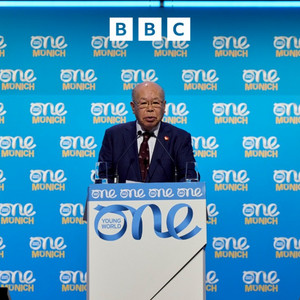
You're listening to The Happy Pod at One Young World.
Guten Tag from Munich.
I'm Holly Gibbs and we are bringing you a slightly different Happy Pod this week.
We're here at One Young World and we have spoken to innovators, politicians and peacemakers whose ambition is to inspire change around the world.
Coming up, I also have hope because there is many people willing for peace and moving so well.
The Nagasaki survivors who are encouraging peace.
I wanted to take my life back.
If we hold on to grudges, if we let things from our past dictate our future, we'll never really fulfill our purpose.
How a man who was shot and paralysed by an officer worked with the police and communities to bring positive change.
Plus, We monitored 200 million hectares across 19 countries and in the last three months, we have alerted more than 400 wildfires.
How AI is being used to tackle wildfires.
One Young World brings together more than 2,000 young people from 190 countries.
Here, they swap ideas about how to change the world and how to get the leaders of today to listen.
We start with a story that isn't happy in its origins, but does bring with it a message of hope.
The only aim of nuclear weapons is extinction. and they are evil.
That's why they cannot coexist with humans.
We shouldn't use them at all, and all the world has to raise their voices to abolish them.
That's Shigemitsu Tanaka.
He was a child when the United States dropped an atomic bomb over Nagasaki in August of 1945.
I spoke to him and Toru Yamaguchi, whose father experienced the bombing.
Their words have been translated.
I was four years old.
When I was four years old, I was exposed to radiation in Togetsu village, which was six kilometers from ground zero.
I have been doing Kataribe, the storytelling activity, and telling people what happened under the mushroom cloud.
I am the second generation that's been exposed to radiation as I was born in 1964.
My mother's house was 700 meters from ground zero.
My father's house was 500 metres from ground zero.
Neither of them were in their houses at the time.
That's the reason I exist now.
I think the differences in thought are inevitable.
It's really important to talk to each other without giving up, even though there are differences of ethnicity religion, country and language.
That is not a problem.
It's my hope for the younger generation, and for me as well, to continue with the many activities that a bomb survivors group has done and add our own activities.
That's very important.
That is what I always think.
Shigemitsu was part of the group who received the Nobel Peace Prize last year.
We received a Nobel Prize in our time, but this is for our bomb survivors, who formed the Japan Atomic Bomb Survivors Group 68 years ago to spread their message to the world.
All bomb survivors received the Nobel Prize and for all those who died, we went to their graves and told them about it.
We feel true joy and also responsibility, and we must carry on more actions to abolish nuclear weapons.
Suzuka Nakamura is third-generation hibakusha, a term that refers to the people affected by the atomic bombings in Nagasaki and Hiroshima.
At the age of 25, she's determined to encourage peace in the world and wants nuclear weapons to be abolished.
I guess it's very simple.
Listening to a lot of stories of hibakusha, I started to think why people made nuclear weapons and how can we abolish them And to figure out those questions answered.
I started my career as a peace activist and I met more hibakusha working hard for this issue and I was very moved by them.
Yeah,
How would you encourage other young people to do the same?
Because there might be a lot of young people listening that think that they won't make a difference.
I met a lot of young people who, when they think about starting making an action they like, tend to think about the definition of peace what is the peace going to be like?
But i guess our dimension is very simple, that we do not want to make.
No more hibakusha, no more wars, no more hiroshima and no more nagasaki.
I guess that's the only messages i want to give.
And what do you think the first step towards peace would be?
Make friends, Because when we want to start making action, if we are all alone, the pressure is so huge.
And I guess we cannot do anything.
But with friends around you, we can share our thoughts or ideas.
Innovation doesn't happen only in one person.
I guess there should be a lot of people around there.
So yeah, make friends.
Yeah.
And on a personal level, how does it feel to dedicate your time to peace and something that matters so much to your family?
I started my peace activism when I was a high school student.
There was a peace studies club in my high school.
So that was my very first step to join the peace activism.
But after that, I wanted to make this activism as my job.
So I decided to learn about how to make peace. or how to start a business.
And so I decided to join a community of startups.
And now I'm doing these activities as my own job.
When I do these kind of activities, I always have anger because, looking around the world, maybe Donald Trump said that he would start again testing nuclear bombs.
And in other countries like Putin, he always has an option to use nuclear weapons.
And When I see those leaders talking about using nuclear weapons so easily, I always remember about the hibakusha, who suffered a lot from nuclear weapons.
And I can't imagine how scary they are, like maybe the nuclear weapons might be used again.
And now we are sharing the same fear.
But at the same time I also have hope, because there is many people willing for peace and moving so well.
I also do not have the clear definition of peace, but I can say that the peaceful world shouldn't have nuclear weapons, I guess.
What's the one message that you think people should take away when they hear about the Hiroshima and the Nagasaki atomic bombings and when they visit the sites?
Please remember it forever. whole time.
It might be seen as one page of history, but it's not.
It's like a continuing story.
Our next story is about the power of forgiveness and turning personal trauma into positive change.
In 2012, Leon Ford was shot five times by a police officer during a traffic stop, leaving him paralysed and in a wheelchair.
But ten years later he's worked with a former Pittsburgh police chief to set up a foundation that brings residents, community leaders and law enforcement together to tackle the use of excessive force and make communities safer for everyone.
Leon told Harry Bly more about it.
That came from years of frustration, of anger, but also years of healing.
So I went to therapy for the first time and I'm still in therapy.
I remember having a conversation with my grandfather who challenged me.
He said, Leon, do you want to make a point or do you want to make a difference?
And so I had to think more intentionally about what making a difference could actually look like.
And I was able to have more of a unified vision where I would train police officers.
I would meet the officer who shot me and really become a model for healing and reconciliation.
Tell me about some of the outreach that you do, the training of police officers.
A lot of officers are trained from like a fear-based perspective.
You have to make it home at the end of your shift.
You have to make it home.
You have to make it home.
You know, listening to our police officers helped me understand that a lot of the communities that the police serve and activists wanted the same things that the police officers wanted right.
To live a peaceful life, to decrease violence within the community, to prevent drugs from coming in.
And so we have more of a collaborative approach, but we're also getting them in front of our students.
There's this stigma that if I take a career experience As a police officer, I'm turning my back on the community and the community will turn their back on me.
And so, through this Bridging the Badge program, we're developing a pipeline where our students will take up careers in public safety.
So law enforcement, fire and also EMS.
Let's go back to your lived experience.
And you mentioned there reconciliation.
You met the police officer that shot you.
The reason I decided to meet with the officer who shot me is because I was interested.
I was very curious.
In my mind, I was thinking about, okay, what is the solution to police shootings?
Specifically, traffic stops where officers may feel afraid and the victim may feel afraid.
It's safety, but safety.
What makes a 19-year-old black kid on the side of the road feel safe is completely different than what would make a 35 40-year-old white police officer with a badge and a gun feel safe right.
The only person who could tell me what would have made him feel safe is the person who shot me.
And it was so interesting.
He wasn't who I thought he was, and I'm pretty sure I wasn't who he thought I was.
But I think sometimes when I share that story people forget how much time and inner work that it took to get me to that point.
Have you been able to forgive him?
Oh yeah.
Yeah, I forgave him even before we met.
That's what helped the meeting be so productive.
One of the things that made me forgive was that I wanted to take my life back right.
I remember when my son first began to walk and i was so angry right, because the only thing i could think about was the fact that this officer took away my ability to walk.
That was devastating to me.
So for me to be happy, for me to continue to live a life of purpose and joy, i had to forgive.
If we hold on to grudges, if we let things from our past dictate, our future will never really fulfill our purpose here on this earth.
And, you know, each individual is responsible for their happiness.
And tell me about your life now.
My life is one of impact, of presence, of creativity and innovation.
I love my life and I think everything happens for a reason.
And the impact that I have on the world, whether it's micro or macro.
I just appreciate that, although I've experienced such tragedy in my life, I did not let that define me.
I'm grateful to be one of those people who actually did the inner work so that, whatever room I roll into, wherever in the world, people could feel the joy.
Leon Ford talking to Harry Bly.
When wildfires get out of control, they can be devastating.
That's why it's important to spot them early.
Human activities and climate change are making them more frequent and intense, leaving ecosystems struggling to recover and threatening the lives of humans and animals.
Here in Munich, we met Franco Rodriguez-Vial from Argentina, who uses artificial intelligence to do just that.
Jacob Evans has been chatting to him.
Wildfires in Argentina were a huge problem.
And I started speaking with hundreds of people who work on a daily basis with wildfires to get to know the problem more deeply in remote areas where no one gets to know about them.
And we developed an AI for the satellites so we can detect faster than NASA, which is the most used system in Latin America.
We process more than eight satellites coming from NASA, NOAA, and the European Space Agency.
We have an AI to detect wildfires on them And when we detect them, we send WhatsApp alerts to the fire departments that we work with so they can go and act in time and reduce the losses of lives and biodiversity.
And in the same WhatsApp message, we send a video on how the fire will evolve in the next hours.
What inspired you at just 21 to make this?
Why is this so important to you?
I started when I was 16 years old mid-pandemic, because I had family friends who lost their houses to wildfires.
And I... felt I had to do something.
So that's when I started researching for months and speaking with hundreds of people who work on a daily basis with wildfires, to get to know why these wildfires were getting so catastrophic.
And then I learned that there are no prevention systems in Latin America, no real-time alerts, and that inspired me to create this project.
And can you give me an example where your systems come into play and really help those local firefighters on the ground?
Yeah, so in Concaran Argentina, last year We alerted fire departments of a fire at 140 am and NASA didn't until 9 am.
And this allowed them to take action in time.
And also there was another case in Cordoba, where we alerted disaster management team of a fire in a campsite.
And the response was so fast that campers were never aware of that fire.
And how many hectares do you cover or how many clients do you have?
We work with 70 fire departments in Argentina.
We have a freemium model with 50,000 users.
We are in 19 countries.
We monitor 200 million hectares across 19 countries.
And in the last three months, we have alerted more than 400 wildfires.
And for anyone listening who, just like you, has spotted a problem in their local community or something in their country and they want to make a change, but they're a bit too scared, perhaps.
What's your message to them?
Life is just one.
And yeah, I think the way to work in this is being aware of the problems or needs that you have or the ones that are around you have, and try to ask more questions from curiosity and from humility, to don't understand the problem and like, get deep on that problem and, with that, try to provide solutions.
It's much easier now, with AI and everything, to start like testing prototypes and things and testing because a startup is basically A successful startup is one that solves a real problem, and just that.
Franco Rodriguez-Vial speaking to Jacob Evans.
Coming up on this podcast... It's kind of all just happened.
I think when you do win things, it kind of gives you that platform to be able to make change, and I think you have to use it.
We don't need to win to make change, but winning makes it a lot easier.
The inspiring tale from playing football in the garden to the international stage.
In somalia, zainab muhammad moved to minnesota in the us as a child.
Then, in 2022, she became the youngest person ever elected to the state senate, at just 25 years old.
Her focus has been on protecting renters, securing an equal minimum wage and access to universal health care.
Work that was recognized here at one young world.
Jacob evans has been speaking to her.
When I was first running, everyone said we think you should wait and run for city council.
Maybe park board, like start small.
You're only 24 years old.
But being a hard-headed African woman, I said absolutely not and ran.
And when I won, I won with the highest number of votes across any district.
I was the youngest person.
I was the first person. black woman elected to the Senate.
I was also the first immigrant and Muslim woman, and it's been three years that have certainly been a journey for me, both personally and professionally.
I've been able to do a lot of work in the community and politically and I think I've been able to make a really good impact.
So alongside all of these things how do you find being young?
Has that held you back?
Do people look at you differently?
Yeah the average age in the Senate is 73 years old.
So a lot of people who could be my grandparents, maybe even my great-grandparents.
I would say being young, people often want you to sit down and learn.
When I first got elected, my colleague in the Senate said, I'm just going to give you advice.
And I said, amazing.
Ears are open.
And he said, what I want you to do is to never speak on the Senate floor for the first year.
Learn, see how it works.
Because one, you're young.
Two, you're Muslim.
Three, you're a black woman in America, so just relax and take it slow.
You don't want to be on the other side of members of the opposition party coming after you.
And, you know, I passed my first bill off the floor my third month into session.
And he had never had a bill in the eight years he's been there on the Senate floor.
So I think, often one we have to be confident in ourselves as individuals and know what we're capable of versus what we're not.
We also have to be willing to take risks and to show some of these older people that just because things have been done a certain way for so long doesn't mean it's working.
Looking a bit more globally, we've seen in Kenya, Madagascar, Nepal, all these youth-led movements.
What do you think is different about young people now and people like you just going for it and trying to make change?
Well, I think Gen Z is like a very vocal, brave group of young people.
I think they're coming into a world that they know they deserve better.
And they're also interconnected because we're in the world of technology and social media is like inspiring young people globally to do better better, to do more.
They can connect with anybody from across the world.
And so I think, if you take a look at the last, the recent years, the people who have led on some of the most transformative movements across the world have been young people.
And those people have been inspired by other young people in other countries.
And so I think in this generation, people are more interconnected than they have ever been.
And there's a sense of community in online and social media.
And I think it's a beautiful thing.
One thing I think we've spotted recently is perhaps a disillusionment amongst young people with politics, a feel that perhaps it's futile.
What's your message to those people and how do we sort of overcome that?
I would say, I think people who have been in politics for so long, those people are no longer in touch with communities.
And then you have young people who are growing up in this country, who have seen these people hold these offices forever forever, and come every year run for election again.
Talk about the same thing over and over again.
That's where that dissolution comes from.
And I would say, you know, for young people, we have an opportunity to step up and lead.
At the age of 26, our next guest became one of the youngest mayors in Spain.
He won in a village of just 70 residents, having promised to reverse declining rural populations, improve social care and lead projects that generate income from natural resources.
He's also known as the TikTok mayor, having built a following on the platform, inspiring other young people to go into politics.
Harry Bly caught up with him here in Munich.
I'm Enrique Collada sánchez and my hometown is el recuenco.
El recuenco, yeah well um, it's kind of like being a neighbor, because it's a little town but uh, you are the one that needs to solve every problem.
It doesn't matter if it's with a your phone company or with some public service, everybody goes with you with the problems.
But I always say it's like giving back my town what I feel it has given to me.
And fast forward to now, you've won Politician of the Year.
Tell me about that.
Well, it's a little incredible.
When I saw the other winners, they were like a senator or a parliamentar.
I thought it was going to be impossible for someone like me, a mayor in a town that it's like 70 people.
I don't know, it's like a... really a recognition.
Also, you feel like the responsibility to represent your town and things that you thought would never be possible.
We are demonstrating that can be possible.
So I think that's the greatest thing, that not only me, but my neighbors also.
They kind of recover the self-esteem of who we are.
And for those that haven't seen your TikTok, you have 18,500 followers.
Tell us about what kind of content you make.
I usually just tell what I do in a normal day as a major.
So usually most of the time I'm in the forest.
I'm with the engineers seeing how we can manage so we can prevent fire, for example.
But also sometimes you just need to listen to people that has a problem.
I don't know, a health problem or whatever.
And you are just like the person, the friend.
What I do in TikTok first is showing that young people can do whatever.
Politics is for everybody and you just need the passion and the love for your community or from your town and you'll be able to contribute.
How important would you say social media is for young people who want to enter politics?
Right now it's very important.
It's essential.
Because many of the challenges we have, maybe you feel that there's no one listening.
With social media, everybody listens to it.
And when you have many views, then the politicians, even in higher positions, they start to listen to you.
So that's why it's so important, because you can influence many decisions or you can propose new policies.
And when you are relevant in social media, you kind of are also relevant for politicians.
And my final question you have put your small town, El Recuenco, on the map because of your TikTok following.
What's the reaction been like?
Sometimes, when you have something like TikTok and people see that television comes, that there are many views, that people comment that they feel like El Recuenco is something interesting.
People living there think, okay, so we might have something we are not seeing.
And it's normal.
When you're used to see these mountains, these forests, this calm life where there's really a community, we all know each other, you think that that's a normal thing, but it's not.
And there's something extraordinary in that.
So the first thing I would say my neighbors feel like it's incredible that El Recuengo can be so well known now in Spain.
And at the same time, They recovered that self-esteem, they rediscovered their abilities and they rediscovered the important things and the beautiful things we have.
Enrique Collada Sánchez.
Our last One Young World delegate is making waves in women's professional football.
Georgia Stanway plays for local club Bayern Munich and helped England win back-to-back European Championships in 2023 and 2025.
The Lionesses' victories have contributed to the rise in popularity of women's football in the UK, but many female athletes still face challenges in their careers.
I started by asking Georgia what it's like being a professional sportswoman.
It's amazing, yeah.
Firstly, it's amazing to be in that space.
It's nice to call myself a professional footballer, having just started out playing football because I love it.
There's still things that we are like fighting every single day.
I think we just have to stop comparing between men's sport and women's sport, because potentially it's two different sports.
Yeah, we just have to find the balance of what's right for a female body in order for it to be in the best position to perform at that sport.
We can look at body image equipment that's solely made for females and yeah, making sure that, at the rate in which female sport grows, so does the surroundings, and whether that be the coaching, the officiating, the facilities, making sure that everything is going in the same direction at the same time and we're always trying to yeah, make the next generation have it a little bit easier than what we had it, like the people that paved the way before, Like me, for example, making sure that everybody has the right access, the right opportunity, no matter where you are in the world.
And that's why I come here and I do these sort of things.
And I would like to speak and use my platform to be able to make sure that opportunities equal, no matter where you are, no matter where you're brought up.
And what is your message for other women, young girls who might be in a similar situation to you and know what they want to do, but can't really get there?
I think you have to use your community.
I think don't be afraid to ask for things.
For me personally.
I remember writing letters at the age of 10 to see if the gym would let me use it for free or the local council could support me with funding in order to get some new boots, and I think there's a really respectful way to be able to ask for help.
There's going to be bumps in the road, but it's those bumps and those little roller coasters that shape the character that you become at the end.
And do you think that there is a responsibility of men in sport to help pave way for women as well?
Yeah, of course, not being afraid to talk about it, not being afraid to support women's football, watch us.
But it's also like i said before, understanding that it is two completely different sports and we don't have to compare and we can take each sport as its own individual.
On a personal level, how does it feel to you knowing that you have been such a powerful force in the rise of women's football?
I think it's a little bit surreal.
I was just a girl that loved playing football as a hobby and next minute I was moving to go and play professionally and it's kind of all just happened.
You do win things.
It kind of gives you that platform to be able to make change, and i think you have to use it and i feel like now, especially as the lionesses, we're at a point where we don't need to win to make change.
But winning makes it a lot easier, and that's kind of what we're doing is not being afraid to ask questions, not being afraid to make change, because at the end of the day, we're in a position and we've got the platform to be able to make change and you are, of course, part of that amazing back-to-back winning team.
How was that?
Are you still riding the high?
Yeah, it was a very crazy summer.
If I compare both the Euros, the first one felt a little bit more controlled, a little bit more in our hands, whereas going into the second one we've got a target on our back and we lose the first game and then we go into survival and that's just a massive show of character, a show of who we are as individuals.
And this is the happy pod.
What is the happiest moment of your career?
The happiest moment of my career...
Good question.
I would have to say the first Euros.
Yeah, it's incomparable playing on home soil, winning at Wembley in front of 98,000 England fans.
Yeah, that feeling will never leave.
Georgia Stanway.
And that's all from the Happy Pod for now.
We'd love to hear from you.
As ever, the address is globalpodcast at bbc.co.uk.
This edition was mixed and produced by Harry Bly and Jacob Evans.
Our editor is Karen Martin.
I'm Holly Gibbs.
Until next time, auf Wiedersehen.
Woo!