N -P -R. This is The Indicator from Planet Money.
I'm Waylan Wong. And I'm Darian Woods.
Msanja Tisho grew up in Tanzania, thousands of miles from the U .S.
And yet the U .S. was a tangible presence.
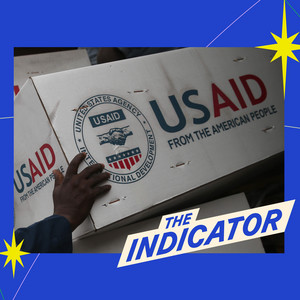
There was one American agency in particular that he knew was electrifying villages and distributing malaria nets.
I remember my parents and my family receiving a lot of nets and they used to say sponsored by USAID.
USAID or USAID, the U .S.
Agency for International Development.
This arm of the government was created in 1961 to distribute foreign aid.
And for Lamsanya, USAID wasn't just part of his childhood.
About three years ago, it set up clean water in the village where he and his family live today.
Mtsanya's wife, Kristen, says you can't miss who sponsored the project.
There's a massive sign that says, you know, water is being brought to you through U .S.
aid and the American people.
This kind of work came to a crashing halt last month when the Trump administration put a 90 -day freeze on foreign aid.
It also effectively closed USAID, throwing thousands of people out of work.
The website even went dark and remains so today.
It was a rapid dismantling of an agency that has historically received bipartisan support.
The agency isn't just about American largesse, but about bolstering American national security and economic interests.
Today on the show, we look at how the U .S.
has wielded this form of soft power and who might fill that power vacuum if USAID goes away.
the bay area is always making news and now there's a podcast that helps you stay connected to all of it every day i'm bianca taylor host of the latest from kqed part of the npr network the latest brings you trusted local news in real time in 20 minutes or less look for the latest from kqed wherever
you get your podcasts hey it's rachel martin from wildcard this Valentine's Day, NPR wants to show our love for listeners like you by giving away a free year of NPR Plus and $100 worth of NPR merch to one lucky winner.
Enter for a chance to win at npr .org slash valentine.
No purchase necessary.
Entry page and a link to the official rules can be found at npr .org slash valentine.
In 2023, USAID had a budget of $40 billion that accounted for less than 1 % of the total federal budget for that year.
The program spends money on things like food assistance, education and public health, including HIV AIDS prevention.
When you look at foreign aid as a percentage of gross national income, the U .S.
is less generous than many other countries.
But the U .S. is the largest economy in the world.
So when it comes to the absolute number of dollars spent on foreign aid, the U .S.
is the largest donor.
That means the money, which flows through agencies like USAID, is indispensable.
That's according to Charles Kenney.
He's a senior fellow at the Center for Global Development.
It's a think tank that conducts economic research on global poverty.
We are talking tens of millions of people who are alive because of USAID rather than dead.
And we do it for this teeny amount of money.
Charles says that studies show that foreign aid can help promote economic growth and trade relationships between countries.
But don't just take it from Charles.
Here's Marco Rubio, former Republican senator and President Trump's current secretary of state, making this argument to Congress in 2017.
People can't be consumers if they're starving.
They can't be consumers if they're dying of malaria.
They can't be consumers if they live in an unstable country.
So there is an economic rationale for our investment around the world.
We are helping people to emerge from poverty and ultimately become members of a global consumer class.
In other words, as people in countries receiving foreign aid get richer, they're more likely to buy stuff from the U .S.
and elsewhere. That's part of the economic argument for USAID programs.
Charles says there's also a related national security rationale.
If you know that your life has been saved by U .S.
assistance, it's a lot less likely you're going to turn around and protest against the United States or join a terror group or whatever.
Marco Rubio, who defended USAID during his time in the Senate, is now presiding over the dismantling of the agency.
Last week, the State Department said that USAID was no longer advancing American interests abroad and that a review of the agency's activities is underway.
Rubio has said that parts of USAID might continue to run under the State Department.
USAID has faced criticism over the years about inefficient, wasteful spending and whether foreign aid actually sparks economic growth.
Last week, the White House circulated a list of projects that considered examples of waste and abuse at USAID.
Most of the examples were smaller in price tag, less than $5 million.
Take an initiative to promote clean energy in Vietnam.
And some of them, like a quote DEI musical in Ireland, weren't even USAID projects.
Charles says there are many ways the agency needed improvement.
For example, shipping American crops overseas to help with food emergencies can be a long and costly process.
It can take four to six months.
But he doesn't see the chaotic closure as the answer to the agency's problems.
The 90 -day freeze has stopped operations like emergency medical care and an early warning system for detecting famines.
Charles wants to see evolution, not revolution.
The reform agenda is really important.
It's not a destroyer agenda, if you will.
It's not an agenda to rip this thing down.
It's to make it even better.
Marco Rubio told Fox News last week that while the goal was reform, there is now, quote, rank insubordination at USAID.
He said that forced his office to take dramatic steps.
We reached out to the State Department via email, phone, and couriered letter.
We did not get a response.
We did talk to someone who works for an organization that gets USAID funding.
She focuses on education.
And she asked that we not use her name because she's worried about reprisal against her employer.
The past couple weeks have been heartbreaking.
I can't even begin to describe it.
The entire field is gone, Waylon.
I mean, it's not even just like someone losing their job.
It's the entire field.
The staffer was working on an educational project in West Africa.
USAID was helping fund things like children's books and radio programming that could be used for remote learning.
Before the foreign aid freeze, her organization had received 11 ,000 tablets with solar chargers.
Those tablets were supposed to be loaded with training material for teachers and distributed to schools.
Now they're just sitting in an office.
The generator needs to run because these tablets are in the office and if the power goes out and the air conditioning goes down, is it going to physically ruin these pieces of technology if the air conditioners aren't running, for instance?
And then if the funding doesn't come back, what's going to happen to these tablets?
The staffer told us her career choice was inspired by her uncle, an agricultural economist who worked for USAID.
She herself was in the Peace Corps and she's married to a veteran who served in Iraq.
I'm no fool when it comes to American interests and the work that I'm doing to forward American values and American security, prosperity.
I get it. It really is partnerships with other countries and soft power and building trusting relationships, you know.
And right now we are abandoning people right and left.
And we're not going to be the partner of choice if this is how we're treating people.
China, however, might step into this void.
For over a decade, the Chinese government has been investing massively in infrastructure projects around the world, including in Africa.
It's called the Belt and Road Initiative.
China is seeking to recruit allies and build goodwill, not through humanitarian assistance, but through economic partnerships.
Marco Rubio, for his part, told Fox News last week that he wasn't concerned about China filling this vacuum.
In Tanzania, where Lamsania and Christian Tisho live, they've seen Chinese -funded mining projects spring up near them.
They say the local reception to the increased Chinese presence has been mixed.
But Kristen Tisho says she expects sentiment to start turning against the US.
People have come to count on USAID for lifesaving drugs, or they were employed through USAID and now they're out of a job.
I'm sure that the hospitals will be quick to say, it's not our fault you don't have your medication.
The Americans who were funding it are no longer sending it.
And we have about 1 .7 million people in Tanzania with HIV, so it affects a huge number of families.
They're not going to be thinking very kindly of Americans at this point.
Meanwhile, two lawsuits seeking to stop the closure of USAID are moving through federal court.
One is from unions representing agency workers and the second from a group that includes contractors and small businesses.
By the way, next week we'll have more on how the closure of USAID also affects American farmers who sell crops to the government.
This episode was produced by Julia Ritchie with Engineering by Sina Lafredo.
It was fact -checked by Sierra Juarez.
Kicking Cannon edits the show, and The Indicator is a production of NPR.