The History Channel original podcast.
History This Week, November 16th, 1961.
I'm Sally Helm.
It's early in Washington, D.C., 7.30 a.m. to be exact.
Two beat-up cars pull up to the curb at 1600 Pennsylvania Avenue, the White House.
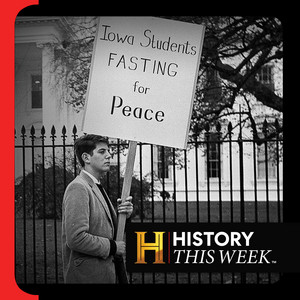
Fourteen college students have driven a long way, almost a thousand miles.
They all grew up in the atomic age, hiding under their desks as young kids for duck and cover drills.
The fear of the bomb has cast a shadow over almost their entire lives.
But just a few weeks earlier, there started to be some new hope that things could change.
That's why the students are here.
They unpack the signs that they made the night before.
No more nuclear testing.
We support Kennedy's peace race.
Those were the two messages, basically.
We spoke with Peter Coyote, one of the protesters who was there.
He was 20 back then and going by his given name, Peter Cohan.
He's now an actor, perhaps best known as the narrator of Ken Burns' documentaries.
And he grew up under the fear of the bomb.
The best quote on it is a quote by Bob Dylan, where he said that the first nuclear explosion made random annihilation a fact.
Just the existence of nuclear weapons fueled all sorts of anxiety.
That anxiety only increased as it became clear that the fallout from nuclear weapons was toxic and that scientists in the US and the USSR were testing weapons in the Earth's atmosphere.
So just like in the air.
In 1959, wheat and milk in the northern United States were found to be radioactive because scientists had been exploding nuclear bombs in Nevada and the fallout had drifted up to North Dakota, settled on the wheat and on the grass where it was eaten by cows.
When the USSR tests more weapons in 1961, the fallout drifts over to the US too, and public health officials warn parents tell your children not to eat fresh-fallen snow.
It might be secretly contaminated.
This, understandably, makes people very nervous.
And President Kennedy has made this one of his key diplomatic issues.
He wants to ban these tests to keep people safe from fallout and as a first step towards nuclear disarmament.
Together we shall save our planet.
Or together we shall perish in its flames.
These Iowa college students think the issue is pretty important, which is why they've shown up on the doorstep of the White House to protest nuclear weapons tests and to engage in a three-day fast which, on this cold, drizzly day in 1961, has only just begun.
It was amazing.
At a certain point you stop being hungry, and you got crystal clear Today, the Grinnell 14, the college students who carried out what would later be called the start of the student peace movement in the 1960s.
How did these students try to make sure that the press and the public would listen to their message?
And what did they ultimately accomplish?
Growing up in New Jersey, Peter Cohan was exposed to what many considered at the time to be radical ideas.
I came from a very political family.
A lot of my mother's relatives were socialists and communists and labor organizers and pretty much lefty Jews.
These are the post-war years, where fears of communism, the Red Scare, start to take hold.
I did see people broken in my family by the McCarthy period adults weeping in my living room terrified.
They lied about my family, called them spies, called them traitors.
And so I was very affected by that.
Peter's father was a wealthy businessman, often absent, and his mother struggled with mental health issues.
The family hires Sue Howard, a young Black woman, to help raise Peter and his sister.
My dad was very volatile, very kind of dangerous guy.
My mom was unreachable.
And Sue was put in charge of the whole household.
And it's like she took all the sorrow and all the grief and she threw it in the sack over her shoulders.
And my sister and I just gravitated to her as a safe place.
Sue and her boyfriend and her friends would be over at Peter's house all the time.
Arguing about the Bible, listening to Errol Garner and Billie Holiday.
And that's where the life was.
And my mom was out in the living room staring into a glass of scotch.
So until I was 14, this woman and her boyfriend were my primary parents.
During this time, the civil rights movement is picking up.
Sue was involved in integrating Englewood, New Jersey, and she was the secretary of the Urban League.
Peter watches as Sue and other activists work to desegregate Englewood's school system a years-long fight.
They go on to conduct sit-ins, marches, boycotts.
So I brought all that in the background to Grinnell.
Grinnell College, in the middle of Iowa.
When he realized that's where he'd be headed, Peter was not enthused.
I applied to nine schools, and the only school I got into was Grinnell.
And I threw sort of a fit.
I said, I'm not going to bum f*** Egypt.
I'm sorry.
I'm not going to do it.
Anyway, it turned out to be a great school. been founded in the mid-1800s by abolitionists.
John Brown stopped through, escaping from one of his anti-slavery raids.
The school had progressive roots and a progressive present.
I met writers, poets, people who knew about folk music, people who knew about art and culture.
Peter falls in to a very hip crowd, early hippies or beatniks.
You know, maybe my hair was down to the bottom of my ears or something was already identifying with the counterculture.
And so were my friends, camel cigarettes and black turtleneck college students.
Not everyone on campus thinks they're cool.
My best friend, the late novelist Terry Bisson, was jumped by the jock squad and had his head shaved for you know, wearing hair that probably covered his ears.
And to this day, I regret that I didn't just cut my own hair in sympathy.
Peter and his friends aren't just into smoking and Jack Kerouac.
They're also activists.
Whatever I was interested in, I did 100% until it was exhausted.
I was arrested.
Something went wrong.
And it soon becomes clear to them where they should direct that energy.
Nuclear bombs have changed the fabric of society around them.
You can see the anxiety everywhere.
In less than three hours, an H-bomb might fall.
Communism.
What is it?
There were 500 science fiction films about flying saucers coming down with rays that would hypnotize people, and communism, and all of this stuff was fueled together.
Destroy America.
And it wasn't exactly recognized as what it was, but it was the specter of annihilation.
We were agitated, and we had to do something.
We felt like, wait a minute, you're taking away the future.
This is bullshit.
I'm not going to just sit around and watch my future evaporate.
Today, every inhabitant of this planet must contemplate the day when this planet may no longer be habitable.
Every man, woman and child.
On September 25 1961, President John F Kennedy addresses the United Nations General Assembly.
The Cold War is at a fever pitch.
The Berlin Wall had just started construction and the Soviets had just ramped up their nuclear weapons tests in the Earth's atmosphere, which led to those warnings about kids not eating snow.
And instead of fanning the flames, Kennedy goes in the other direction.
It is therefore our intention to challenge the Soviet Union not to an arms race, but to a peace race.
To advance together, step by step, stage by stage.
A peace race is actually a controversial thing with the Cold War at such a fever pitch.
But over in Iowa...
Kennedy already has a lot of supporters on campus.
First of all, she was hip.
He brought poets in to read.
He walked down the street in Washington at his inauguration.
He's seen as a president for the youth and his message resonates with college students across the country.
Together we shall save our planet, or together we shall perish in its flames.
Save it we can't. and save it, we must.
Civil rights had taught us that stepping out and being part of a mass movement caught the attention of the press.
So we decided that we would support Kennedy's peace race and we would protest the resumption of nuclear testing.
Cold War tensions have only risen since Kennedy's speech.
On October 30th, the Soviet Union detonated a 50-megaton bomb.
It is still, to this day, the most powerful nuclear device ever tested.
Kennedy's argument is that each successive nuclear test provokes the other side to conduct their own test, usually with a bigger bomb.
If there's a test ban, the bombs will hopefully stop getting bigger.
Some Grinnell students buy this logic and decide to publicly support Kennedy's plan.
They adopt some of the tactics of the growing civil rights movement.
The same kind of protest that Peter had seen back in New Jersey.
There were about 14 of us, and we conceived of a trip to Washington.
We strategized it so that we'd have short hair and we'd have jackets and we'd look presentable.
This is a key decision.
The group doesn't want to be accused of being radicals and have their message shoved aside.
They're coming from Iowa.
And they want to look as mainstream American as possible.
So the men shave.
The women adopt Jackie Kennedy-style haircuts.
And they make their plan.
Go to Washington, protest in front of the White House, while also fasting for three days.
We raised the money.
We bought two old cars, a 48 Chevy and a 49 Ford.
And Terry and I fixed them and got them running in good order.
The 14 students gin up some media attention. reporters interviewing them from local papers.
The head of an insurance company in Des Moines heard about us and he gave us a brand new Chevrolet and three walkie-talkie radios.
They'll need the radios to communicate as they drive, to stay together in their little road trip caravan.
On November 13th, 1961, the Grinnell 14 depart from Iowa.
During their trip, A letter to the editor appears in the Des Moines Tribune.
One Des Moines resident writes in, That is what these students are about to find out.
50 years ago, the SS Edmund Fitzgerald sank to the bottom of Lake Superior in a massive storm.
All 29 crew members died.
But not far away, a father and son were swept up in that same storm, clinging to their capsized fishing boat.
The little-known survival story of a few fishermen who became forever connected with one of the most infamous shipwrecks in US history.
Hear that story and more on Points North, a podcast about the Great Lakes region.
Subscribe to Points North. wherever you find podcasts.
What's up world?
It's Von Miller, Super Bowl MVP, chicken farmer, and now host of Free Range.
This is a show where I go off the field and off the script.
We're talking what's hot in music, film, trending news, and everything blowing up your feet.
If you love football, you'll feel at home.
But if you're here for the vibes, the internet deep dives, the conversation, this is your podcast.
Join me every Wednesday.
Follow and listen to Free Range with me, Vaughn Miller, everywhere you get your podcasts.
We had signed support Kennedy's peace race.
We looked nice.
We kept our mouths shut.
The Grinnell 14 aren't shouting.
It's not that kind of protest.
They silently march in a circle carrying their signs.
Their tactics are meant to reflect the seriousness of the nuclear threat.
Plus, They're fasting.
Not a lot of energy to get loud.
In Washington, no one seems to have anticipated their arrival.
The first day of the protest goes mostly according to plan.
No problems.
When the day comes to an end, the students return to the places they're staying.
And then, a visitor.
A White House aide, Marcus Raskin.
He says, the president has read about your protest, apparently in that morning's paper.
Word was starting to get out.
And he was just below hysterical with excitement, saying, do you know what this means?
You're the first protest group in the history of the White House that's ever been invited in.
Do you know what this means?
This is like a historic moment and you can capitalize on it.
And we did.
The next morning, the 17th, the students start their protest in front of the White House again.
Some of them do interrupt their fast a little, depending on how you look at it, by taking aspirin for their headaches.
At 11 a.m., they take a break and head over to talk to the other side.
We were trying for peace.
So we were testing weapons to extinguish the Soviets and they were testing weapons to extinguish us.
So it was just natural that we would go talk to them.
They walk over to the Soviet embassy.
They reportedly get a cordial reception.
It was rigid.
They meet with a deputy attache, who gives them the party line.
The Soviets are conducting their atmospheric nuclear tests out of self-defense.
That afternoon, the protesters make their way to the White House, per their invitation.
They're ushered into the fish room where FDR liked to hang his fishing trophies.
It's now called the Roosevelt Room.
Their meeting isn't with JFK himself.
He's still away.
But with National Security Advisor McGeorge Bundy, a Yale-trained technocrat in the president's inner circle.
He's known as a prodigy, a condescending prodigy.
So we go in, we sit down this far away from McGeorge Bundy.
And I looked at him and I thought, I know who this guy is.
This guy's solving a problem for his president.
He doesn't care about us.
Bundy starts the meeting with an offer.
He said, would you like orange juice?
Remember, they're fasting.
It feels to Peter like the offer is almost meant to taunt them, even though in theory they should all be on the same side.
And I just sat there and sort of felt the room and I said, no, thank you.
And he said, Gandhi drank orange juice during his fasts.
I said, we're not, thank you.
That's how the meeting got started.
The icy tone doesn't really improve.
The meeting lasts for about 45 minutes, the students laying out their positions.
They ask that the White House convene a national student conference centered around peace.
Bundy nods along, not giving them much, says he'll pass the idea along to the president.
Peter says Bundy even somewhat undermines the president's earlier position saying that it's possible the US could resume atmospheric nuclear testing as a defensive necessity.
The meeting ends and Peter leaves feeling like, what just happened?
He expected them to be welcomed as serious political actors supporting the president.
Instead, they leave feeling like they were treated as annoying teenagers.
The only way that I could get this guy's attention would be to come back with an army.
The hypothetical army would have to wait.
After the meeting, the Grinnell students walk back over to their protest site, where trouble is waiting.
These guys were eating fried chicken and throwing the bones at us.
Classy act.
Counter-protesters are carrying buckets of KFC, haunting them with food.
American Nazi Party founder George Lincoln Rockwell is there too, in full uniform, along with his stormtroopers, to jeer and heckle.
The protest carries on for its third and final day without incident.
In fact, students from Bluffton College in Ohio join the Grinnell 14 to start their own three days of protest.
And students from Carleton College in Minnesota are on their way.
I will never forget the hamburgers we had that night.
With those burgers comes a real sense of accomplishment.
This protest could be the start of something big.
The drive back to Iowa feels like a victory lap.
They pick up a friendly hitchhiker.
All's going well.
Until... The Ohio State Troopers threw a roadblock across the highway.
They're stopped somewhere in Ohio by the police.
The holidays mean more travel.
More shopping, more time online and more personal info in more places.
That could expose you more to identity theft.
But LifeLock monitors millions of data points per second.
If your identity is stolen, our US-based restoration specialists will fix it.
Guaranteed or your money back.
Don't face drained accounts, fraudulent loans, or financial losses alone.
Get more holiday fun and less holiday worry with LifeLock.
Save up to 40% your first year.
Visit LifeLock.com slash podcast.
Terms apply.
Kay Jewelers' early Black Friday sale is happening now.
Get up to 50% off Black Friday deals and up to 40% off everything else.
Don't miss this sale.
Start your season with savings.
Only at Kay.
Exclusions apply.
See Kay.com slash exclusions for details.
On their way back to Iowa from Washington DC, the Grinnell 14 have been pulled over by the police.
But when the officer approaches their caravan, they're told...
You are not under arrest.
No, they extended an invitation from Cyrus Eaton.
Cyrus Eaton.
He has close business ties to the Soviet Union and is well known for his effort to end the Cold War.
The Grinnell students get a police escort to Eaton's estate.
This highway patrol took us into the millionaire's house.
We brought the hitchhiker with us who was stuffing rolls into his jacket.
It was kind of surreal.
The students join Eaton for breakfast.
Grapefruit, bacon, eggs, toast, jam, coffee.
I think he was showing a statement of appreciation for us including the Soviet Union in our deliberations and being fair players.
I mean, this guy's not a communist.
He was a really rich, indulgent guy.
But he was correct, you know.
Russians were people.
Then the students go on their way, though not before being taken to see the three white horses that Nikita Khrushchev had gifted to Mr Eaton.
It's a strange but harmless coda to their adventure.
The students from those two other schools who agreed to go take up the mantle of the Grinnell 14.
They turn out to be the first of many more.
It was an affirmation that you could generate something in your imagination and bring it to bear on the physical world, actually make it happen.
The protests continue for a year.
120 schools in total from around the country come to voice their support for nuclear disarmament right in front of the White House.
The culture was changing.
Things were actually changing.
And we were sort of on the curl of the wave.
In February of 1962, 4,000 students come to Washington to protest nuclear testing.
The New York Times says the march had its origins at Grinnell.
Later, Tom Hayden, leader of the Students for a Democratic Society, is said to have credited the Grinnell 14 as the start of the student peace movement.
The activism on college campuses, of course, continues throughout the 60s.
When Peter looks back on that time, on the peace movement that he was a part of, he thinks the results are mixed.
Although it didn't completely overturn the United States that we wanted to overturn, it did change the culture, and all of these movements are still extant and now exist in the real world and they're being carried on by real people.
So, you know, you win some and you lose some.
On the narrow issue of nuclear test bans, there's some success.
In July of 1963, the United States and the Soviet Union agreed to ban testing in the atmosphere, underwater and in space.
That was followed by a comprehensive test ban treaty in 1996, though the US eventually refused to ratify it.
And the last confirmed nuclear weapons test in the US was in 1992.
But a few weeks ago, President Donald Trump announced on Truth Social that he wants the US to resume testing immediately.
His administration later clarified that this didn't mean nuclear explosions.
But it sometimes feels like the era of nuclear anxiety might be coming back.
History This Week is a Back Pocket Studios production in partnership with The History Channel.
To stay updated on all things History This Week, sign up at historythisweekpodcast.com.
And if you have any thoughts or questions, send us an email at historythisweekathistory.com.
Special thanks to our guest, actor Peter Coyote.
My name is Peter Coyote.
I'd like to be credited as a kind person.
This episode was produced and sound designed by Ben Dickstein.
It was also produced by me, Sally Helm.
For Back Pocket Studios, our executive producer is Ben Dickstein.
From the History Channel, our executive producers are Eli Lehrer and Liv Fidler.
Don't forget to follow, rate and review History This Week, wherever you get your podcasts, and we'll see you next week.