This message comes from U.S.
Bank.
Simplify how you do business with Business.
Essentials a powerful combination of no monthly maintenance fee checking and card payment processing.
Deposit products are offered by U.S.
Bank National Association, member FDIC.
This is the TED Radio Hour.
Each week, groundbreaking TED Talks.
Our job now is to dream big.
Delivered at TED conferences.
To bring about the future we want to see.
Around the world.
To understand who we are.
From those talks, we bring you speakers and ideas that will surprise you.
You just don't know what you're going to find.
Challenge you.
We truly have to ask ourselves, why is it noteworthy?
And even change you.
I literally feel like I'm a different person.
Do you feel that way?
Ideas worth spreading.
From TED and NPR, I'm Manoush Zomorodi.
The other day, I went grocery shopping.
I wanted to find, aha, on my list, the usual.
Milk, fresh produce.
So we've got...
Beautifully stacked, broccoli raw.
We've got fresh, loose carrots.
Usually, I like to get in and out of the store as fast as possible.
It looks pretty good.
But this time, I brought a new friend with me.
In grocery stores, oftentimes in the produce section, you see this, like, piles.
This is Dana Gunders.
It makes us feel like everything's abundance.
Yes, a bounty.
And that sort of makes us want to buy more.
Yeah.
Right?
She's a mom and a grocery shopper, too.
She's also one of the country's top experts on food waste.
Around the world, we waste about a third of all of our food.
It's one trillion dollars worth of food and about one billion meals every day.
And Dana says it's not just big portions in restaurants or unsold inventory in grocery stores.
It's us.
We as...
Consumers are the largest source of food going to waste in the US.
So if we don't start to work on this as individuals, we will not make a real dent in this problem.
So how do we do a better job using the food we buy?
Well, it starts right here in the produce aisle.
This is a lot of cilantro.
If I'm going to make guacamole for my family, I mean, I'm not going to put all of this in there.
And I feel like it always ends up at the bottom of the drawer, wilted.
I have to tell you, cilantro is like my nemesis of everything in this aisle.
This is one of those products where they are packaging it in a way that typically can lead to waste in homes.
I actually store them in a jar of water in my refrigerator.
And I find it helps like double, triple the amount of time that cilantro can last.
So that's one tip.
And with some herbs, we will chop them up and put them into ice trays.
Oh.
And fill those ice trays with oil.
And then you have kind of like a little cooking block that you can use.
And part of it is just coming up with recipes that you know will use cilantro in the time that you have it.
Just then, another shopper reached past us for some parsley.
Yeah, go for it.
What are you going to make?
Shrimp scampi.
Oh.
Do you think you're going to use all of that parsley?
Oh, God, yeah.
Really?
Are you going to make it tonight?
Yeah.
Okay, you have a plan here.
7.30, 8 o'clock. but also he's shopping for the day.
Like.
One of the things that's really challenging is that some people shop for the whole week or even two weeks if they're in a rural area where it's hard to get to a store, and it can make it harder.
Do you have any idea of the money that the typical American family spends every month on groceries?
What percentage of that ends up being wasted?
Yeah, our estimate is that the average household of four is throwing out over 200 a month in food that they never eat.
$200 a month?
Yeah, that's pretty crazy.
So you're talking like...
That's a big percentage of potentially their food budget that is just going in the garbage.
Somewhere around $50 a person that we could be spending on food that we never eat.
I wish people would stop and take a moment to really appreciate what it takes to get food to our plates.
Because I think if they did, they wouldn't be so quick to throw it out.
Most of us don't realize that our global food system has five times the greenhouse gas footprint compared to the entire aviation industry.
And we all contribute to it every day.
Think of last night's dinner that you swore you'd heat up.
Or that bag of lettuce that you forgot was in your fridge.
All the food we end up tossing turns into a problem for the planet and our wallets.
But there are solutions.
And so today on the show, the great food rescue.
Ideas about getting more food onto people's plates and less of it into landfills.
From the farm to the grocery store to your local restaurant and your kitchen.
Which brings us back to Dana Gunders.
She's now the president of an organization called ReFed, a nonprofit that helps businesses waste less food.
And she was one of the first people to sound the alarm about food waste.
For the past 15 years, I have been obsessed with the amount of food we waste.
This makes me, like, the last person anyone wants to have dinner with.
Here's Dana Gunders on the TED stage.
Inevitably.
We're sitting there at the end of the meal.
They're pushing food around their plate.
They don't want to eat and they're looking at me with some awkward excuse.
And I say, look, we can't eat our way out of this.
This is a systems problem, and it's just way too big.
From science experiments in the back of our refrigerators to truckloads of product that are too close to some arbitrary expiration date.
Globally, one billion meals go uneaten every single day.
That's more than a meal per person for everyone on this planet who faces hunger.
Now, I know it's not obvious why food waste would have such a big climate impact, so let me explain.
First, landfills.
Landfills are the third largest source of methane in the U.S.
And almost 60% of that methane is coming from food rotting.
And as big as that is, it's dwarfed by the huge amount of energy and resources it takes to grow harvest transport cool, cook food and get it to our tables.
And there's an even larger reason.
And that's land use.
We are looking ahead at a future in 2050 where it's projected we'll need about 50 more food than we had in 2010.
And the question is, where is that food going to come from?
Are we going to cut down more rainforests to grow it, or are we going to use the food that we already have?
Researchers estimate about 20% of that gap could be met by simply wasting less.
It's interesting.
Growing up, it was always clean your plate because there's not enough food for everyone around the world.
It was almost a moral imperative.
But here we are, several decades later, and it's shifted.
It's now a climate issue.
Yeah, it's interesting.
We are now wasting more food than we did 40, 50 years ago.
Actually, one estimate is that we waste about 50% more food now than we did in the 1970s.
And our attitudes have really changed.
I think our lives have gotten busier.
We have a lot more working parents now, and so less time to prepare food, plan how we're eating.
Convenience has become a much bigger priority.
And when you stop and think about it, there are people that are hungry in the world.
We have enough food for them.
Like, why and how are we throwing food out?
It is just the dumbest problem, right?
And a lot of it just comes down to going back to the basics.
Overall, fixing food waste is not rocket science.
At ReFed, the organization where I work, that is entirely dedicated to reducing the amount of food we waste.
We have identified over 80 solutions that can help.
Many of them are about prevention, about making sure that extra food does not occur in the first place, which is really our priority, because prevention gives you the most bang for buck, both environmentally and financially.
After that we look at donating food and only when that's been exhausted, at feeding it to animals, composting it or other recycling methods.
There are so many successful examples out there of these solutions.
One is Too Good To Go.
It's an app that restaurants and grocery stores can use to discount product at the last minute before they might otherwise throw it out.
Businesses, they get extra revenue, customers score a deal, and it has spread like wildfire.
Now in 17 countries, they saved over 100 million meals last year alone.
From a different angle, there's Compass Group.
It's the largest food service company in the world.
And they are busy trying a lot of unsexy things like tracking their waste, experimenting with smaller containers on buffets or offering different sized portions so that there's a smaller option if you say don't want a massive burrito.
They've had a lot of success across the world, even decreasing waste up to 50 in some of their largest sites.
I think one of the things, certainly when it comes to climate, is people feel like well, you know, little old me, if I do one thing really, what difference does it make?
How do you explain to people that they should pay more attention to how they buy food, how they cook it, how they serve it, how they make sure that they use it?
I think one of the most important things is to not be all or nothing.
You know, if you do a little bit better at managing your food and you, one night a week, make a choice to use what you have instead of getting takeout, even if you're kind of tired, that literally can avoid that food from going to a landfill and emitting methane, right.
So it is a very direct line from that food to greenhouse gas emissions and it doesn't need to be perfect.
You can, if you do 10% better, if you do 20% better, that's gonna make a difference.
Here are five tips that you can try to manage your food better in your own lives.
First, shopping.
Shopping is really where we commit to food, and so we need to be careful not to overbuy.
Old school things like shopping lists and meal planning really help.
And let me be clear, frozen pizza and takeout are totally legit as part of your plan.
Next, as I tell my friends at the end of dinner, love your leftovers.
They are the only true free lunch, and when you get sick of them, you can move on to number three, which is freeze your food.
Your freezer is like a magic pause button, and so many things can be frozen that you don't think of.
Bread, milk, cheese, and that half jar of pasta sauce you didn't use.
Next, use it up.
In my house, this looks like my husband eating that peanut butter and jelly sandwich for dinner.
But for you, it might be whipping up a stir fry with whatever veggies are wilting in your fridge.
Whatever it is, be sure to shop your fridge before you restock it.
And lastly, learn your labels.
Best by and enjoy by are really just guesstimates of when food is at its best.
They're not an indication that it's gone bad.
So be sure to use your senses before you tell us things.
These strategies are not earth-shattering.
They're things that many of our parents and grandparents did, and you can be sure that my son is learning them as well.
Because, as we tackle this massive climate crisis, reducing food waste really is the low-hanging fruit.
But no matter how sustainably we grow that fruit, it's only a good use of resources and nutrition if we all do our part to make sure that it actually gets eaten.
Thank you.
That was Dana Gunders.
She's the president of the nonprofit ReFed and the author of The Waste-Free Kitchen Handbook a guide to eating well and saving money by wasting less food.
You can see her talk at TED.com.
On the show today, The Great Food Rescue.
I'm Manoush Zomorodi, and you're listening to the TED Radio Hour from NPR.
We'll be right back.
This message comes from BetterHelp.
As a dad.
BetterHelp president Fernando Madera relates to needing flexibility when it comes to scheduling therapy.
I have kids under 18, so time is very limited.
That's why, at BetterHelp, our therapists try to have sessions, sometimes at night, depending on the therapist, or during the weekend.
So I think that's what we need to tell the parents.
You're not alone.
We can help you out.
If a flexible schedule would help you visit BetterHelpcom.
Slash NPR for 10 off your first month of online therapy.
Every day, millions of cyber threats compete for attention, but only a few truly matter to your business.
As a leading threat intelligence company Recorded.
Future cuts through the noise with precision intelligence.
That's why top banks and governments trust them.
Because security leaders don't just react.
They foresee, spotting the signals that others miss and acting before threats become setbacks.
Recorded future.
Know what matters.
Act first.
This message comes from Mint Mobile.
At Mint Mobile, their favorite word is no.
No contracts, no monthly bills, no hidden fees.
Plans start at $15 a month.
Make the switch at mintmobile.com.
That's mintmobile.com.
Upfront payment of $45 for 3-month 5GB plan required.
Equivalent to $15 a month.
New customer offer for first 3 months only.
Then full price plan options available.
Taxes and fees extra.
See Mint Mobile for details.
This message comes from Carvana.
The Carvana value tracker shows you your car's worth.
Check it anytime, track changes, and sell when the timing feels right.
Use Carvana value tracker to track your car's value today.
It's the TED Radio Hour from NPR.
I'm Manoush Zomorodi.
On the show today, rescuing our food.
Because in the U.S., we waste up to 40% of our food supply every year.
Businesses are wasting about 80 billion pounds.
You add to that households, then that's another 80 billion pounds.
I mean, we're wasting so much in this country.
It's insane.
This is Jasmine Crow Houston.
She was on the show before in 2021, talking about her company Goodr, which connects businesses that have too much food with people who are going hungry.
And since we last spoke, her business has continued to grow.
Right now, we are in about 15 states, 26 different markets.
We're pretty heavy up in like New Jersey, in the tri-state area.
I went to see How Gooder Works at their headquarters in Atlanta.
In a large warehouse, pallets and pallets of food were stacked up.
Today was bread day.
So lots of breads, lots of breakfast items snacks bagels, English muffins, and our team is going through it.
Usually this would all end up in a landfill.
In America, when we go to the grocery store, we are looking at dates and we want the newest things, the things that are the freshest.
So when a company is bringing in new bread, they're taking off the stuff that's already on the shelf.
Nothing's wrong with it.
It's just like, hey, I have a whole new rack of brand new things.
And there's only so much shelf space.
So instead of getting tossed, Gooder workers were sorting them into three broad categories.
If the products weren't expired, they'd deliver them to food kitchens schools, shelters and churches.
Anything that's edible is going to go out to nonprofits all across the city today.
Okay.
If the food wasn't rotten, it went into another pile to be delivered to farms for animals to eat.
Whatever is non-edible, we are going to get to a cattle farm.
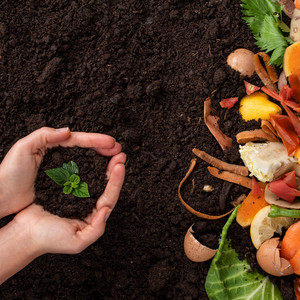
The rest would get taken to a massive composting pile where it would get turned into good dirt and taken to farms and we're going to sort through it and nothing will go to landfill.
Jasmine says companies pay for waste management anyway.
They might as well pay to have their excess food donated.
Plus, this way, they get a tax deduction.
The goal is to turn food waste into a win-win-win.
Better for hungry people, the climate, and businesses.
And it's all done with the tap of an app.
So the app essentially inventories what it is that they have.
They tell us, hey, I've got 15 racks of bread.
We get it picked up.
Now, this is more of a white glove service.
So, on our end, we're tracking what it is.
How many of the items are breakfast?
How many of the items are snacks?
What's wheat bread?
This is what we do on the back end.
It gets picked up, we get it delivered.
When the nonprofit receives it, they sign for it almost like they would a UPS package, and the driver takes a picture and that signature generates a donation letter into our clients portal.
So now they have a record of everything that was donated.
Plus they see what went to a hog farm or what went to compost.
So it's kind of like a pie chart.
This was donated.
This is recycled.
And do you tell them how many emissions they kept from being released?
Yep, we let them know for poundage.
So we measure it by pound.
So for every pound of food they keep out of landfill, we tell them what the CO2 emissions are that they're helping to prevent.
So I want to say, last year with Goodr we had about 7 million pounds of CO2 that we prevented and about 5 million meals we provided to people in need.
Later, Jasmine joined me on the TED stage to explain more about her business model and why companies are initially reluctant to change how they can get rid of their excess food.
And I think what it is is that the old guard is we've always done it this way.
We've always thrown it away.
And this is how we do it.
And, of course, when I was first starting, people were like oh well, if someone gets sick and we'll get sued.
And so Goodr said, hey, we'll take on all of that onus.
We provide the packaging materials.
We provide the labels.
When nonprofits receive the food, it comes from Goodr.
They sign hold harmless agreements.
I have a multimillion dollar liability insurance because the airport was my first customer.
We were driving on tarmacs and I ended up having to get insurance that I wasn't quite ready for.
But it definitely helped the business.
And even with all of that. people will still say, well, we're just afraid.
Or our lawyers just can't wrap their heads around it.
Or we're going to compost everything, even if it's edible.
Talk to me more from the corporate side.
How did you get people to come on board with this?
Did something have to change when it comes to laws and forcing companies to do this, because they want to be able to say to their customers like we are a sustainable company, like.
So what i used to do is i would go to the websites of the big hotel groups, the big food groups and i would look at their sustainability reports.
This is how i got the airport as a customer And I went to them and I said hey, you know, 27 of I'm looking at your waste tonnage and 27 of this, according to the EPA, is food.
You guys are sitting in College Park.
64% of the children in this city are living in poverty and all this food is going to waste.
So I think so much, it was really about making people keep their promises.
You know like hey, I won't say the hotel group, but I was like hey, you guys said you're gonna cut food waste in half by 2025.
This is in two months.
Like, why have you guys not started?
Like, what's the process?
People need to keep, I think we live for the announcement.
And we as people don't follow up on the delivery.
Growth.
I mean, we should be clear.
You're not a nonprofit.
You are a B Corp.
Why is that important to you?
Why did you decide to go for a for-profit company?
Is it because that is something that you hope to scale?
Where are the pros and cons with that? things.
One.
I think the nonprofit was going to be a much harder old guard to get past, because everybody always donates to the food bank.
It's all we ever know.
We've been doing canned food drive since we were eight.
Our kids are still doing it in school now.
And I felt like I was going to be spending a lot of time trying to gain.
The biggest piece that I saw though, was that businesses were already paying to throw this food away.
So this was not newfound spend.
They're already paying waste management, Republic Services, whoever their waste company is.
Mind you, the waste industry is a trillion dollar industry.
None of us ever say, let's just keep our trash.
We are paying for this on a daily basis.
It was going to be a better spin.
So, dollar for dollar, we're a little bit more expensive, but the outcome, the return on the investment for our clients, is far, much greater than they would ever get from a traditional waste company.
And so I do look at us as a triple bottom line.
We're for people, we're for planet, and we are for profit.
Back at the warehouse, I wanted to know if food waste is a problem that Jasmine thinks can go away.
Like for one of her first clients, the Hartsfield-Jackson Atlanta International Airport.
Food waste is inevitable.
There's no preparation for it.
I remember when I was first starting this company, I would go and pitch to investors and I would say, like listen, we're going to help them track the things that they waste the most.
We're going to get things diverted from landfill.
And people would ask me, well, why don't you put yourself out of business?
Because if they know what they're wasting, they're going to stop wasting it as much.
And the thing is you plan for 100 people at the airport.
People get delayed and now you've got 60 people there and 40 mils that are extra.
That's what happens.
And so that's why there's waste.
But do you ever get people who are like ugh, this is so annoying.
This company is creating more hassle for us.
We used to just throw it away and now she's changed the whole thing and we have to sort it, we have to put it over there, we have to call them.
You know, sometimes at the top, but not at the bottom.
When we first started with the airport, A lot of the concessionaires were like oh, this is going to be a big hassle.
And I told them, hey, this is not a huge habit change.
It's not going to cost you a lot more in labor.
It's going to maybe take these people five to 10 minutes to, instead of putting in a landfill, put it in a package and get someone going to the app and request a pickup.
What we found is when we went over to the airport and I started talking to different employees about it.
These are people that themselves are living on the marginal poverty line, making 9 10 an hour at the airport.
And so many of them said I used to hate having to throw this food away when I needed it at home for my family.
People think it's going to be harder, it's going to be a lot more, but the circle of life here is so critical.
I mean, this is creating this circular economy.
And for someone who's living on the marginal poverty line, themselves working in the food service industry.
They often don't get a chance to give back and to be part of this, because they're really just trying to survive.
I mean, every state must have different laws or different corporate responsibility goals or even just different sentiment towards this.
Tell me what the landscape is like out there.
I would say New York and California are on the rise.
If you think of this from a global issue, which of course it is countries like France Italy Denmark, they actually fine businesses for not doing this.
So it's a big deal.
But in states like California and New York, they are introducing legislation.
There are no fines yet.
But it's coming.
I think the actual enforcement is a little delayed.
I do believe that once that enforcement starts, then businesses are going to be calling and knocking down our doors trying to get to us because they don't want to be fined.
One of the things that we're kind of pushing for in Georgia, specifically in the city of Atlanta.
We want, when any business gets a food service license, we want them to have to select a nonprofit or an organization that they would donate edible food to and a location that they would compost with.
Just having that on their brain and having that be part of the process.
Just normal.
What you do.
What are you going to do?
What is your plan for your food waste?
If you had to say what your biggest obstacle is or challenge, in terms of like I see it in your eyes.
You're sparkling.
You have growth on the brain.
What's gonna make it hard for you to do that?
There's two things.
One is obviously access to capital as a company, because a part of us getting more companies to join on is being able to get in front of them.
So I think that will make it hard, specifically because I'm a woman, specifically because I'm a person of color.
I think the other thing that makes it hard is people wanting to stick to the old guard.
And we cannot do the same thing and expect different results.
We have to make changes.
And I should have...
100 employees in here with more than enough work, and everybody's working 40, 50 hours, because that's how much food waste is out there.
But we're not getting it.
We're not getting to the level that we need.
If you're an everyday person, you're supporting your local stores, your local businesses.
Ask them what they're doing with their food waste.
If you find that they're not doing anything, ask them have they heard of Gooder.
We've gotten calls from administrative assistants who are like hey, I order food at this office for all of the team.
We have so much waste here.
You need to come and meet with our executive chef at the cafeteria.
Like, this is what happens.
So, no matter who you are, you have the ability to kind of make a change and get people involved in this journey with us.
That was Jasmine Crow Houston, founder and CEO of Goodr.
You can see her full talk at TED.com.
We have talked about preventing food waste at home and repurposing excess food.
But what about all the resources we humans use to grow food to begin with?
That is something chef Anthony Myint was definitely not thinking about in 2010.
That is when he launched Mission Chinese Food, the now famous restaurant known for its delicious food and fun atmosphere.
Mission Chinese Food was kind of like a party Chinese restaurant.
And we were trying to offer like really affordable and craveable and tasty food.
And making that happen was really stressful.
Orders are coming in.
Oh, we ran out of this ingredient for this dish last night.
Nobody told me.
Somebody is hungover.
They're calling in sick.
The dishwasher's not coming.
Who's going to do that?
Nobody's eating on the patio.
How are we going to make payroll this month? oh, the refrigerator's not working.
You know oh, this like you're constantly just putting out fires and trying to get through that day.
But then Anthony and his wife had a baby and they were taking pains to feed her sustainable, organic food, food that was good for her and the planet.
And this got him wondering about the food he was serving in his restaurant and how he was contributing to climate change there.
It wasn't like we were, you know, a farm to table restaurant, but it's because the restaurant industry is the biggest part of the food economy.
And so it just started to feel like this huge part of the economy needs to be working on climate.
You know, let's think about 20 years ahead instead of like two hours or two weeks ahead.
So in 2016, Anthony and his wife, Karen Leibovitz, made a big bet.
They put their life savings into a new restaurant called The Perennial.
The idea was to run a fully sustainable, no-waste restaurant and only cook with environmentally friendly ingredients.
Not an easy task.
Yeah, so when we started the perennial, we were basically just using it as a laboratory to explore all the different practices that a restaurant could engage in.
For example, the perennial, true to its name, sourced long-living perennial grains to make their sourdough bread.
You know, we composted the menus and fed them to worms.
Beef came from an experimental low-carbon cattle ranch.
We were using the food scraps to grow black soldier fly larvae and then feed that to fish, to kind of create this closed loop.
And they only bought from farms practicing regenerative farming, using less extractive practices.
Applying compost instead of fertilizer, planting cover crops and reducing tillage to kind of leave the soil covered.
Perennial got great reviews and Anthony became known as the sustainability guy in the restaurant industry.
But after three years, Anthony and Karen realized that even if hundreds of restaurants also became strictly sustainable, they still would barely be supporting these farmers.
We started talking to farmers and ranchers and asking them Just honest questions.
You know, over a beer.
Hey, I just paid my invoice.
Does that help you do the next thing, this or that?
And the answer was like, no.
You know, one rancher told me, like I'm not driving a Maserati around, you know, like I'm seeking government grants.
When you buy my product and pay your invoice, you're just buying my product.
There's not an extra $100,000 in there for me to change farming.
I mean, the whole organic movement is just 1% of acres after 50 years in the U.S.
Learning this was a little bit soul-crushing, to be honest.
Here's Anthony Mient from the TED stage.
Because we had gone all in with our life savings.
You know, trying to make this change happen, only to learn that awareness, price premiums, better choices, were probably never going to regenerate acres at scale.
Basically, we were trying to change eating instead of changing farming.
Changing farming is different.
You can't just walk into the grocery store and hand the cashier a buck for farmers to switch from chemical fertilizer to compost.
You can't just ask the waiter for a side order of cover crop planting.
Society didn't even really have mechanisms to directly change farming.
But why not?
That's basically the kind of question we were grappling with as we closed the restaurant and then started our next chapter.
It just became clear like oh, we need billions of dollars to change agriculture, not just a few people buying different ingredients.
And so Anthony pivoted away from farm to table, to what he now calls table to farm, enlisting a collective of restaurants to tack on a small fee to the food they sell, which then adds up to sizable grants to regenerative farms.
So a business might send a dollar or a couple cents and we collect funds like that and then work with farms and ranches to apply compost plant cover crops and basically just do the next practice on the next acre.
We have a pretty wide range of crops that we can grow.
Zero Food Print, as the organization is called, supports farmers like Veronica, Mazariegos and Estacio.
Everything from your leafy greens collards cabbage broccoli, and even your tomatoes, peppers and potatoes.
And the techniques that Veronica and her team used to make their 40-acre farm in Central California sustainable.
Well, they're a lot of extra work compared to conventional farming.
Because you really are trying to mimic natural processes.
So in the case of cover crops...
Usually it's a mix of bell beans, vetch, peas.
These are all nitrogen fixing.
And really what we're trying to do is increase microbiota activity.
And this really helps with increasing the nutritional density of our food, but also helps control pests and disease.
The goal is... really investing in our soil.
And that is a process that takes time.
We're already operating on very And therefore we are always looking for opportunities to be able to cover those costs.
Veronica says grants like the one she got from Zero Foodprint allow her to plan for the future.
And so I do think it affords us a little bit more flexibility.
Were it just up to us, we wouldn't be able to do In a minute more about the table-to-farm movement and how restaurants and their customers are helping suppliers be more sustainable.
On the show today, The Great Food Rescue.
I'm Manoush Zomorodi and you're listening to the TED Radio Hour from NPR.
We'll be right back.
This message comes from Mint Mobile.
At Mint Mobile, their favorite word is no.
No contracts, no monthly bills, no hidden fees.
Plans start at $15 a month.
Make the switch at mintmobile.com.
That's mintmobile.com.
Upfront payment of $45 for 3-month 5GB plan required.
Equivalent to $15 a month.
New customer offer for first 3 months only.
Then full price plan options available.
Taxes and fees extra.
See Mint Mobile for details.
This message comes from Jackson.
Seek clarity in retirement planning at Jackson.com.
Jackson is short for Jackson Financial Inc.
Jackson National Life Insurance Company Lansing, Michigan and.
Jackson National Life Insurance Company of New York.
Purchase New York.
This message comes from Mint Mobile.
At Mint Mobile, their favorite word is no.
No contracts, no monthly bills, no hidden fees.
Plans start at $15 a month.
Make the switch at mintmobile.com.
That's mintmobile.com.
Upfront payment of $45 for 3-month 5GB plan required.
Equivalent to $15 a month.
New customer offer for first 3 months only.
Then full price plan options available.
Taxes and fees extra.
See Mint Mobile for details.
Support for this podcast and the following message come from Lisa.
Lisa isn't just about sleep.
It's about impact.
They donate thousands of mattresses each year to those in need, while also partnering with organizations like Clean Hub to help remove harmful plastic waste from oceans.
Visit Lisa.com for 20% off mattresses, plus get an extra $50 off with promo code NPR.
That's L-E-E-S-A dot com, promo code NPR.
It's the TED Radio Hour from NPR.
I'm Manoush Zomorodi.
On today's show, The Great Food Rescue.
We were just talking to Anthony Myint, co-founder of the celebrated restaurant Mission Chinese Food and the nonprofit Zero Foodprint.
This group gives grants to regenerative farmers, farmers who are trying to make their land more sustainable and grow healthier food.
Anthony calls this model Table to Farm, because the money for those grants comes directly from restaurants and their customers.
A business might send a dollar or a couple cents and we collect funds like that and then work with farms and ranches to do the next practice on the next acre.
It's just a new service that allows customers and businesses to directly and proactively change farming.
And Anthony says most people feel good about paying a little extra for an entree or they don't even notice that their daily coffee costs a few cents more.
The best thing is, citizens are just kind of going about their daily lives, you know, while the change is happening.
And so Zero Food Print is trailblazing collective regeneration.
We're using these same principles and then a few cents from the downstream food economy to make a direct shift in upstream agricultural production.
Basically, we're improving the food grid.
And so, for an example of how this works, around the corner from Mission Chinese Food is an amazing coffee shop Linnea Cafe.
So they source from a really high-integrity grass-fed dairy company, Strauss Creamery.
So you go in, you get your coffee, and instead of, say, five bucks, it's $5.05.
So Zero Food Print collects the five cents and then we make grants for compost application cover, crop planting, reduced tillage, managed grazing, planting perennials.
And so it's like that five cents is decarbonizing the food shed.
In the case of the coffee shop, it's actually kind of regenifying the supply chain because we've already made over 100000 in grants to Strauss producers.
And this kind of table-to-farm work is underway at dozens of businesses wine companies, Michelin-starred restaurants, catering companies, composters and even every Subway Sandwiches location in Boulder, Colorado.
And if this was every Subway location period sending 1, that'd be something like 160 million per year from just one corporation.
But the real key is that it's what customers want.
It's amazing marketing because it's real.
It's local, direct climate impact that's affordable. but it also adds up quickly.
ZeroFoodPrint has already awarded over $3 million in grants to 120 farm projects.
But really, we're just getting started.
We've proven the concept on a process that's easy and transparent for farmers but rigorous enough for government collaboration.
Any farmer can request funds to begin or to advance their progress, and then Zero Food Print analyzes the requests and then selects the most cost-effective projects.
Then we act as almost like a general contractor, taking the project from start to finish, working with local experts and boots on the ground to validate and coordinate each one.
And the funds could come from anywhere.
It could be a dollar per trash bill, a penny per pound, one percent, a grocery store roundup.
But the difference is that we can use the funds and then just implement the projects now.
So it's not just 2040 goals or whatever.
That's really what used to frustrate me with governments and corporations.
It seemed like they weren't taking the climate crisis seriously.
But I've come to realize that they didn't really have a mechanism to team up and that nobody could do it alone.
Governments can't raise taxes because it won't pass a vote.
Corporations can't give away tons of profit because shareholders would sue.
Farmers didn't have the resources to take on all these risks themselves.
And customers didn't even have a way to vote effectively with their dollar.
But now at a zero footprint business, you can.
When I was growing up, nobody used the word compost, except for my weirdo parents who had one in the backyard.
Is that something that you know is a bright spot when it comes to helping connecting restaurants to farms and closing that loop, as you described?
Yeah, I would make the case that compost is the most important regenerative practice.
And the reason is because it resonates with people.
The food system was actually part of nature in the way the rest of all growing on the planet works.
Compost projects are really, really climate beneficial, basically.
There's avoided methane from the landfill, from the organics not off-gassing in landfill areas.
There's the potential for it to replace fertilizer.
There's literally just the actual carbon that you're applying to the soil.
And then oftentimes if you apply compost enough or for a couple of years, then that kind of jumpstarts the soil biology.
So for all those reasons, compost is one of the most cost-effective compounds.
With New York City, it's happening through policy.
So California just required composting starting a couple years ago.
Washington state just required it starting last year.
And so there's this...
World in which, like the government, may not tell people how to farm, but the government is creating millions of tons of compost by law.
And so if the economy can find a way to get it to farms and ranches, that would be like the low hanging fruit, like biggest scalable opportunity.
Hmm.
This episode is about food waste and I think to many people that might mean portions that are reasonable so that there's not a lot of leftovers, or making sure to check expiration dates.
But in your world that you're creating, food waste is really tied to resources.
How do you see it?
Yeah, and that's actually why it's so optimistic is that nature is so powerful that if we plant that seed with those couple cents or the little bit of organic matter going back, nature can restore itself.
And I think that there's probably half the regenerative movement or something does this because of that optimism.
And you know, for me anyway I'll kind of quote my wife it almost like sort of fills a little bit of a religious void for a secular person where I feel like I'm actually working to save a little bit of the planet at a time.
A dollar at a time, a thousand dollars at a time, an acre at a time.
You know, one practice at a time.
And then in a way, that's actually what each community is going to need in the medium term.
If a community did this, they would have less of a problem at the next fire or flood or drought or whatever.
And so I think that it's actually probably more locally beneficial than renewable energy.
And so I'm optimistic that there will be transformative change soon.
That's Anthony Mient.
He's the co-founder of the nonprofit Zero Foodprint and the restaurant's Mission Chinese Food.
You can watch his full talk at ted.npr.org.
So we have spent the hour hearing about how we can waste less food.
But can we also make ourselves feel happier while doing it?
Feeling good while we make greener decisions is the only way we can turn actions into habits, says behavioral scientist Xiaoying Zhao.
And she has some life hacks that can help.
Here she is on the TED stage.
Hey, everyone.
I'm Jay-Z.
Not the cool rapper, but the professor trying to cool the planet through behavior change.
The other day, I gave my students an assignment.
I asked them to come up with individual actions they can take that serve two functions reduce greenhouse gas emissions and make themselves feel happier.
They did a great job coming up with actions to reduce emissions, but they had a much harder time with the happiness part.
One student told me that he wanted to cut back on cheese.
But right after he said that, he got really sad.
Unfortunately, my students are not alone.
When most people think about climate action, they immediately default to things that have to give up for the planet.
This mindset is so ingrained in us partly because the current narrative on climate action is about personal sacrifice.
Drive less.
Eat less meat.
Shop less.
Less, less, less.
Now, I'm a behavior scientist, so trust me when I say this.
This framing doesn't make us feel great.
If anything, it makes us feel shameful and guilty.
And those negative emotions are not conducive to long-term behavior change because they make us retreat and disengage.
If the future of a planet depends on a few people willing to make personal sacrifices, we're not going to make it.
So what should we do instead?
The aha moment came to me at the end of a faculty meeting, when my colleague Elizabeth Dunn approached me and asked can we make climate action feel happy instead of miserable?
I said, of course.
But then it struck me that I don't think anyone ever connected happiness to climate action.
So Liz and I sat down to do exactly that.
This is a happiness scientist.
She knows what makes people happy.
I'm a behavioral scientist.
I know what makes people change their behavior.
I'm also a human carbon calculator.
I like figuring out exactly how much emissions certain activities have.
So first, I came up with a list of actions that can substantially reduce greenhouse gas emissions.
And then Liz identified the actions with the largest happiness benefits.
And this is how we came up with what we call the happy climate approach.
It's actions in this sweet spot that not only reduce emissions, but also make you feel happier at the same time.
Now I know that some of you might think that individual actions may seem trivial without large-scale system change.
I get that.
But let me tell you how I think about this as a behavior change expert.
Our individual actions do matter because they can spread like a ripple effect to instigate collective action.
They send a market signal to businesses and they can trigger broader structural institutional change.
So yes, we do need system change, but we also need individual behavior change.
Don't let anyone tell you otherwise.
All right.
Now I want to take you on a whirlwind tour through some of my favorite happy climate actions.
Are you ready?
Yes.
Great.
Let's start with my pet bunny.
A few years ago, my partner and I adopted Greenwich, She's adorable.
She's also a vegan.
We have so many plants, vegetables and fruits in our house, thanks to Greenwich.
And because of that, I'm eating a lot more vegetables myself than I used to.
Eating more plants can reduce agricultural emissions by up to 80%.
I guess that part you may have known before.
But do you also know that a plant-based diet can make you feel happier?
So researchers think that this is because plants so fruits, vegetables are high in vitamins and phytochemicals that provide both antioxidant and anti-inflammatory benefits to the brain and the body.
So the happy climate action here is eat more plants.
This does not mean never eat meat, because I can tell you that deprivation is a disaster for happiness.
Instead, we should aim for the right balance of meat and plants in our diet.
That will make us maximally happy.
Now, as you're thinking about this diet and this balance, understand that not all meat is created equal.
One kilogram of beef emits about 100 kilograms of greenhouse gases.
That's roughly the same as driving 250 miles.
But other types of meat, like fish, pork and poultry, have a lot lower emissions.
But if you do want to eat beef, here's the happy climate hack.
Make it a treat.
One study shows that temporarily giving up something we enjoy can actually renew our capacity to savor that thing when we have it again.
And that can increase our happiness.
And beyond food, we can turn other things into a treat as well, like shopping.
Now, you know that fast fashion has a huge climate impact.
So instead of shopping often, make shopping a treat.
And here's the happy climate hack.
Jackets, jeans, shoes have a lot of greenhouse gas emissions.
So treating ourselves to high-quality versions of these products that won't fall apart after a few wears is actually good for the planet.
Underwear, on the other hand, have pretty low emissions.
So, you know, please buy those whenever you need them.
You're welcome.
Now let's talk about waste.
Do you know that if your space is clean, zero waste and organized, you may feel happier?
Let's take a look at perhaps the messiest part of everybody's home.
The fridge.
Some environmental experts recommend that we put perishables into the drawers and put the condiments at the door.
I hate to say this, but I disagree.
I don't think the fridge is designed with human behavior in mind.
We often forget about the things in the drawers, right?
Out of sight, out of mind.
And that can lead to a lot of food waste and emissions.
So what's the happy climate action here?
Feng shui your fridge by moving the perishables to the door and the condiments into the drawers, so I can catch things before they rot.
I also five-fold my fridge.
That is, first in, first out, meaning moving older items to the front of the fridge, so I don't forget about them.
This way, you can have a zero-waste, clean fridge, and you may feel happier.
Now, beyond waste, we'll have to talk about travel.
And here's the happy climate hack.
Instead of saying drive less, we should say drive more people.
Yes.
Some studies suggest that the more time we spend with our friends and family, the happier we feel.
So what this means is that instead of driving alone in our car, we should drive our friends.
Because carpooling can turn those dreadful minutes behind the wheel into joyful moments of socializing.
I think you get the gist here, and I encourage you to take a moment and think about the actions you can take in your own life that not only reduce emissions but also can make yourself feel happier.
There's probably a lot of those in this sweet spot.
So please get creative.
Because the bottom line is this.
We need to change the narrative on climate action.
We need to make climate action feel good.
Because if we get this right, our future will indeed be happy.
Thank you.
That was behavioral scientist Xiaoying Zhao.
You can watch her full talk at TED.com.
Thank you so much for listening to our episode.
It was produced by Katie Monteleone, James Delahousie, Rachel Faulkner-White, Harsha Nahata and Fiona Gearan.
It was edited by Sanaz Meshkenpour and me.
Our production staff at NPR also includes Matthew Cloutier.
Our executive producer is Irene Noguchi.
Our audio engineers were Jimmy Keeley and Zoe Vangenhoven.
Our theme music was written by Ramteen Arabloui.
Our partners at TED are Chris Anderson, Roxanne Heilash, Alejandra Salazar, and Daniela Balarezo.
I'm Manoush Zomorodi, and you have been listening to the TED Radio Hour from NPR.
This message comes from NetSuite.
What does the future hold for business?
Can someone invent a crystal ball?
Until then, over 42000 businesses have future-proofed their business with NetSuite by Oracle, the number one cloud ERP, bringing accounting, financial management, inventory and HR into one platform.
With real-time insights and forecasting, you're able to peer into the future and seize new opportunities.
Download the CFO's Guide to AI and Machine Learning for free at netsuite.com slash story.
Support for NPR and the following message come from Washington Wise.
Decisions made in Washington can affect your portfolio every day.
Washington Wise from Charles Schwab is an original podcast that unpacks the stories making news in Washington.
Listen at schwab.com slash Washington Wise.
This message comes from NPR sponsor Rosetta Stone, an expert in language learning for 30 years.
Right now, NPR listeners can get Rosetta Stone's lifetime membership to 25 different languages for 50 percent off.
Learn more at Rosetta Stone dot com slash NPR.