Welcome to Spotlight.
I'm Andrew Devis.
And I'm Megan Nolat.
Spotlight uses a special English method of broadcasting.
It is easier for people to understand, no matter where in the world they live.
His top event was the 100-metre dash.
He was the fastest in the world.
He dreamed of winning a gold medal for his country.
He was favoured to win at the Olympic Games that year.
He trained hard and was ready.
Then something happened that forced him to make a choice.
It was the most difficult decision of his life.
The Flying Scotsman sat down.
On today's Spotlight, we look at the life of Eric Little.
He was one of the top competitors in the 1924 Summer Olympic Games in Paris.
He entered three running events.
Eric was also a Christian.
One of these events caused conflict with his beliefs.
Eric Liddell's parents were Scottish.
But they spread their faith in China while living as Christian missionaries.
They raised Liddell to be a follower of Jesus.
Later, he went to a special school for the sons of missionaries.
There, he developed a talent for sports.
He performed well at rugby, cricket and track.
He was very fast.
He won all the school races.
In college, Liddell continued to do very well in rugby and track.
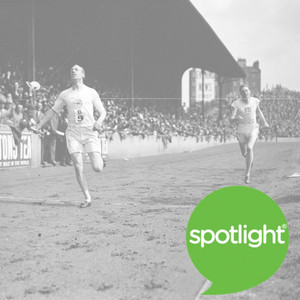
Local newspapers called him the Flying Scotsman because of his speed.
He earned a place on Great Britain's Olympic team.
Eric said, I believe God made me for a purpose.
But he also made me fast.
And when I run, I feel his pleasure."
In the Summer Olympics.
Little was to compete in the 100-meter dash, the 200-meter dash and the 400-meter dash.
The fastest runners competed in these three races.
The 100 meter dash was Little's best event.
Many thought he would win the gold medal.
But he learned that the qualifying races were on Sunday.
These events were when the top runners earned a spot in the final competition.
However, Little believed that Sunday was the Sabbath.
The Sabbath is the one day of the week when Christians rest.
It is a day to focus on God.
Little did not work. or compete on Sundays.
The book of Exodus is part of the Christian Bible.
It says, remember the Sabbath day by keeping it holy.
Six days you will do all your work, but the seventh day is a Sabbath to the Lord your God.
On it you should not do any work.
Little had to decide if winning a gold medal was more important than his beliefs.
It would only be one day.
Little could honor the Sabbath for the rest of his life.
The sacrifice would be for his country.
No one would blame him.
He did not want to disappoint anyone.
But he also wanted to follow his religion's command.
Jenny Somerville, Eric's sister, said, He was under great pressure.
He was very upset.
Am I doing the right thing by not running?
Am I letting king and country down?
King George V was the King of England.
He tried to persuade Eric to race, but Eric decided his religious beliefs were more important than anything else.
He would not compete.
I am not running, he announced.
He spoke in a Paris church on Sunday as they ran the qualifying races for the 100-metre dash.
The 200 and 400-metre dashes were not Little's best races.
He was much faster at shorter distances.
He was not expected to win either race.
In the 200m dash final, he came in third place.
He won the bronze medal.
He barely managed to qualify for the final of the 400m dash.
He was given the outside lane, number 8.
Runners considered this the hardest lane.
The runner covers a slightly longer distance due to the curve of the track.
Also, he could not see the other runners because he was so far outside.
He did not know how well he was doing.
No one thought Little had a chance to win.
One of Little's trainers gave him a note on the morning of the 400-meter dash final.
It read, In the old book it says, He that honors me, I will honor.
Wishing you the best of success.
Always.
Little recognized that his trainer was referring to a Bible verse.
This note helped Little believe in himself during the race.
He decided he would run the entire race with all his ability.
He could not see his other competitors from the eighth lane, so he would not worry about looking.
He ran as fast as he could the whole way.
Eric raced around the track with his head held back and his arms pumping wildly.
He was determined not to stop until he crossed the finish line.
When he finally did, he realized that he had won the race and a gold medal.
He had also set a new world record for the 400-meter dash.
After the Olympics, people celebrated Little as a hero.
He spoke at many events.
He talked about his Olympic victory.
But he always gave credit to his faith.
He then returned to China, where he was born.
Like his parents, he also served as a Christian missionary.
When Japan invaded China during World War II, Little was held in a camp with others.
He continued helping people and making them happier.
He taught children.
Years later, someone from the camp wrote a book about their experiences.
He said about Little, He was the finest gentleman.
It has been my pleasure to meet.
In all the time in the camp, I never heard him say a bad word about anybody.
England's Prime Minister, Winston Churchill, finally arranged for a prisoner exchange with Japan, so that Little could be released.
But Eric refused to go.
Instead, he gave up his freedom so that a pregnant woman could go in his place.
A year later, Little died from a brain tumor while still in the camp.
Have you ever had to make a choice based on your beliefs?
What did you do?
Do you feel you made the right choice?
You can leave a comment on our website at wwwspotlightenglishcom Facebook, TikTok and X.
You can also get our programmes delivered directly to your Android or Apple device through our free official Spotlight English app.
The writer of this programme was Peter Anderson.
The producer was Michio Ozaki.
The voices you heard were from the United Kingdom and the United States.
All quotes were adapted for this program and voiced by Spotlight.
This program is called The Flying Scotsman.
We hope you can join us again for the next Spotlight program.
Goodbye.