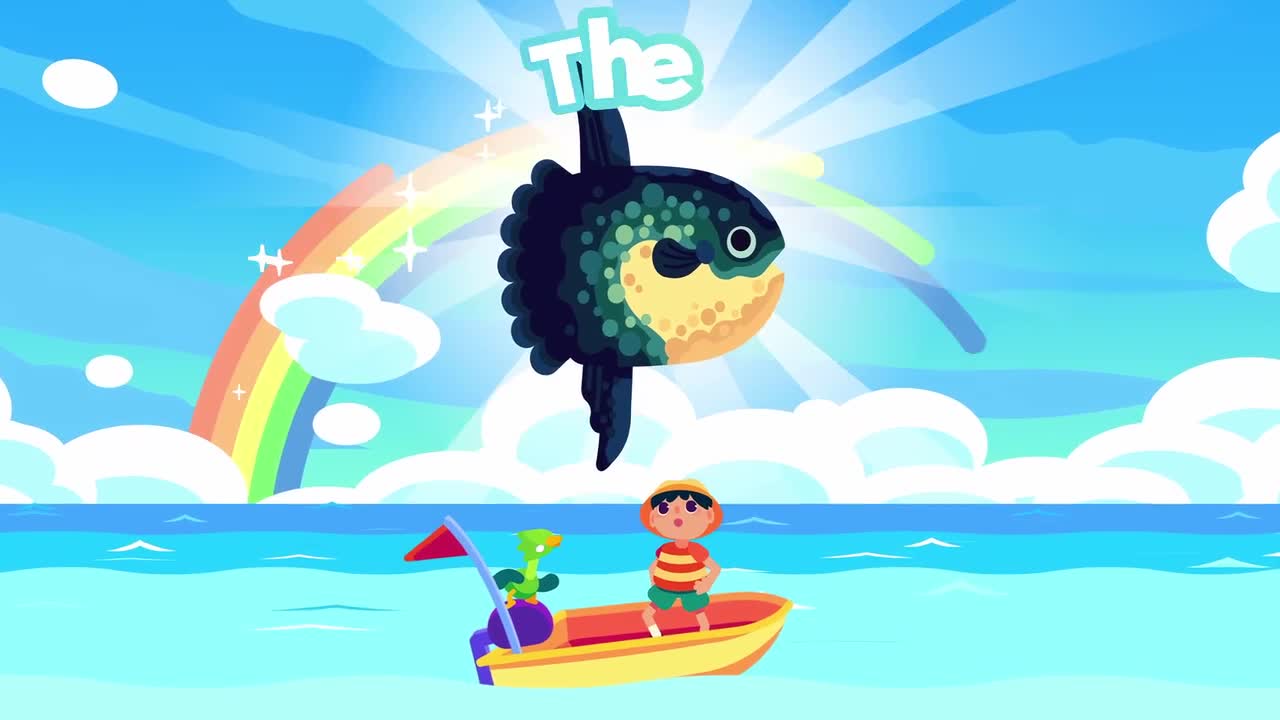
The sunfish, or mola, is the dumbest creature alive.
Not just from an intelligence perspective.
I mean, look at it.
It's a being of extremes and comically bad at being an animal.
Its evolutionary strategy is to be chunky boys, weaker than their predators, staring into the ocean with empty, dumb eyes, eating the least nutritious food possible, but growing amazingly fast, getting infested by parasites and dying horribly.
If you presented the sunfish in animal invention class, everybody would be really upset with you.
And yet, somehow, the molar doesn't just survive, but thrives.
How?
Like, actually, how?
Are you okay, evolution?
The genus of Mola is a fish built wrong.
A giant head that evolution lost interest in halfway through.
Its body is very flat and circular without a real tail.
Instead, it has a sort of rudder-like stump.
Two fins on the top and bottom give it an unorthodox swimming style.
They propel themselves forwards by flapping their fins in a goofy, wobbling motion, with as little grace as possible.
It's less like swimming and more like underwater flying, although when they really try, molar can match strong swimmers like salmon or marlins.
Some fish also don't have a swim bladder, the gas-filled organ most fish use for buoyancy.
Instead they have a jelly-like layer of flesh.
That's 90 water to dive or surface, which definitely doesn't help with agility.
Most of the time, molar cruises around leisurely.
Their teeth are fused into a parrot-like beak that sits in a tiny gaping pout that's open most of the time.
Together with two huge empty eyes, the sunfish has a perpetual derpy face, always looking stunned.
Some fish don't have proper scales, but some of the thickest skin in the ocean after whales.
Up to 15 centimeters thick.
It's rough and rubbery and often covered in mucus, like armor made from car tires.
Although most of what it's protecting is not that great in the first place.
Sunfish can become as big and massive as a large car, but its organs are collected together in the front of their body, while most of their bulk is oddly textured.
Flabby, gelatinous tissue, an animal made from all the worst parts of a steak.
This very mid meat is supported by a sort of weird skeleton without ribs or a tailbone and a lot of cartilage.
Their weird bodies are a mobile mini-ecosystem infested and saturated with around 50 species of parasites, probably more than any other fish.
Crustaceans barnacles, various worms and protozoans live on and in their skin muscles, gills or organs.
They're such a paradise for parasites that even their parasites have their own smaller parasites.
Some molar are also followed by an entourage of other fish that seek protection, food scraps or feed on their inhabitants.
This awkward situation may be the root of their most bizarre behavior.
Mola frequently swim to the surface to float on their side like a pancake.
They're sunbathing to warm up again from deep cold dives, which is where they got their name from.
But they also do it to present their body to seabirds like albatrosses.
The birds start picking the parasites from the sunfish body, while smaller fish that live near the surface take care of the bottom half, cleaning them in exchange for a snack.
While this is a great adaptation to their parasite infection, it sadly often leads to dead sunfish when they collide with boats.
Since they're still cold and slow from the deep when they float on the surface, they can't react to anything coming at them.
Once molar reach a certain size, most predatory fish seem to avoid them, probably wrongfully, assuming their size means that they could fight back, and because their outsides are too tough.
But orcas, sharks and sea lions sometimes attack and take a bite, usually only to say no, thank you, I prefer starving to death.
Because for big predators some fish are watery, not very nutritious cartilage-filled, parasite-ridden jelly donuts.
They simply prefer to eat almost anything else, leaving molars swimming around with big chunks missing looking even more ridiculous.
Sea lions have been observed to skip the whole sunfish and only eat its organs, play with its body like a frisbee and then leave the rest for scavengers.
The sunfish might be sad about all of this, but we'll never know, because our chunky boys are incredibly stupid.
Lovable chunky derpy idiots.
Sunfish have one of the lowest brain-to-body ratios in the animal kingdom.
A car-sized molar has a walnut-sized brain and only a tiny spine.
So its mind runs an early alpha version of intelligence with updates disabled.
If you look a sunfish deep in the eyes, you'll mostly see your reflection.
Despite or maybe because of their daftness, they're pretty gentle fish that show no aggression towards other larger animals and are friendly to humans.
Sometimes they even approach divers or boats to check out what they are and to stare at them durbly.
Even if some fish could get angry, they kind of lack the tools or temperament to hurt a human.
Adult sunfish are loners that spend most of their lives drifting and wobbling through the ocean solo, although sometimes they come together to make babies.
Spotting two sunfish making love is extremely difficult because they rendezvous in the deep ocean.
But we know that their strategy is for 99.999% of their offspring to die.
Female molar carry far more eggs than any other vertebrate on Earth.
Hundreds of millions of eggs in a single mating party.
Sunfish eggs are tiny and float in the plankton where millions are eaten, starve or don't even hatch.
The larvae that do hatch are adorable rice grain sized weirdos covered in little star shaped spines with the derpy facial expression of adult sunfish.
All kinds of predators gobble up these tiny molar by the millions.
So to have any chance, they need to become large quickly.
Luckily, some fish have the most rapid and extreme growth of any animal.
A larva can increase its weight 60 million times from hatching to adult.
This is the equivalent of a human baby growing to the weight of an aircraft carrier.
If you grow fast, you need a lot of nutritious food, and this is why MOLA have chosen to specialize on the dumbest meal available.
The dumbest predator versus the dumbest prey.
The sunfish found a truly remarkable ecological niche.
If your prey is so pathetic that some other predators don't want to bother with it, you have it all for yourself.
Mola are generalized predators with a focus on small and soft stuff.
Their huge eyes can see incredibly well, especially in dim water, and they can sneak up on small prey or sift through drifting zooplankton.
Mostly fish larvae squids shrimps mollusks starfish, small crustaceans, really any soft critter they can get to.
But maybe their favorite meals are from the jelly kind of sea life, like jellyfish, tenefors and salps, which really is something, since these are almost entirely water and have almost no calories.
So to get any meaningful amount of nutrition, some fish can mow through swarms of jellyfish, sometimes devouring thousands in a single day.
Without a swim bladder.
Molar can dive very deep and surface quickly and freely, giving them a huge range, able to travel dozens of kilometers a day to graze on the seafloor or reefs, hunt for jelly in the deep or consume plankton and algae near the surface.
Mola are the cows of the ocean, huge and constantly floating around, slurping in high volumes of low-nutrient food.
Since they don't really chew with their beak, some fish have found another absurd way to eat long, claw-like teeth in their throat.
Mola suck in their prey, pull it through their throat teeth that prevent it from escaping, and maybe move it around and rip it apart like a slow-motion woodchipper.
Okay, as much as we're roasting the sunfish, and don't worry, it doesn't understand that we're making fun of it.
Actually it's kind of genius.
Nature has a sense of humor and has left niches in the ecosystem that are best filled by being passive and bad at everything.
Mola are derpy goofballs that are bullied by everyone.
And while it is fun to call them dumb, actually they're a highly specialized and resilient species, widely spread throughout the oceans of the world.
A marvel of evolution, a truly genius creature.
And as the human gazes into the sunfish's eyes and wonders how evolution could produce such an ingenious creature, Sunny suddenly wonders about her own origins.
There's a deeper version of her story that nobody told her, so let's help her find out.
With the MyHeritage DNA test, she can take a deep dive into her own DNA, discover her family history and explore her geographic origins.
And for only $29, she decides to go for it.
The DNA test is incredibly simple.
Just a quick swab inside her cheek, pop it back in the mail, and that's it.
After a few weeks, she gets her results back.
Like taking a journey back through the millennia.
She can now explore her ancestors' fingerprints etched into her DNA.
With Ancient Origins.
A new feature by MyHeritage DNA.
Sunny traced her story back 10000 years to find out she's descended from Norse Vikings.
And there's more.
She also discovers thousands of distant relatives all over the world.
All these people share a small part of her DNA.
Makes you wonder if they like Sunfish as much as she does.
This was more than just a DNA test.
It was like a global family reunion.
If you're curious about what your DNA might reveal about you, order your MyHeritage DNA kit today for just 29.
Click the link or scan the QR code.
Your DNA connects you to every other human on this planet, and learning about your origins can yield some truly amazing insights into how you became you.
Want the dumbest animal alive on your wall?
Our official Sunfish poster is now available on our shop, but only while supplies last.
This poster also kicks off a brand new series of dedicated video posters.
While you're browsing the shop, check out our other sciency products.
Every purchase directly funds new videos.
Thanks for helping this dumb fish make smart science happen.