This message comes from Capital One.
Banking with Capital One helps you keep more money in your wallet with no fees or minimums on checking accounts.
What's in your wallet?
Terms of law. See capitalone .com slash bank for details.
Capital One N .A. member FDIC.
Just a heads up, in this episode, a former president curses a few times.
This is Planet Money from NPR.
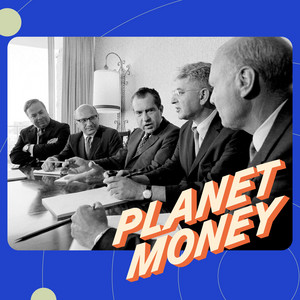
Secretly recorded audio from the White House, specifically 1 ,527 hours of secretly recorded audio.
Yeah, by 2004, 1 ,500 hours of Oval Office visits, Cabinet meetings, phone calls were now available for the public to listen to.
The full unfiltered dump of the Nixon tapes.
Do you remember where you heard the announcement?
It was on the news.
This is economist Burton Abrams.
It was probably a newscast that talked about the Nixon tapes.
And I said, this is what I've been waiting for.
Because obviously everyone wants to know about the dirty details.
Watergate. The nonsense.
The corruption. Well, everyone else was interested in Watergate.
I was interested in monetary policy.
Popular man I bet you were.
Yeah, see, ever since Burton Abrams was just a grad school whippersnapper.
He had hoped that the Nixon tapes might solve a mystery that he'd been somewhat obsessed with.
A mystery that begins with a famous economist named Arthur Burns.
Arthur Burns had a reputation of being an extremely cautious monetary economist who had written a book called Prosperity Without Inflation.
Prosperity without inflation.
Burns discussed how inflation was caused by too much money flowing through the economy.
Too much money chasing too few goods.
And in 1969 Richard Nixon appointed Burns chairman of the Federal Reserve.
And then Burns did things at the Fed that frankly seemed like letting too much money flow through the economy and chase too few goods.
And all of a sudden we get the worst decade of inflation probably in US history.
And the question I had was why did he do that?
Why did he abandon his prosperity without inflation ideas?
And did Nixon play a role in that?
At the heart of Burton's question was this thing you may hear about from time to time.
Fed independence. This is the idea that the Federal Reserve, our central bank, is too important to be a political tool and must be left alone to do what's best for the economy.
So Burton Abrams' mystery was did Richard Nixon use his power to bully Fed Chair Arthur Burns into doing things that helped Nixon in the short term but caused huge problems in the long term?
And then if so, how did Nixon do it?
Like literally were there recordings of him doing it buried somewhere in the 1500 hours of now released recordings?
So I almost immediately headed down to Washington DC from Delaware.
Like immediately? Yes.
What Burton's quest uncovered would show why Nixon and Burns is the cautionary tale about Fed independence.
Hello and welcome to Planet Money.
I'm Kenny Malone. And I'm Mary Childs.
A scandal like Watergate.
Well, that's the kind of thing they make movies about.
Burglars. Informants.
Et cetera. Today on the show, one economist's quest through the Nixon tapes to find proof of Fedgate.
Yeah, Fedgate. It is the story of Richard Nixon and his Fed Chair.
It's more subtle than Watergate.
It is more about monetary policy, but arguably had way bigger implications.
This message comes from Grammarly.
Eighty -nine percent of business leaders say AI is a top priority.
The right choice is crucial, which is why teams at one -third of Fortune 500 companies use Grammarly.
With top -tier security credentials and 15 years of experience in responsible AI, Grammarly isn't just another AI communication assistant.
It's how companies like yours increase productivity while keeping data protected and private.
See why 70 ,000 teams trust Grammarly at grammarly .com slash enterprise.
This message comes from Capital One with the Venture X card.
Earn unlimited double miles on everything you buy.
Plus, get premium benefits at a collection of hotels when booking through Capital One Travel.
What's in your wallet?
Terms apply. Details at CapitalOne .com.
Nixon and Burns, Burns and Nixon.
I will go out on a limb here and guess that we don't need to do too much background on Richard Nixon.
37th president, elected in 1968, famously claimed to not be a crook.
He's been dead for 30 years, and I would wager most Americans can still do a passable Nixon impersonation.
Do you have in your repertoire, like a Nixon impression that you could do?
Pretend I'm Richard Nixon.
Yeah, yeah. Full disclosure, it did take a little convincing.
But of course, our intrepid economist Burton Abrams can do a Nixon.
Well, Nixon would have said, Arthur, goose the money supply.
The economy needs to be rolling.
Yeah, you had it. See?
Pretty good. Now, our other main historical figure today, Arthur Burns, leading expert on monetary policy at the time taught at Columbia, died in 1987, obviously far less well -known than Nixon.
I'm sure you could do an Arthur Burns impression.
We wouldn't know if it was good or not.
But if you were casting Arthur Burns in a movie, who would you have play Arthur Burns?
You have to have white hair.
OK, OK. Spectacles, and a pipe.
OK. Apparently, Burns would use the pipe to emphasize statements that he was making.
Oh, how does that work?
When he was asked a question, he would take time to restuff the pipe, make it more dramatic before he spoke.
So that's a good trick.
So yeah, Burns and Nixon, Nixon and Burns.
And our Nixon -Burns story begins before either of them had fully ascended to power.
This was back around 1960.
Nixon was vice president at the time to Eisenhower.
Arthur Burns had been a member of ICE's economic council and noticed that the economy was slipping into a recession.
Unemployment was rising a little, and Burns actually went to then VP Nixon and said, this is going to be a problem for your upcoming presidential campaign, Dick.
The one against JFK.
Vice President Nixon then took that advice to President Eisenhower and essentially said, we need fiscal stimulus.
We need expansionary monetary policy.
Eisenhower, to his credit, said there's no way we're going to do that.
Unless we have evidence that the economy is entering into a severe recession, we're not going to manipulate the economy for political gain.
Nixon was very upset by this, lost the election, and said that's not going to happen again.
Eisenhower and his economic advisers were upholding the tenet of Fed independence.
And the reason it is so important for the Fed to be independent is because what is good for politicians, for the president, and what is good for the country do not always align.
For example, when you are trying to fight inflation, the Fed might have to increase interest rates to slow the rise of prices, and that is short -term pain to wrangle that long -term problem.
Now, Fed independence is not a law.
It is a norm, an agreement.
And our investigative economist, Burton Abrams, deeply suspected that the catastrophic inflation in the 70s and 80s might have begun because of Richard Nixon ignoring that norm.
If so, perhaps the Nixon tapes could allow a kind of autopsy of the whole mess.
Like, how exactly might Richard Nixon have pressured his Fed chair, Arthur Burns, into disastrous monetary policy?
So, in 2004, shortly after the Nixon tapes became widely available, imagine our economist Burton Abrams speeding, or driving sensibly your choice, down I -95.
He is headed from Delaware, where he is a professor, to College Park, Maryland, just outside D .C.
He has an appointment at the National Archives to start listening and investigating.
The tapes were not extremely accessible.
They were available on reels.
There were no transcriptions or very few.
They certainly did not transcribe the monetary policy conversations.
And you sit down, you get the literal physical reel, and you like put it on the thing and like play it.
It was a little cassette player, yeah.
And then you had to put on earphones and try to make out the garbled conversations that existed.
Yeah. So the first thing you learn the instant you listen to the Nixon tapes is that they are very often very hard to understand.
Nixon installed this recording equipment three years into his presidency.
Why did Nixon install this recording equipment three years into his presidency?
Well, it's a good question.
Nixon was a famously paranoid president and wanted exact documentation of his conversation, so no one misconstrued what he said.
But yeah, it's an odd choice for sure.
I wouldn't do it personally.
But he had the Secret Service install the recording equipment and this is the very first Nixon tape.
It's a recording of a meeting in the White House Cabinet Room.
You can hear how people are really far away from the microphone.
And plus, there are all kinds of unidentifiable noises.
People would back and bang on the table like in a...
Is that true? Can you hear him banging on the table in the Nixon tapes?
Oh yes. Oh yes. And coffee cups hitting, you know, they serve coffee and the coffee cups would be clattering.
A sound engineering nightmare.
So yeah, Burton had his work cut out for him.
And I'm imagining a big old research montage here.
He grabs a tape, he puts his headphones on, he hits play, rubbing his brow, you know.
New tape! New tape!
New tape! New tape.
New tape. New tape.
So you're hearing them for the first time.
And do they tell a story?
Do they answer the question that you wanted them to answer?
Yes, indeed. In the end, Burton discovered a handful of tapes that, to him, tell the story.
And so, we shall now walk through five of those tapes with Burton.
We begin with tape number one.
The date is October 29th, 1971.
Arthur Burns enters the Oval Office.
Nixon is waiting. Arthur, how are you?
Arthur, how are you?
Nixon says... Burns says, good.
Now, this meeting is a year before the 1972 presidential election.
And Nixon was worried, likely, that over the last two years, unemployment had almost doubled.
It was now around 6%.
And to deal with rising inflation, Nixon had helped implement a now unthinkable policy of wage and price controls.
So you know, fighting inflation by saying, you can't do it.
No one is allowed to raise prices or salaries.
And in this meeting with Arthur Burns, Nixon seems concerned about the economy's effect on his re -election.
So this will be the last conservative administration in Washington.
Will be the last conservative administration in Washington.
And then he adds...
Really, what we really want to respond to with the government, you could go out of town fast.
I don't want to go out of town fast.
Which, I guess, is Nixon slang for, I don't want to be a one -term president.
Very cool slang. And it appears that Nixon wants to get unemployment under control.
And it appears that his solution to this is more money.
More money flowing through the economy, more money being lent by banks.
A hotter economy in general.
And that might make sense, but it might also contribute to inflation.
And in fact, it seemed that Nixon had heard arguments to this effect.
People thought there was already too much money flowing through the economy, too much liquidity.
And Nixon, in response to this argument, says...
How does he put it?
Yes. It's, quote, bullshit.
This liquidity, shall it be bullshit?
I mean, I've heard a lot of pictures you should investigate.
These people are buying re -issues in front of the news.
Nixon seems to be saying, Arthur Burns, Fed Chair, oh, mine, you should do something.
And our Nixon -tape -listening economist Burton Abrams says, this meeting is hugely informative.
Because Nixon's political career is not supposed to be the Fed's business.
Fed independence. Yeah.
And as such, Arthur Burns seems to take a stand.
Yeah, Burns is like, no, man, it is not B .S.
There is a lot of money sloshing around.
And Burns seems to worry that more could affect inflation.
And inflation expectations.
I don't want to see a pursuit, actually.
Burns is making an appeal to Nixon that he doesn't want to stimulate anymore.
He's still holding out, yeah.
So I assume Nixon is not super jazzed about that meeting.
No. So I suspect that behind the scenes, pressure is still to give Nixon the monetary policy he wants.
OK. Nixon -tape number two.
This is about two weeks later.
It is a phone call.
A fun, old -timey phone call with an operator and everything.
Well, not today. Yeah, yeah.
Yeah, I know, Arthur.
Yeah, how are you, Mr.
Brown? Hi, how are you?
Fine, did you have a good trip?
Oh, yeah, I just got back from Chicago.
I know. Yeah. Yeah.
Why do they talk like that?
I don't know. Yeah.
A month before, Burns had seemed to push back against the idea of increasing the money supply.
And yet, with what news has Dr.
Burns called the president on this fine day?
Look, I want you to know that we are reducing the discount rate today.
Oh, I see. And this will be announced around 4 o 'clock.
Yeah, right up to the market, right?
Right. Mm -hmm. Lowering the discount rate.
The discount rate is the interest rate that the Federal Reserve will lend to banks.
So, by lowering the discount rate, they're telling banks, come and get it.
You can borrow at a lower rate and then make loans.
This tends to increase the money supply.
Yeah, more money flowing through the economy, just like Nixon wanted.
And then, exactly one month after the last call...
Dr. Burns? Yeah. Yes, how are you?
Oh, Arthur, how are you?
I'm fine. Yeah, you called me earlier but I had...
I was inside in the tax bill.
Yeah, I know. Look, I wanted you to know...
That was a good result.
We reduced the discount rate today.
Oh, yeah, yeah. Yeah, good, good.
And, what is it now?
Four and a half percent.
We got it down to four and a half percent.
Four and a half, yeah.
Mm, lowering the discount rate again?
It's Marx's National Policy.
Flooding the banks even more.
And do we know why Burns was willing to do this?
There's two theories.
And one is that Burns thought that the inflation was caused by irrational inflationary expectations and that the stimulus that was going to occur would improve the unemployment situation without exacerbating inflationary pressures.
Right, so okay, theory one.
Inflation and unemployment had been ticking up during Nixon's first years in office.
And it is possible that Burns thought the inflation part was largely caused by people freaking out about inflation.
Yeah, if everyone assumes everything will cost way more in the future because they expect inflation, they may start freaking out and buying lots of things today, which can create a surge in demand, which would then lead to a surge in prices going up, up, up.
So maybe Burns thought this inflation has less to do with too much money chasing too few goods and more to do with people thinking irrationally.
Maybe he thought he had wiggle room and could add money to ease unemployment and not spike inflation.
Maybe he thought now the president would push for less government spending.
Plus, there were literal price controls in place to artificially keep inflation down.
The other explanation is that he capitulated and gave in to the pressures imposed on him by Nixon.
Ah yes, the pressures.
Which brings us to our next Nixon tape, Christmas Eve, 1971.
The election is less than a year away.
Hello, Mr. President.
I thought you were taken off today.
Well, I am at home right now.
Great. Now this Christmas Eve phone call is, I think, one of the most damning, the most damning that Burton found.
Nixon is on the phone with one of his cabinet members named George Shultz.
And we're just going to let this play for a bit.
You're going to hear Nixon speak first.
You feel as far as our current money supply, we've got that about as far as we can turn it right now, have we?
I mean, as far as my influence on him, that's what I really ask.
Well, you know, he said that they voted to increase it.
I know. And he said I, what was his word?
He said, I'm on the line on that.
I'm on the line. That it increased.
And that's what he said.
I put that in my little note record.
Yeah. Well, you watch it and then remind me if I have to talk to him again, I'll do it.
Well, I'm sure next time I'll just bring him in.
What? I'm sure we'll have to keep after it.
We'll have to keep after him.
Next time I'll just bring him in.
This is not Fed independence.
No, this is as close to a smoking gun in the tapes as you will find for Fedgate.
It lays bare that Nixon thought of the Fed as a tool at his disposal.
The regular phone calls, the Oval Office meetings.
Like none of that, Burton Abrams says, is what an independent Fed looks like.
The Federal Reserve should not be treated as a branch of the administration.
Are you saying the fact of the meetings alone is troubling?
Yes. I see. When you get a personal conversation between the president and the Fed, there's too much possibility for manipulation to take place.
After the break, the manipulation, the catastrophe, and the secret thoughts of one Arthur Burns.
This message comes from Intuit.
Why is Intuit Enterprise Suite a better solution for growing businesses?
It provides powerful financial management and accounting capabilities integrated with payments processing, payroll, HR, marketing, third -party apps, and more.
Through powerful automation and insights, it helps you manage one or more businesses in one place.
Visit Intuit .com forward slash Enterprise to learn more.
Money Movement Services by Intuit Payments Inc.
licensed by NYDFS. This message comes from American Express.
With Amex Business Platinum, you have the card that works just as hard as you do.
With 1 .5 times membership rewards points on select purchases, you earn rewards that can take your business further.
And with complimentary access to more than 1 ,400 airport lounges globally, you can stay up to speed no matter where your business takes you.
That's the powerful backing of American Express.
Terms and points cap apply.
Learn more at AmericanExpress .com slash Amex Business.
When you're listening to the Nixon tapes, what you're listening to are the Nixon tapes.
Like, you're listening to people come in and out of his world.
Everybody other than Nixon is just an ancillary character.
And that is frustrating when you are trying to answer a question like, why did Arthur Burns seemingly capitulate to Nixon?
The only clues we get are these few moments when Burns visits the Oval Office or calls the White House.
But even then, he's talking to the President of the United States.
He's not confessing his innermost thoughts and feelings.
No. But you know where he does confess his innermost thoughts and feelings?
You can hear my Post -it notes.
This is well marked up.
This right here is the secret diary of Arthur Burns.
Well, it was a secret, at least until they published it in 2010.
As inside the Nixon administration colon, the secret diary of Arthur Burns.
Just like a little excerpt here, February 23rd, 1969, saw Prez off from Andrews Air Force Base on his trip to Europe.
Rained hard. I couldn't love it more.
At one point, he explains to his dear diary that he hasn't written in a while because he's been working 16 -hour days, 7 days a week.
At another point, Burns wonders if Nixon has been drinking because he calls Burns and then 30 minutes later calls again, seemingly forgetting about the first phone call.
But critically, this diary gives us a sense of what Burns might have been thinking when he was Fed Chair.
There are a series of entries in the months leading up to his decision to drop interest rates and expand money supply.
And when you put those diary excerpts together, they do sound not great.
Yeah, allow us to demonstrate here.
So entry from December 29th, 1970.
We have Burns writing a story about Nixon meddling, maybe meddling, in a public speech that he was supposed to give at a college.
Mary will do her best Arthur Burns now and read that entry.
The phone rings, and Catherine announces the president wanted to speak with me.
My heart sank, for I knew at once that he would want to advise me how to proceed at Pepperdine.
And so it was. Now is that?
Is that an Arthur Burns or is that a Catherine Hepburn, Mary?
That's an Arthur, it's pitched lower, so that's an Arthur Burns.
Okay, okay, Arthur Burns, yes.
March 21st, 1971, Burns is warned of enemies from within.
Recently, a journalist came to see me and told me that some W .H.
operatives, W .H., that is his way of writing White House.
That some W .H. operatives had their bayonets out for me.
August 5th, 1971. R .N.
telephoned. R .N., Richard Nixon, and apparently R .N.
was calling to say he'd made a public statement to clear up a nasty rumor about Arthur Burns, selfishly demanding a big pay raise.
Nixon did not address what Burns deeply suspected about this rumor.
R .N. said nothing about this foul leak coming from the White House, nor did he refer to the report, similarly leaked, that the membership of the Fed Board was to be raised from 7 to 14, and that the Fed was to be placed under the authority of W .H.
W. House, White House.
That is a threat to pack the Federal Reserve Board and fully overthrow its independence.
Big deal. November 3rd, 1971.
I got a stern letter from the president urging me to start expanding the money supply and predicting disaster if this didn't happen.
And then exactly one week later, this phone call.
Look, I wanted you to know we reduced the discount rate today.
Oh, yeah, yeah. Yeah, go ahead.
Yeah, yeah. Yeah. Okay, yeah.
When you just listen to the Nixon tapes, it sounds like Arthur Burns suddenly one day changes his mind about expanding the money supply.
But when you read his diary, you realize that this change happens after months of phone calls, after an alleged White House smear campaign, after a leaked threat to fully take over the Fed by the White House.
I think his lowering the discount rate is a capitulation to Nixon.
Again, our Nixon tapes searching economist Burton Abrams.
Both the discount rate and the federal funds rate now begin their decline exactly what Nixon had hoped for and wanted.
I wonder if a favorable interpretation with Burns is he knew that this was not the optimal way to run the Fed during this time.
But if he didn't do a little bit of it, he was going to somehow be ousted, somehow be run out of town and someone else would be put in place who would do it even worse.
Well, I think that's fairly accurate.
Here's why I ask. He doesn't comment on this stuff literally in the diary, but he does sound torture.
It doesn't sound like he enjoys being a Nixon hack.
I mean, there's a quote specifically in his diary from November where he says, The president's preoccupation with election frightens me.
Is there anything he would not do to further his reelection?
I am losing faith in him.
My heart is sick and sad.
That doesn't just sound like a crony to me.
No, he was a person that really wanted to do a good job with monetary policy.
But he was being pressured by Nixon.
Nixon wanted Burns to be afraid that he was going to lose control of his board.
So now all of a sudden, Burns is worried that he is the odd man out.
This brings us to the final Nixon tape that Burton Abrams found that we're going to talk about.
February 14, 1972. Nixon is in the Oval Office with George Shultz, that cabinet member from the Smoking Gun phone call.
Nixon is impatiently waiting for Arthur Burns to arrive.
He's got to get his butt in here, but not butt.
Picture Nixon and Shultz in the Oval Office preparing for a meeting with Burns.
They're fixated on the election.
They need a strong economy and they're kind of panicking that Burns hasn't given it to him.
Burns has done the things they want, like what do they want exactly?
Well, he was trying to parcel out a bit of benefit, but hadn't taken the full step yet.
Nixon says this is going to be the last time I see him.
The last time he sees Burns.
War is going to be declared if he doesn't come around some.
Into the Oval Office comes Arthur Burns, presumably with a pipe.
Nixon tells Arthur to come sit down.
Now, Richard Nixon was pretty savvy about some economics, Burton Abrams says.
So like Nixon knew that unemployment is a lagging indicator.
This meeting is eight months before the election and if Nixon wanted good unemployment numbers for election day, he needed Burns and the Fed to act now.
And this one's quite hard to understand, but best we can make out.
I really don't care what you do in April.
But between now and April, something, something garbled.
That can hurt us. Something, something garbled in November.
Nixon actually tells him, well, okay, by April you can do whatever you want and you can reverse yourself.
Try to reverse the expansionary policies in April and try to offset any damage that is done in the lead up to the election.
And Burns allows the relatively loose monetary policy to continue.
Burton Abrams says maybe Arthur Burns was convinced that later he could reverse the policy, avoid a bunch of inflation.
But in the end, there was no uncooking the economy.
The next year, inflation doubles.
Then again, by one point in 1980, it was 14 .6%.
Yeah, it seems the wage and price controls were just temporarily keeping a lid on the building inflation.
Those controls were eventually lifted and then inflation exploded.
The next Fed share, Paul Volcker, gets credit for fixing all of this.
It wasn't pretty. He raised interest rates so high to like 19 % that it essentially caused a recession, but did eventually seem to get things under control.
How do you walk away feeling about Arthur Burns?
Well, I'm disappointed in Arthur Burns.
Unfortunately, as soon as Nixon was reelected, he started looking at the next two -year election coming.
And so I kept the pressure on.
He could not be stopped.
Well, art midterms are coming up in two years.
Better get it moving again.
You know, it's a little bizarre because, you know, he won in a landslide in the election.
But anyway, I think we could have avoided the 10 years of problems.
Burton Abrams took his investigation and wrote the paper, the bomb drop, on how Richard Nixon pressured Arthur Burns.
It is titled How Richard Nixon Pressured Arthur Burns.
Evidence from the Nixon tapes.
Burton says there are people who will defend Arthur Burns.
He is not one of them.
Was Burns pressured?
Yes. Should he have known better?
Also, yes. The legacy of Arthur Burns is that he is now shorthand for a failed Fed share.
For a Fed share susceptible to manipulation.
He has been invoked recently, with the Trump administration taking over.
And Trump having explicitly said he'd like more control over the Fed.
You will hear the question.
Does current Fed chair Jay Powell want to be an Arthur Burns or a Paul Volcker?
Right, does he want to go down in history as the person who capitulates and does a popular thing now that's really bad in the long run?
Or someone who does the hard, unpopular thing, but gets remembered as a hero?
I imagine Arthur Burns, somewhere, taking a long, meaningful inhale on his pipe, thinking, thinking, thinking.
This episode of Planet Money was produced by Sam Yellowhorse Kessler and edited by Jess Chang.
It was fact checked by Sierra Juarez and engineered by Sino Lofredo with help from Quazy Lee and Jimmy Keeley.
Alex Goldmark is our executive producer.
Special thanks this week to, I mean, I guess Richard Nixon for the inexplicable decision to record everything he ever did.
Big ups to Dick. I'm Kenny Malone.
I'm Mary Childs. This is NPR.
Thanks for listening.
Oh, one other thing.
I told John to put on on the White House theater Monday night the Brian song.
I don't know whether you saw it.
You probably didn't, but it's an ABC hour and a half movie on Brian Piccolo and Gail Sayer.
It's the best thing in race relations.
It's been done in my memory, and it's a beautiful movie.
So be sure to have you, your kids, anybody that are around, go Monday night to the theater to see it.
Will you do that? I'll do that.
It's a really wonderful movie.
Okay. Okay, good. Bye.
Support for NPR and the following message come from Boland Branch.
Change your sleep with Boland Branch's airy blankets, cloud -like duvets, and breathable sheets.
Feel the difference with 15 % off your first order at BolandBranch .com with code NPR.
Exclusions apply. See site for details.
This message comes from Mint Mobile.
From the gas pump to the grocery store, inflation is everywhere.
So Mint Mobile is offering premium wireless starting at just $15 a month.
To get your new phone plan for just $15, go to mintmobile .com slash switch.
Support for the following message come from LinkedIn Ads.
With LinkedIn Ads, you can reach professionals relevant to your business.
Target them by job title, industry, company, and more by launching your next campaign with a free $100 ad credit at linkedin .com slash results.
Terms and conditions apply.