This message comes from Progressive Insurance and the Name Your Price tool.
It helps you find car insurance options in your budget.
Try it today at Progressive .com.
Progressive Casualty Insurance company and affiliates.
Price and coverage match limited by state law.
Not available in all states.
You're listening to LifeKit from NPR.
Hey, everybody, it's Marielle.
There is a scene in the Jane Austen novel, Pride and Prejudice, Where the main character, Lizzie Bennet, receives a letter, from her will -they -won't -they, hate -you -love -you, sexy crush -man, Mr. Darcy.
He actually hands it to her in person.
It's really dramatic.
And whew! When I tell you the anticipation I felt as she opened the envelope, the way I got butterflies in my stomach the first time I read this letter, I felt like I WAS her.
That obviously says a lot about the immersive magic of a good book, but also about the potency of a well -written letter.
The drama, the intrigue, the focused attention that it drums up in the recipient.
Rachel, Syme, and I are kindred spirits in this way.
I loved reading like novels that turned on a letter.
I loved, you know, watching You've Got Mail and The Shop Around the Corner and all these sort of films about correspondence and reading Jane Austen novels.
You know, I just loved the idea of letter writing.
Rachel is a writer for The New Yorker and she just published a beautiful book called Simes Letter Writer.
It is a guide for how to get into letter writing.
And she says there are a lot of reasons to go down this rabbit hole.
And I think the first one that is really simple and kind of broad is just that it's enjoyable, that it's fun, that it is a way to spend your life and spend your time that actually has tangible results attached to it and that you're building something with someone else, you're building a relationship, you're building an archive, you're building a body of work.
Not a lot of people can say that about something they do that's just past the time.
It's also a way to stay in the practice of writing and it can help you form and nurture relationships that are unlike any others in your life.
Because they are sort of divorced from time and expectation in a way that pretty much no other relationships are.
Like my friends, I'm in group chats with them, text with them, they're constantly available, I'm constantly available.
We're pinging each other all the time.
I'm calling my family all the time.
I'm checking in all the time with work people.
The thing about the people that I write letters to is that, I mean, it's like the slow cooker of friendship, you know.
I'll write a letter to them.
Maybe it'll arrive at their house, you know, given the vagaries of the postal system in two weeks, they'll read it, and I know that it will be read intentionally, and I have found that to be such a delightful rhythm when it is sort of contrasted against everything else that's bombarding us.
Rachel is uniquely qualified to teach us about the pleasures of letter writing, because a few years ago during the pandemic she was looking for a way to spend less time on screens and more time connecting with people.
So she went on social media, I know, ironic, and said basically, does anyone want to be my pen pal?
I got like 300 responses and I realized, Oh my gosh, I can't possibly write a letter to all these people, but there's some kind of need here or desire, so I have to find a way to connect all these people to one another, so they can get writing to each other.
Rachel started a program called penpalooza, which now has 10 ,000 members from more than 75 countries.
And she met some of her best friends this way.
So, today on LifeKit, how to write letters to your friends, your family, that person who changed your life, your lovers, and even strangers.
We'll give you some writing prompts, talk about stationery and embellishments, and how to use this practice as a creative opportunity.
Support for NPR and the following message come from Betterment, the automated investing and savings app.
CEO Sarah Levy shares how Betterment utilizes tech tools powered by human advice.
Betterment is here to help customers build wealth their way and we provide powerful technology and complete human support, where technology can deliver ease of use and affordability, and the people behind that technology can provide advice and guidance.
Learn more at Betterment .com.
Investing involves risk.
Performance not guaranteed.
This message comes from Capital One with the Capital One Saver Card. Earn unlimited 3 % cashback on dining and entertainment.
Capital One, what's in your wallet?
Terms apply, details at capitalone .com.
This message comes from NPR sponsor Disney Plus.
Season 1 of Andor had critics calling it the best Star Wars series yet.
Now season 2 of the Emmy -nominated series returns April 22nd.
Follow Cassian Andor as he embarks on a path from a rebel to a hero, starring Diego Luna and from creator Tony Gilroy, writer of Michael Clayton and the Bourne identity.
Season 2 of Andor is streaming April 22nd only on Disney Plus.
This message comes from NPR sponsor Dana -Farber Cancer Institute, where hundreds of researchers and clinicians make new discoveries inspired by the work of previous Dana -Farber scientists.
See why nothing is as effective against cancer as a relentless succession of breakthroughs.
Learn more about their momentum.
Go to danafarber .org slash everywhere.
The First Amendment is a cornerstone of American democracy.
On The Sunday Story, how people are feeling about their right to free speech under the Trump administration.
Conservatives are just much more willing to speak their mind.
They just shut down the conversation by saying I'm putting you on a list. Voices of the emboldened and the silenced.
This is now to The Sunday Story on the Up First podcast from NPR.
Okay, well, let's say, let's say I'm curious...
Yep. ... your letter curious...
I'm letter curious.
... correspondent curious.
I'm thinking about sending my first letter.
What language do you use when you are trying to—I'm not even going to say level up.
I'm going to say go down this other avenue with a friend and you want to start writing letters to them.
What do you actually say?
I mean, in this day and age, I think you have to sort of couch it in a little bit of, like, a silliness.
So you have to say something along the lines of, I just got the most beautiful stationery I've been dying to use it and write a letter to somebody, would it be interesting to you if I wrote to you?
Or you know, say I'm interested in writing more.
I'm trying to get more intentional about my writing.
I think one way to really sell it to people is say I'm trying to get off the internet.
I'm trying to do less being on my Instagram at 2 in the morning and instead hanging out with my fountain pen and do more sort of purposeful, slow communication with people that I care about.
I'm making an active effort to do it and I would love you to be a recipient of this attention.
You can also write to strangers, right?
How might you find strangers to write to?
So social media is probably, I mean I hate to say go there because I'm trying to tell everybody to get off of there in order to write letters, but I think to find somebody to write a letter to, it's a great place.
If there's anyone that's sort of like your mutual on Instagram or, you know, that you've been following for a while and they've been following you, you can always try to write them a, you know, a direct message and say like, hey, I'd love to write you a letter, I'm doing, again, I'm doing this thing where I have beautiful stationery and I'm trying to write letters to people.
You'd be surprised how far that sort of approach will take you.
There's also, you know, other penpal exchanges online that you can find.
And there is a great site that's been around since I think the 90s called Post Crossing, which I love, which allows you to send postcards to anyone in the world.
And you can, you know, you'll get a bunch of people to send postcards to, but you can always include your return address and say like, I'd love to keep this exchange going.
I often... Yeah, there's great websites where you can write letters to prisoners, you can write You know, if you're an older woman writer, there are younger women who want to become writers and need mentors, and often those relationships are based in correspondence or in epistolary communication.
I feel like it's kind of like a law of attraction thing.
It's like once I started writing letters, I found a lot more people to write letters to.
It just became so part of my life.
Okay, take away one.
If you want to receive letters, start writing letters.
You can reach out to friends and family, ask if anyone's interested in getting a letter from you.
You could also send a letter to someone who made a difference in your life.
Your third grade teacher, or that person who showed you kindness in a moment you really needed it.
And if you want to write to strangers, there are programs you can sign up for.
Or you could send some fan mail.
Rachel talks about that in the book too.
Write to an author, tell them how a certain passage in their book has woven its way into your soul.
How you felt alone in the world, until someone else put your exact feeling into words.
That kind I think means a lot to people.
Okay, let's move into the very tactile part of this.
Choosing your paper.
Yep. How - Very personal.
Yeah. How do you start to decide?
First of all, like are you handwriting or using a typewriter or even printing off the computer?
And then what paper are you going to use?
Well, I think you should do whatever you want.
It's a free for all, really.
But I write my letters by hand for the most part, though I have carpal tunnel now from doing such a thing.
I mean, I have a really beautiful fountain pen that I use that's very smooth writer and doesn't require much of my wrist strength, but whatever way you choose to actually get the words on the page, totally up to you, if you do want to go down the rabbit hole of handwriting and pens and fountain pens and calligraphy and ballpoint pens and going to the pen store and going nuts.
I mean, you can go so far down that rabbit hole.
It's endless and very addictive.
In terms of paper, I mean, again, so personal.
I have sort of so many different types of stationery at this point that I change my mind every single day.
Sometimes it's, you know, a beautiful piece of Florentine stationery.
Some days it's a note card. Some days it's postcards, some days it's vintage hotel stationary, some days it's onion skin paper because I love the way that that feels, some days it's this pink notepad that I write on because I learned that Jacqueline Suzanne who wrote Value the Dolls always wrote on pink notepads and for some reason I just like had an instant craving for pink legal paper and then ordered like a hundred of them.
A lot of people I know you know collage their letters, do water color, sort of create their own stationery.
I mean, I have people who I know who have personalized letterhead.
I have other people that will write on found paper, napkins, the back of other things, you know, recycled other printouts from work, it really is so open that there are no rules.
I'm opening up to the page where you give writing prompts.
Oh, yeah. Because I think it could be hard if you're just writing a letter for the first time unless It's to congratulate someone on something or whatever or thank them to know what to say like if right You know, this whole book is one big writing prompt is how I saw it.
Basically. Yeah. Yeah and then but then specifically you have some that I like I'm just gonna read a few of them Sure Write a series of letters while sitting on public benches at the park describe the people who walk past Inside a museum describe the art you see while sitting down outside a coffee shop describe the dogs that trot by I mean, it sounds like description is a great way to go.
Yeah. I mean, I think that literally if you don't know what to write about, write about what you did that day.
I mean, I think I start the book with a section that's called How to Write About the Weather because a lot of people begin their letters with what's going on in the weather and they apologize for it.
They go like, I'm so sorry.
I'm boring you because I'm talking about how it snowed today.
And my contention is that there's like a can be a great thrill in writing about the seasons and the weather and detail and sensual experience and the way you move through the world and a lot of people don't do that.
Write a detailed account of the last time you got food poisoning.
Do you know what the culprit was?
Did you have that sinking feeling that eating three -day -old shrimp was a terrible idea?
Go into the gory timeline.
Oh, yeah. It's very generative.
Everybody remembers and they will never eat that thing again, whatever it was.
You do have a section in here about how to write a love letter and that is something that often involves imagination as you note like, if you were here I would do this to you.
That's like a pretty classic formula for sexting.
Steamy. So, with love letters, any particular tips you want to share?
I think that, you know, a love letter, first of all, you can write a love letter to anyone in your life, not just somebody that you're in a romantic relationship with.
I think what it has to be about is an act of noticing, an act of sharing certain specific details about the person.
I think that the most well -received love letters and the ones that really stick with people are just memories and specifics and a sense of what you really, the small details about this person that you've noticed, that only somebody that loves them would notice.
And cataloging those often love letters contain poetry, often they'll contain waxing about your future or what you hope that will look like.
And sometimes it's about the past. It's it's odic you have to think of yourself as a poet a little bit like what am I singing a song of about this person and Sometimes it can be like the smallest things that you notice, you know, it can be like a freckle it can be a day that you were together and they said something and it's always stuck with you and You can again write these kinds of letters to anyone in your life that has had great meaning.
That's beautiful. No, thanks Take away 2.
Get so creative with this.
A letter can be about anything you want.
Some more prompts from the book.
Make your own mad libs.
Take Polaroids of your life for a week and drop them in an envelope with a message on the back of each one.
And draw a map of a stroll you often take through your neighborhood with pinpoints and descriptions of your favorite memories at each spot.
Okay, you also have an idea in here to mail recipes.
Love mailing recipes.
Yeah, what is so magical about that?
I think it's like we're going back to this sort of hand -honed tradition, a thing that passed down through generations as much as I love recipe books, I love family recipe books.
So if you have your own recipes that you can pass along.
I think of letters in many ways as creating an archive.
And what's funny is like you can't really see the archive you're creating unless you get together with the person you wrote letters to and said like, let's pair our letters and they'll be in one archive forever.
Although in the book, I encourage people to take pictures of the letters you're sending so you have copies of what you've done in case you ever want your side of the correspondence.
But you are creating an archive of your work out there somewhere in the world.
And I think recipes are the product of, you know, trial error, generational secrets passed down, and so sending it along to somebody else it's like very intimate too.
Okay let's talk about embellishments.
Sure. We wanna give our letter a little pizazz.
Yep. What would you say are the dos and don'ts here?
I think that letters are one of these places where you can really express unbridled creativity.
I mean in terms of like what will actually get through the postal system, I mean there's a lot of sort of if you glue a bunch of stuff on googly eyes and, you know, that it won't make it.
At least through the traditional male system.
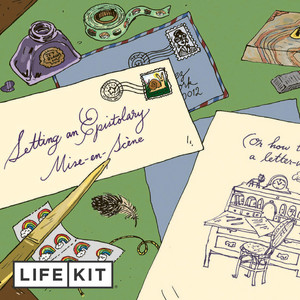
So there's, you know, flat things you can mail, ways you can embellish with collage and stickers and how to make male art.
I mean, I'm obsessed with male art.
Male art was kind of an art movement that really had a sort of a heyday in the 60s and 70s, which was where a lot of artists were actually expressing themselves by making really ornate envelopes and seeing what they could move through the male system, but it's still going strong.
there's TikToks devoted to it, there's Instagram, there's tutorials on YouTube devoted to mail art, how to make something look really beautiful, ornate, lots of interesting sort of origami type envelope folds, lots of ways you can sort of add ephemera to both the outside and the inside of your envelope.
I mean, I think letters are a great opportunity to mail anything that excites you.
Takeaway 3. Embellish the heck out of this thing.
You gotta put some stickers in there and then include some tiny flat treasures like pre -wrapped tea bags, ticket stubs, ornate wine labels, vintage photographs, iron -on patches, and dried flowers.
Just make sure your recipient isn't allergic first. So if you get into writing letters, I could see that things might just fade away sometimes, like, you might fall out of the habit or maybe somebody stops answering you back or like, what are some of the common letter writing or like correspondence snags that people hit?
Well I think people become quickly overwhelmed because it's not something that they're used to, right, so it seems really novel and fun when you first get a letter and then you go, oh my god I have to reply to this.
It's a like any other thing that can be worked out.
But, you know, so I think that starting small is really, really good and really healthy.
I think that if you don't feel prepared to write a big, long letter to somebody, send a postcard. I also think that a short letter is better than no letter, in so much as you might think, oh, gosh, if I don't have the time to respond to this in such a major way, I'm going to be doing this person a disservice, but the truth is they just want to keep the volley in the air.
And so often, if somebody sends me a really long letter and I don't have the bandwidth, I'll send a postcard or I'll send an interim kind of short letter being like, loved your letter, it moved me, I'm gonna get back to you soon.
But in the meantime, here's a silly, you know, vintage hotel thing.
So there's, I think you can hit snags of being so overwhelmed that you just stop.
And I think maybe the idea is just to keep the ball in the air is really useful.
I think also just sometimes correspondences run their course.
I think that I have several people that I started writing to at the beginning of this project, for example, that I'm still writing to.
But some people have fallen away or some people, our relationship has changed.
It started as an epistolary friendship and then we got really close writing letters and then started texting and calling and that's more of our friendship now than letters.
And we constantly say like, we got to get back to writing letters, you know, but, um, I think they can change and honestly if something like this fizzles out, it's okay.
It's okay. I think in general you should practice kind of like radical kindness in this letterwriting game because the truth is it's really it's a hobby.
It's something that people should be doing for fun, for connection, for delight.
If it's not delighting you then why do it?
Okay, so takeaway four, be gentle with yourself and other people.
Letterwriting is a hobby after all and it should be something you're both enjoying.
If not, let this correspondence fizzle, pair up with somebody else.
You know there are about eight billion people in the world.
Okay, you have a page in the book about signature sign -offs.
Yeah. My favorite, from Zora Neale Hurston in a letter to, is it Elaine Locke or Alan Locke?
LA— La, la, a la. I don't know, it's French. Forgive me, French speakers.
Okay, so in a letter from Zora Neale Hurston, she says, so long, old cabbage.
I just freaking love that.
I love that too. I mean, I think in France, you know, people call each other little cabbage or whatever as a term of endearment.
But yeah, I think it's cute.
I think everybody should come up with their own signature sign off.
I think that's a really, that's a great eccentricity to have. When you tell me yours?
Um, yeah, I mean, I have different ones that I use for different people.
Um, I'll often, I often call people kids, so I'll say, you know, until the next letter, Kid.
Mm -hmm. Right back, Kid.
Even if they're older than you?
I also say see you in the mailbox.
See you in the mailbox?
Yeah. That's cute. It's cute.
Love to be cute. Okay, our final takeaway is, come up with a signature sign off, one that is uniquely and unmistakably yours.
Here are some that I'm workshopping.
So long, sweet pea.
Bye -bye cutie pie. See you in my dreams, darlin'.
Catch you on the astral plane.
Y hasta luego, guapo.
Okay, Rachel, thank you so much. Thank you.
I hope people write letters and find joy in this practice.
Okay, letter writers, it is time for a recap.
Takeaway one, if you wanna get letters, start writing letters.
Reach out to friends and family, to old acquaintances, and even to strangers.
Takeaway two, if you don't know what to say, start with a writing prompt.
We've shared some here, and you can find more in Rachel's book and also online.
Takeaway three, embellish.
Give that letter some pizzazz.
Takeaway four, letter writing is a hobby.
Do not turn it into work.
Have fun with it. And go with the flow.
In Takeaway 5, come up with a signature sign -off to rival Zora Neale Hurston's very cheeky So Long Old Cabbage.
For more Life Kit, check out our other episodes.
We have one on how to write a memoir and another on how to make a really good playlist. You can find those at npr .org slash life kit.
And if you love Life Kit and want even more, subscribe to our newsletter at npr .org slash Life Kit newsletter.
Also, we love hearing from you so if you have episode ideas or feedback you want to share, send us some fan mail.
You can email us at lifekit at npr .org.
This episode of LifeKit was produced by Sam Yellowhorse Kessler.
Our visuals editor is Bec Harlan and our digital editor is Malika Gharib.
Megan Cane is our supervising editor and Beth Donovan is our executive producer.
Our production team also includes Andy Tagel, Clarie Marie Schneider, Margaret Sereno, and Silpy Douglas.
Engineering support comes from Zo Vindgenhoven and Gilly Moon.
fact -checking by Ida Poorasad.
I'm Marielle Segura.
Thanks for listening.
This message comes from Amazon Business.
How can you free your team from time -consuming office tasks?
Amazon Business empowers leaders to not only streamline purchasing, but better support their teams. Smart Business Buying tools enable buyers to find and purchase items fast so they can focus on strategy and growth.
It's time to free up your teams and focus on your future.
Learn more about the technology, insights, and support available at AmazonBusiness .com.
This message comes from Capital One.
Banking with Capital One helps you keep more money in your wallet with no fees or minimums on checking accounts.
What's in your wallet?
Terms apply. See CapitalOne .com slash bank for details.
Capital One N -A member FDIC.
Wait, wait, don't tell me.
Fresh air? Up first. NPR News Now.
Planet money. Ted Radio Hour through line, the NPR Politics Podcast code switch embedded books we love wild card are just some of the podcast you can enjoy sponsor free with NPR+.
Get all sorts of perks across more than 20 podcasts with the bundle option.
Learn more at plus .npr .org