From the New York Times, I'm Anna Martin.
This is Modern Love.
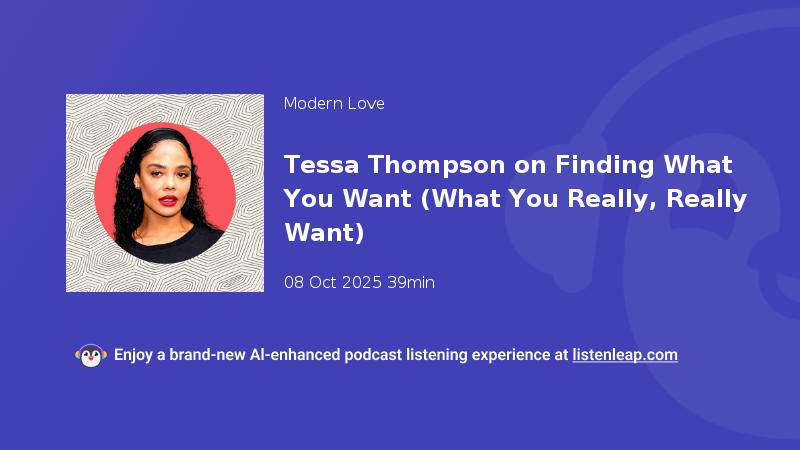
Today I'm talking to Tessa Thompson.
Tessa is an actor and a producer, and in her latest film she plays maybe one of the messiest characters of all time, Hedda Gabler.
Hedda is an iconic role.
It comes from a play by Henrik Ibsen.
It's been performed for over 100 years now and I like to think of Hedda as kind of the original chaos agent.
She's manipulative, she's destructive, and Tessa's version of Hedda takes all of that to the next level.
We watch her get so fed up with the choices she's made in her life and in her marriage that she decides to burn it all to the ground.
Today on the show Tessa Thompson on why she was so drawn to Hedda and maybe even finds her a little inspiring.
And Tessa reads a modern love essay about getting out of a marriage without causing so much chaos.
Tessa Thompson, welcome to Modern Love.
Hey, thanks for having me.
Of course, we've been looking forward to this.
So your new film, Hedda, is coming to theaters soon.
Some would say it's the role of a lifetime.
Some do say that.
Does that mean you can retire?
Yeah, I plan to right after this.
Right after this interview?
Okay, wonderful.
Hedda is sometimes referred to as the female Hamlet.
Do you agree with that?
What does that comparison mean to you?
I what that means.
I think it has to do.
No, I think they're very dissimilar in a lot of ways.
But I think it has to do with the fact that, you know, it's canon, it's one of those kind of iconic roles to play and I think really what it illustrates more than what it says about Hedda Gabler, I think is just that there's still a dearth of these, like you know, tour de force, complicated roles for women, and Hedda is certainly one of them, And Hamlet, to me, is sort of like famously torturously indecisive.
He's like, and this is paraphrasing, like, what do I do about my mom?
Right.
But he's like to be or not.
Yeah.
He's like, I don't know.
Exactly.
But Hedda, I feel, is so decisive.
So maybe I agree with you.
She's not the female Hamlet.
Right.
She's the female Hedda.
Or maybe Hamlet is the male Hedda.
It's anachronistic, but I love it.
Your Hedda, the Hedda you play, lives in 1950s England.
She just got married to a handsome guy named George.
They live in a lavish estate.
Hearing that, you might say, Hedda's got it made.
But tell me what's really going on with this character that you play.
Yeah, she's got it made.
I think in our adaptation, our Hedda is a woman who wants access to society, to the good life.
She wants a fab house.
A great party.
A great party.
But she's also sort of torn between two worlds.
The world, in this case, of academia and the world of bohemia.
I think she's caught between two sorts of lives.
A life in which she can feel free and to explore who she is, explore maybe a loose sense of sexual identity and, on the other hand, a life where she is taken care of.
In the original source material also there's this idea.
Hedda says herself for once I want control over a man's destiny.
I think she's a woman who's struggling.
For once, I want control over a man's destiny.
Of course, as opposed to the opposite.
Yeah, her own.
Yeah, yeah.
Well, there you go.
Yeah, yeah, there you go.
Also, there's a lot of conversation around how bored she is.
And in fact, I think she's not bored.
I think what she is is struggling for a sense of real purpose, which I think is something that we all feel.
But I think particularly in our adaptation off of the heels of the Second World War where suddenly it was like actually women like go back home.
Like, get back in the kitchen.
Thanks for helping us build stuff.
Thanks for helping us.
Like, we understand you can be in the workforce, but like, probably we don't really want you there.
Right.
It's a rueful laugh I'm doing.
It's not in support.
No, we should probably just go back home, right?
I don't know about the rest of you ladies.
But certainly in the 50s I think there was this yeah, this sort of struggle, I think, culturally for a lot of women.
And then privately, I imagine a lot of inner turmoil.
And that's sort of the time in which we meet this Hannah.
Yeah.
You're talking about she's torn between academia, which is her husband, George, is a professor.
Yes, her husband.
Her husband, who she loves, question mark?
Question mark.
Right.
Yeah.
I think it's a marriage of ambition and convenience.
Yeah.
I'm not sure that it is a marriage of true love, but yeah, I think she loves what he represents.
Which is?
Which is stability. proximity to wealth and society.
And also in Hedda's case as a young black woman in 1950s UK.
I think he also represents proximity to whiteness, which is something that feels advantageous for her.
And let's be really clear, even though it's probably, that's in your adaptation.
That's in our adaptation, yeah.
Not in the original play, certainly.
There's also this interesting spin on another romantic relationship in Hedda's life, right?
Can you describe the role of the lover in this film?
Yeah.
In the original piece there is a character named Eilidh Loveborg who is a brilliant writer but sort of a ne'er-do-well.
He has some drinking issues and some other host of problems, probably, and is a bit brooding.
In our adaptation, Nia DaCosta has brilliantly made Eilidh Eileen.
So she's a woman who is sort of a flame of Hedda's from the past that comes back and sort of sets certainly the evening off.
Upside down.
Oh, yeah.
Things get pretty intense.
I mean, they're intense from the jump.
The first scene is Hedda firing a gun, but it gets even more intense when the ex-lover comes into the picture, into the party, as it were, because Eileen has brought her current flame.
Yes.
And that makes Hedda feel really not great.
Yeah, she's not happy about it.
No, she's not.
Without spoiling, sort of how do things play out for our heroines?
Yeah.
I mean, first of all, she's someone that's interested in a fair amount of chaos, which she introduces to the party at every turn.
It's sort of part of her appetite, I'll say, her social appetite.
And she uses people.
She plays them.
I think it speaks to this thing of wanting to have control over someone's destiny.
I think she wants to feel like she can exert control over the people around her.
And so I think one of the things that you get to watch is her sort of moving people like pieces on a puzzle board yeah, and there's a kind of energy to that and delight to that.
Her lack of power over her own future yeah, causes her to lash out, as you say uh, to try to get what she wants, but it has to all be indirect, because she's not empowered in her current position, in her relationship in society.
She's trapped.
She's totally, Totally trapped.
And I think one thing that we really wanted to talk about is the ways in which yes society, culture hems us in as women or whatever our particulars are, but the way that we do that to ourselves.
She's someone that's deathly afraid to live the life that she knows she wants to live.
And the thing that unfortunately, I think she does is because she cannot take agency and live that life.
She also doesn't want anyone else to do.
Yeah, yeah.
Totally, totally.
To do it, you know?
I mean, but I want to know for you as Tessa, why were you drawn to Hedda?
Did you recognize something in her, in yourself?
Yeah.
The first time I ever read Ibsen was when I was maybe 16, 17.
And it was not Hedda Gabler, but it was A Doll's House.
Yeah.
And spoiler alert.
At the end of A Doll's House Nora, who is a very dutiful mother, leaves her husband and her very young children.
And I think even today, in 2025, when you make a story about a woman deciding, not because of any abuse or anything, just deciding to leave her family, it's still controversial.
It's still hard for people to sort of deal with that.
And it made me look at my mother and consider my mother differently.
Whoa.
I had never thought that actually she had continued to make an active choice.
Talk more about what you mean if you want to share.
Well, just that, like, I just think we take moms for granted.
Amen.
Yeah, totally.
You know?
Yeah.
I think there's this cultural assumption that moms are moms and they're going to be moms.
Yeah.
And I think it's something that we're handed.
I feel a deep amount of gratitude for my mom.
And I think just reading the play was the first moment that I was like, Oh, right.
Like every day my mom is deciding to continue to be a mom.
It's it's yeah, it's not a foregone conclusion, actually.
I think in in our culture it's not uncommon to think like that.
A man might not be in a child's life, for example.
But the other way around, the idea that a mother could leave her children in her happy home.
Just at that moment.
Reading it as like a 16 or 17-year-old, it really blew my mind.
And then, when I read Hedda a couple years later, I thought who is this Ibsen who's writing about women in this way?
And so I think that was one of the things that really attracted me to the project was if we could make something that sort of wanted to wrestle with these ideas that we've been wrestling with for a long time, which is like what are the appropriate things, as a woman, to desire?
Yeah, I wonder if these women sort of made you think like blasted open the possibilities of your own life.
Like, as a 16-year-old reading this, were you like, I could make a different choice?
Or in playing Hedda, were you like, I could make a different choice?
I think so.
I mean, at 16, also, it was probably early to be wrestling with it.
But I think it's one of the birthrights, perhaps, of being a woman in some ways.
And maybe this is changing culturally.
But I think this idea of like, do I want to be a mother?
Yeah.
You know?
And I think the sort of common popular opinion is, the choice to become a mother is then a forever choice.
And what Ibsen did is upset that for me.
Like, dude, is that important to me?
Is that a life I'll choose?
It brought that into clearer and in some ways clearer focus and murkier focus in a weird way.
Yeah.
Yeah.
It reminds me of a quote that you actually gave my colleague, Leah Greenblatt, recently in an interview about the film.
You said approaching the part of Hedda.
As a woman of my age now I think I really understand what it is like to contend with a lifetime of choices.
And I have a clear understanding of what it may feel like to wake up one day in a life that you really don't want but, for a combination of reasons, made sense at the time.
Maybe don't make sense anymore.
How fun to sort of hear yourself back yourself, right?
I mean, but I think it relates to what we're talking about.
And certainly this question of motherhood, one that Hedda also, at least in your version, grapples with.
She may be pregnant.
She tells George, her husband, she's pregnant.
Yeah, I wonder like this question of motherhood did playing this role make you think any differently about it for yourself?
No, if I'm frank, I think it's something that I'm still wrestling with.
I find and this is maybe a dicey thing to say for what your follow-up questions might be there's something about these women, Ibsen's women, both Hedda and Nora, that I find kind of aspirational.
They do things that are questionable.
Hmm.
But I think it's out of a desire to, even if they have to upset everything or end their lives, they want to live their lives on their own terms.
They're struggling to live a life that actually works for them and feels like they.
And not spill out the sides.
And they fail and there's a lot of missteps.
But I find at least that fundamental desire to be inside of a life that you choose.
I'm not suggesting that you should destroy other lives in the pursuit.
But I think the fundamental desire is something that's aspirational.
Yeah.
It's really interesting what you're saying.
It's like these women in Ibsen's work.
There are these roles they're meant to fulfill and these pathways to agency to break out of those roles.
It reminds me of the essay you've chosen to read today.
A kind of cage, a kind of gilded cage, which again reminds me of Hedda.
Before we have you read this, what drew you to this piece?
I think there was so much resonance, as you said, with sort of the connection between Hedda and this woman.
And also we meet her post-divorce.
So she's looking back on a life that she tried to choose that didn't fit too squarely on her.
So I thought sort of that kind of reflection.
It made me think generously about Hedda, about the ability for her to then choose like a life after this, life that maybe didn't go so well.
Yeah.
That epilogue to Hedda.
Exactly.
Totally.
And then separately, there's this idea at the end of it that maybe it's okay that she's alone.
Yeah.
I have an update for you on her life, actually, after you read this.
Good.
I cannot wait to dig into this.
Let's just take a really quick break and then we'll have you read it.
When my ex-husband called four months after our divorce to tell me he was getting married, I laughed.
That he was marrying an old friend, a woman who had been a guest in our home, struck me as the final ironic gesture in a relationship that had been, from the first, predicated on well-meaning but doomed intentions.
He had acquired me as he had acquired his house, furniture, and car.
And I had allowed myself to be acquired through a faulty syllogism.
Youthful passion is doomed.
This was not youthful passion.
Therefore, it would be a good marriage.
In his earnest proposal, not a month after we had met, and before any hint of love, he expressed a desire for me to teach him to enjoy life.
In exchange, he would love and cherish me and take care of me always.
After my initial rebuff, I began to consider his reasoning.
I was an actress, a writer.
In other words, I was unemployed.
He was a master of the universe on Wall Street.
Have you no sense of self-preservation, I asked.
You don't even know me.
I'm an actress.
Don't you know what someone like me could do to someone like you?
He was utterly unlike any of the sly egotistic, impecunious boyfriends I had tortured my parents with.
He was goofy, besotted, inarticulate, and defenseless.
He was a gentleman and a stellar salesman.
One by one, he struck down my arguments against our union until I had none left.
I wasn't in love with him and he knew it, but he claimed I would grow to love him and he was right.
He was kind and generous, and I began to believe that there was no better course my life could take than to bring happiness to this man who worked so hard and seemed to enjoy so little.
The first time I visited his home, I noticed something on his kitchen bulletin board.
A list, torn from some magazine, of ways to smell the roses.
Suggestions like taking a walk at dawn, dancing with yourself, skinny dipping, that sort of thing.
I laughed as I read it.
I thought it was funny that anyone would need to be assigned these things, all of which I had been doing regularly for as long as I had lived.
What I had not been doing regularly was precisely what he had been doing.
Growing up, getting serious, establishing a foothold in the marketplace.
We were a perfect match.
My friends didn't agree.
They were horrified, though none of them said so.
They dutifully came to our beautiful wedding and then lost my phone number, none but a handful accepting my invitations to join us for weekends in the Hudson Valley farmhouse we had redone.
Years later, I learned that they couldn't bear to watch what was happening to me.
You see, I failed my mission to teach my husband to skinny dip in the moonlight.
Instead, I became a creature of the marketplace.
Soon after embracing my new destiny, I asked him what his dream was.
He stared at me, twitched, fidgeted like a schoolboy called upon to recite.
Finally, he managed to admit that he had always wanted a barn.
A barn?
I laughed.
We can do that this weekend.
And we did, finding a wonderful old farm far from his country club.
But instead of splashing the river or sledding down the hill, I fretted over wallpaper and antiques.
My previously aimless days of wandering and dreaming became ordered by meals and domestic chores, by managing the increasing responsibilities of two homes and their attendant minutiae.
Of course, there was the obligatory dog, which required walking and fussing over in all the ways we do with our pets.
There was the doorman in our New York apartment, the guy in the garage where we kept our car, the stream of my husband's colleagues who had babies or birthdays that had to be shopped for.
The calendar of holidays we had to celebrate in ways that drained all pleasure.
Our life together was clockwork, privileged and enviable, but something was rotten at the heart of it.
Instead of transforming him into a lighthearted dancer in the rain, I grew as grim and duty-driven as he was.
As it became evident to me that I was floundering in my mission, I grew nervous and edgy, and he was no longer charmed by my frivolity, but irritated that I kept rocking the boat.
There are countless arguments for and against marriage, but the greatest of these is love.
Love too much and you risk fluttering like an exposed nerve in the fickle wind.
Love too little and you may grow brittle and wither.
Love in harmony and you get that gift of the magi thing going on and you're golden.
But striking a bargain where love is absent or unbalanced is the surest way to misery.
As I gaze over the years, to the moment when I was naive enough to believe that good intentions were sufficient.
I feel as if I'm watching a movie and someone in the audience yells watch out.
I don't doubt his desire was authentic.
Not just for me, though.
I know that was true, too.
But for a different self.
A new possibility for how he experienced life.
And I happened to scamper across his radar and both of us needed, or thought we needed, what the other seemed to offer.
I remember how I would beg him to put down his paper and take a walk with me.
How without looking up he would wave, dismissing my requests.
How many times I put on my coat and went out alone, taking walks full of wonder at fresh snow or bird sightings, wishing he were with me, wanting to share my delight.
But his refusals wore me out and I gave up.
One summer Sunday, I was sitting on the riverbank thinking of a story I was writing.
A lifetime of scribbled ideas and abandoned projects had begun to take the form of a collection, and I was in a creative fervor.
Suddenly, I felt the hairs on the back of my neck prickle.
Turning, I saw him standing above me, glaring.
He had been laboring for hours, as was his wont.
He had mowed the lawn, weeded the garden and painted the porch and, for all I knew, plowed the back 40.
He was fed up with me sitting there, doing nothing.
I was ashamed.
It wasn't until later, after I'd swept the house and washed the dishes and cleaned the fridge and we were on our way back to the city, that I realized the story I had been thinking about had faded away.
I tried to summon the characters and reimagine the setting to stoke the urgency I'd felt on the riverbank, but the curtain had dropped.
The stage was dark and empty.
I looked at my husband driving his face set in stern concentration, and saw how pleased he was with what he had accomplished over the weekend.
Listen, I said.
When you see me sitting there, staring off into the distance, doing nothing, I'm busy.
He smiled and squeezed my thigh.
After a moment, he said, I want to clean out the pack of Sandra around the barn next week.
On our last day of marriage counseling, when the therapist asked him if he thought I had lived up to our contract, he replied she didn't try hard enough to change me.
And he was right.
How arrogant of me to think I could remold a man who was firmly set.
When I see my ex-husband and his wife together, as I do on occasion, I notice how comfortable they are.
They dress similarly, share the same frame of reference and want the same things from life.
They are kindred souls.
It makes me happy.
It makes me feel that perhaps I didn't fail after all.
Had he not married and divorced me, he never would have turned to her.
And I think in retrospect that there had been something between them before I showed up and that she had always loved him.
So, in a labyrinthine way, I did manage to teach him to enjoy life.
As for me, I thought I would slip back into my premarital skin, but I found it was out of style and no longer fit.
I was, for a while, skinless and shivering.
But unhappily married people live with a particularly viral strain of loneliness, and the interesting thing about loneliness is that it forces you to confront yourself.
Thus began the really hard work. my inner dialectic soon took the form of a cast of characters.
Three couples.
And in dissecting their relationships, my novel emerged.
Did I solve the great mystery?
No.
But I did discover that the questions are more interesting than the answers.
These days I spend a lot of time staring off into the distance, thinking about my new story and characters.
I am, as I once declared myself, busy.
We'll be right back.
Wow.
First of all, you read that beautifully.
Thank you.
What did it bring up?
What are your immediate thoughts, reactions?
And who you are.
And who you are.
I think that feels like a gift, as a provocation, because there's so much pressure on romantic love, on partnership, And I think it's very crippling for people.
And then particularly, I think, as you get older, there's this sense of something sort of caving in as opposed to expanding in your world.
And I think about people in my life and girlfriends of mine who feel really crippled when they have a breakup and the time invested.
And I think that that time isn't wasted anymore.
If it points you closer to who you are, but also it makes when you're inside of a relationship and all the you know ups and downs sort of less daunting, to think that you actually cannot fail.
Oh, I needed to hear that.
I mean, you cannot fail because why?
Because why?
Because every step is a step in the direction.
Try to show up, I suppose, as yourself.
Yeah, I was going to say the only failure, perhaps, is continuing, perhaps, to be in a relationship.
It doesn't work.
It doesn't work.
Okay, so here's the update.
Here's what it is.
Teresa told us, I remain contentedly unmarried.
Yeah, cool.
Though I believe that marriage is a blessing and a noble pursuit with the right partner, which is...
Which is what you're saying, right?
Like, and hell yeah Teresa, let's just say this this listening to herself pointed her at least in this direction of remaining alone.
We also spoke about you said a lot of your girlfriends are very shattered when a breakup happens.
And I found myself saying this and truly believing it because it's been true in my own life.
This is not a rupture in your life.
But when you're living it, it's so hard to understand that to be true.
Totally.
It can feel saccharine and empty, those sort of platitudes, I think.
And guess what?
In my experience, they tend to be right.
But I wonder if that has been true in your own life.
If a thing that you thought was a rupture or an end, you look back on now and you're like oh, I learned a lesson from that or that brought me closer to myself.
Yes, I think so.
I think so.
I have an interesting way, I think, because I had a very long relationship.
I was in a five-year relationship, well, very long for me.
But I was in my early 20s, you know where I think is a time where you're still sort of figuring out who you are.
I remember a period where I would look back on photographs during that time and I couldn't recognize myself in a way, because that relationship didn't feel right for a long time.
And I think the lesson there for me, and a part of the reason why this essay resonated with me so much is Is I'm someone who's always really enjoyed being alone, just as I love to travel alone.
Like, we're here in New York City.
I love to sit, you know, with a book at a restaurant.
Can you do that?
Yeah.
Wow.
Hang out sometimes.
I mean, the book is helpful because you just cover your face with it, you know.
Yeah.
Why is that woman reading so strangely?
If there's any riffraff, you just use it, you know?
Hardcover, if you need to bonk someone.
If you need to bonk somebody, though, I don't promote bonking, that kind of bonking.
But it's dual purpose, so that's great.
No, I think the lesson in that relationship, I think, is that it's for me it has always felt better to be alone than to be in a partnership where I feel lonely.
Yeah.
But that's the thing that I think is remarkable, and is that we change so much as humans that hopefully we get to find ourselves in relationships where we get to change inside of them.
And we are changed by them, which I think is the best thing.
That is a really important part of this essay, too.
Like I feel like Teresa and her ex-husband enter into this relationship, both hoping to change the other person.
Be changed perhaps.
And that can have, by the way, like, very good intentions.
Certainly I have gone into, like I started dating this guy who's really chill, which is not a quality I have but I aspire to.
And I was like, maybe he'll make me relax.
Yeah.
We're not together anymore.
And I wonder if you have ever done that, like entered into a relationship hoping that this person will cause you to grow or cause you to change in some way.
And what happened if you've ever been in that position?
I, yeah, I would say I, yes, I have been in that situation before.
I will say I think I used to have relationships mostly with people that I felt a lot of similarity with.
In fact, I remember dating one person and he and I both agreed that we shouldn't date anymore because we were too similar together.
We were two Libras.
Understood.
Say no more.
We were like, we can't even decide where to eat dinner.
We should probably just call this quits now.
Good for you.
That was a good choice for both of us.
Shout out to him.
He's great.
But I like the idea now of...
Really being with someone who's actually very, very, very different.
And I think it requires a kind of robust communication.
I think it requires a tremendous amount of grace.
And that's sort of the place I'm in now.
And I think that kind of partnership that stretches you and challenges you and really expands your world, because their world is very different than your world.
That's something that I personally really think is beautiful and am enjoying.
Are there certain challenges?
Definitely.
I think they're deeply worth it.
It's funny, a girlfriend of mine had a big crush on this guy and it wasn't going well.
And she was talking to her friend about all the incredible things about him.
And her friend said it sounds like all the things you like about him are just things you like about yourself.
It was like all the incredible books he read and music that he likes and things that he thought of.
And she's like, isn't he just reflecting back you to you?
Oh, God.
What you're saying is making me and I'm going to butcher this and I wish I remembered it.
But I was talking about this kind of stuff with my friends and my one wise friend.
I think she called it matchers versus balancers.
Oh, yeah.
That's nice.
So you can have someone who well, I was just going to sort of say the same words again, but you have someone who matches you and then someone who balances you, which I hope that cleared things up.
But, you know, in my own life, I have certainly gone for people who match me.
Who match your freak.
Yeah.
And it's been like, except for that guy who was really chill, that I, you know that was an attempt at a balance.
But I'm sort of dating simultaneously a person that's a matcher and a person that's a balancer.
Oh.
Oh, yeah, I did that.
Really?
Yeah.
I'm like, whoa, the split screen of that is really interesting.
I did that.
Where do you think it's going to go?
Oh, God.
I mean, I'm feeling quite drawn to the balancer.
And not just because you said that you're dating someone who's in a balance right now.
I'm going to take the overall balancer.
How did it play out for you?
You took the balancer of that.
Yeah.
Yeah.
Well, God, it's going well.
So is the guy something to look forward to?
Yeah.
It's challenging too, because I think there's so much pressure that we put I certainly have been there where, like on your romantic relationship that they sort of have to fill all these buckets, you know.
They ain't gonna.
They ain't gonna.
So like, if you're with a balancer, you probably need to find like you gotta find your match or friends and get out there, you know.
That is so freaking right.
Yeah.
Yes.
And it also brings me back to this thing that you said that I loved, which is that you've discovered you love to be alone.
And it seems as if Teresa has as well.
Teresa writes that loneliness forces you to confront yourself, right?
Yeah, that's definitely true.
And loneliness and being alone, obviously very different.
But I wonder if in these moments of like being alone, whether you're lonely, whether you're not.
Yeah, you've had to confront yourself.
And what did you find?
Does that make sense?
Like when you're sitting alone with yourself, what rises?
What a tough question.
It makes total sense.
And I think that also, when you're trying to do some investigating, particularly in terms of like, what you want, what you really want, you know, when you are talking to yourself and you're like, tell me what you want, what you really really want.
I'll tell you what I want, what I really, really want.
I think it requires you to really be alone and really be honest with yourself.
I've never had like a huge preoccupation necessarily with marriage.
I also was like always one of those people that thought, you know, my parents weren't married.
I've had in my familial circle partnerships where people are together for 21 years before they decide to get married.
That's awesome.
And then just marry on a beach with friends and family and eat tacos after.
This very relaxed idea around marriage and, in some ways, an orthodox way of thinking about commitment.
And so I think one of the things in being alone is really wrestling and trying to parse and decide like My feelings around these things.
Are they mine?
Have they been handed to me?
To what extent have I sort of metabolized things that I've been told by the culture, by society?
Funnily, when we were going to make Hedda the first time around, the after strike happened.
And so we couldn't work.
And so suddenly I had a lot of time.
I mean, I spent lots of time with friends and friends.
But I had time alone.
And I think one of the discoveries during that time which felt very auspicious right before Hedda, which is that actually, like I had always thought I was someone that may be like oh marriage, marriage.
I think it's cool, actually.
What changed your mind?
I don't know.
I just...
Yeah.
Or the other day.
It's lovely.
I just love it.
And I love seeing them in the park and on museum steps.
People that have just come from, you know.
City Hall.
City Hall.
I just, there's something about it.
I think it's very easy.
I understand people that have issues with the institution of marriage.
I have been that person and I don't disagree.
There are things about it in terms of where it comes from and what it's for that like yeah, we can maybe do without.
We're going to try really hard.
And we're going to need your help, too.
You're going to keep us honest.
I think there's something about it that frankly is beautiful.
You're going to spend some alone time today.
Do you have any book reading at a restaurant alone on the docket?
No.
Today I'm for the people.
Dang.
Tomorrow.
Maybe tomorrow.
Yeah.
The good thing is I really like people.
I just love people so much.
And guess what?
I loved this conversation.
So thank you, Tessa, for this.
This was great.
Thanks so much for having me.
The Modern Love team is Amy Pearl, Christina Josa Davis Land, Elisa Gutierrez, Emily Lang, Jen Poyant, Lynn Levy, Reva Goldberg and Sarah Curtis.
This episode was produced by Reva Goldberg.
It was edited by Davis Land and Lynn Levy.
Our mix engineer was Daniel Ramirez, and we got studio support from Maddie Macielo.
Original music in this episode by Pat McCusker, Alicia Baitoup, Mary Lozano, Diane Wong and Dan Powell.
Dan also composed our theme music.
The Modern Love column is edited by Daniel Jones.
Mia Lee is the editor of Modern Love Projects.
If you'd like to submit an essay or a tiny love story to The New York Times.
The instructions are in our show notes.
I'm Anna Martin.
Thanks for listening.