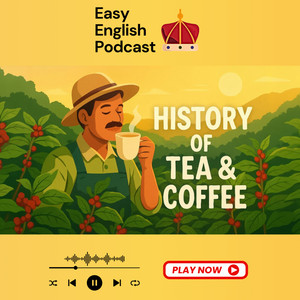
We all love hot drinks, like tea or coffee.
But where did they come from?
What is the history of this?
In today's episode of Easy English, we are going to look at two of the most popular drinks in the world tea and coffee.
I'm Oliver and welcome back to the Easy English Podcast, the best place to learn and practice your English listening skills while learning new vocabulary and phrases in English.
I'm recording this episode quite late at night because I've had a very busy weekend.
So I apologize if I sound a little bit tired.
Okay, so many of us start our day whether it's a work day or a weekend with one of these hot drinks.
Or perhaps we enjoy them at different times throughout the day.
But have you ever wondered where they come from?
Like, why are they popular?
Coffee and tea.
We drink them all the time.
And how did they become so loved by so many people all over the world?
Different cultures, different countries in lots of different places.
Today we are going to take a very simple journey, and a fairly short one too, through the history and culture of tea and coffee.
But first, as always, we are going to look at some key vocabulary for the episode.
So I'm going to read you some new words and phrases and I want you to try to listen for these during the episode and see if you can spot them.
Some of them you will know, some of them you won't, but try your best.
But first, if you are listening to this podcast and you would like to have the full transcripts ad-free, with vocab lists and all of those extras, as well as bonus episodes every week, Check out the link in the description below and you can support for 5 a month at the lowest.
You can support and get access to all of that on the Patreon.
It really helps to keep this show going.
And it helps to support me as well as the project, and allow me to continue to grow and spend more time creating these podcasts for you and other things as well.
So let's look at our key vocabulary.
The first word we have today is beverage.
Beverage.
Beverage.
A little bit of a strange word.
It is a noun and it simply means a drink.
So any drink that isn't water.
So a soda or a Coca-Cola, a tea coffee, these are all beverages as well.
They're all drinks that aren't just water.
They're a bit more complicated than water and a drink, of course, is just a liquid that you Consume, that you drink, basically from the verb.
So our second word for today is plant, plant.
And this is in the noun form.
And a plant is simply a living thing that grows in the earth.
I wanted to highlight this because I will be talking about coffee plants, right?
Tea plants, plants in general.
Some plants will be talked about today.
The third word we have is origin.
Origin.
Origin.
And the origin of something is the place or the time where it came from.
So where something begins or comes from.
For example, the origin of coffee is in Africa.
Or we could say the origin of pizza is in Italy, right?
The fourth word is an adjective and it is popular.
Popular.
And this means liked by many people.
So pizza is a very popular food all over the world.
I'm making lots of examples with pizza tonight.
Maybe I'm still hungry.
And finally, our word, which I use a lot in many episodes, but I want to make sure that I have defined it correctly for you guys.
And that is culture.
Culture.
And culture simply means the way of life, including beliefs customs, traditions and a particular usually of a particular group of people or place.
So different countries have different cultures.
But the reason I have included this word is we can often talk about things having a culture too.
For example, coffee culture.
We can have a coffee culture, a way of doing things and people liking types of coffee.
You can have a craft beer culture as well, and maybe a culture around pubs and cool different pubs for different beer and food.
There are lots of cultures related to things as well as people and places, so without further ado, let's get into our topic today.
And to talk about tea and coffee, I want to describe in English what they are.
So what actually are they?
It might sound stupid, but I guess it can help for you to hear the words.
So tea comes from a very specific plant called Camellia sinensis.
I've read that, so hopefully I've said it correctly.
People pick the leaves from this plant and they process them.
What that means is they dry them.
They make them very dry.
Dry is the opposite of wet.
And sometimes they ferment them, so they leave them for a long time in this process.
And then people put these leaves in hot water to make the drink or the beverage that we talked about.
So it's quite a simple process for making tea, to be honest.
It's not so complicated.
Coffee on the other hand comes from the seeds, often called beans.
And these are inside the fruit of the coffee plant.
So you can think of tea is like leaves and coffee is seeds of a plant.
So you have the leaves of a plant and seeds.
Of course, they are different plants, but you get my idea.
And with coffee.
People pick the fruits, so they take the fruit off the plant, they remove the beans from the fruit, they dry them and then they roast them so they heat them.
What roasting means is they heat them until they are dark, and then they grind the beans up, so they crush them.
They make them small, into a powder which is mixed with hot water, And then that creates the beverage that you drink.
And both tea and coffee contain natural substances, natural chemicals.
I guess that can make us feel more awake and focused.
The most common that you know the best is caffeine.
And I can guarantee that most people listening to this podcast episode are probably at least a little bit addicted to caffeine.
So to start with, let's look at tea.
So the origin of tea being drank as a hot beverage or a drink is in ancient China, thousands of years ago.
So there is a legend.
So I have some notes here.
The legend of tea's origin in China.
And the story goes that around 2730, 37 BC, so that's almost 5000 years ago, a Chinese emperor who was called Shen Nung was boiling water under a tree when some leaves from the tree fell into his pot.
He drank the water with the leaves inside and found it very refreshing.
This was the first cup of tea.
Whether it's true or not, tea definitely began in popular tradition in China.
At first in China, tea was used as a medicine, something to treat illness, but later it became a popular drink for pleasure and for helping monks to stay awake during their meditation as well.
And then it spread to Japan.
Around the 9th century, Buddhist monks brought tea seeds from China to Japan.
And in Japan, tea became a very important part of their culture.
So there's some very strong cultural elements in Japan around tea, including something which is very famous and I even know about, which is the Japanese tea ceremony.
And I know that we have lots of Japanese listeners in the audience and I think that It's a very beautiful it seems like a very beautiful tradition.
And I know that even things like the matcha tea is becoming so popular all over the world.
So Japan is definitely very famous for their tea.
So tea then... began to travel.
And it arrived in Europe not until the 17th century, so in the 1600s.
And this came because Dutch traders, people from the Neverlands, right?
They brought it from Asia to sell.
And at first it was very expensive and only drank by rich people.
But the real growth of tea around the world did come from Britain, from the United Kingdom, because tea slowly became popular there, and especially after Queen Catherine.
So she was Portuguese and married King Charles II in the 1660s, so a long time ago.
And with her love of tea, she spread it all around the aristocracy.
Those are the rich people, the very rich in Britain at the time.
And afternoon tea became a very common social event amongst those wealthy people.
And as tea then became more popular, particularly in Britain, they started growing it in other parts of the world and selling it all over the world with their large navy.
And as a result, they started to produce more.
They started to sell more and introduce tea to different parts of the world that had never drank it before.
And that's one of the main reasons why tea has become a global drink all around the world, particularly in the last sort of three, four hundred years.
And today, in 2025, tea is the most consumed drink in the world after water.
I thought it might be Coca-Cola, but it's tea.
So now let's quickly look at the history of coffee, which is my favorite.
I love coffee much more than tea.
Tea is good.
It's not bad, but you know, I've talked about this before.
I love coffee.
Coffee is so nice.
I love the taste, the aroma, the smell.
It's amazing.
So coffee's origin, so it originated in Ethiopia in Africa.
And there is a legend, a story, just like tea, when we talked about tea in China.
And the legend is of coffee's origin in Ethiopia is about a goat herder.
So a goat herder is someone who looks after goats, like a farmer almost, that takes care of these goats.
And the goat herder was called Kaldi.
And this happened the story around the 9th century.
He noticed that his goats became very energetic after eating berries from a certain plant.
Kaldi tried the berries himself and felt awake and full of energy.
He told a local monastery where monks at first thought that the berries were evil and then discovered that they could stay awake for long prayers after drinking, and a drink made from these berries, which we know are coffee beans and from Ethiopia.
So this is the true part of the story.
We don't know exactly why this started in Ethiopia, but after it began to become a drink and something that people used, it spread across the Red Sea to the Arabian Peninsula, into the Middle East.
Especially in countries like Yemen, it was very popular.
And people started to grow coffee in all of these areas in very large amounts.
In cities like Mecca and Cairo the first coffee houses appeared, And these were very important social places where people drank coffee, they talked, they played games and they shared news together.
And again, like tea and a lot of other things, coffee arrived very late in Europe.
It was something that took quite a long time to get there.
And it reached Europe... just like tea, around the 17th century, so the 1600s.
And merchants from Venice in Italy brought it from the Middle East to Europe.
At first, some people were actually scared of it.
They were a little bit concerned.
They didn't trust it.
But soon coffee houses opened in major European cities like London, Paris and Vienna, and it became quite fashionable.
They also became important centers for business, news, and conversation.
As this coffee demand grew and grew, coffee plants were taken to lots of new and different places.
And in the 18th century it was brought to South America, where countries like Brazil became some of the largest coffee producers in the world.
So not a lot of people know, but the plants were never from there.
They came from Africa and they were taken to these other parts of the world and became popular big producers.
I have a lot of listeners from Brazil and I know there is amazing coffee comes from Brazil.
And today, as a result of all of this coffee and production, it is loved by billions all around the world, including me.
So I hope you enjoyed this story today.
To me it's a little bit of history, I guess, about the drinks that we drink and hopefully some new vocabulary around those.
And I would like to say that if you haven't yet checked out my new book, it is still available at a slightly discounted price.
It will be increasing the price a little bit later.
I just wanted to make sure that all of my subscribers and followers that have been listening to this podcast for a long time get access to the book the ebook for lower price for a time, so do make sure you've already checked it out.
It's available.
I think it's like there's um you can.
You can purchase it from the link in the description below and it teaches you phrasal verbs english phrasal verbs through short stories.
I know loads of you have already checked it out and some people have told me they're really enjoying using the book.
It's helping them to learn and to practice and it's something a little bit different for them, which is great to hear.
So if you want to support, you can do that or you can check out the Patreon as well.
So thank you so much for everything for supporting the show, for listening and for being here, for being a subscriber and a follower.
So I will see you in the next episode.
Have a lovely rest of your day.
Goodbye.