Welcome to The Game Maker's Notebook, a podcast featuring a series of in-depth one-on-one conversations between game makers, providing a thoughtful, intimate perspective on the business and craft of interactive entertainment.
The Game Maker's Notebook is presented by the Academy of Interactive Arts and Sciences, a member-driven organization dedicated to the recognition and advancement of interactive entertainment.
Hi, everybody.
I am Tim Schafer's special guest friend here on the Game Maker's Notebook to talk about a very special thing with some very special friends.
We're talking about the Game Maker's Sketchbook.
It's a little different and we have the people behind it here and we're going to talk to them about what it is, what it's all about, where it comes from and how you can get involved.
So would you please, my dear friends, introduce yourselves and tell us all what you're doing and how you're involved in this thing.
I'll start with introducing myself.
I'm Megan Scavia, the president of the Academy of Interactive Arts and Sciences, and we're the folks behind GameMaker's Notebook and GameMaker's Sketchbook.
And I recruited two of my friends here to help produce GameMaker's Sketchbook.
I'll let them introduce themselves.
So, Belle, you go first.
Okay.
I'm Sigal Sinar and I'm founder and head of 47 Communications, which is a communications firm now going into our 20th anniversary in games.
And I have been friends and colleagues with John and Megan for a long time.
And we have a shared passion around art.
So we cooked this sketchbook up, now going into its fifth year uh, and i'm john gibson, the co-owner, co-creative director at im8bit.
Uh, we do lots of artsy things and have been doing it for one more year than 47, so we beat you uh, 21 years.
Yeah, i know we're winning, and you also supplied much of the art that you can see behind people in these rooms, um.
So uh megan, since i talked to you first about this, what is uh, the game maker sketchbook and how long has it been around?
As well mentioned, we've been here.
We've been doing this for about five years now.
It was kind of inspired uh, by into the pixel, do you remember into the pixel?
So a gathering of art that was shown at a E3.
Don't say the words.
It was shown at a previous place.
There's nothing wrong with that.
It's like Voldemort, isn't it?
No, no, no.
The Academy runs Dice Summit.
And Dice Summit used to produce Into the Pixel with the ESA.
And when E3 stopped happening, so did Into the Pixel.
So we really missed it.
And then the pandemic happened.
And we you know John and Sabelle, as she mentioned we all love art and we love.
One of the missions of the Academy is to support and celebrate the art and craft of making games.
And I Am 8-Bit has been doing that their entire existence.
That's why they were founded.
They were an art gallery.
Sabelle is a painter and has a degree, an art degree.
So we thought like, let's pick up that ball that got dropped and start a new art showcase.
And sort of, that's where this started.
And we wanted to really expand on the idea, and Into the Pixel was just sort of let's have the best art in video games and have an auction and sell it at E3.
And we thought let's do that but not auction it off and expand and go a little deeper and have more categories and look at all aspects of video game art and really celebrate the artists and open it up to fans.
So we spent a lot of time kind of creating a new art program and art celebration.
And I think I'm pretty excited about it.
I really, really like it. that's awesome.
I mean, like it's great to be celebrating art and it's great.
It's for a charity, right?
Yes.
It started as a uh for charity for the foundation, because the Academy runs the AIAS foundation, but we have recently expanded it to celebrate or uh go to another charity which might you might know something about Day of the Devs.
Oh, Day of the Devs.
Oh, I had no idea.
Day of the Devs that great uh game special that happens in other times during the year to celebrate uh, undiscovered great gems in indie gaming.
Yes, i think that is a great thing to bring up.
It's involved in dave's revs too, i think yeah, what.
There's so many people here.
What a great gathering is this like?
Is this how episode of real housewives works?
Like they like stage the whole conversation and then like we try to make it seem normal?
Uh, we all.
I don't know what you're talking about, john John.
Why do you care about this whole thing and why are you involved in it?
What did you mention?
You know Megan mentioned Into the Pixel and that was a really great thing for the industry but it only really celebrated concept art.
It was artists that knew how to paint things in Photoshop real well.
But there's storyboard artists, there's UI designers, there's a whole bunch of other folks craftsmen Crafts, people that make all the art for games.
I mean, Tim, you know a thing or two about this.
Like, you can't just make a video game concept art.
There's lots of other kinds of art, too.
So this was all about celebrating that stuff.
But it goes way way, way back to the beginnings of I Am 8-Bit because, like Megan mentioned, I Am 8-Bit started as an art show.
But really, I Am 8-Bit started as a bunch of friends hanging out who happened to be artists playing video games and then an art show emerged from that uh so when you get to know the artists behind the art you start to realize like they're relatively unknown like most of the folks that make art for games uh in in terms of even concept art frankly but like storyboard artists ui artists etc no one knows their names and they deserve to be spotlighted too And Tim, you've always been so good at highlighting the artists that work on your games.
If we think about Scott C on the Psychonauts stuff, when we talk about Nathan Bagel, your Double Fine Action Comics showcase on the Double Fine website you were never shy about saying hey, there's these people that work here, that make beautiful things, and I want to showcase their personal work and give them a chance to get out there.
Yeah, most developers publishers, like there's, there's not only an opportunity for that there's, there's not really a forum for it.
So that's what game bigger sketchbook is all about is showcasing those fine folks in the industry that are doing hard work.
So um, games are made by human beings and it's always great to talk about them, and this is really focused on the artists um, a lot of different um people who work on making games, but i love focusing on the art because uh, it's so important.
Sabelle, let me ask Sabelle, why you care about this so much.
What's your personal interest in it, why it's an exhibit, and what you hope to do with it?
Well, I'm interested in art broadly.
I have a background in art, and I've always loved games' place in art and popular culture.
And from the early days of iMateBit I was a collector of the game.
I mean game-inspired art that the gallery put together.
There's Dig Dug by Ben Butcher behind me.
And I was a collector of Into the Pixels art as well.
And I've been in games for 20 years and love it.
And you know, I think there's been a lot of art that's been celebrated, but there's also just art not just in but around games that uh were not necessarily getting a lot of credit or spotlight, and i was really excited about that idea.
And, of course, um being able to do it with the academy, so it could benefit some of their non-profit work, was extra compelling.
And then add that to the mix.
And I'm going to punt it now to John but having 8-bit, who produces a lot of things for fans, whether they're prints or vinyl or whatever, where we could connect these artworks and actually turn them into prints and have the fans involved in supporting the industry, which is definitely a step further than what Into the Pixel did.
It was super exciting to me.
And I'll let John talk about 8-bit because They're deeply steeped in art, of course.
Why does IMAPIT care so much about art?
It has to fit into the mission of Game Maker Sketchbook.
It's in our DNA.
IMAPIT started 21 years ago as an art show.
It was just a bunch of artists getting together to reinterpret 80s video games and paintings and sculptures and all sorts of media.
And it was a bunch of diverse artists from all backgrounds.
And that's kind of the neat thing about video game art.
And I'm not talking about I Am 8-Bit video game art.
I'm talking about the people who make art for games, like the UI artists, the storyboard artists, the concept artists and folks that make really pretty icons that you might not think twice about but probably went through 18000 different iterations to make Tim Schafer happy for Psychonauts 2.
Like you know, all these things are fine art forms and and it's it's a lot of collaboration and teamwork, but there are individuals that specialize in those crafts and, you know, into the pixel was was a nice start to that, like it was just that concept art, but we really wanted to showcase all the art that goes in the games.
You know, including marketing art.
Key art is part of it too.
There's lots of beautiful things that happen at the very beginning of the gestation of the game idea, all the way to the very end.
And art's in our DNA, as a company like me and my fellow co-owner, co-creative director, Amanda White,
We're big collectors.
I think we've sold far too many pieces to Sabelle and Megan through the years, too.
They might be our couple number one customers.
But the whole mission of 8-Bit in general was always to spread the love of art.
So if you you know to Sabelle's point look at our vinyls or look at our physical games, we're always bringing that joy onto the covers and onto the gatefolds and all that stuff.
In addition to art shows, in addition to stuff you can hang on your wall.
I think yeah, it is like working in video games.
You get just being around creative people all the time in many different disciplines is always really fun, rewarding and really inspiring.
But um, artists got the actual benefit of an artifact you can end up putting on your wall and then behind you when you're doing um web interviews and your camera's on i.
Um, why do you think uh, do you think it's important that there is a live show component of this?
Because we get a lot of art digitally now and it's like download stuff, but there's a live show element of this?
Uh, do you think that's an important part of it?
Anybody you, you look at things differently when you see them in person versus on a screen.
I mean, like you, you've noticed details you, i mean, that's the beauty of yeah, i guess this is also one of the challenges is when we first started the game maker sketchbook.
Uh, sometimes we don't get pieces and resolutions that are uh, very appealing for printing.
Uh, they're very small And we have to enlarge them without pixelating and distorting them.
But through the years, we've seen higher and higher resolutions get submitted.
So maybe we're infecting people in a really lovely way.
But when you see something big and it's not on a phone screen, it's a much different experience when you can live with it.
Same thing with a vinyl record versus listening to a song on its own, like you have to listen to the whole album.
That's the idea of what a painting is.
It's like there's there's a lot going on in that thing and there's there's a lot to stare at for for many, many minutes and many, many months if it's on your wall um.
So megan um, who can submit to this?
How do you submit?
What categories can you submit it to?
How do you do it?
All right?
So uh, studios submit And you have to submit.
So, for instance, this year's submission is open on January 30th and you can submit any game that was released last January.
So January 2025 onward.
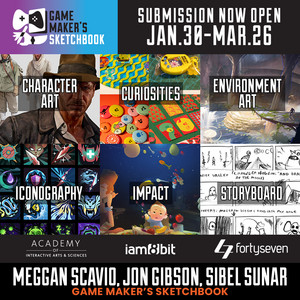
And you submit into any category of your choice, and those categories are impact, which is generally key, art character, art environment, art iconography, and then we have a category called curiosities, which is really just a catch-all for anything that doesn't fit into one of the other categories.
Then we have a jury of game artists, non-game artists, anyone else in the.
We have curators who work for galleries and they judge the art and choose three selections from every category.
And of those selections.
We then hang them in a gallery And we then print, with the permission of the artists, prints for fans to purchase for a two week window.
And all of those proceeds then go to the two charities, the Devs and the AIAS Foundation.
It's really cool.
Like no one's making dough off this.
We're not going to like lunches, eating caviar.
Like this is, This is 100% go to the charities.
So anyone that's afraid to submit their art and benefit these good causes, let's duke it out.
Right.
So no one loses their rights to the art.
They're lending you the ability to sell prints for a couple of weeks, and then they retain all the rights after that.
And all the proceeds go to charity.
Correct.
And the charities are AIS and Data Devs.
And if you're listening to this on a podcast, just the audio file you can't see.
But Megan has such beautiful art on her wall behind her.
That was stuff that she purchased and hung up to benefit her own charity.
Like, look how amazing that is.
Like you bought art from your own charity.
And to be honest, you know, we, we, We do it.
Tim and I had this conversation before when I invited him to when I asked him to host this.
We can't actually sell all the art that we take.
And this is a conversation that we have as a group because we want we want to celebrate video game art and not all of video game art is we're not allowed to sell.
And so, but we take it anyway, because we want to yes, raise money for charity, but we also want to celebrate game art.
So, as I think someone mentioned earlier, some of the art can't even really be reproduced because it's hand-drawn and it's really small.
You know, it's not easily printable.
So we do it for two reasons.
We do do it to raise money, but we also do it to just celebrate the craft of art in video games.
That's a good segue to talking about the fact that, like You know, we're celebrating the art pieces and also the artists that have actually created these.
And the reason to do a gallery spotlight is that sort of physicality that John was talking about.
But also we found a great home to display it with play days which of course, John and Amanda are producers of at the Summer Game Fest.
Play Days, because there you have press and creators.
We bring in a bunch of journalists and content creators, and they're able to view all this art in a gallery context as well.
And so there's multiple layers to being able to sort of lift up the names of the people as well as spotlight the art pieces themselves.
Yeah.
I mean, it looks, it sounds great.
Yes.
Let me just, you sold me on it.
Are you into it?
I get to see it tomorrow.
Did you order Prince?
No, I used to love into the pixel.
I'm really glad that has a new form and game maker sketchbook.
It sounds like you've all come together because you love art and that you want to celebrate art and that you want to raise money for charity.
And I think it's great to just draw attention to the humanity that goes into these games that are like these handcrafted objects in so many ways.
So many other ways too, but also specifically here for art.
And it also helps you make your house look as nice as Megan and spells.
You too, can have a beautiful, beautiful piece of art in your home from a game that was released in 2025 or later.
See how I got that in the dates?
Is there anything else about the Game Maker sketchbook that you three feel like you want people to know about it?
You know, Megan mentioned the jury, you know, a contingent of gallery folks and artists.
But, you know, it's really cool people.
Scott C, who's worked at Double Fine on many games but also is an award-winning, lauded children's book illustrator.
You know we have Katie Rice, who's an animation director, most recently the Animaniacs revival.
It's like talented, incredible artists that like, have been around a long time and know what good stuff is and know how to recognize when the storyboard is a really rad storyboard.
Like these aren't just like people off the street not knowing what they're doing.
So it really is a really wonderful collection of a really diverse selection of different kinds of art.
And every year we're always surprised.
But we never have a good collection without submissions.
And that's one of the other reasons why we're talking.
You know as much as we tell you how to submit.
It really takes a lot of effort to encourage people to actually do it.
Uh, studios just put it on the back burner.
Like they'll tell us like, yeah, yeah, we'll get to it.
Uh, but like it's, it's not a robust, beautiful thing uh, to to view unless, like more studios and more artists actually pay attention and contribute to it.
Uh, so that's a lot of.
The reason why we're doing this too, is is to build awareness into, to get people out there and and click and send it.
It's just like uploading and clicking a few boxes and you're done.
Uh, but we want all the art.
We want art from indie games.
We want art from big studios.
We want art from all the stuff in between that too.
Uh, there's nothing too big or too small.
If you're a one person team making art, awesome.
Submit it.
Uh, if you're a 3000 person team, let's do it.
Let's see it.
Um, if you made DLC, even that still counts it, that's considered new content.
Uh, so don't be discouraged, but like, please like, Think about some in your art.
It's a really cool showcase.
And the submissions are open for a while this year.
March 26th is when it closes.
So there's plenty of time to get all those great pieces in.
And where do they go again?
GameMakersSketchbook.com.
Dot com.
Dot com.
GameMakersSketchbook.com.
Until March 30, what did you say?
March 26.
I need to hear dates over and over again before I remember the March 26th.
Yeah.
That's awesome.
And you need to talk to the people who have the rights to like let you print it for two weeks.
So that's who needs to submit.
But if you're not that person, you can still bug that person at your company.
That's what I'm hearing.
Is that if you're an artist, talk to the person at your company who can submit these things and get them to submit because they're busy.
But if you poke them enough, I'm sure they'll do it.
And honestly, if you can't do it like, talk to your PR team, talk to your marketing team, like they'll figure out how to do it.
And if you're listening to this and you're on the PR team or the marketing team, this is awesome press.
It's great attention for your game.
It's like another beat on your marketing calendar.
It's pretty dope.
So this is all for charity.
Can you tell us a little bit about the charities and what they do and where your money goes when you buy a print from a game or a sketchbook?
Right.
So I can talk a little bit about where it goes when it goes to the AIS Foundation.
So The foundation supports really has two programs.
It has the scholarship program where we support students in game programs, in university programs and early career professionals.
So we actually help with tuition assistance for university students.
And we bring them to Dice and we send them to GDC with travel stipends and conference passes.
And then we run another program called Amplifying New Voices, where we help underrepresented mid-career developers with the skills to become the next generation of spokespeople for games.
And we provide on-camera media training, on-camera speaker training, professional headshots.
We do a full day workshop the day before GDC.
And it's a really cool program.
And we give them $1,000 travel stipend and a free pass to GDC.
And a bunch of amazing people have come out of that with a mentor and a whole bunch of new friends.
So our programs at the foundation are something that I'm incredibly proud of.
Some of our mentors are Mark Cerny, Amir Rao.
We've had Siobhan Reddy from Media Molecule.
Pretty amazing people.
So I'm really quite proud of that.
And we can always use more funding because funding these days, really hard to come by.
Yeah.
I can second that.
Funding is really hard for, you know, nonprofits are there to do things that aren't getting done otherwise.
And the foundation is is a wonderful program.
Able to find new voices is like even just saying like you're giving people professional headshots, like that is such an amazing thing that is so useful through someone's career for like decades.
You know like I mean, I haven't changed my headshot in like 15 years and that stuff is useful.
Um, but you know the, the game maker sketchbook also benefits day the devs.
Uh, and you know Tim, you know This is your namesake.
I think you've actually named Day of the Devs years ago, didn't you?
Yeah, it's been like more than a decade ago that we wanted to have a games festival, like a celebration of games and mostly indie games that people might not find out about.
And we have an all-volunteer curation committee that looks over a ton of games that are submitted and is taking submissions right now, in fact, if you go to dayofthedevs.org. look into that was that wrong and if we like look at the venn diagram it's like there's there's all these wonderful developers that are submitting we get like over a thousand plus submissions every time we do a call uh but you know all those games have art that goes into them and you know this just again it's not about big corporations it's it's about like smaller developers too uh so this is a wonderful wonderful opportunity for like big or small to submit And in purchasing the art, you're also benefiting day of the devs existing.
And our whole platform is to showcase games that would otherwise not get attention and get lost in the shuffle and not get discovered, potentially.
Like, it's hard out there if you're on Steam.
It's hard out there on the platform.
There's so many things.
And that's in person and online day of the devs?
Yeah.
We have multiple shows throughout the year.
There's been digital shows.
Um, and there's a live show in San Francisco and there's digital shows in the summer and during uh, around the time of the game awards.
And um and, but we we, we rent a venue and we put on the show and just go.
It's like we pay for all that, but it's all um free to attend and free to submit your game to it.
So if you have your game there, it's one of the only shows you can go to, where you get a booth and everything is like.
You get a stand to show your game and it's absolutely free to you.
And it's absolutely free to everybody who can come.
So all ages show.
And putting together those digital showcases also costs money with the editing and all that kind of work.
And so that's stuff that needs funding.
Yeah.
My favorite thing about our collective Venn diagram is that it's all about lifting people up, from the foundations work with the students, to what we do with amplifying new voices, to what um day of the devs is doing to lift up indie developers and then, of course, game maker sketchbook to lift up artists.
So that third line is a beautiful one for me.
Yeah, none of this, none of this gets out there without pr.
And that's where 47 comes into.
Like the the team at 47, led by sabelle, you know spreads the word frankly.
Like we can do all this great work, but like, without people knowing about it it's, it's not actually going to function the way we need it to.
And 47 is full of people who are also collectors and lovers of games and art.
And our offices are full of 8-bit and Day of the Devs and sketchbook art.
And so everybody does it with a passion.
And we really want to get the word out now for submissions.
And then when we have the selections, we want to celebrate those artists.
47 is volunteering their work services for all of this too, by the way.
So everyone here is volunteering their services and their time and all of the and their energy towards all of these programs.
So um, i really appreciate everyone on this.
On this podcast, right now we're we're doing the good work, the hard work well, but you're not getting paid.
Right now i'm getting paid a lot to be here.
I got the big, i asked for a lot of money just to do this intro.
No, we're volunteering.
I didn't.
I a lot of people don't realize how much of the things that you take for granted in games like the AIS, it just shows up.
You hear about the dice awards and you don't realize it's like a nonprofit at the heart of that.
And you're like, why, why is it nonprofits?
Like someone's actually trying to lift something up in games and be a positive force in games.
Just because we just fancy an award doesn't mean that it's a bunch of rich people getting rich.
What I love is how long most of us have known each other.
I think I've known, uh, Sabelle and John for over 20 years.
When I was with GDC, we used to hire IM8Bit.
I have to say IM8Bit does such amazing work.
We used to hire IM8Bit to do kind of really fun stuff at GDC.
I don't know if Tim you remember I know Sabelle does but the first thing we hired IM8Bit to do was this pixel wall where everyone who checked in got a little tiny square that had.
It was a different color and it had a number on it.
And then we had a giant wall downstairs.
It was like a paint by numbers wall.
And they just had to put the square somewhere.
And by the, and then we time-lapsed it.
And by the end of the conference, there was a really big image of like, what was it, John?
A cowboy with a jet pack flying over the Golden Gate Bridge.
It was, it was a legally purified image to not, you know, you know, infringe on any IP.
At one point... It was beautiful.
No one asked you that, John.
No one asked you that.
You're like, it's clear.
It's clear.
It's not generated by AI.
It's fine.
This was pre-AI.
Yeah.
But, you know, that was a fun one.
At one point I made these pixel block flowers that were centerpieces at the uh.
That's what I was going to mention.
I know a lot of people who still have those flowers in vases in their homes right now.
I may put a lot of really cool stuff.
You guys have all done so much, you know, a giant Voltron of charity and caring.
Um, i think that is our time for talking about uh, this amazing game maker sketchbook that you shall submit to and you shall come to the gallery show and buy prints and um, and talk about it online.
Tell a friend tim, can we, can we put you on the spot and encourage you to submit keeper art into game?
I can't draw john oh oh, you mean like lee's art?
Like okay yeah yeah yeah, we'll definitely.
Lee is often submitted to um these shows, and so I think we'd love to have a good piece of Walking Lighthouse art from Lee Petty in there.
The art in the Keeper is absolutely gorgeous.
That game is beautiful.
Kudos to Lee.
Oh yeah, by the way, play Keeper.
Available now.
While we're plugging things.
Yeah, that's not a non-profit.
That's straight up.
So yeah.
Buy Keeper and play it.
Okay, well thanks everybody.
Great talking to you and see you at the show.
Thank you for joining us for The Game Maker's Notebook.
For more information on the Academy of Interactive Arts and Sciences, our podcasts and our other initiatives, please visit wwwinteractiveorg.