This is a Squiz Kids podcast.
Your fresh take on what's happening in the world around you.
Each fortnight, we give the world globe a spin and see where we land.
Then we take the kids of Australia on an audio excursion to visit that country and its people.
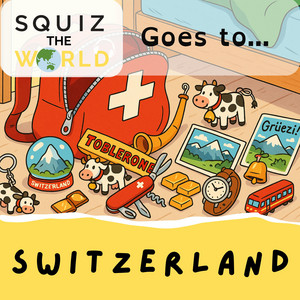
I'm Christy Kidgerina, and today, on Squiz the World, we're visiting a country where the most famous mountain looks like a giant Toblerone triangle.
It has four national languages and it's home to the Red Cross, the World Health Organisation, and lots and lots of cows wearing bells.
Can you guess?
Strap yourselves into the Squiz Kids superfast supersonic jetliner as we take off and take a squiz at Switzerland.
Just the facts.
Switzerland is a small landlocked country in the middle of Europe, surrounded by France Germany Italy, Austria and the tiny country of Liechtenstein.
Its capital city is Bern, not Zurich, even though lots of tourists get that one wrong.
Around 9 million people live in Switzerland and the landscape is spectacular.
Their mountain range, called the Alps, covers about 60% of the whole country.
There are more than 4000 mountains, including the famous Matterhorn and the Eiger, and more than 7000 lakes, including Lake Geneva and Lake Lucerne, which are so clean that you can drink from fountains fed by them.
Switzerland has a very unusual government.
Instead of one president running everything, the country is led by a team of seven people called the Federal Council.
They make decisions together.
Every year, one of them gets to be president, but only for 12 months.
It's a bit like taking turns being the team captain.
Switzerland is also divided into 26 regions called cantons.
Think of them like states or territories, but with even more independence.
Each canton has its own parliament laws, education system, traditions and sometimes its own official language.
Some cantons speak Swiss German, some French, some Italian and one even has Romance as its official language.
It's a little bit like driving from New South Wales to Queensland and suddenly the road signs change language.
What?
Switzerland is also famous for something called neutrality, meaning it hasn't taken sides in wars for more than 500 years.
Which is probably wise, because while the Swiss army knives are brilliant for camping, I'm not sure that teeny tiny tweezers would scare off many enemies.
And because the country is neutral, lots of international organisations have their headquarters there, including the World Health Organisation, the International Olympic Committee and the Red Cross.
But it's not just the landscape and the government that are super interesting.
The Swiss people are pretty interesting too.
So... Let's get cultural.
If you have any...
Ever had a creamy Swiss chocolate?
You've tasted one of the country's proudest inventions.
Switzerland is famous for chocolate thanks to two clever men Daniel Pitta, who invented milk chocolate by mixing cocoa with condensed milk, and Henri Nestle, who helped perfect the recipe.
Another chocolatier, Rudolf Lindt, invented conching, a smoothing process that makes chocolate just melt in your mouth.
Switzerland is also known for some pretty unique music.
There's yodelling, that's the echoing singing style used in mountain valleys, and there's the alphorn, a long wooden horn sometimes taller than the person playing.
It used to send signals across the Alps.
Sport is a huge part of Swiss life.
People grow up skiing and snowboarding and ice hockey matches are loud because fans often ring cow bells in the crowd.
And on the beautiful Rotsi Lake in Lucerne.
Rowing competitions attract athletes from all over the world.
But when it comes to celebrations, one of the most colourful is the Cow Festival, also called the Alpine Descent, where cows come down from the mountains as the summer draws to a close, wearing giant flower crowns and beautifully decorated bells.
I need to see that.
After all that culture, I think it's time to speak to some locals.
So let's... Switzerland has four, get that, four national languages.
German, French, Italian and Romance.
Which one you hear depends on where you are.
Most people speak a version of German called Swiss German, which sounds quite different to the German spoke in Germany.
In the West, people speak French.
In the South, they speak Italian.
And in one mountainous region, a small group of people speak Romance, a language that originally comes from Latin.
And today we're lucky enough to have a couple of native Swiss kids, Louis and Robin, here to teach us a few words in Swiss German.
Hi, I'm Louis.
I'm 16 years old and I'm studying at high school economy and law.
And I'm Robin.
I'm 14 years old and I'm also at the high school.
My field of study is biology and chemistry.
We live in Bellach.
It's a village with about 5,555 inhabitants.
We live close to Solothurn, the most beautiful baroque town of Switzerland.
Luis, let's teach them some Swiss words.
Okay, Robin.
How do you say good morning?
Guten Morgen.
And Luis, how do you say thank you?
We often use the French word merci.
And what about bye?
Now boys, I hear that you also have a tongue twister for us today.
Oh my goodness, that is a real tongue twister.
Merci Louis and Robin.
And in case you were wondering, the translation of that tongue twister into English means the Pope ordered bacon cutlery too late in spits.
We have learned so much already, but i think it's still time for school.
Swiss kids start school at around the same age as australian kids, but their school days can look pretty different.
For starters, most swiss schools don't have uniforms.
Kids just wear their regular clothes, And many have a long lunch break, sometimes two hours or more, when students walk home to eat with their families before heading back to school for the afternoon.
School is free and compulsory and learning takes place in whichever language the region speaks.
Outdoor learning is really popular too.
Many kids take part in forest kindergartens, where they explore nature, climb trees and learn outside, even in snowy weather.
As students get older, they can choose different pathways academic, high school, vocational school or an apprenticeship, which is a really popular way to learn a job while still studying.
And now that we've worked hard at school, let's discover some of Switzerland's amazing surprises.
Believe it or not.
So the country of Switzerland might be small, but it's responsible for some pretty big inventions.
Have you ever used Velcro?
Oh, that sound is so satisfying.
Well, it was invented by a Swiss engineer who noticed how burrs from plants stuck to his dog's fur and thought hmm, this could be useful.
And today it's used in shoes, jackets, astronaut suits, and even in hospitals.
Way back in the 1890s, the Swiss Army needed a tool that could help soldiers fix equipment, open cans and stay prepared in the mountains.
A clever cutlery maker created the Swiss Army Knife a small tool packed with scissors screwdrivers tweezers, toothpicks and maybe even a can opener.
Very handy.
Here's something that you see everywhere that was designed by the Swiss.
Helvetica font.
It's simple, it's clean, it's easy to read and you'll find it on Apple computers, on Coles and Woolies product labels, on logos like Target, Sony or cotton, on and on signs in airports all around the world.
Oh, that is so much invented by the amazing Swiss.
And after all those clever ideas, I'm feeling hungry.
Let's taste something delicious.
It's Swiss food is warm, hearty and perfect after a long day in the mountains.
Bread is a big part of meals.
Crusty loaves, braided buns and pretzel-style rolls.
Dairy is everywhere too.
Fresh milk, yoghurt, butter and lots and lots of cheese.
Popular dishes in Switzerland include rosti, that's crispy shredded potato, and raclette, where melted cheese is scraped over potatoes.
Oh, my tummy is growling now and we haven't even reached the best bit yet, fondue.
So if you haven't heard of fondue, it's a pot of bubbling melted cheese placed in the middle of the table, and everyone has a really long fork that they use to dip pieces of bread into it.
It's often eaten in winter and there's a really fun rule you drop your bread into the pot.
You might have to do a silly challenge chosen by your friends and family.
And I've stuck a link to a recipe in the episode notes.
Time for the quiz.
This is the part of the podcast where you get to test how well you've been listening.
Question number one.
How many official languages does Switzerland have?
That's right, it is four.
Question number two.
What is the name of the musical instrument that's a long wooden horn used in the Alps?
The name says it all.
It's the Alphorn.
Question number three.
Which melted cheese dish do Swiss families enjoy dipping bread into?
Wow, that's all we have time for.
Thanks for staying curious about the world and joining me on this incredible trip to Switzerland.
Now get out there and have a most excellent day.
Over and out.