Discussion keeps the world turning.
This is Roundtable.
Green rose ahead. Do you know China just wrapped up the global sustainable transport forum in Beijing?
Let's dive into the highlights and see what China and the world have in store for greener, more efficient travel.
And from little bursts of joy to unforgettable tunes, we're here to share the happiness that brighten our week.
Join us in Roundtable's happy place, coming to you live from Beijing.
This is Roundtable.
I'm He Yang. For today's program, I'm joined by Steve Hatherly and Yu Shen in the studio, first on today's show.
Beijing just hosted the Global Sustainable Transport Forum, 2024, from September the 25th to 26th.
With newly released reports, big plans and game -changing ideas on the table, the event brought global leaders together to tackle the future of eco -friendly transportation.
But what does sustainable transport actually mean, and how does that impact our everyday lives?
So Yu Shen, your chance to take up explainer duty today.
Okay, so according to...
That looks good on a business card.
Official explainer.
Of some official terms, okay.
According to International Institute for Sustainable Development, which is a UN's advisory group, so sustainable transport refers to services and infrastructure that advance social and economic development in a safe, affordable, and environmentally friendly manner, reducing carbon and other emissions.
So to offer some more down -to -earth examples, public transportation, such as electric buses and trains, that can carry people far more efficiently than cars and other healthier methods, like cycling and walking, are all included.
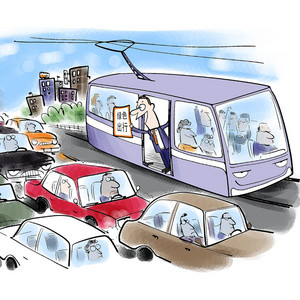
And one thing I think I would like to introduce is called BRT, bus rapid transit.
It is also included in the sustainable transportation.
And it is kind of a public transportation system, I think, quite localized in China.
I've seen it in many cities with smaller populations.
You know, building a subway might be a bit too costly for them.
So this kind of above -ground transport system, which operates similarly to a subway, is very suitable.
It has dedicated lanes, so it won't be obstructed by other vehicles or traffic lights, making it highly efficient.
Yeah, sometimes you'll see a city where the bus lanes are in the middle.
In the past, you'd see a bus pull over to the side of the road a lot of the time, and that would really hinder traffic because it would cut off the cars on its way to the sidewalk area.
Sometimes cities now will have the bus lanes, dedicated bus lanes through the middle, and it really helps to alleviate traffic congestion.
And we have both here in Beijing.
So in the inner, let's say, fifth ring road of the city, which is a rather large area, actually, but a lot of the old city structure is there.
And that's where all the traditional buses, traditional bus lanes take place.
And also just a quick reminder, actually, during weekends, now some of these bus lanes are open to private cars as well.
And that's sort of like a new development of things.
But also, please check because not all lanes are open.
Yeah, that's very important to know where and where you can't bring your car.
The electric buses in Beijing are awesome.
I like watching them take off from picking up their passengers because they're so quiet.
Remember those old diesel buses when they go, you know, there are manual transmissions, but the electric ones are like...
And then they're gone.
Oh, interesting. I never knew that.
They're so quiet. But the vehicles are huge.
These are these huge buses, but they're still so quiet.
That's kind of becoming a signal or a signature sound of new energy cars or buses because they always have that kind of sounds.
Some people call them actually sound like ghosts because they're wu -ng and then go away.
Vehicle ghosts. Whenever you hear that sound, you will know there is a new energy cars coming.
Right. And in Chinese cities for public transportation, now mostly is green.
We're talking about taxis, the buses, according to the BRT systems that you shouldn't just mentioned in Beijing.
Yeah, but that's usually like in the slightly outer side areas of the city center because these are massive buses and then they go so quickly, they can pack in at least half, 50 percent more passengers.
They're huge. They look like double buses sometimes, right?
They look like an accordion if you know what that musical instrument is.
Okay. They're connected by that rubber looking thing in the middle.
What is it called in Chinese?
I can't think of it.
It's not called… Yes, yes.
Anyway, sustainable transport.
Really important topic, isn't it?
And it's really important to society.
It's a crucial driver of economic and social development.
Transport infrastructure, it connects people to their work, education, healthcare, all of the different lines of work out there.
It's a really important thing, it enables global trade.
You look at rural roads, for example, and they can help prevent deaths, maternal deaths, through timely access to medical care, boost girls' enrollment in school, increase and diversify farmers' income by connecting them to markets.
There's a million examples that we could give and those are just a couple.
Yes, and this is actually key to, I suppose, the Chinese understanding of development.
That is you need to build the road before any other economic development can actually happen.
I guess a lot of people believe that and therefore to bring up the economic condition of, let's say, a remote area or a place that really needs some extra cash flowing into that area, then sometimes it's done privately and a lot of the times it's with public funding and then you build the road so that you
can connect the people to the outside world and facilitate more economic activity.
Also, we're seeing that transportation infrastructure has a real big impact on ecosystems.
This is, I guess, now a more up -to -date look at how to further develop transport systems in 2024.
Yes, but at least we can see that the transportation sector is a major contributor to global carbon emissions.
That's actually accounting for around 23 % of energy -related carbon dioxide emissions and shifting to a more sustainable transport can actually help reduce this kind of environmental footprint, improving air quality and reducing pollution.
When we are talking about these, we've always said that protecting the environment is protecting ourselves.
There is a reason for that because when we are, basically, damaging the environment, we're damaging the environment that we are living in.
The public health may also relate to it when we are affecting the environment by emitting these things.
The health of the people.
Also, the number, just the sheer number of people.
When the UN Conference on Human Environment, the Stockholm Conference, convened way, way back in 1972, the world's population was about 3 .8 billion at the time.
Today, a lot more. It's more than doubled.
It's about what is it now?
Over 8 billion, right?
Somewhere in that area.
And they project it to be 9 .9 billion by the year 2050.
Now, that's important because currently more than 55 % of the world's population lives in urban areas.
And urbanization and an increase in the population around the world, that could add another 2 .5 billion people to urban areas by that year 2050, with close to 90 % of this increase coming in areas of Asia and Africa.
Now, if we think about that, if there is going to be a lot more people, and those people are living in urban areas, then between the years, maybe early 2000s up to 2050, vehicle numbers will increase three or four -fold.
And that will happen particularly in developed countries, or developing countries.
So the importance of having the infrastructure there for those people to be mobile, that's crucial.
But also, we need to keep our planet clean, which is why sustainable transport is such an important topic.
Oh, that's such a good point.
And did you know that transportation is apparently responsible for around a quarter of global CO2 emissions, and 72 % of which come from cars and other road vehicles?
And from 1970 to 2010, these vehicles were responsible for 80 % of the increase in emissions, and this is according to a 2021 IICD report.
And so on the one hand, we see that travel and transportation actually emits a huge amount of CO2.
And on the other hand, with the growing population, and a lot of people actually lack convenient access.
And then there's just plenty of room for things to be done to how to, on the one hand, close that gap a little bit.
And on the other hand, talk about how to, without polluting the environment, a lot further more in doing so.
Data from 2019, they looked at 610 different cities in 95 different countries around the world, and they found that only half the world's urban population has what they called convenient access to public transportation.
Well, that's good, I guess, if you look at it from one side of a coin, but if you flip that coin over, that means half of the world's urban population does not have convenient access to public transportation.
That's from the 2020 UN Sustainable Development Goals Report.
So that proves your point, is that, yeah, things have been done, but there's plenty more to be done.
And that's why forums like this are such an important thing.
And also, I think, you know, with the infrastructure is building, it is actually making our lives more convenient.
It's not only about public transportation that you can use within the cities.
It's also connecting people from different cities, even different countries.
We see, according to China Daily, as of the end of 2023, China's high speed rail network and freeway system were extended to 45 ,000 kilometers and 184 ,000 kilometers respectively.
And also China has 38 airports with annual passenger throughput exceeding 10 million.
And these public transportations, I think it is doing something that you guys just mentioned, that making people connected and making them to be accessible to all of these public transportations.
That's a fun fact. 38 airports in China.
I did not know that before.
I'm going to use that on my friends next time when China quiz questions come up.
According to the five -year plan, 2021 to 2025, China's 14th five -year plan.
The aim is for high speed rail.
You mentioned high speed rail or rail here in the country, Yuxin.
The aim is to have lines to connect 95 percent of all cities with at least 500 ,000 inhabitants by 2025, with a total of 50 ,000 kilometers of high speed lines operational as part of a total national rail network of 165 ,000 kilometers.
And that's a big thing because, Hyun, you talked about the importance of infrastructure having a simple road connecting one community to another community.
It can help out the economic status of both communities.
Well, take that to a much larger scale and you're thinking city to city, a city in the northern part of China, like us here in Beijing, to a city in the south.
High speed rail makes things a lot more efficient for passengers, but it makes things a lot more efficient in terms of the economy as well.
Yes, and China certainly has placed sustainable travel and transport high on its agenda, committing extensive resources to it.
And we've seen with the fast development of electric vehicles and also essentially we're talking about electric battery development as well.
And this is one area of fast growth in China and it promises the Chinese people a greener future.
Yeah, and China is being recognized internationally as well.
Kim Yong -tae is the Secretary General of the International Transport Forum, pardon me, and Mr.
Kim noted that the country, the growing presence of electric vehicles here in China, is impressive.
And it's indicating a significant shift away from fossil fuel cars.
And I think that we even see that on the streets, don't we?
Whenever I look at the cars that are driving around, not all of them, of course, but a large number of them, it seems, are electric vehicles, which is a good sign.
That's just my own eye test walking around the streets.
And also, if we are speaking of this, I think the development of the sustainable transportation is also a sign of the country is putting more emphasis on providing citizens a convenient and a life that they can get just so easily.
I think it's a huge signal and reflection of city urbanization when we have these kind of facilities.
My example may seem a bit childish, but I think I was thinking about the opening scene in Zootopia.
Do you remember? It uses a train running through the entire city along with various innovative transportation modes to showcase the city's modernity and sophistication.
So because the sustainable public transportation connects the development of many other areas and industries, so citizens' work and even life are highly relying on public transportation.
I love how that was such an official statement from Yushin, but it referenced a Pixar.
I think it was Pixar.
Was it Disney? For my next point, I would like to reference Zootopia.
Yeah, didn't see that coming.
Try my best. No, very good.
Very good. More electric cars, more electric vehicles, more electric transportation is a good thing.
According to the International Energy Agency, let's call it the IEA, electric micro mobility options, they're expanding rapidly as well.
We're talking about things like electric scooters.
We talked about that on a previous episode of Roundtable, I believe.
Also, electric assist bicycles, electric mopeds, they were available in over 600 cities across more than 50 countries as of 2021.
And an estimated 350 million electric two or three wheelers, the majority of which were in China, by the way, made up about 25 percent of those in circulation worldwide.
And looking into a greener future, lots of measures are already in the pipeline, and we can possibly spotlight on a few Chinese cities and just see what they're doing or what they've done in this area.
Yeah. And one example that I can think of is the one that I saw that a lot of cities are developing a system of green road freight system so that they can actually build up a platform for drivers to connect with each other and improve the efficiency of using their trucks.
So because we know that road freight is a core battleground for carbon reduction in China's transportation sector, within the transportation sector, road traffic contributes over 80 percent of carbon emissions and road freight accounts for more than 60 percent.
Road freight, you're referring to larger delivery trucks.
Right. For all of these road traffic emissions.
And technology can be a very important part in this sector.
And this digital freight platform called Manbang utilizes big data and algorithms to enhance matching efficiency and improve vehicle capacity utilization.
Because I think, you know, the load factor of large trucks is closely related to transportation efficiency and energy conservation.
If you are driving an empty truck, then that's absolutely a huge waste.
Yes, because those trucks, when we think about freight transport, we think about, oh, okay, they're carrying cargo from point A to point B.
Well, what can we do about that?
But those trucks often make empty trips to the places where they have to pick up that cargo.
Yeah, it's a big problem.
You asked for some examples about cities.
Let's go to Shanghai for a moment.
Shanghai focuses on things like smart taxis and smart logistics and smart public transportation.
Smart, smart, smart in the city of Shanghai.
They're encouraging traditional taxi companies to participate in innovation.
They're also asking them to accelerate the creation of an intelligent travel service ecosystem.
They've opened a total of 1003 test roads with a total mileage exceeding 2000 kilometers, 32 enterprises, 794 vehicles in Shanghai have obtained licenses of road testing.
And this is demonstrating application operation.
They've got a cumulative test mileage of about 22 .9 million kilometers, which means all those numbers mean that they're trying their best to make the taxis.
Taxis are always on the road.
Taxis are always contributing to traffic as well, but they're trying to make them as smart as they can.
Yes. And that involves a lot of data collection, data mining, and data sharing, I suppose, and with the logistics examples that you guys were talking about, about the freight trucks and stuff.
And well, certainly that's been a point of contention in this country for some a few months ago, I suppose.
And most people, I mean, I don't think we need to worry too much for the fact that drivers because they don't want to lose money running around with driving around an empty truck.
So they'll find ways to fill that truck.
But what's really important here is to find safe ways to secure the safety of the driver as well as the stuff that that person is carrying, as well as with all this data that's being presented.
It's really useful to maybe in a faster and more efficient way to find the right cargo for those round trips to be filled.
And hopefully that will, you know, make lives a little bit easier for the truck drivers, as well as make the whole process streamlined and more efficient and possibly greener if we can employ more of the green energy into all cars and freight on the road.
They could look to Switzerland as an example.
I thought this is a really interesting story in Switzerland.
It's a very, very ambitious proposal, but it could see the construction of an expansive underground network through which self -driving pods would transport freight across the country.
It's a really, really, really cool idea that would be amazing for the planet.
It's called cargo su terrain, which means underground cargo in English, and it's intended to reduce the reliance on trucks for moving cargo trucks.
Yeah, to mention it again, the demand for freight transportation is growing around the world, but there's also a shortage of truck drivers worldwide as well.
Then you've got high fuel prices, and that's made road transportation more expensive.
And transporting freight by road accounts for about 6 % of global carbon dioxide emissions.
So with this project, they're hoping they will reduce heavy traffic from Swiss roads by up to 40%, because it will only be using renewable energy, and it will emit 80 % less carbon dioxide per ton of cargo than transporting freight by road today.
The goal is zero emission.
They're having some bumps.
I just checked before our chat today to see how the project was going, because that information was from CNN that I just gave you from 2023.
They're still trying to figure out some of the finer details, like where the hubs will be.
Some of them are planned to be in residential neighborhoods, so they're still squabbling about that a little bit.
But that's such a unique idea, isn't it?
Put the freight underground with these pods that don't take any energy, totally renewable energy sources, and the traffic reduction, the fossil fuel gasoline reduction, really, really good for the planet.
So is it like underground?
You still need to dig these tunnels out, right?
Absolutely, yeah. So if they build it, the network is going to stretch about 500 kilometers from Geneva, in the west of Switzerland, to an area called St.
Gallen in the northeast.
They're hoping it can be completed by 2045.
The goal for the first 70 -kilometer section is 2032, but like I said, they're fighting a little bit about hub locations right now, but it's not like they've canceled the project.
They're still planning on going forward with it.
Yeah, speaking of transporting cargoes and goods, I think when we're talking about these, having a sustainable transportation system connecting one country to another also needs to be included.
So we saw China has fostered global cooperation in sustainable transportation by means such as signing multiple bilateral agreements on international road and air transportation, as well as building railways abroad.
When I was on a business trip to Xinjiang, Uyghur Autonomous Region, I saw the China -Europe Railway Express, which connects many neighboring countries.
These trains carry goods from various countries, facilitating, I think, a very smooth trade between different regions.
And I believe this not only promotes the infrastructure development of these various areas, but also strengthens the friendship between countries while mutually boosting economic growth.
I definitely enjoy that idea, and I think it's really important to have these kind of connections with the countries around us.
And also, what do you see as ways to promote sustainable transport to benefit the people here as well as benefit the world?
I think we can look to Abdul Alim Khan for an answer here, the Federal Minister of Pakistan's Communications, Privatization, and Board of Investment.
Mr. Khan emphasized the need for improved connectivity between urban and rural areas, particularly in developing countries like in Pakistan, for example, where they have an inadequate rural road system.
And that hinders economic development, and it exacerbates inequality.
So, yeah, that would be a perfect example, improved connectivity between urban, not just rural to rural, but rural to urban areas too.
Yeah. And that's definitely where a lot of the future possibilities and opportunities could happen, you know, from the rural areas to urban, and vice versa, where more connectivity could happen.
And the journey towards sustainable transport is just the beginning, and the innovations.
And let's say, measures today that we talked about are testament to what's achievable when nations unite for a common cause.
And as China invests more into green technologies and future, the road ahead seems there are more options and a little bit more promising.