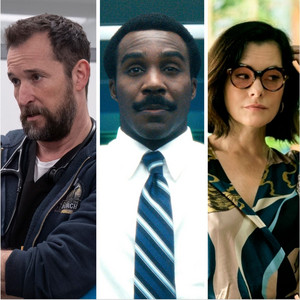
Welcome, everyone, to the Daily Sunday Special.
I'm Gilbert Cruz, the editor of the New York Times Book Review.
And every week here you'll find us talking about movies books, the arts, just all sorts of culture.
Today, we're talking about TV.
The Emmy Awards are tonight the biggest night in television, marking the best shows released between June 1st 2024 and May 31st of 2025.
They've made it very simple.
It's not at all confusing.
Here in New York, a group of us has gathered to talk about some of the nominated shows that just keep rattling around in our brains.
And we're going to be talking about some of those shows in depth.
So if we get to something that you don't want spoiled, you're in the middle of the season just jump ahead a few minutes and all will be well.
Here with me is Jason Zittemann, a critic who writes about comedy for The Times.
Hello, Jason.
Hello.
Good to be here.
And also, Alexis Solosky, one of our culture reporters.
Hello, Alexis.
Hi.
Hi.
All right.
There's a conceit here.
And I'm hoping that you can, like, come along with me.
You have to use your imagination.
So picture the three of us sitting together on a sofa.
It was really relaxed.
Potato chips and soda.
And I'm just flipping through channels.
We're looking at TV.
I'm going to stop on a show.
And then we're going to talk about that show for a few minutes.
And then we're going to change the channel.
TV roulette.
Yes.
Can you imagine that?
Yes.
This is Audios, the theater of the mind.
Got it?
I'm on board.
Excellent.
Okay.
So I am going to pick up this not at all metaphorical remote.
It's actually a real remote.
That's old school.
It is.
I think we should just get started and flip to our first show.
I am the one who knocks.
Welcome to the pit.
We got two traumas from the tea.
Five minutes out.
Okay, copy that.
Actually, this is the most important person that you're going to meet today.
This is Dana.
She's our charge nurse.
She is the ringleader of our circus.
Do what she says when she says it.
First up is The Pit.
This is a medical drama that was a bit of a sensation this year.
It's streamed on HBO Max.
It's set in an emergency room in a hospital in Pittsburgh, hence the name of the show.
And it follows a veteran doctor named Dr Robbie, played by Noah Wiley, who you just heard in that clip, and the sort of residents and interns around him.
I had not watched a hospital show in years.
Really enjoyed this one.
Alexis, I know you watched and enjoyed this one too.
I did.
I didn't at first because I thought, oh, I don't like hospital shows.
I don't need hospital shows.
I find them stressful.
I find them melodramatic.
And then...
I started watching this one, and it was like sinking into a warm bath of competence.
These people are so good at what they do, and watching them be good at what they do, it's my ASMR.
Like, it soothes me.
I agree with everything you just said.
I possibly have not watched a medical show intensely since ER, and there's weirdness around this.
Michael Crichton essentially created ER and Michael Crichton's widow said this just feels like a reboot of ER.
It has... one of the main producers, John Wells.
It has one of the main stars, Noah Wiley.
What are you guys doing?
This is a real Theseus ship kind of situation.
It's fraught and the courts won't work it out.
But the competence is real.
And there's something about the time we are living in in which it is soothing, even though the show is intensely stressful.
Just watch people be good.
It's like, I wish I was as good at anything I do in my life as these people are at what they do.
And when people come in with problems, they diagnose them.
They find out what's wrong and then they treat it.
It's the... Are you saying this is how medicine should work?
Yes.
Wouldn't that be amazing?
What did you think about Noah Wiley, who I guess I forgot how wonderful a screen presence he is.
He is.
I mean, I think that when he was on ER he was so young and he looked so young that I didn't find him as compelling.
But, you know, a Noah Wiley with some miles on him, with some lines on his face.
That gray in his beard.
Straight into my veins.
I love it.
Dr. Robbie, which is the name again of his character, is my guy.
I cannot wait until season two, which is starting in January.
Jason, you didn't sort of dip into this.
No, I've never seen the show.
Hearing you talk about it makes me curious.
Does it always end the same way?
In what way?
Like, does it always end with the problem being solved?
No, no, no.
It's not procedural.
Like, it is, you know, storylines will go through several episodes, but it is one 15-hour shift.
And there is a particular crisis.
And you were like, oh, I did not need a crisis.
There was crisis enough already in this overcrowded, understaffed emergency room.
But there is a crisis there.
And they handle it.
They handle it the best they can.
Also Charge Nurse Dana.
How much better would all of our lives be if Charge Nurse Dana told us what to do and we did it.
I think it would be very good.
Listen up!
Central 789 is now the Blood Donor Center.
Anyone who says, oh, neg or oh, pause, we need you to donate now.
Hands where I can see them.
She's very good at her job.
You think everyone needs a Dana in their lives?
Yeah.
I can see the fantasy of it, because it's hard to think of an experience with the hospital that isn't frustrating on multiple levels.
So to hear this description sounds like wonderful escapism.
I mean, it's also, you know, the doctors experience tons of frustrations.
One of the tensions early on in the series is between Dr Rabi and the administrator, sort of the main administrator of the hospital, who is coming down and saying you know, your patient satisfaction numbers need to go up.
And he says, we don't have enough nurses, we don't have enough beds.
So it definitely sort of grapples in that way with what appears to be real tensions in the emergency rooms of today.
And I think I have also read that emergency room professionals who watch this show are like...
Yeah, that's what it's like.
I mean, you know, give or take a couple of dramatic moments here or there.
Like, by all accounts, there's a great sense of verisimilitude to it.
And because it's streamed on Macs, you also can do what you were never able to do on ER, which is show some really gnarly stuff which you would see in an emergency room and then have people curse a lot.
Yeah.
So it's towing this line between sort of the hospital procedurals of old and, like a more prestige TV of the present day.
I also love it, I'll admit, because it is a nepo baby bonanza.
There are at least three nepo babies.
Okay, I did not know this.
Yes, yes.
There are at least three nepo babies in the cast.
And I love a nepo baby.
I feel...
You're an expert, too.
You should say.
Because in only one case is the parent what we might think of as famous.
The other two parents are just working actors.
And you would never, you don't know.
You would never know that these are the children of these parents.
Well, I had never seen many of the actors in this cast other than maybe the top two or three.
So whose parents?
I mean, whose kids are these?
Yeah, it's three of the doctors.
It's Taylor Dearden, it's Issa Briones, and it's Fiona Dourif.
And...
Probably the one with the most famous parent is Taylor Durden, who plays Mal, who is a resident who the show suggests is neurodiverse.
And I love this actress.
I love this character.
She is an angel.
She should be protected at all costs.
Like, her empathy is extraordinary.
You okay?
I just, my patient hasn't... seen her daughter and it won't happen again.
Never apologize for feeling something for your patients.
And it turns out, surprise, she is the daughter of Bryan Cranston.
What?
Yeah.
Yeah.
Mel is the daughter of Brian King.
She's great.
She's great.
That character is wonderful on the show.
And then two of the other actresses, Issa Briones and Fiona Dourif, who play young doctors, are the daughters respectively, of John John Briones and Brad Dourif, both of whom are working actors.
Let me, we should say, you've written some excellent profiles of Nepo babies last year.
And so I feel like you're like the good person to ask it.
You say that this is like the best example of a Nepo baby.
What's a bad example of it?
Is the point that if you can tell too much who the parent is?
I think it is.
A bad example is if you have to spend a moment thinking, oh, God, did they really deserve this?
Was there someone better that could have cast in this role?
Did they only get the role because of their parent?
That's when it feels icky.
And I've never had a thought with any of these actors who are wonderful and who really disappear into the roles, who are really acting.
Jason, you've got to watch some of this.
It sounds like it.
I know your deck is stacked.
I know.
I mean, there's only so many hours in the day.
I will say, you are a comedy critic, and this show is not very funny.
There's no comedy in it.
And again, I love the show, but it is incredibly serious.
That's okay.
I mean, that means that a serious hospital show is my version of relief.
There's one funny thing that happens, and it's not funny, but it's the recurring motif of Dr Robbie walking into a room where something terrible is happening and then two minutes later saying it looks like you all have this and then walking out.
It's like 30% of the show.
Okay, okay.
There are raps who show up, there are rats and there is one poor medical student who keeps being like sprayed with body fluids.
See, now you're making me not like it because I'll say, as somebody who has spent time in an ER with family members, and one thing I've learned also from the comedy scene because nurse comedy is a genre, a popular genre that ER nurses have some of the darkest senses of humor out there.
They are hilarious.
And there's a whole market of hospital humor.
And I guess the idea being, if you see these horrible things on a daily basis, where your job is to repress your feelings and put on a you know, a straight face on it that you need relief.
So when they go, you know when they finish treating you as a patient.
Know that when they leave they're making fun of you later on.
Can you take both of us to the next hospital open mic, wherever...
Whoever that may be.
Sure, I will.
I will.
Nurse Blake.
Yeah.
The basement of old St.
Vincent's or whatever.
You might have to go to a cruise.
They're big on cruises.
All right.
Well, I'm totally out.
I do not like cruises.
All right.
We're going to change the channel here.
It's time to move on to our next show.
I'm the youngest boy.
Macro data refinement.
Welcome back.
Please, take a seat.
Irving, if you wouldn't mind being in back.
Tall glass of water.
So, obviously, that was Milchak from Apple TV's Severance.
And it's sort of like a minor goal in my life to achieve the calm presentation that Milchak gives in all scenarios at work.
This is the second season of Severance.
It aired this past winter, earlier this year.
And it's a sci-fi, drama...
It's a bit of a paranoid thriller about a bunch of office workers whose memories have been surgically severed.
We live in a world, in this show, in which you can divide your time between your work and your personal lives.
You're essentially two different people in the same body, and neither person has memory of the other person's life.
This season follows up on what was a pretty dramatic season one finale, which aired so long ago in TV years.
It was three years ago.
And Severance.
This year is the most nominations of any show at the Emmys 27 nominations, which is so many for a show show.
That is fascinating to me in how both exciting and sleepy it can be at the same time.
Jason, did you watch season one and season two in real time?
I did.
In fact, this is one of the few shows that I watch right when it comes out.
And I kind of resent it because it forces you, with a straight face, to use terms that you previously only used to describe your belly button, which Innies and outies.
It's humiliating to have to do this.
We're grownups.
But you sort of have to do it for this season because I think the big shift is that the first season the fundamental drama is about the innies who are kind of oppressed and controlled by this sinister, mysterious company Lumen.
And that sort of shifts a bit in the second season to the innies being oppressed and controlled by their outies, which opens up all this new kind of metaphorical running room, because they're kind of prisoners of themselves.
I love this show because it has great ambition in terms of its tone and It both is very, very serious and very, very silly.
In fact, I think it kind of sometimes teeters on the ludicrous.
And it escapes that, I find, because of the strength of the cast.
I think Adam Scott is amazing.
And so is, what's his name, Britt?
Britt Lauer.
Britt Lauer.
And I think this season in particular, because they're playing two characters who are getting increasingly different, and it's their.
The subtlety in their performance is really remarkable.
And you know this, this season sort of culminates with a meeting between Mark sending messages from his Indy to his Audi, his Audi back to his Indy.
Oh, hey, Miss Google, tell me you like someone down there.
Helena Egan, right?
Any names Helene?
Which again, it's always when I watch it.
It's a little bit silly, but they managed to make it a sort of dripping fair fight.
It's Heli, actually.
Heli.
It's a person I'm in love with.
Which you'd know if you'd ever taken an interest in my life. before tonight when you need something.
I love it and I find it exhausting.
Like, I do not care.
I do not care anymore what Lumen is up to.
I do not care anymore what will happen to these employees.
Uh...
It's just stretched out the mystery too long for me and not enough has happened.
And yet I enjoy it so much.
Like any episode that involves the goats, the mysterious goats, I am here for the goats.
I would watch the show.
That was just a super cut of employee perks, because when the indies do well, they get these perquisites like melon bar egg bar music, dance experience, little finger trap toys, and i would just watch that in my heart of hearts.
I love a workplace comedy.
I love a workplace comedy so hard and And all the parts of this that verge on workplace comedy and absurdity I love so much.
And the parts that are deeper and more philosophical, I have come to find enervating.
But goats and the design.
Oh, my God.
But goats.
The design.
It's like the mid-century modern of it all.
The creepiness of it all of having these huge spaces and then crowding all of the workstations into one tiny part of this large space.
The low ceilings, the lighting.
It's beautiful.
Beautiful.
It is.
It is beautiful.
I mean, I love the production design.
I love the the the score, the acting.
But by and large, maybe give or take one performance.
Oh, provocative.
Talk about who I'm talking about here.
But the.
Who are you talking about?
I'm not.
I'm not.
I'm not in on Patricia Arquette's performance.
I think she's a wonderful actress who's been in many good things, but the character that they have set up and her performance is not.
There's one episode late in the season that's focused primarily on her, and I think I fell asleep twice.
I watched her two successive nights.
Is that her fault or is that the script?
Well, I would say both.
I would say both.
Everyone else is great, particularly Tramiel Tillman, who you heard at the beginning, who plays Mr Milchak and who many people saw this summer in the new Mission Impossible movie.
He's incredible.
What a star.
But there is... I...
Agree with both of you.
I find much of the sort of the metaphorical conceit fascinating.
I think the thing that I continue to trip on is, as you were alluding to, sort of the mystery element of it, the lostness of it.
And I use that not pejoratively because I think Lost is one of the great shows ever.
The past many decades.
But there is this part of it just like, all right, what is Lumen doing?
What are the goats who why are there only four seemingly four people working at this company, you know, in charge?
I think I empathize and I also felt that.
But I also at some point I realized, oh, this isn't the strength of it isn't the mystery.
Okay.
Like I think you know, like Alexis is saying, like it has moment to moment all these incredible jewels.
I mean, the relationship between Christopher Walken and John Turturro is beautifully realized.
Zach Cherry is showing—
Incredible range.
That's an it's a fascinating relationship with Merritt Weaver.
The language of it is incredibly ornate and interesting.
But fundamentally, I think it like it's not a show where plot is its strength.
And increasingly, the way that we're taught to watch these shows is as in trying to solve a mystery of the plot.
You know, we're not living in a golden age of TV.
As our TV critic pointed out, we're in a mid-era of TV.
But if you were to make a case that we are, if you were to try to strain it, I think you'd have to start here, because what it's attempting to do is so ambitious.
And if you look at really great art, plot is important, but it's not...
Certainly not what you would describe as the most important aspect of most great art.
And I think at some point it became less interested in plot and the mystery of it than in some of these, these ideas, which actually quite dark ideas.
I mean it's about.
It turns into a show, in my view, about slavery.
You know about whether these innies are.
Are they?
Are they people?
Are they worthy of love?
Are they worthy of life?
Or are they just means to an end?
I think it's fascinating too, because there's a show.
It's sort of created by a gentleman named Dan Erickson, but it is produced, and many of the episodes are directed by.
Someone who we used to consider one of the great comic actors Ben Stiller who has become someone now who I feel like has moved into this phase where this sort of is his life now, as opposed to being a comedic actor.
It's true, and you sort of... You forget it.
It doesn't feel like a bad.
Every once in a while something will happen where you're like oh yeah, there's a comedian behind this.
And I do think that's the magic trick of the show, is that the tone...
You know, it's paranoid.
It's kind of unlike anything else on TV, I would say.
It really is.
Like, the flavor is unlike anything else.
And it could—I mean, it is a dark show and it is a dour show in its way, but it could be so much darker and so much more dour.
And there are moments of pure absurdism that really— love in it and make it feel like nothing else.
That there would still be enough for the show to persevere.
That this is just a carapace and maybe a carapace that it doesn't really need anymore.
Well, another element, you're right, I think it also becomes like a romance.
There's a love triangle.
There's a love triangle in which he has to choose at the end.
Because he has two selves, so it's like a love quadrilateral.
Yeah, that's right.
And then you know he chooses and he doesn't.
And then there's, like this, Butch Cassidy and the Sundance Kid, you know freeze frame.
It is.
The last minute of this season is quite striking and memorable, both in musical choice and imagery.
Yes.
Yes, the velvet fog returns.
It's like The Graduate before they get on the bus.
Yes.
Yeah.
We are going to keep surfing.
Let's move on to our next show, gang.
We were on a break!
Kim, would you stop taking pictures of yourself?
Your sister's going to jail.
Who did you meet with a boat?
Are they decent people?
Yeah, they own their own yacht.
They're rich.
Just because people are rich doesn't mean they're not trashy.
Most rich people are trashy.
I wouldn't go that far.
That accent can only be from one show.
We've changed the channel back to HBO.
We're talking about The White Lotus.
This is the third season of the Mike White drama, in which essentially rich people go to a fancy resort somewhere, all owned by the White Lotus chain, and then someone dies.
First one, Hawaii.
Second one, Sicily.
Next season's going to be in France, but this one was set in Thailand.
Alexis, I don't watch the show.
I've never wanted to start.
I don't think I ever will.
How do you, what do you do at, oh my God, at cocktail parties, do you talk about books?
Jesus.
Yeah, and I can't find anyone to actually engage with me.
How do you participate in the life of the culture?
I think I'd just say, have you seen The Bear?
That show's great.
Oh, my gosh.
Yeah, The Bear.
Talk about The White Lotus.
I love a show that understands the assignment.
I love a show that understands that the job of TV TV has many jobs, but I would say the really big one is to entertain and that knows that what we want to see are beautiful people in a gorgeous location being miserable.
Yeah.
So it is all the wealth porn and all the schadenfreude rolled into one.
And because Mike White and his casting directors are very savvy, they get some of the greatest working actors to populate these shows.
And so it has mystery, it has excitement, it has sex, it has me imagining what my life would be like if I too could afford room service.
It has it all, it delivers.
Why do you think other than wealth porn, schadenfreude when you talk to your friends about the show?
You want more?
Do you want more than that?
I'm not sold yet.
Tell me.
What?
I need you to sell me the Parker Posey accent.
Yes.
And, you know, when you said this could only be one show, I think it could actually be two shows.
One is The White Lotus and one is an unusually demented episode of Southern Charm.
Okay.
But I think it has everything.
And I don't think you need to think too hard.
I think it has these incredibly beautiful locations, this evocation of luxury.
I think it has wonderful actors.
In every season, something really terrible and awkward happens on a boat.
So, I mean, you need more than this.
I get that.
But I do feel like this season got some mixed notices, as they say.
I think it did.
I think this season did feel sometimes like it was repeating beats of the previous seasons, which you could say suggests a show that's out of ideas.
I like to liken it to the Buddhist concept of samsara.
Yeah.
Right.
Remind us what that is again.
You don't know?
I do, but I just want to be on the same page here.
I know.
Just this idea that you know we are in a constant cycle of death and rebirth and that we are always going to work out the same tensions, the same conflicts, the same desires, that that is at the core of our humanity.
And I also think that television does benefit somewhat from the familiar.
I do enjoy a procedural.
I do enjoy the comforts of a procedural.
And I would not necessarily call White Lotus comfortable show because there was a lot of cringe.
There was like uh, semi-incest plot line this season that I absolutely had to watch through my fingers.
But I do think that there is something comforting in seeing a writer-director, at the top of his game, do what he does, which has always been, if you're Mike White to display humans at their most venal level.
Most people don't have good values.
They're scammers.
You're all gorgeous and you come for money.
So you have to be hyper-vigilant, okay?
You have to be on your guard.
Let me ask you if you agree.
I sort of have.
There's so many of these shows about rich people behaving badly that are intended for us to dislike them.
And I, you know, there's a thing that people say, or a theory about war movies, that there's no such thing as an anti-war movie, that if you put war on screen, it's inevitably going to come off glamorous and it's going to romanticize violence.
And I've kind of grown to feel like that's true of rich people movies and television shows, of which this is not an insignificant part of our cultural diet.
Succession, most famously.
I don't care how much they make us want to think that being insanely wealthy looks bad.
It still looks pretty good.
I would like to try it.
I think that the secret to these shows is the feeling that you have, even if you don't express it, which is I would do better.
If I were in this gorgeous hotel in this gorgeous location, I would behave appropriately.
You know, everyone thinks they'll be a better rich person.
Sure.
Do you?
No.
No.
All right.
Do I think I'm going to be better?
No.
I think, you know— You're just going to be gross?
Yeah, I'm going to be—like.
What arrogance, what hubris to think that I'll be—like.
Clearly there's something corrupting about being surrounded by having everything taken care of.
Why would I be any better?
I don't feel that way.
And I guess—
I mean, I also really, I confess, I do come to television for fundamentally different reasons.
I like to feel bad.
I like shows that aim to disrupt and make me feel uncomfortable.
This explains so much.
I wrote a book on horror films.
This is who I am.
It's funny because The White Lotus, I enjoyed the...
Because it is uncomfortable and there is a tension.
And although I didn't see the season, I did see that monologue by Sam Rockwell everywhere.
That was this year, right?
Which did make me very interested.
And he goes for it, Mike White.
And those are the parts that are exciting.
This is so funny because all I want out of TV is to feel okay.
And you want the opposite.
But wait, Jason, because you have introduced this, I have to know.
Yeah, yeah.
What is the most disgusting thing that you would buy with your billions?
What is the most like disgusting, abusive waste of money?
He would buy a comedy club.
Yeah. for nurses.
I would buy a nursing comedy club and I would pay the audience to laugh at my jokes.
I would go on stage and tell nursing jokes.
All dad jokes.
All dad jokes.
All the time.
Yes.
All the time.
All the time.
No, I once I've been to a like fancy, you know, fancy hotel before.
And there are perks there that are corrupting.
And I've been to one where it was like a resort, where at any point in the resort if you asked for a bowl of popcorn, it would appear.
Yeah.
And I can't think of anything better.
Like imagine in your life, at any time in your life, you just think.
I feel like you know who shares this.
Like a popcorn concierge?
Yeah, Lorne Michaels.
I'm sure you've read Profiles of Lorne Michaels.
He always has a bowl of popcorn.
And I get it.
All right, we are going to take a quick break.
And when we come back we'll talk about some proper comedies.
Welcome back.
This is a sunday special.
I'm gilbert cruz and i'm here with jason zinneman and alexis soloski.
On this, emmy's day, we're talking about some of our favorite tv from the past year.
Let us go to our next show.
Channel change now.
I couldn't help but wonder.
You start packing yet?
Oh no, but i will.
You want some help From who you?
Yes, from me.
Well, because you hate packing.
Everybody hates packing, Joel, but, you know, we do the things that we hate for the ones we love.
Oh, my gosh, are you being tender with me?
Yes.
I like it.
So this is Somebody Somewhere, which aired its third and final season.
This is about a woman, played by Bridget Everett, who moves back to her Midwestern hometown and finds a bunch of friends, a bunch of outsiders that she falls in with.
And it's sort of like a warm show.
Both of you like this.
I love this show.
This is a show that breaks my heart and then puts it back together with a Band-Aid and a kiss.
I felt so many feelings just in that little clip that you played.
All I want are shows about people being kind to each other And learning to grow and be better in incremental ways.
Like, this is what I love.
And this does it so well.
And if you have ever seen Bridget Everett on stage, she is an alt cabaret performer.
She is dynamic.
She is exciting.
She is sumptuous.
She is over the top.
And all of that too muchness and over-the-topness she has restrained into playing a very real character.
Yeah, I mean, I can't think of a half hour show, comedy or otherwise.
That's made me cry more than this show.
Now, I don't know.
And it's something I thought, why am I always crying at this show?
But I think there's a couple of theories.
One is the use of music.
Music is the most emotional of art forms.
And, as Alexis points out, you know Bridget Everett is a singer and they strategically use this incredible gift cup of coffee or a trip to the store.
I'll take forever and then I'll take some more, And not just her, but there's a couple other sort of strategic songs in the show which are heartbreaking.
Second of all, I think so much of entertainment is these high-stakes stories about fighting aliens or, you know, doctors saving lives or billionaires fighting people.
It almost feels radical to see a carefully observed portrait of ordinary people, working class people in the Midwest, trying to make connections.
Because, oh, the way you look at me, I can't explain it, but I know it's love.
And it's funny.
It's an irony of the show that it's this middle-American portrait because it's made by all these downtown New York theater people.
And Bridget Everett and Jeff Hiller get a lot of credit, as they should.
They're the kind of Friendship that's at the core of this show.
But the the writers and creators of the show ran a off Broadway theater company called Debate Society that really put on these jewel like productions.
And they you know, they were also a lot of them were set in the Midwest.
And what they—I would describe them as being very fully realized and very detailed.
So every choice felt like an incredible amount of thought came into it.
Every character felt like they had a considered backstory.
It felt very lived in.
At the same time, there was something a little Lynchian about these shows.
And so what they did here is they took out the kind of Lynchian aspect to it and put in this realism anchored by, as Alexis points out, this understated performance by Bridget Avery.
And there's a real power in this marriage.
Particularly.
I think one thing that's always emotional is when these larger-than-life characters— go small.
You know, when you see the tenderness of, you know, Marlon Brando and The Godfather at the end, at the end of The Godfather, that makes our people cry.
And there's something similar about Bridget Everett's performance that she's this powerhouse, but she's constantly making herself small in a way that is very recognizable.
And it's really not what you feel, at least what I feel.
When I see Bridget Everett doing Cabaretia, you think this is this sort of superhero-like person.
But she really is playing against it in a quite heartbreaking way.
It's so particular.
It's so beautifully observed.
It has been ignored by the Emmys until now.
And this year, finally, it has two nominations.
One from Jeff Hiller, who is extraordinary, and then one I think really really deserved, for outstanding writing, because the writing really is outstanding and I'm so pleased to see it recognized.
But I think there was a moment in the 2010s where studios, network streamers, were putting their money a little bit behind these sort of smaller voicey comedies.
That felt really lovely and really particular, and we've moved away from that.
And the fact that somebody somewhere, was allowed to exist, that was given three seasons what a gift, what a joy.
Yep yep, yep.
Well, listening to music Jason, and watching TV and watching movies are really the only way that I can cry these days, so I think I need to watch Somebody Somewhere.
We are going to change the channel.
You unlock this door with the key of imagination.
You come at the king, you best not miss.
You know, prestige films and box office hits, those are not mutually exclusive.
We can do both and we will do both.
And that is why I am excited to announce that we are fast tracking A Kool-Aid movie.
Oh, yeah.
This is The Studio.
This is a show that all three of us watched.
It's an Apple TV Plus show.
It's co-created by and it stars Seth Rogen.
And he plays an executive at a Hollywood studio named Continental who, at the beginning of the series, is elevated to studio chief when his mentor, the former studio chief, is deposed.
And this is a Hollywood satire, obviously something that Hollywood loves to do.
It loves to make fun of itself, whether it's in something really dark like The Player, the Robert Altman movie, or lighter things like this one.
What did we think of this show?
I'll be honest, it took a minute for me because Seth Rogen is playing a very Seth Rogen character.
His studio executive, Matt Remick, is extremely doofy.
He is so doofy.
And it was hard for me, even in the comedy universe, the heightened reality universe, to imagine that someone like this stupid and this out of touch would have risen this high.
And I wouldn't say I'm someone with like a glowing opinion of studio executives and yet.
So I kept longing for someone who was just a little smarter, a little savvier, who would still make these mistakes.
But I was staying with my sister in L.A. and I have compromised night vision.
And as such, I walked through her screen door.
And the only thing I could think of to say was, oh, yeah.
So it got me.
And by the final episodes, the Golden Globe episodes, perfect.
It got me.
I was all in.
I loved it.
I mean, I love this genre.
I mean, Larry Sanders is probably my favorite television show of all time.
This is not that.
If you're expecting, like a scathing takedown of, or one deeply realistic, for that matter this this, this is much more warm hearted.
I think it's good that the Emmys are going to like celebrate an actual comedy.
This is the bear.
I mean, I know it's... You laughed more then than I did at the bear.
The jokes per minute ratio on the bear, they were like, what, zero for 30?
Exactly, which is not good.
I mean, the Golden Globes episode of the studio, I thought was hilarious and was very well crafted.
It's not a show where you've seen everything it has done before.
At the same time, I think it has one great insight and innovation, which is that we're living in this time where, you know, Hollywood has lost its mojo, has lost its swagger.
And bosses more generally of prestige institutions seem like the stature has fallen a little bit.
No offense, Gilbert, as a boss of a prestige institution.
A boss with a small b, so Yes, yes.
Okay.
And I think what the people who, you know, created the studio, they saw this as an opportunity.
Because if you think of like a Hollywood mogul, what do you think of like a cigar chomping person?
Robert Evans.
Robert Evans, someone who's intimidating, someone who's making decisions because of the bottom line, not because What they realize is that oh, you could actually make a Hollywood mogul who's not only like an underdog but a pathetic, likable underdog.
You can make him like a Seth Rogen figure, which I had never seen before.
And I think it's In its most Larry Sanders moments.
He's this guy who's desperate for validation, who got into this for the art, because he loved these great movies.
And then he suddenly finds himself in this diminished business where it's really run by tech.
And that is realistic.
I talk to a lot of people in Hollywood or in show business who have that same story.
So in that sense, I think it's actually quite topical.
No one as a child at the movies, staring up at that big, beautiful screen, thinks one day I will green light Kool-Aid.
No one.
Except for Marty Scorsese who in the first episode makes one of many great cameos.
That happens by many people over the course of the season.
And he, you know he's forced to turn his three-hour Killers of the Flower Moon-type project about the Jonestown Massacre into a Kool-Aid movie which, when you think about it, of course, is both gross and yet hilarious at the same time.
And he was nominated for an Emmy for that cameo.
One of the great joys of this is all the other cameos that you have in it.
Zoe Kravitz, Olivia Wilde doing an amazing self-parody.
Zoe Kravitz in three episodes.
At the end Ron Howard doing Ted Sarandos.
I thought setting himself up was hilarious.
Anthony Mackie, all of these people just skewering themselves.
It's beautiful.
Yeah.
And it's something that Seth Rogen and Evan Goldberg and all the people around him have done well in the past.
I mean, they've made many movies in which sort of the line between actors and their real Hollywood friends are very fuzzy.
There's an incredible Dave Franco run near the end of the season that I would watch again just to see his scenes.
I found the show hilarious.
I actually would watch the entire season again.
And it also feels like there's something about...
Seth Rogen's laugh that sort of drives the doofiness of this character.
I didn't know that anyone else could play this character in the way that it is played here.
And it all rests in his sort of type laugh.
I think he's really good in this performance.
He's having a beautiful moment, our Seth.
Can I say who I also think is having a beautiful moment on the studio?
Sal Saperstein.
The character played by Ike Barinholtz, who might be my favorite character of the entire year so far.
I'm not going to pretend to have a dead cousin to give Ron Howard a note that you should give him.
Oh, are you stricken by the morality of this situation?
Is that what's happening?
Oh, you're a bear?
He is great.
No, him and Katherine Hahn are a fantastic duo.
There is saliva!
Saliva is flying!
God, what is wrong with you?
Why can't you just give him the note?
Okay, now look at you.
You look just like my son did when I caught him watching porn on my iPhone.
And yeah, the running joke of everyone thanking Sal Saperstein and the Golden Globes.
So there's a bunch of lines in there that were when Rami is complimenting Zoe Kravitz and he says you know it's good.
It's not just diversity good.
It's good.
That's, like, also a very of the moment... There's some cutting stuff in there.
That's some cutting stuff.
One of the interesting things about this show is how beautifully it's shot, which I don't know if it's good or bad.
I wonder what you guys think about that.
I mean, if it had a grittier aesthetic... would that make it better or worse?
I think it does increase the sort of loving tribute, love tribute to Hollywood aspect of it.
It makes... It definitely draws your attention to the sort of...
The quote awesomeness of the camera work.
I mean these swirling handheld cameras, the tracking shots, like that stuff is forefronted, like you're supposed to notice it.
Right.
And it makes it feel like a weird contrast.
Like you have these people who love movies who are doing the stupidest things possible.
But yet look at the beauty of the filmmaking that is happening here.
I actually think the two work in tandem.
I'm a sipper, right?
I just I like something pretty to look at.
No, I do, too.
I like it.
And I think it as you say.
I think there's a way to kind of rationalize why it makes sense with the material.
But I'd be curious to know what what it like.
It does draw me out of it.
Yeah.
The moments where you're immersed in this world, it keeps saying, hey, look at this gorgeous shot.
Is the point, is it trying to say, hey, look, Hollywood can still pull off this magic?
To me, that is part of the point.
I think it is.
Filmmaking can be beautiful, even in a show about a bunch of doofuses, you know, making bad horror movies.
All right.
Let us change the channel one more time into a show that made me deeply uncomfortable.
Marsha, Marsha, Marsha.
Look, what you're about to witness is going to seem weird.
Which is why I'm putting myself through it before I invite any real pilots to participate.
But if a personality transfer can work on a dog, then maybe, just maybe, It could work on a human being.
Okay.
That's like the 15th craziest thing in that episode.
That line is like It's impossible for me to hear Nathan Fielder's voice without the giftina from Bob's Burger.
But we've arrived at.
Nathan Fielder's nearly impossible to describe show.
This show, which aired its second season and has two Emmy nominations this year, sort of sets up, creates scenarios where you could quote, rehearse for moments in real life.
In the second season and again Nathan Fielder is a comedian.
He becomes obsessed with the idea that the reason that some plane crashes happen is because there's a dynamic that happens in pilot communication that leads to the co-pilot not being able to sort of stave off emergencies that they see.
Jason?
This is a weird show.
I almost watched it on a plane ride back from Colorado.
I decided in the first two minutes to turn it off.
Wise.
How do you describe this show?
How do you describe Nathan Fielder?
First of all, I think this show's a triumph.
I love this show.
And I think it's interesting.
It is a hard show to describe, but I think it's actually fundamentally about like a socially awkward, emotionally clueless control freak trying to be a normal person.
That's what all his work is kind of about.
And the method of creating these rehearsals is a means to that end.
You know he has this big theory in the show that miscommunication among pilots is the cause of plane crashes.
And if we could fix that, then we could solve this major problem.
And he goes a long way to convincing you he's right.
More than any of his previous work, which always kind of blurs the line between reality and fiction, this one really makes you question what is real, what is not?
And in thinking of what this has in common with all his previous work...
Flight is a big part of his aesthetic.
At the end of Nathan For You, the last image is this drone shot flying up into the sky.
At the end of The Curse, there's this horrifying levitation where he violently floats up into space.
And the end of this show, Nathan Fielder flies a Boeing 737 passenger plane.
And there's an element of Nathan Fielder, of the showman of him, that he's tried to create a sense of awe in the way that, like in Wicked, when she flies, the impact it has on the audience is this it's trying to create this sort of disorienting sense of wonder.
And in the third episode, where he, you know, recreates the life of Sully, which also includes a crazy bit of theatrical flight when he turns himself into baby Sullenberger.
And he shaves his body.
And then you see him in a diaper walking out.
And then suddenly you see this giant crib.
And you have no idea what you're watching at that moment.
You're like, what?
Your brain's got to re... And you realize, oh, he's built this three-story tall crib.
And then he's hooked into these harnesses like from Peter Pan.
If even just the tiniest bit of Sully could become a part of me, it would all be worth it.
And he flies up into this crypt.
It's a very magical moment, which precedes the most horrifying, awkward moment I've seen all year.
It was difficult at first to inhabit the mind of a baby.
Is it the scene where he is breastfed by a giant puppet?
By a giant puppet, yes.
And basically he's almost like drowning on mother's milk.
So I tried not to think about the fact that I was a 41-year-old man and just did my best to be present in the moment.
The face that Alexis is making right now.
I'm so scarred.
I'm so scarred from this show.
Just wait until you watch it.
No, no, I did.
I did.
I watched it.
I watched it.
Oh, God.
I can't unwatch it.
It is like it sticks with you.
Maybe it's scarring, but maybe it's wonderful.
But unlike a lot of most stuff on television, it sticks with you.
I will say, I mean—
There is no one who commits to the bit harder.
Like there is no one working in TV right now who goes harder and who follows things through in ways that make me distinctly uncomfortable.
Never takes the easy option when a more elaborate option would work.
I mean in that sequence that you mentioned before the horrific breastfeeding.
There's also a very uncomfortable thing where he's supposed to get sexually excited.
Yeah.
Oh, God.
Anyway, but before that, when he's still the baby, they use like a very sophisticated form of Japanese puppetry to like puppet, a giant mother for him.
He does the most.
And his tall father on stilts.
Oh, my God.
It's all very Eternal Sunshine of the Spotless Minds or, like, Kaufman-esque.
But it's also, like, it's also about obsession.
Like in that episode.
I also see it as like a parody of, like the sort of obsessed literary theory that can find meaning in anything if you look at it long enough, right.
He has this theory about the reason Sully did this act of great bravery in landing this plane is tied to a song by Evanescence.
And you believe it because I've felt this, Alex, I'm sure you have.
If you look closely enough at something and you get obsessed with it, This sort of the act of criticism, the act of analysis takes on a life of its own.
It has its own pleasure.
And he mocks that and dramatizes it throughout.
There was something also in that episode and many other things, many other wild things happened throughout this second season.
Yeah.
That felt like he was connecting the entire conceit to the way that we're all sort of Reddit-pilled now and everyone is just trying to you know, figure out what the reason is and go deeper and deeper and deeper.
And if you reread Sully's memoir over and over and over again, look for the holes and find these connections, then you can understand why something actually happened.
Everything's a murder wall if you try hard enough.
Like, you can red string just about anything.
And just to be clear, this is an episode that starts not with Sully, but with...
Nathan Fielder building a replica of a dog owner's house.
A dog owner who has cloned her dead dog to try to see if he can make that dog act like the dead dog by creating the circumstances under which the dead dog lived.
Yes.
No, it's it's I mean, this is this is a series I've seen twice.
And so there's there's layers upon layers to go.
It's funny because it's making fun of this, but it's also building something for you to analyze and unpack.
It's it's structurally really clever and ambitious and and also just just insane.
Is this for everyone?
Is it for anyone?
Who is the show for you?
It's for you.
It's for you, Jason.
It is literally Nathan for you.
It is.
It is.
When you were describing a kind of like anxious, like hyper-intelligent person, like trying to control the world and like be normal, I was like oh.
I don't want to control the world, Alexis.
That's somebody else's job.
But no, it's a cult thing.
Which I think actually in the current culture is very – it works because it doesn't have as big a fan base as you know Star Wars.
But the people who like Nathan Fielder are in the tank for Nathan Fielder.
They're obsessed with it.
And I do think it speaks to today in a way a lot of other work does not.
Yeah.
Yeah.
All right, before we get to our game segment, I just want to mention obviously there's so many shows that came out over the past year or whatever the crazy eligibility period for the Emmys actually is that we could not talk about.
Adolescence, one of the most talked about shows of the past few months.
The aforementioned The Bear.
Abbott Elementary.
Adults, which I know that both of you love.
An FX show.
The Late Show with Stephen Colbert.
The Last of Us.
Slow Horses, which I'm a super big fan of.
Andor.
My favorite show of the year.
I'll devote an episode to that separately down the line.
We should have let Gilbert talk about Andorra.
We should have.
I feel guilty about that.
Yeah, but you didn't.
So that's where we are.
And we'll play our game right after this break.
Welcome back.
I'm Gilbert Cruz.
I'm here with Jason Zinnemann and Alexis Solosky.
And we are going to, as we do at the end of every Sunday special, play a game.
Jason and Alexis, one of the defining features about...
This year in TV, the past 10 years of TV have been just how much of it there is.
So in honor of that, we're going to play a giant game this week.
We're going to channel surf through a bunch of essentially mini games.
I'm going to explain the rules as we go along.
You both have buzzers in front of you.
The person who gets the most points wins.
The goal is not to win, but to have fun.
Is that right?
The goal is... Disgusting.
Is... Disgusting.
To do both.
Are we in America?
You're going to win something, guys.
So you do want to win.
Is that right?
This might change my calculus.
What is our lovely prize?
You'll see at the end.
Seems like it's not going to be good.
Well, Jason, you are correct.
All right.
Round one of our game is called Don't Cross the Streams.
I'm going to name a streaming service and you tell me if it is real.
Are you ready?
Yes.
Yes.
Friendly TV.
Jason.
Not real.
Not real.
It is real.
It's focused on family programming.
Opus.
Real.
It is not real.
It's not about the Catholic Church.
It just shows Conclave 24 hours a day.
I would watch that.
All right.
Next up, Psalm TV.
Psalm TV.
Jason.
Sam TV.
That's not real.
That's nonsense.
It shouldn't be real.
It is real.
No, it's not.
Where's the proof?
It's focused on wine and food programming.
Somalia TV, I guess.
This is nonsense.
Next.
Is there a streaming service named Virgo?
No, not real.
Not real.
One point.
Someone finally got a point.
All right.
Next one.
Howdy.
Yes.
Yes.
Real.
Real.
Alexis, it is real.
Hey, you.
Jason.
Real.
Yes, it is real.
Apparently, it distributes NBC content around the world.
Who knew there were all these streaming services?
All right.
Hi-ya.
Jason.
Sure.
Yes.
This is martial arts movies.
What's up?
Jason.
No.
No, it is not a stream service.
That's right.
It's a hilarious catchphrase from the 90s.
I still say it.
That was round one.
Hopefully, someone is keeping score because I am not.
Round two is called The Plot Thickens.
I'm going to give you a log line for a TV series from the past year and you have to tell me what the show is.
A brilliant septuagenarian attorney rejoins the workforce at a prestigious law firm.
Matlock.
Alexis Matlock.
Correct.
An itinerant former military policeman solves crimes and meets out his own brand of street justice.
I don't watch TV.
Again.
The answer is Reacher.
Reacher.
Oh, yeah.
A group of singles come to stay in a villa for a few weeks and have to couple up with one another.
Alexis.
Love Island.
Love Island.
We can share.
All right.
Love Island.
Alexis, correct.
Unlike the Love Island.
Three friends navigate the journey from the complicated reality of friendship and life in their 30s to the even more complicated reality of life and friendship in their 50s.
What is the show, Alexis?
Was It and Just Like That.
Correct.
You're on a roll here, Alexis.
Final one in this round.
A documentary crew searches for a new subject, finding a dying Midwestern paper and its publisher's efforts to revive Jason.
The paper.
The paper.
Correct.
Next and final round.
Yes.
Emmy thing goes.
The Emmys are tonight.
That's why we're here in honor of that three pieces of Emmy trivia.
What Hollywood legend star of two major film franchises is nominated for his first Emmy this year at the age of 83.
Oh, oh, oh, oh, Harrison Ford.
Harrison Ford, who is in Apple TV Shrinking.
That is correct.
All right, next question.
None of the 16 nominees for Outstanding Comedy Series and Outstanding Drama Series air on network TV, with the sole exception of what Philadelphia-set sitcom.
I know the answer.
I'm going to say Abbott Elementary.
Abbott Elementary.
I'm trying to lose now.
Okay.
Tank it.
Tank it, baby.
I'm trying to get a perfect score of zero.
Final question.
Only three actors are nominated for Emmys this year for portraying real people.
All three actors appear on the same series based on a famous murder case from the 1990s.
What is the name of that series?
Alexis.
Oh, no.
Oh, no.
That is wrong.
Oh, no, it's not.
I was going to say monster, but it's not that.
The answer is monsters.
Oh, it's monsters.
The Lyle and Eric Menendez story.
Okay.
How topical.
That is the end of our quiz.
We have to do a lot of adding up to see who won.
I'm not exactly sure.
Fair.
Fair.
Well played.
Well played.
Alexis, I believe you are the champion of this week's game.
Oh, my God.
I don't deserve it.
I don't deserve it.
I don't know what to do.
Let us have someone bring in the prize.
No.
No.
I don't want it.
There have been three episodes of the Sunday special so far.
We have awarded one of these in each episode.
It is something we call the Gilby.
Oh, thank you.
You know, I thought I didn't deserve this, but looking at this small plastic trophy, I really feel that this is aligned with what I believe I deserved.
Given that my face is on it, I don't know how to feel about what you just said.
But congratulations.
Both of you were really game in coming on this week's episode to talk about some of our favorite TV from the past year.
Jason, thanks so much.
Good to be here.
Alexis, thank you.
This episode was produced by Kate Lopresti with help from Alex Barron, Tina Antolini and Luke Vander Ploeg.
We had production assistance from Franny Kartoth and Dalia Haddad.
It was edited by Wendy Doerr.
The Sunday special is engineered by Sophia Landman.
Original music by Dan Powell, Marion Lozano, Elisheba Etup, and Diane Wong.
Special thanks to Paula Schumann.
Thanks for listening, everyone.
Next week I'll be talking with some of my colleagues from the food desk about the 50 best restaurants in America.
See you then.