Hi, I'm Dave Isay, founder of StoryCorps.
Support for this podcast and the following message come from Dignity Memorial.
Did you know that a prepaid funeral plan is one of the greatest gifts you can give your family?
Plan your life celebration in advance to protect your loved ones.
For additional information, visit DignityMemorial .com.
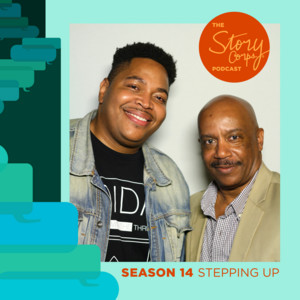
My name is David Ned.
I never thought in a million years I would be doing what I'm doing right now, sitting here with you.
I'm Darius Clark Monroe.
I'm talking to this man who was at gunpoint in a robbery I was involved in down in Texas.
That robbery happened back in 1997 in Houston.
David was cashing his paycheck when Darius and two of his friends walked in with a shotgun.
It is pretty astonishing that David would sit down and talk to Darius at all, let alone in front of a microphone.
But we've actually heard a number of these seemingly impossible conversations at StoryCorps.
And it's stories like these that inspired our new season.
We're calling it stepping up, and it features people who made a choice to confront the conflicts in their own lives head on.
And of course, we're all navigating this incredibly divisive election cycle right now, but no matter what happens, the question remains, how are we going to move forward together?
So in sharing stories from the bravest among us, maybe we can take their lead and find some hope for the rest of us.
I'm Michael Garofalo.
And I'm Jasmine Morris.
It's the StoryCorps podcast from NPR.
When Darius walked into the bank that morning, he was a high school honor student who had never been in serious trouble before.
In fact, he went straight to the bank from his third -period Algebra 2 class.
After serving his sentence for the crime, Darius sought out the people in the bank that day.
Not many wanted to talk, but David Ned had questions.
How did you get to that point where you said, I'm going to rob a bank?
What was happening at my house was that things weren't going well in terms of the finances.
My parents were working all the time.
And once they told me that we were in like $25 ,000, $30 ,000 of debt, I was thinking, how am I going to help because nobody else is going to come save the day.
And so one day on TV, there was this guy who had robbed this bank.
And I was struck by how easy it seemed.
Did you really think you was going to get away with this?
I literally thought no one would ever find out when I came home with the money.
You know, I got the shoebox and I put about 25, 30 Gs in it.
And I sent it right on my mom's bed.
And then later she opened up my door and she was hysterical.
I knew everything from that moment on was going to be different and not in a good way.
I was arrested and then sent to prison.
How many years do I was given you?
Five. Five years. When I got out, I wanted to apologize to the people who were inside the bank.
And when I spoke to you, it was the first time I got to truly understand the seriousness of what I did.
When you came into the bank, he made us all lay on the floor.
Can you imagine laying on the floor and all you hear is that shotgun.
Everything in me was shaking.
And I kept saying to myself, it's over.
I used to think I wasn't scared of nothing.
They used to call me brave days.
I figured if anybody tried to rob me, I said, well, they're going to take my life to get my money.
I don't work too hard for them.
So that was hard for me because I had to come to grips with that.
And when you guys left out the bank and went back to work, like you literally have to go do your shift after that.
Yeah. I had to go back to work.
You act like everything is just great, but you just know that a few minutes earlier, you could have been dead.
And one thing that helped me when you came by and asked me to forgive you years later, I thought about my son.
He could have been put in jail because he's been through some stuff.
But should he ever turn his life around, I would like that somebody he may have taken advantage of would give him a second chance.
It has been incredible to be given a second, third, fourth shot and having you be a part has given me hope.
I'm really proud of you.
And I don't know if you've got a good relationship with your dad, but if you don't, he's the one that missed out on a great son.
And I'm here to do whatever it is I need to do to help you be a great young man.
Earlier we said that this was a pretty remarkable conversation and it's true.
Not everybody would be ready or equipped for this kind of thing, but something happened to David when he was a young man that made him open to having this conversation at all.
I had a little dog, a little white German shepherd.
I was living in an apartment and the manager's kids was kicking my dog.
I talked to the manager about it.
And about 10 o 'clock that night, a husband came knocking on the door and he says, you got any problem?
You need to talk to me about it.
I said, are you the manager?
No, my wife is the manager.
I said, well, I don't have nothing to say to you.
I already talked to your wife.
He said, well, I'll tell you what, in two weeks I want you moved and your dog gone.
I got hot then. He walked downstairs, closed my door, and I went to my bedroom and I got my gun.
What a gun does, it talks to you.
Things that you'd normally say, I'm not going to do or I'll just let it pass.
Gun talks to you and say, you don't have to take that.
So my wife was putting chain locks on the doors and she's by the door.
I don't want you to go.
So I ended up saying, okay, all right, forget it.
But I called the manager, the company, and I told him about the incident.
And in less than a week, they were dismissed.
Then I came home one day and I found my little dog was poisoned.
And in my mind, he poisoned my dog.
I said, I'm going to get him.
But I didn't see him no more.
And then I was driving down the street and this car passed me by and I saw this face and I had flash back of who he was.
So I did one of the highway patrol special.
I ran them all on the curve, jumped out of my car, snatched his door open, and that was the wrong man.
He said, what is wrong with you?
I said, I'm sorry. You look like somebody I don't like.
And believe it or not, I took the guy and said, come on, let's go to the club.
I went and bought him a drink.
I was dead wrong. And I know that if I would have had the gun, I'd shot that man.
And at that point, I knew that my anger was so bad.
If I don't control this thing, I'm going to hurt somebody or somebody's going to hurt me.
So I said, I'm done.
I can't pack no gun no more.
And it took that kind of thing to get me right.
That's Pastor David Ned with Darius Clark Monroe.
They recorded together back in 2014, and they're still close a decade later.
After a short break, another conversation between two men who easily could have been enemies.
I went through 39 years of incarceration because of some things that you put in motion.
Right. Stay with us.
This message comes from NPR sponsor Subaru.
Join Subaru in celebrating their sixth annual National Make a Dog's Day on October 22nd.
A day to do something special for all dogs.
This day, combined with the Subaru Loves Pets initiative has helped many shelter animals find loving homes, including hard to adopt underdogs.
Learn more at Subaru .com.
Our next story takes place in Cleveland, Ohio back in 1975 when a man was murdered in broad daylight outside a neighborhood grocery store.
At the time, Eddie Vernon was a seventh grader who lived nearby.
He remembers he was on his way home from school when the murder happened.
We were on the school bus.
We heard pow pow. After we get off, we start running up and saw the man's body laying down on the ground.
I'd never seen nobody dead before.
And this kid, he's like, Man, I know who did it.
I was like, Who did it?
He was like, Ricky, Wiley, and he said buddy.
So I said, Well, I'll do the right thing and tell, you know what I mean?
So Eddie went to the police to give them the names he'd heard.
And at just 12 years old, he became the key witness in the case.
But Eddie was questioned by police without his parents or a lawyer present.
And he says he was coerced into sticking with his story, even after he told the police that he didn't actually know anything.
Eddie's testimony became the only evidence that led to the convictions of three innocent people.
One of them was a teenager named Ricky Jackson, who would go on to spend almost 40 years in prison.
After decades and decades of trying, biting, screaming, yelling for somebody to listen, you get to that point where man, I ain't never getting out.
Your toes are hanging over the edge of the abyss and your teeth are in there.
I don't want to fall, but I wouldn't be mad if I did because I can't do this anymore.
But then, at the age of 52, Eddie came forward with information that would change everything for Ricky.
My lawyer called me, he said, Edward finally told the truth.
And I was like, what do you mean?
He said we counted this initial testimony and we have a written sworn statement.
Ricky was exonerated for the crime, and when he was released, he reached out to Eddie.
This StoryCorps interview was the first time they had a real conversation about what happened.
Ricky starts. Throughout the years, did you ever think about me?
Yeah, I wanted to trade places because I said it should be me and study them.
And as I grew up, I was depressed, suicidal.
It ate me up so much inside, man.
I used to think about you a lot.
Hatred, loathing, I even used to fantasize about ways that I was going to kill you.
We didn't have any physical evidence to bring back into court, it was just you.
When I came forth, I was tired.
I couldn't live no more like that, Ricky.
I know that so much was taken away from y 'all, so many years.
Y 'all deserved our freedom.
In court, I hadn't seen you since the trial, 1975.
So when you walked in that courtroom, I almost didn't recognize you.
And when they were cross -examining you, I saw the little 12 -year -old kid in you.
But I also saw the strength of a man who had come there to do something.
And the next thing I know, I'm a free man.
It was a very courageous thing that you done.
And in order for me to move forward, I wanted to put everything to rest.
So I talked to my lawyer and asked him if there was any chance that you and I could hook up.
And when I saw you, all that stuff I used to think about you, the animosity, I could hardly remember.
And might have been my imagination, but when we embraced, it felt like you just got lighter in my arms.
Yeah, it took a whole lot off of my shoulders to wait and been caring for all these years.
I don't know if I ever told you this, but you did your part when it counted most.
You know that? You hear me talking to you, man?
Yes. You did your part when it counted most.
Okay, thank you. People still find it hard to understand that I forgive you.
And I think people confuse that with forgetting.
I'm not going to ever forget you.
But if forgiveness is my way out, I gladly take it.
And I thank God for that, man.
I really do, Ricky.
Ain't nothing phony about it.
Ain't nothing corny.
You know, after all that we've been through to finally be sitting here face to face, talking about what happened, I'm saying one man to another, I wish you nothing but the best, always.
That's Ricky Jackson with Eddie Vernon in Cleveland, Ohio.
In 2020, Ricky and the two men he was falsely convicted with received an $18 million settlement from the city of Cleveland.
That's all for this episode.
Next week, an elementary school teacher and his fourth graders tackle what's maybe the biggest problem of them all, world peace.
Sometimes world peace game feels like, you know, the weight of the world on your shoulders.
This is exploding over here.
This is firing over there.
This is spilling oil.
And I just look at the board and I say to myself, oh, my gosh, I need to fix this.
As always, we'd love to hear from you.
Our question for this week is this.
Who's the person in your life you'd really like to talk to, but are afraid to do it?
What's holding you back?
Tell us on our voicemail line.
7 0 2 7 0 6 talk. The number again is 7 0 2 7 0 6 T A L K.
Or send an email to podcast at StoryCorps .org.
If you want to learn more about the first story in this episode, Darius Clark Monroe made a film about the bank robbery.
It's called Evolution of a Criminal.
This episode was produced by Judd S .D.
Kendall. Max Young -Rice is our producer, our technical director is Jared Floyd.
Amy Driesdowska is our executive producer, and our fact checker is Katie Scott.
The art for this season was created by the one and only Liz McCarty.
And special thanks to John White.
I'm Jasmine Morris.
And I'm Michael Garofalo.
Thanks for listening.
Support for this podcast comes from the Corporation for Public Broadcasting, a private corporation funded by the American people.