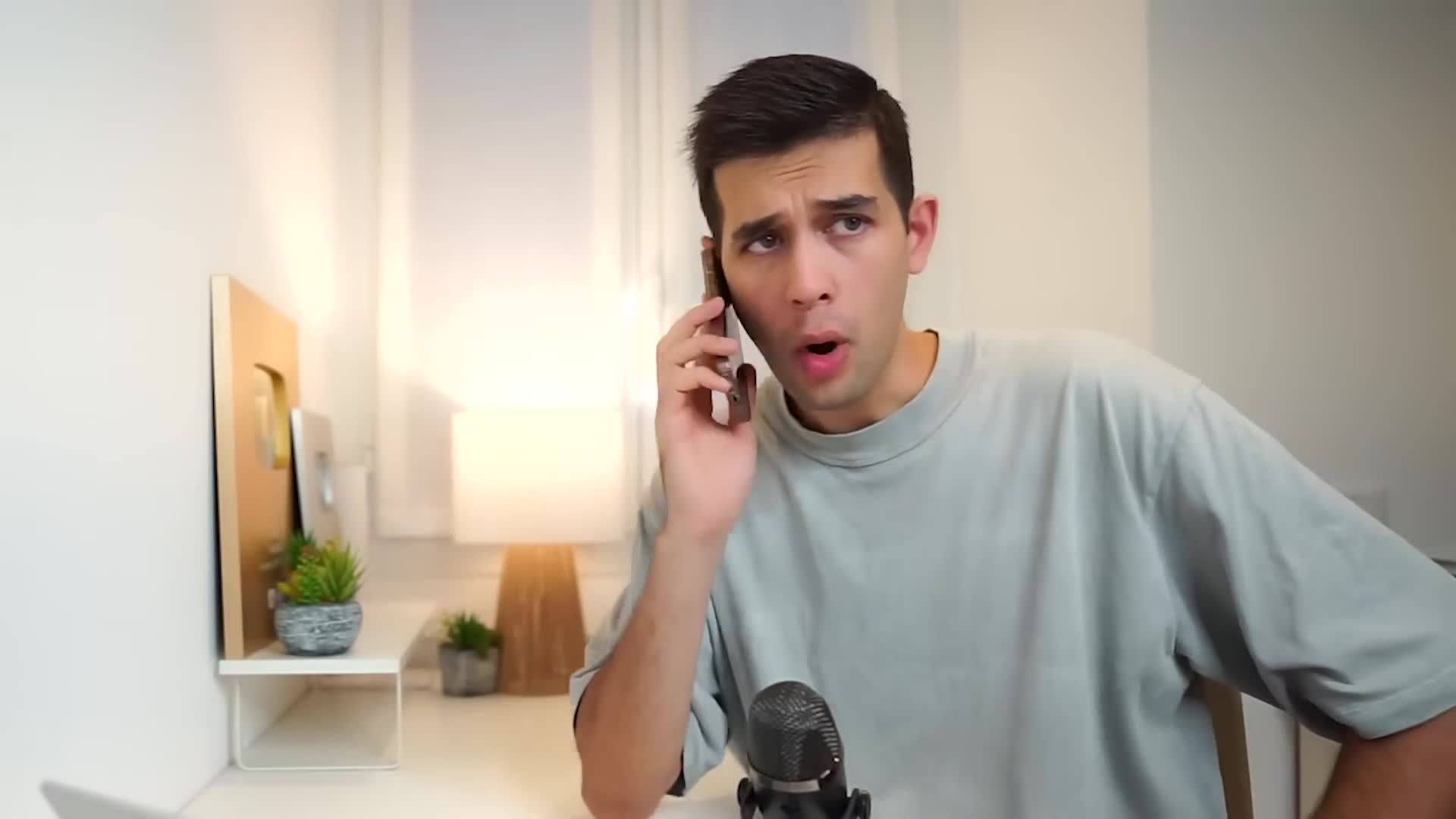
Who are you and what do you want?
That was not the best way to answer a phone call, was it?
So let's make it better!
When your phone is ringing and you want to pick it up, what is the first thing you say?
If you know who's calling, keep it friendly and say whatever you want.
Yo, Mr. White, let's cook!
If it's a new number, just say hello.
Hello?
Albert Pickard, but if it's your business phone number, say your full name.
All right, so that's how you start.
Now, let's say you want to call Cristiano, but Georgina picks up the phone.
You want to ask Georgina to hand the phone over to Cristiano.
What would you say?
You can use this structure.
Can I speak to name?
Please.
Can I speak to Cristiano, please?
Now, when you do this, Georgina would want to know who you are.
So she would ask for your name.
But what would she say?
What's your name?
No.
Who are you?
No.
That's not how we do it over the phone.
If you want to ask someone's name over the phone, instead of saying, what's your name?
Or who are you?
You should say, and who is this?
Who is this?
Generally speaking in English, when you cannot see the other person but you can hear them, we say who's this?
Instead of, who are you?
Let's say somebody's knocking on the door.
You can hear them but you cannot see them.
So I don't say, who are you?
I would say, who's this?
The same is true over the phone.
Who's this?
So Georgina would say, who's this?
Or she would say, who am I speaking to?
Now to answer, you should say, I am Maddie or my name is Maddie.
No.
Again, over the phone.
When the question is, who's this?
The answer should be, this is.
This is Maddie.
So, this is plus your name.
Now, after this, Georgina would ask you to wait until she hands the phone over to Cristiano.
Hey, Chris, Maddie's over the phone.
Maddie's called you.
Now, what would Georgina tell me?
She would want me to wait, right?
So she would say something like this, just a moment, or hold on a moment, or hang on.
Now, hang on is informal.
Let's say Georgina goes and looks for Cristiano, but Cristiano's not home.
So she comes back, she picks the phone up, and what would she say?
You can start your sentence with this.
I'm afraid.
Now, I'm afraid doesn't mean I'm scared.
No, I'm afraid at the beginning of a sentence means I'm sorry.
I'm afraid Cristiano is not in at the moment.
I'm afraid Cristiano's not in at the moment.
That's how Georgina would tell me that Cristiano's not home.
Now, she might offer to take a message.
And she might say can I take a message?
Or if she doesn't offer and I want to leave a message, I can say sorry Georgina, can I leave a message?
So can I leave a message?
Means can I leave a message for Cristiano?
Can I take a message?
Means do you have any messages that I can deliver to Cristiano?
Now, if Georgina says, can I take a message?
How would you reply?
You can use this structure.
Could you tell him?
Plus your message.
Could you tell him that Maddie called?
Or if you have a request and if there is something you want Cristiano to do, you can use this structure.
Could you ask him plus your request?
Could you ask him to call me back?
So the conversation would be something like this.
Hello?
Hello, can I speak to Cristiano, please?
Who am I speaking to?
This is Maddy.
Hold on.
I'm afraid he is not in at the moment.
Can I take a message?
Can you just tell him Maddy called?
Now, let's say somebody is calling you.
You pick the phone up and you say, hello.
And the other person would say, hi, can I speak to Maddy, please?
But I'm Maddy.
He wants to talk to Maddie and I am Maddie.
What do I say?
Hey, I'm Maddie.
No, I say this is he.
Pay attention.
This is he.
I'm not saying this is him.
This is he.
I know it sounds weird, but that's correct.
Over the phone, we don't say this is him or this is her.
We say this is he.
Or if you're a woman, this is she.
Instead of this, you can also say speaking.
Just say speaking.
Can I talk to Maddie, please?
Speaking.
That means I'm Maddie and I'm talking to you.
Speaking.
Now, if you've dialed the wrong number, the other person might say sorry, I think you've got the wrong number.
Or if you have realized that the number is not correct, you might say sorry, I think I've got the wrong number.
I think I've got the wrong number.
I think you've got the wrong number.
All right, now let's talk about the problems that may happen as you are talking over the phone.
Tomorrow, we need to make sure we have all the documents.
It's a big day and we need to be fully prepared.
I'm really nervous.
I hope everything goes according to the plan.
Whoa whoa sorry sorry, can you speak up please?
If you cannot hear them well, if their tone of voice is low and you're struggling to understand what they're saying over the phone, you can ask them to speak louder by saying can you speak up, please?
Can you speak up, please?
Can you speak a bit louder?
Can you speak up, please?
Now, look at this.
Tomorrow, we need to make sure we have all the documents.
We need to be fully prepared.
I'm sorry, but you're breaking up.
If the connection is not stable, if you can hear part of what they're saying, then they break up.
Then again, you hear another part of what they're trying to say, but you don't understand the overall message because the signal is not strong enough.
You can tell them, sorry, but you are breaking up.
You are breaking up.
That means your signal is not stable or my signal is not stable, and I cannot completely understand what you are trying to tell me.
You are breaking up.
Let's say you're talking and suddenly you lose signal.
The connection is interrupted.
You call them again.
What would you tell them when they pick up the phone?
You can apologize.
Sorry.
But you need to say something.
What happened?
I got cut off.
Sorry, I got cut off.
I lost signal.
I lost my connection.
Sorry, I got cut off.
So you were saying, I got cut off.
Now, if you call someone but it's not successful maybe because they didn't pick the phone up or the line was busy or they just saw your name and they didn't like you you can send them a message and say something.
But what would you say?
You can say, I tried to call you, but I couldn't get through.
Get through is a very interesting phrasal verb.
It means to be successful at talking to someone over the phone.
Sorry, but I couldn't get through means.
I tried to call you and I tried to talk to you, but I just couldn't.
Maybe you did not pick up the phone.
Maybe your line was busy.
Maybe my signal was not stable.
Maybe I didn't have network.
Maybe, maybe, maybe, maybe.
Now, do you want to have the summary of this lesson?
All of the useful phrases that you need to know if you want to have a very good conversation over the phone in one PDF file for free.
Click on the link above this video.
I don't know if it's on the right side or on the left side.
Click on the link on my website.
You can download the PDF for free.
Now it is time for a small quiz of three questions.
Are you ready to test yourself?
Let's go.
Question one.
Someone calls and says, can I speak to Jordan, please?
But you're Jordan.
What's the most natural and professional reply?
So over the phone, somebody has said, can I talk to Jordan?
You are Jordan.
And you want to say, yeah, I'm Jordan.
What's the most natural and professional way to answer?
Yeah, that's me.
This is he.
This is him.
This is he.
Remember, this sounds a bit weird, but over the phone, if you want to say that hey, you're talking to me, you can say this is he?
If you're a woman, you can say this is she.
Or alternatively, you can say speaking.
Can I talk to Jordan, please?
Speaking.
Next question.
You're trying to reach Jacob, but his friend answers the phone instead.
You want to talk Jacob, but Jacob's roommate picks up the phone.
You want to speak to Jacob.
What should you say?
Pass me to Jacob, please.
Can I speak to Jacob, please?
I don't need you.
I need Jacob.
Clearly, it's the second one.
Can I speak to Jacob, please?
And the third question.
Midway through the call, you can barely hear the other person.
You cannot hear them well.
You can barely hear them.
What is the most natural and respectful way to handle this situation?
Hello?
What are you saying?
You need to speak louder.
Sorry, could you speak up a little?
Clearly, the third one is the correct answer.
Sorry, could you speak up a little?
Could you speak a bit louder?
And that's it, guys.
I hope you've enjoyed this lesson.
Don't forget to give this video a thumbs up.
And if you're new to my channel, click subscribe.
See ya.