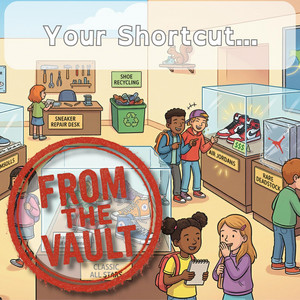
Hello, it's bryce here, and welcome to another episode of from the vault, where we dive into the archives and dust off a squiz kids classic for your listening pleasure.
And today we've dug up a shortcut that was really popular when it was first released our shortcut to sneakers.
Now i hear you asking how can a deep dive on footwear be even remotely interesting?
Well, that's because, While you might take sneakers for granted, they haven't been around all that long and the history behind their invention is fascinating.
And from a humble piece of clothing they have turned into a cultural phenomenon, with collectors spending hundreds of thousands of dollars on rare pairs.
So settle in, put your sneakered feet up, and enjoy.
This is a Squeeze Kids podcast.
Your fresh take on what's happening in the world around you.
They're known as sand shoes, plimsolls, trainers and more.
Some are worth tens of thousands of dollars and they have a pretty big impact on the environment.
This is your Squiz Kids shortcut to sneakers.
The podcast where we dive into the who, what, when, where, why and how of the big news stories.
I'm Amanda Bower.
And I'm Bryce Corbett.
Now, Bryce, I hate to say it, but the clock is ticking and it's almost back to school time.
And it's highly likely that families are gearing up to buy school supplies as well as uniforms and shoes, because kids do have that nasty little habit of growing only joking kids.
When my kids were in primary school, it felt like I was buying them a new pair of shoes every couple of months.
Their feet grew so quickly.
Oh my goodness.
I know, right?
Today, we'll take you through when sneakers were first invented.
What are sneakerhead is and how sneakers are contributing to climate change.
Listen carefully, there's a quiz at the end.
When?
Bryce, I fired up the Squiz Kids time machine because we are heading back to 1830s England.
Oh.
And specifically to the city of Liverpool.
Excellent.
It's here that we will find the Liverpool Rubber Company, which has been making tyres for years.
Yeah.
But now the company founder, John Boyd Dunlop, has figured out a way to get canvas fabric to bond, which basically means stick to a rubber sole.
Okay.
He's made something that he calls sand shoes for people to wear on their trips to the beach.
Aha.
The new railroad would take them to the seaside for the day.
They'd wear their sand shoes and life was grand.
Wow.
Hang on.
I always thought the English word for sneakers was plimsolls.
Oh.
Yeah, well, that word comes a few years later after the sand shoes.
OK.
One of the problems with those sand shoes was that the canvas separated from the rubber sole pretty easily.
So in the 1870s some manufacturers started wrapping a thin rubber band around the place where the canvas met the sole.
Ouch! to hold it on more tightly.
Now, at the same time there was a British politician called Samuel Plimsoll and he was fighting to have a line painted onto big cargo ships to show how much load they could safely carry.
Right.
That line became known as the plimsoll line.
Okay.
And it looked a lot like the line that went around the sand shoes.
And so they became known as plimsolls.
Wow.
Don't you love the history of words and names?
Yeah, absolutely.
Now, these rubber-soled athletic shoes are also called runners and trainers today.
Which is pretty self-explanatory.
But how did we get the name sneakers?
Well, that one comes from our American friends.
In 1887, a newspaper called the Boston Journal reported that young men were calling the new rubber-soled shoes which they wore to play tennis sneakers, because they were so quiet on the ground.
You could sneak up on someone.
So what you've got to remember is that standard shoes back then had hard leather soles, so they made quite a lot of noise when you walked.
Sneakers were stealthy.
I see.
So the rubber-soled shoes were a big hit with tennis players.
Yes.
They were.
And then in 1917, an American rubber company introduced its non-skid rubber-soled shoe for basketball.
Right.
Now, in 1921, a salesman called Chuck Taylor joined that company, the Converse Company, and he made some suggestions to improve the shoe.
Yep.
Including putting a kind of star logo on the ankle.
Right.
Those shoes became known as Chuck Taylor All-Stars and they are still in production today.
Amazing.
So when Chuck's signature was added to that star logo, they actually became the first kind of celebrity endorsed shoe.
There I was thinking it was Air Jordans.
That came a good 60 years later.
Yeah, right.
So that was in 1985 when basketball superstar Michael Jordan, you've probably heard of him.
Yeah, I have, yeah.
He teamed up with Nike, and the Air Jordans that they launched together also created a new kind of person the sneakerhead.
Now what, Amanda, is a sneakerhead?
What?
A sneakerhead is a sneaker collector.
Right.
And I'm not talking here about someone like me who has one pair of sneakers for netball, another for running and a cute kind of coloured pair for wearing out.
Yeah.
These are people who together, spend more than 10 billion a year buying collectible sneakers from other people.
Wow.
That's what's known as a resale market.
So someone buys the sneakers and then, instead of wearing them, they keep them until they're worth more, and then they sell them again.
Wow.
Sounds like someone who invests in a piece of art or even in a company, hoping to make money off it later, when it's more valuable.
Yeah, that's exactly right.
So sneakerheads will queue for days to get pairs of limited edition sneakers when they're released.
And they'll stay up all night to make sure they don't miss online sales somewhere in the world.
They go to sneaker swap meets and parties.
They've got a special app on their phones.
They're constantly on the hunt for rare, vintage or dead stock sneakers.
Deadstock.
So what does that mean?
Well, there's a whole language associated with sneaker collecting.
Deadstock is a pair of sneakers that has never been worn or tried on in the shops or even re-laced.
So that makes them more valuable than B grades, which are apparently shoes that have been tried on in the shops but never worn outside.
Okay.
And then some other words you might want to know if you want to talk to a sneakerhead.
Become a sneakerhead, yeah.
Js are Jordans.
Red october are very rare red sneakers by nike and rapper kanye west, okay.
And if someone says your sneakers are steezy yeah, that means they're stylish.
Which steezy yeah.
And that also explains why kanye west, who sometimes calls himself yee yeah, named his new adidas line yeezy wow.
Every subculture has its language.
I guess that's for sure.
Now amanda, when you say that sneakerheads are after valuable kicks, what are we talking?
How much are they prepared to pay to add to their collections?
How much money are we talking here?
Well, because I am dedicated to my job Bryce, I spent a little time on a sneaker trading site called StockX.
StockX, all right.
You know those red Octobers I mentioned?
So sellers are asking about $35,000 for a pair in my size.
What?
Yep.
And there's even a sneaker called the Air Jordan 1 Retro.
That came out in 2022, but it's modelled on the original 1985 Jordans.
Okay.
That will set me back about $500.
Wow.
$500 for a pair of sneakers that you're not going to wear?
That's fascinating.
Now, Amanda, I read somewhere that 23 billion pairs of sneakers are made each year.
There are only 8 billion people on the planet.
That's almost three pairs of sneakers per person per year, which seems a lot, even when you take growing kids into account.
And, just like with every industry, people are looking at the environmental impact of so many sneakers trainers runners plimsolls, et cetera, being made.
Okay, yeah, good point.
So how are sneakers contributing then to climate change?
So, Bryce, I watched a really great TED-Ed video that I'll stick in the episode notes.
It's all about what it takes to make a sneaker.
OK.
And I learned that making sneakers generates 313 million metric tonnes of carbon dioxide every year, which is equivalent to the emissions of 66 million cars.
Wow.
How does that happen?
Well, more than two thirds of those emissions are caused by transporting sneaker parts all over the world.
Right.
So I did not know this.
A sneaker is made up of more than 60 different parts, and it's cheaper for companies to make those parts in specialised factories instead of having everything made under one roof.
Okay.
But then they have to transport them all to one place to be put together to make the sneaker.
Yep.
The rest of the carbon footprint comes from mining and manufacturing the materials that the sneakers are made from and, of course, powering the factories.
So what are manufacturers doing to reduce their impact on the environment?
Well, starting with the simple stuff, many sneakers now come in recycled packaging.
There are also sneakers made with fully recycled materials or with materials that are sustainable, like eucalyptus tree fibres and wool.
Adidas has actually released a sneaker made using mushroom leather.
Mushroom leather.
Made from mushrooms instead of synthetic materials.
So not only does the mushroom leather have a much lower carbon footprint than those synthetic materials, it also biodegrades much faster when you grow out of them or you know they'd be on repair.
I'll put a couple of lists in your episode notes of sustainable sneaker brands.
Of course, there's also a push for people to reduce their environmental impact by simply buying fewer pairs of sneakers.
Yeah, and there are also new companies emerging that will repair your sneakers so you can wear them for longer instead of having to buy new ones.
Right.
Of course that doesn't address the environmental impact of sneakerheads, who keep buying and not wearing sneakers.
Yeah, that's true.
It could be hard convincing them to take up another hobby.
Time for the quiz.
This is the part of the podcast where you get to test how well you've been listening.
Question number one who is the American basketball star whose Nike collaboration kicked off the sneakerhead phenomenon?
Yeah, of course I'm talking about Michael Jordan.
Question number two where do people in Victorian England wear their sand shoes, as they were first called?
Yep, the answer's right there in the name.
They wore sand shoes to the sandy beach.
Question number three, why did these rubber-soled shoes get their nickname sneakers?
That's right, because you could sneak up on someone quietly when traditional shoes had loud hard soles.
That's all we have time for today.
Thanks for joining us as we explored the who, what, how, where, when and why of sneakers.
Now get out there and have a most excellent day.
Over and out.