The world moves fast.
Your workday?
Even faster.
Pitching products, drafting reports, analyzing data.
Microsoft 365 Copilot is your AI assistant for work.
Built into Word, Excel, PowerPoint, and other Microsoft 365 apps you use.
Helping you quickly write, analyze, create, and summarize.
So you can cut through clutter and clear a path to your best work.
Learn more at Microsoft.com slash M365 Copilot.
For Scientific American Science Quickly, I'm Kendra Pierre-Lewis, in for Rachel Feltman.
In late 2024, Nicola Coughlin, the actor famous for work on Dairy Girls and Bridgerton, was asked about her work with Chudi Gatwa, who played the 15th Doctor on Doctor Who.
Her reply was, he's amazing and he smells amazing.
Look, I get it.
How someone smells, whether it's good or bad, can leave a long lasting impression.
That's why we pour so much money into scented bath washes, deodorants and perfumes.
But under all those products remains our natural scent.
And while factors such as illness and how often we bathe can affect that smell, so can food, according to a number of studies.
Freelance science journalist, Sophia Qualia, has covered this research and we spoke to her about the surprising ways that what we eat can affect how we smell.
Here's that conversation.
Thank you so much for joining us today.
So is it like if I eat a lot of jelly beans, I'll start smelling sweet?
I don't think, no, it's not that clear cut.
So obviously caveat here is that this is a very new field.
And so we're only starting to collect data.
We don't have that much data that we can really draw really, really good lines about, like smelling sweet is because you've eaten sweet stuff, or smelling sour is because you've eaten sour stuff.
And in general, it's not really that straightforward of a process, right?
Because the food goes through our body and gets digested inside our gut, and And then either we're smelling because our breath smells a certain way, because of the volatile chemicals coming back up from our gut, or because they've gone through our bloodstream and we're sweating them out.
Right.
So the sugars and the foods and the delicious jelly beans go through a lot of processes before they affect how we smell.
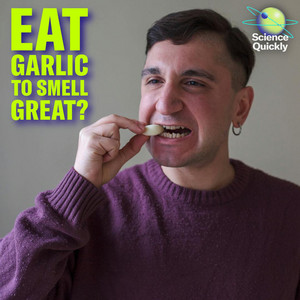
One of the things that I found surprising in your article was the work that researchers did on the way garlic makes body smell.
Can you talk about that work?
Yeah, I love that.
So obviously we all love to eat garlic.
It makes things super tasty.
But then our breath doesn't smell exactly as delicious afterwards.
I know a lot of people wouldn't fancy a kiss with a garlic smelling breath.
And so researchers it's one of the reasons researchers targeted it.
Right.
They're like oh, it's the most annoying of the smells when you're when you're smelling it on somebody's breath.
Let's see what happens to body odor after garlic.
Right.
So the researchers actually had about 40 men wear some armpit pads like yeah, like absorbent pads under their armpits, collecting their sweat for about 12 hours.
And then they made some of them eat a little bit of garlic.
Some of them eat loads of garlic and some of them take some like garlic supplements.
Then they had 80 women rate the scent from those pads, which is kind of gross if you think about it too much.
Yeah.
How do you sign up for that study?
I have not.
I have not signed up for this.
And then the women basically had to rate the men's smell, right?
According to like subjective ratings of how they felt, whether they were pleasant and attractive or masculine and intense.
So they filled out a survey.
And the findings suggested that the men with a little bit of garlic consumption weren't making these women react in any particular way.
But those eating a lot of garlic were perceived as very sexy.
So their rankings for sexiness went up.
So the smell of garlic under the armpit was smelling good, was smelling delicious, smelling sexy.
The researchers themselves.
I spoke to them when, after they conducted the study, they were quite confused too.
They were like we had to do this three times because garlic.
We didn't think the data made sense right.
You would expect garlic to smell nasty under an armpit as well.
So they were also confused and surprised and they thought it was quite funny to have this data.
They've actually thought long and hard about it and their theory right now is that, you know, maybe because garlic is a good food for your health, right?
It's a healthy food.
It has a lot of antioxidants.
It has a lot of antimicrobial properties that improve people's health.
Maybe that's what's making someone smell subconsciously more sexy.
It's because, you know, we've evolved to select romantic partners or sexual partners that are healthy.
Because of the way that evolution works and how Our bodies are wired to think about like oh, we need to procreate.
So maybe that's what's going on.
This evolutionary lens is how the scientists have been trying to explain it.
So the solution is eat a garlic heavy diet, but really make sure to brush your teeth.
Exactly.
Brush your teeth and then just go around with your armpits kind of just like musty.
You can't see, but she's lifting up her arms to illustrate her armpits to us.
But the garlic research did sort of fall in line with the broader research that suggests that eating a lot of fruits and veggies tends to make us smell better, at least from a sweat perspective.
It can be depending on how gassy you are as a human.
It could be hit or miss with your GI tract and your breath.
But when it comes to sweat in particular, it does seem that, like lots of fruit, lots of veg are pretty good for us.
Yeah.
So while maybe our pee smells a little weird after we have asparagus or we can get a little gassy after some veggies, similar studies where they had kind of people wear sweat pads and stuff I think this one was done in Australia found that the men who were eating more fruits and vegetables were kind of smelling better.
They were smelling more fruity, more floral, more sweet and kind of more widely.
Yeah, the fruits and veg were making them more attractive to women who are smelling their scent.
And again, researchers kind of justify that by saying okay well, it's probably because you know veggies fruits, they're healthy for our diet.
They make our bodies healthy and strong.
And so that's maybe what our body scent is then subconsciously communicating.
But again, these are really small studies with small samples.
So we don't have like loads of data, but All in all it seems to be that there's a trend or a pattern here.
Are there foods or things that we consume that may make us less appealing, like smell less great?
Although there isn't a lot of data and we are just starting to see emerging trends, researchers have started to see a little bit of patterns on stuff that are making us smell a little bit less pleasant.
So, for instance, that same team that put the absorbent pads for garlic, They also looked into whether meat makes us more attractive.
They had men who were either eating a lot of meat or a non-meat diet for two weeks.
And then they had again.
Women rate their scents for pleasantness attractiveness, masculinity and intensity.
And the odor of the men who weren't eating the meat was, on average, rated as more attractive, more pleasant and less intense.
And again the researchers kind of had to rack their brains about this, because they were like oh, but what?
I mean, we evolutionarily, we've always eaten meat.
Why would that make us smell less pleasant?
This was not what they were expecting to find, because meat is considered kind of like an important part of the human diet.
But the researchers also did know.
You know, early humans were eating meat sure, but they were eating like a lot less meat than what we're eating today.
And they weren't eating the super ultra processed meat that we eat now.
They were eating different types of meat.
They were eating game.
So maybe that's kind of the effect that we're seeing there.
And another one is alcohol.
Although alcohol might make us feel relaxed and in a better mood, it does seem to be one of those that doesn't smell that good.
I feel like with alcohol in particular, we kind of know that intuitively if anyone you know went to college and drank a lot.
There's a smell that happens after you've had a hard night of drinking that is not great.
But the meat was a little bit surprising, especially now in an era where there are so many people pushing like meat only diets.
It does feel like, in addition to the health effects that can come from subsisting off of just meat, it also might make you less attractive to people you might want to be attracted to.
Yeah.
Again, this is very early, early days data.
These are very small studies.
So I don't know if we can really make huge sweeping statements, but...
For sure, there seems to be a little bit of a subtle shift.
So, depending on how much you care about, how much you smell, that could be something to take into consideration.
I think an important caveat to point out here is so much of this is also culturally mediated.
Things that somebody growing up in a certain type of culture might not find attractive and scent somebody from another culture might.
So we need to take into consideration all of that and kind of see that there's Obviously like subjective preferences, there's cultural preferences.
If you've grown up eating rice and curry your whole life, you're obviously going to have a different predisposition towards that scent compared to somebody who's never eaten rice and curry before.
Right.
So there's a lot of cultural mediation here that we need to think about.
There's a lot of context.
That's why it's been quite hard to set up these experiments.
Right. aside from the icky parts of like, how do we collect men's sweat under their armpits?
So I think this is a super fascinating area of study, for sure.
But we also kind of know that scent is important intuitively.
Like everyone talks about, like how a newborn baby smells or, you know, wearing your partner's old hoodie, because it still smells like them when they're away from you.
So we kind of know like yes, it's culturally mediated, but there does seem to be a there there in the sense of like The way a person smells can really factor into whether you're attracted to them or you're repelled by them.
For sure.
And what's super fascinating here is that each one of us has a unique scent profile, right?
Like a fingerprint.
There's a growing body of research here that shows that everything from our personality type like whether you're an extrovert or whether you're an introvert to our mood and our health really affects the way we smell.
You know, it comes from genes.
It comes from hormones.
It comes from health, from hygiene.
It comes from whether you're a male or a female, whether you're young or old, gay or straight, dominant or subordinate ovulating pregnant sick happy, sad.
So like all of these things affect our odor and our scent, the way our body smells.
So diet is just like one of the small bits and pieces that goes on top of that, right?
That's also why it's hard to say okay, I'm going to make decisions about how I smell from now on just based on my diet, because there's a lot of other things at play, for sure.
What I've heard is I'm going to live on a broccoli and carrot-only diet from here on out, with apples.
Broccoli, carrot, and apples.
And jelly beans.
Don't forget the jelly beans.
Can't forget the jelly beans.
That's all for today.
Tune in on Friday when we'll talk about people who made incredible scientific contributions that were lost or hidden in the passage of time.
But before you go, we'd like to ask you for help for a future episode.
It's about kissing.
Tell us about your most memorable kiss.
What made it special?
How did it feel?
Record a voice memo on your phone or computer and send it over to ScienceQuickly at SIAM.com.
Be sure to include your name and where you're from.
ScienceQuickly is produced by me, Kendra Peer-Lewis, along with Fonda Mwangi, Shashmita Patek and Jeff DelVisio.
This episode was edited by Alex Seguiera, Shana Poses, and Aaron Shattuck, Fact Check Our Show.
Our theme music was composed by Dominic Smith.
Subscribe to Scientific American for more up-to-date and in-depth science news.
For Scientific American, this is Kendra Pierre-Lewis.
Have a great week!