Most humans are underestimating themselves.
This goes through from childhood, teenage years into adult life and all this, you know, kind of negativity shapes you.
So somehow you have to break free of it.
Somehow you have to be a little bit brutal to yourself.
It's easy to say, it's difficult to do, but is it worth it?
Yes. Hey guys, how you doing?
Hope you have any good week so far.
My name is Dr Rongen Chatterjee and this is my podcast Feel Better, Live More.
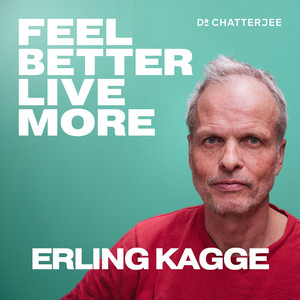
This week, my guest is the Norwegian adventurer and philosopher Erling Käger.
Erling is a remarkable and inspirational human being who I have been wanting to speak to on my podcast for years.
At the age of 29, he spent 50 days walking to the South Pole by himself in complete silence and he's the first person to complete the Three Poles Challenge reaching the North Pole, the South Pole and the summit of Mount Everest on foot.
He's also the author of multiple best -selling books, including Silence in the Age of Noise, Walking One Step at a Time, and his very latest, The North Pole, The History of an Obsession.
In our conversation, we discuss why his expeditions, even though they start off being physical journeys, end up as being something far more profound journeys inwards into himself.
Erling believes that silence is where all the world's secrets are hidden and that finding quiet moments in our day to day lives can help us get to know ourselves better and appreciate others more.
We also discuss how our experience of boredom has completely changed in modern times from being bored because nothing is happening to feeling bored because too many things now are happening at once.
We explore the importance of making our lives more difficult.
Why Erling felt no fear when coming face -to -face with a bear and the three simple things that Erling found renewed appreciation for during his epic expeditions.
Feeling warm after being cold, feeling full after being hungry, and resting at the true physical exhaustion.
Erling believes that most of us do not truly realise what we're capable of.
In his words, Finding fulfillment is about finding your own North Pole a journey that asks us to be brave enough to face ourselves in silence.
I want to start off by talking about silence.
Okay, you have said that silence is where the world secrets are hidden.
So how can someone who's just stumbled across this conversation who is constantly surrounded by noise start to cultivate that inner silence and what are the benefits of them doing so?
The benefits are so many but one of course is to get to know yourself better and to be satisfied in your own company and I think one of the ways to discover the silence is this inner silence is to be aware that noise and not only sounds but also distractions from your phone or distractions for whatever in your life, could also be a light, it could be sound, it could be a smell, it could be of course your telephone buzzing etc, etc. All this noise is about other people, all this noise is about running away from yourself, running away from who you are, forgetting yourself, living through other people,
other devices, while silence, inner silence is about you, it's about who you are.
And if you're going to be able to live a rich life, a fairly happy life, you get to know yourself.
Of course, the easiest solution in life is to go for noise and relate to noise.
And the more difficult option is to listen to yourself, listen to your own inner silence.
And that's, of course, why people quite often choose noise.
Now, when I hear you talk about silence, and the benefits of silence, I think it has an extra resonance for me.
Because you are this world famous explorer.
Okay, you've been to the top of Mount Everest, you've been to the North Pole, you've been to the South Pole.
And I want to talk about a lot of these adventures and what you learnt about the world, about time, about yourself, through those explorations and those expeditions.
But relating this to silence, when you went to the South Pole, my understanding is that But you did that with no radio, with no one surrounding you so you had an entire 50 days in silence.
First of all, is that correct?
If it is, can you paint a picture for us?
What is that like? Because I think today some people struggle to get even five minutes of silence yet you had 50 full days.
It was a superb experience because for the first couple days you get restless, you're missing the noise, you're missing people, you're a bit worried because it's 1300 kilometres to go just by yourself, and, but then you calm down and you adapt to the circumstances, you're starting to look into nature, you're starting to listen to yourself and fairly soon you don't miss other people's company that much. Kind of, the only thing i missed walking to the South Pole was skin contact, we kind of, hugging another person and I think that was about it.
For me, Of course, it was a journey, an expedition towards the South Pole, but it ended up being a more important journey into myself, into my own soul.
And I learned a great lesson on silence.
But then later in life, I got three daughters and eventually they became teenage daughters and my life was very much about noise.
And I understood my kids, they didn't really know what silence is, and they said silence is nothing.
Most philosophers say that silence is nothing and nothing comes from nothing.
And then I understood I have to sit down and write a book about silence, about what silence is, where it is and why it's important.
It was my expedition to the South Pole who really taught me the importance of silence and being able to be silent.
Silence is not about turning you back to the world, it's not about living a more egocentric life, it's about the opposite.
It's about seeing the earth from a different perspective, it's about respecting other people to a greater degree, it's about appreciating yourself and your own company more, and it's about loving life even more.
It's interesting, you went on this individual journey journey, yet you're saying that the silence that you managed to experience and I guess cultivate within yourself through that journey has helped you appreciate the world around you more, it's helped you appreciate other people more.
And I want to ask you then, is there a contradiction in some ways where we say that humans are social beings, right.
You know, there's parts of our physiology and our brains that are we think about connecting with others.
Yeah, at the same time, you said something really, really fascinating for me that when you are or when you were going to the South Pole, after a few days, you didn't want other people around you.
Is that a contradiction?
No, it's not a contradiction, I think, because I think a good start to be able to appreciate other people and also respect other people is to be content with yourself and be able to be enjoying your own company.
And I think that's one of the reasons why you have so much unhappiness in society, because people have, to a great degree, forgotten themselves and forgotten how to be in their company and always living through all the people, always living through all the devices, and then it's, in my experience, it's getting difficult to appreciate other people in that way.
How old were you when you went to the south pole?
29. What year was that?
1992, 1993. Ok. Different world back then, pre -internet, pre -smartphone, pre -social media.
It's easy for someone like me, or frankly anyone these days, to look back on the 90s or the 80s with rose -tinted glasses and go, oh, you know, we all had Solitude then.
We all had silence back then.
But that's not true is it?
No, no, no, no. I think those years were quite similar to the lives we're living now.
Really? Yeah, I think so.
In many ways. But one huge difference, of course, is the smartphone that they're available at all times and they want to be available at all times.
And this whole idea about being entertained all the time has been growing.
And also that they are being bored in a different way today.
Like when I grew up, very bored because nothing was happening.
And I remember my mother said to me, Eileen, it's healthy to be bored every now and then.
And I thought almost she was joking.
Today I understand she was right.
And today people are bored because too many things are happening, too many alternatives, and then there's always some action on their screen.
So then they have kind of a different existential boredom.
But I think, you know, it's kind of the same kind of feeling, but you're still where people are really bored, I think.
When you went to the South Pole, was there an option of having a radio?
Yes, it was an option.
I was actually forced to bring a radio by the airplane company who flew me off to the northern edge.
For safety. So, but my goal was to be the first to walk alone to the south pole.
And I also wanted to do it in solitude.
So I threw away the batteries of the radio in the garbage bin of the plane.
Oh, you took the radio to comply with legal.
And then you thought.
Because, you know, you need to choose your battles and I couldn't take that battle with the airplane company because they, you know, we're not going to fly you unless you bring a radio.
So, I took the radio, emptied the battery with the batteries and when I was standing on the ice seeing the plane taking off and it was between 1 ,400 kilometres to the south pole I was totally by myself.
I had a kind of a beeper who could send messages out, not receiving anything, if it was in emergency.
But of course, if you fall into a crevasse, no one's going to hear that signal.
So, I was, you know, pretty much by myself.
And that was the goal to be by myself for 50 or 60 or 65 days.
But, you know, it's a kind of a Norwegian dream to be able to ski all day, sleep well at night, and ski the next day again.
But also, what I experienced is this silence.
And you move, you are being moved.
It's, it's in our language.
You have motion, emotion.
So it was in that respect, it was kind of one long kind of meditation.
You kind of get self hypnotized because life becomes so simple to get up in the morning at the same time, you do things, two things at the same time, cook breakfast, maintain your gear, repair your gear, prepare lunch, then you take down the tent to get going.
You have fixed routines of when to have breaks, eat the same food every day.
It doesn't take that well when you start on the expedition, but after you're getting more and more exhausted, it tastes better and better and better, and you go to sleep the same time every evening.
So in that respect, it's kind of also very comfortable life.
And you live in the present, that you tend to forget the past, you tend to stop thinking about the future, because all those thoughts are also noise in your life that you're thinking too much. But someday you gradually become present in your own life.
You know, when I was rereading Silence, one of your earlier books, which came out a few years ago now.
It really struck me that, or certainly came to me something I've been saying for many years now is I think for most people, I can't say for everyone, because we're all different.
We all live different lives.
We can never say for everyone.
Exactly. But I would imagine for most people that the single most important daily practice they can do in the modern world in 2025 is having a daily practice of solitude.
I really believe that more than more than I ever have done, but I imagine that when people hear that, one of the things they're going to say is, I don't have time for that.
Right? That's usual comment.
Okay, what's your take on that?
I think in general, people are underestimating themselves.
I have traveled to more 100 countries and talk to thousands of people and in general people are underestimating the possibilities they have in life and you know 10 minutes of solitude is better than no solitude and I also think I have to respect that you know some phases of life with small kids etc, it's more difficult, but in general I think people are wrong when they And I think, you know, what they said is so true.
That solitude of course, it can be something negative, just like with silence, it could be something negative of course.
One minute of silence, silence in the church and a funeral, silence when you're sitting, when you're heartbroken.
It could be negative, but it's also very enriching.
And solitude is certain needed.
And people today, they have too much noise and just too little solitude.
What's interesting is when you were describing the start of that South Pole journey to me, you said for the first two days you were a bit restless, right?
And I think this is a really key point for us to just emphasize here.
This idea that if you're used to constant stimulation and noise, If that's your norm, 10 minutes of silence may well feel quite threatening.
If you came from the city, you got the plane out to the south pole and you're about to embark on this journey for the first two days, you almost need to let the thoughts burn themselves out so that you can access the silence that's actually there within us.
That's right. Back in October last year, so 2024, I was involved with a Channel 4 documentary about smartphones in children.
And we went to a school, and we did this experiment.
So for 21 days, year eight, so this is kids who are about 12 years old, or so, gave up all technology, smartphones, gaming devices, and their laptops, right?
And we were measuring, with the University of York, what happened?
And what you said in this sort of macro view of going to the South Pole happened in the micro when we went to the school, right?
The first two to three days, it was like they were withdrawing from a truck, really restless.
They were kind of missing it, they're like, what am I sugar or alcohol, whatever it might be.
I was like, wow, this is really interesting.
And then they all pretty much dropped in to this greater feeling of calm, right?
And we studied this and anxiety went down, depression went down.
The kids felt more socially connected, right?
They were worried beforehand.
They thought they were gonna feel less.
They felt more socially connected without these devices and they were sleeping more, But you had to go through two to three days of discomfort.
And so bringing it back to how someone watching this video or listening to this podcast right now can find silence in their lives, have you got any advice for us in terms of this idea that actually if you're used to noise, silence is going to feel uncomfortable at first, but you've almost got to get through that to get the peace?
Seriously, it is uncomfortable to search for silence.
And of course, hundreds of thousands, maybe millions of people actually working day and night to make us addicted to different apps, to get us addicted to the screens.
So of course, many of these people are super clever and doing a good job.
And so it is difficult to search for silence and experience silence as I said for a while and I think you know your experiment is really interesting and I would find it like maybe next time you know also combine it with having the same people doing some off -doors because of course young people today they hardly spend any time in nature yeah and they hardly walk they hardly move like just here in England when I wrote my book on walking.
I saw this research that, you know, who is spending the least time doing, being outside of a building in UK.
I thought it would be prisoners, like, they routinely have one hour outside of the cell every day, walking back and forth, whatever they do.
But 40 % of kids in UK spend less than an hour outside every day.
25 % of the kids, they're not outside at all.
Of course, they go back and forth to school, whatever.
But that's it. So, you know, the possibility to have a good life, if you're not outside.
I don't think anything is impossible, at least not philosophically in life, but it's almost impossible to have a good life.
So of course that experiment, combined with being a little bit in nature, you know, I think miracles will happen.
And of course, miracles are happening every day.
if you just don't see them.
But this will be a huge miracle.
Interesting enough, although we didn't prescribe what they would do, a lot of the kids actually ended up outside more.
And they were playing more and they were starting to invent games with twigs and that kind of boredom stuff, which we would have done in the past. But I do think this is one of the most alarming things in the modern world and how we've eroded silence away from our lives.
It kind of doesn't exist for many people.
In your book on silence, and actually, this is even a theme, I would say, in your latest book, The North Pole, The History of an Obsession, which is just another phenomenal book, which has really captured my attention.
There's this theme of silence, I think, throughout all your work, at least all the work that I've read of yours, right?
And one of the things that you write about that comes across this is the that silence is not emptiness, but it's a gateway to self -discovery.
Yeah. And, you know, the most important discovery in the world is to discover who you are.
And we have this tendency in life to always choose the easiest option, which I think is a huge mistake.
I think we actively need to make our lives more difficult than they have to be.
It's not for everyone but let's say most people they should actively make their life a little bit more difficult.
That's the only way to find meaning in life, to make it more difficult.
In my last book I put forward this hypothesis that I've had for a number of years about certain patients that I'd seen.
Okay. And it really relates to what you have just said, and I'd love to get your take on it.
A lot of patients over the years, I have seen have this almost low -grade anxiety.
And I've had this strong feeling for a period of time that this comes from not regularly testing themselves.
So I believe on a core, deep level, we all know that life could get tough at some point.
Life is a struggle.
It has to be a struggle.
This whole idea to have as little resistance as possible in life is just a huge misunderstanding.
Yeah, but here's the thing.
And I think this relates to your point, right, that if you are not regularly doing things that test you, that are a bit uncomfortable, you actually become weak, physically weak, yes.
But also mentally weak.
And I don't say that in a judgemental way, just to be clear.
I'm just saying that you have this kind of fragile sense of who you are, you know that if life was to get tough, which it could do, you can't cope because you haven't regularly tested yourself.
So people's got the benefits of physical activity and they look at your hormones and what it does for your muscles.
And sure I've seen all the research and I agree at the same time I think one of the key benefits of physical activity depending on how you do it is that you teach yourself resilience.
You show yourself that I'm a capable human being who can cope.
If you never have silence or solitude or adventure or you do anything uncomfortable, you're not showing yourself with any real world evidence that you can cope.
It's dramatic for everyone who's in that situation.
It's a major problem in society.
Same in Norway. Yes, it is, but Norwegians are closer to nature than people in the UK, and people in most places.
When you say closer to nature, what do you mean?
Do you mean it's easier to access nature for Norwegians?
Easier to access nature, but also spending more time in nature in general.
Norwegians should improve I think, they're also hooked on social media and blah, blah, blah.
And also prefer to sit down and share, looking into a screen to see what's going on in the world and getting to know themselves and have a good life.
But then again, compared to UK and most countries, Norwegians spend more time in nature.
It's more integrated in their lives.
So it's a little bit better, but it's moving the wrong direction.
Yeah. Do you meditate?
I meditate in the sense that I do a lot of walking.
I love walking and for me that's a kind of meditation.
I would walk without holding your phone in your hand and for ten minutes or for two hours or for more, for me that's meditation.
And in addition, I do self -hypnosis.
So I try to self -hypnosis myself every late afternoon, because then quite often I'm a little bit tired from a long day, and then I get into my subconsciousness for 20 minutes.
And I feel told to refresh the rest of the evening.
So you do self -hypnosis in the afternoons.
Yes. Is that something you had to learn?
It's something you can learn, but it's very easy to learn.
I met her in UK in 1995, and I was reading philosophy.
He said to me, Harling, you have been self -hypnotized yourself, throughout your life on expeditions, et cetera, without knowing it.
So you should learn the technique to get to know yourself better.
So he taught me in one day, which I think everyone can learn, how to hypnotize myself.
And you said you have energy afterwards.
What are some of the other benefits you get from self -hypnosis?
Certainly energy. I still need to sleep the same amount of hours, but energy.
And also I believe I'm kind of manipulating my subconsciousness a little bit, but of course the subconsciousness is either with you or against you.
So I think it's getting on my side.
And sometimes I'm hypnotized just go into this silence and everything's disappearing.
And all the occasions I try to follow an idea into subconsciousness and chase that idea while I'm subconscious.
Wow. And thoughts about self -hypnosis?
That is, you know, it's only 20 minutes.
And for me, it's like, you know, it's not super important, but it is important and it makes my life more comfortable.
Yeah. Let's talk about time, right?
Because whether it's in what you just said, or some of the powerful ideas I've been reading about in your book The North Pole, right?
I've been thinking a lot about time and how clock time appoints.
I don't have a watch on, where I don't wear a watch for that reason.
I think that's, you know, a good idea.
Yeah, it's funny. I used to be obsessed with watches as a kid.
I'd always want to know the time and about four or five years ago I thought I'm not interested.
I will think about that actually.
Because wearing a watch - and I guess if you have a smartphone, then you're going to constantly see the time on that thing anyway.
So that's one reason why I guess people don't need to wear watches in the way that they may have done in the past. And I also accept that you may have a certain job where you need to look at the time and be on that clock time regularly.
but time really is a human constructs.
Totally right? You think that oh, that time has moved on in a linear fashion.
But that doesn't account for your experience of time, right?
One hour with your best friends having a deep conversation is still one hour of clock time.
But one hour of watching paint dry may have a completely different experience.
But we still measure in the same way, And so going back to this idea that people will say, I don't have time for solitude.
I bet for most people, that 20 minutes of solitude you take each day, because of how it will change the way you see yourself, view the world, you'll probably process certain ideas, you will actually get that time back throughout the day.
So that 20 minute investment probably gives you two hours in the day, but you don't realise it.
What's your take on that because you've got a really interesting relationship with time.
I'll talk to you about the bits about the North Pole, which really resonated with me, but how do you see time?
Today's episode is sponsored by Vivo Barefoot.
So if you've been listening to my podcast for a while, you will know that I am a huge fan of barefoot shoes and believe that everyone at some point in their life should try wearing them.
I myself have been wearing Vivo barefoot shoes exclusively now for over 11 years well before they started supporting my podcast. So, why do I think you should give them a go?
Well, not only are they really comfortable, many people also find that when they start wearing them all kinds of niggles, like back pain, knee pain, hip pain, even neck pain, can sometimes get better.
We also know from research that wearing barefoot shoes regularly helps to strengthen your foot muscles.
Now, this is really important.
People think about strengthening their arms in the gym or other body parts, but your feet muscles are some of the most important muscles in your body.
They help you walk, interact with the ground and balance.
So now that spring is finally here and many of you will be trying to get outside more and move your bodies, why not give Vivo barefoot shoes a try?
One of my all -time favorites is the Primus Trail, which come in a variety of different colors for men and women and although I've been wearing them for many years now I do think that the Primus Trail are a great shoe to start off with if you're new to barefoot shoes, so why not make 20 -25 a year?
You give them a go and don't forget it is completely risk free to do so because Vivo offer a 100 day trial for new customers so if you're not happy you can just send them back for a full refund.
If you go to vivobarefoot .com forward slash live more, they are giving 20 % off as a one -time code to all of my podcast listeners.
Terms and conditions apply to get your 20 % off codes.
All you have to do is go to vivobarefoot .com forward slash live more.
This episode is brought to you by Airbnb.
My family and I have enjoyed some wonderful trips over the years using AirBnB from Greece to Egypt.
And recently we went to the Swiss Alps and stayed in the most amazing AirBnB.
And when I got back I caught up with one of my old schoolmates and he mentions that he and his family host their place on AirBnB whenever they go away on holiday.
He tells me it's really easy and completely flexible.
They decide when they want to host and how long for.
Plus the extra money they earn helps cover future trips away, meals out, activities with the kids, and even everyday household expenses.
Which got me thinking when we're next away as a family and our house sits empty perhaps we could also host our place on Airbnb and make some extra money too.
And if you have a trip coming up and want to make the most of your space, maybe you could do the same.
Your home, might be worth more than you think.
Find out how much, it's Airbnb .co .uk forward slash HOST. First of all, when – as I said earlier on, of course, sometimes you're simply short on time because you have small kids or whatever, like blah, blah, blah.
But in general, when people say they're short on time, I don't say it straight to because could be upsetting, but you know, in general, it's bullshit.
Because we have a lot of time and life is long if you live your life in a way that you have some variety.
But of course, if you spend three or four hours every day on social media, many people of course, spend a lot more.
That's around 13 years, night and day, of your life and no wonder you feel the short on time.
So you just need to, you just need to...
you know, change that habit...
99 % or 50 % or whatever...
and you will certainly have time.
So that's one one take.
But then, how to experience time?
Of course, if you go to Japan, stay for two days, you feel like you've been there for two or four weeks.
because everything is different.
And but if you sit at home looking to a screen most of the time you feel like you know two days have been like you know it could be two hours or whatever and then people tend when they're getting as old as me 62 years old you go to the 60th 70th 80th even 90th birthdays and people usually give the speeches and they say like you know all these days and weeks and years pass by and I didn't really understand that this was life and the guests feel like, you know, this is really deep, sensitive, you know, speaking.
But to me it's just a sad story because we had this huge possibility to have a rich life and we're wasting it.
But also another apropos to time is talking about spending time in nature, But if you travel from A to B and you take a car and it takes you 20 minutes to drive, you go on the highway and you get, you know, we get to be in 20 minutes, you feel that you have saved time.
But if you happen to walk the same distance, maybe it takes you three hours, and you walk on some narrow road or through a forest or over a field.
Mathematically, you have spent a lot more time walking than actually driving the distance.
but that's also only part you know that's in reality i don't find it to be the case because when you drive that distance you don't experience anything you don't see anything you don't smell anything you don't hear anything you're hard to have time to uh think about anything but if you happen to walk instead and let's say you're walking towards a mountain you hear the sounds of some water, you hear the sounds of the wind, you see the colors, you know, you experience the different smells, you experience the wind coming on the skin and you have time to think and somehow the world space is expanding
and time is expanding.
While when you drive the same distance time is narrowing in space or the world is narrowing in.
I'll eventually when you get the mountain.
It's like, you know, it's almost like reaching a good friend.
Yeah, it's really interesting that idea that we think we're saving time by taking the car.
But are we? Right are we really?
I don't think so, sometimes yes, but you know quite often not.
And also I should add, you know, quite often when they get to be in a rush, you know, you don't have that much to do at point B.
You sit down and look into your phone again.
So it is actually, I don't think, you know, hardly anything in life is 100 percent meaningless, but it's almost 100 percent meaningless.
Yeah, this idea of time is interesting, and how walking changes our perception of time.
I heard you say something yesterday in an interview, which really got me to pause and think.
Last time you were in LA or certainly one of the times you were in Los Angeles, you walked.
But you walked a long distance.
Now for people who've never been to LA, I was there a few months ago doing all my book promo, right?
It's a very large city, it's not easy to walk.
most people don't walk.
It's a very car -driven city.
So can you just share your experience because it was really quite fascinating for me to hear this.
To get to two friends, Norwegian friends, Petter Skavel and Per De Lune.
We have this project about walking through cities and we decided to walk from Eastern LA.
Kinda gangland, Cesar Chavez Avenue, Way East, walk down Cesar Chavez into Sunset Boulevard and walk all the way Sunset to the ocean.
And - Can you give us an idea what that sort of distance is?
It's only like 45, 50 kilometres, maybe.
Okay, hold on a minute.
I just love the fact that you get, it's only 50 kilometres, right?
So your perception, having been to the extremes of the world is different from most peoples, but okay.
But we spent three or four days, So it's like, you know, it's so it was physically easy.
But what was interesting that you see LA is we kind of seeing everything everyone else is seeing, but is seeing it from a different angle, because we see it from the curb of the road and we see it in slow motion.
Because almost everyone is driving and everyone is kind of looking and into the next car in the queue all the time.
But when you're slowly walking through the city, you see everything in a different way.
Our idea was to not leave those two avenues, stick to the avenues, and do whatever we could on the trek.
So, we went to the Church of Scientology at the beginning of Danger Boulevard. We applied for membership, we had 45 minutes into each, we had four to five minutes introduction course to Scientology just for fun.
Just for something to do.
Just so you know, just we did whatever we could do by following those two streets.
And way East in LA we were stopped by the police not because we looked like we're going to commit any crime, but because they were just suspicious that you know, Gee, guys were walking with a tiny backpack each through that part of the city.
So, hold on, you got stopped by police because walking is so rare in LA that they thought, this is weird, there's two guys here walking?
Especially that part.
It's all over LA, it's kind of walking long distances, very exotic.
But that part of LA is lots of crime going on.
What did you say to the police?
We told them the truth, of the three Norwegians that want to explore LA in slow motion.
I'm convinced, eventually, eventually model, please, guys, said, would you like to take a photo with me?
Which we did. So no, but it's interesting to see a city in that way.
And another time, together with a guy called Steve Duncan, American urban explorer, we went, we crisscross New York City through the sewage, train, water and subway tunnels.
We started at 242nd Street in Bronx and moved towards the Atlantic Ocean, Jamaica Bay, through the tunnels, sleeping on the ground and getting above ground quite a few times to change tunnels and sometimes took to metro, sometimes took a taxi, but for five days, just moving slowly through the city, alpine style with a little madras, we could sleep in the ground, a little cooker.
So that was another great way to see a city from the inside out, and what New York would look like if you turn it upside down.
And of course, everything happens below ground is somewhat reflected above ground.
I wanna move on to your north pole expedition in just a moment.
But there's two things about what you've said so far about when you walk to the South Pole that I can't get out of my head, okay?
The first thing, this idea that life was actually in some ways quite monotonous when you were walking to the South Pole, but it didn't matter.
You shared with me that you actually had some whiskey bottles with you, but you never actually touch them.
Can you explain that because I think it relates to what you said before about this boredom, right?
So you were saying when you were a kid, you were bored because there was nothing to do.
Now people have got this kind of existential boredom because we're just having this kind of low grade stimulation all the time on our screens and we don't realise, we think it's nourishing us, but on a deep level, it's actually starving us, right?
It's starving us for meaning.
It's starving us for meaning.
It's brutal. I mean, you starve something for meanings or meanings in life, not the meaning of life, but it's starving them for meanings in life.
That's super brutal.
But we are in a meaning crisis at the moment.
Absolutely, and you know, it's increasing meaning crisis.
But I think the only way you get to meaning is through solitude.
I think that's a very good observation.
You have to have it.
It's brutal but it's true.
Yeah and I worry about kids these days who are being conditioned from a young age to not have any time alone with their thoughts.
I purposely fight in my house to keep a low -tech house.
I don't want high -tech in the house.
I say to my wife, I want it to be an analog house, as little digital as possible.
Because I think that's who we are.
We're analog beings trying to live unsuccessfully in an increasingly digital world.
I think it's a very good idea.
I think as a father, of course I've done many mistakes but maybe the biggest mistake I did as a father was not to enforce the kids to leave the telephones in the kitchen before they went to bed or like, you know, one hour before they went to bed.
That's, like, you know, that was just stupid.
But, you know, they're doing really well now.
They're all in the 20s so I mean it's not a catastrophe, but it's like, you know, that was that was a huge mistake by me.
Can you just explain what that sort of simple, almost monotonous life was like and why you never chose to open those whiskey bottles.
So what, first of all, why did you take the whiskey bottles with you?
And why did you never end up opening them?
I thought, to bring these kind of super small, these miniature bottles, I think I had three or four with malt whisky.
I should celebrate, when I was halfway, I should celebrate on Christmas eve which is a great day in Norway for Christmas I should celebrate on New Year's Eve with a little whiskey because I thought that would give me satisfaction which it usually you know does but as I said after a few days total solitude no possibility to communicate with the outside world you have the same written during the day you put one leg in front of the other.
Technical wise, it's easy.
You just have to be willing to do it.
And of course, the greater challenge every day is to get up in the morning at the right time.
That has been the same challenge in polar exploration for hundreds of years.
Why is that such a challenge?
Because you're a bit exhausted.
It could be cold. The North Pole is super cold.
Maybe minus 45, minus 50 in the tent.
Let's just clarify it.
Centigrade. Yeah, centigrade.
So that's like, you know, 60 Fahrenheit or something down to 60 Fahrenheit.
So just let me be clear, I got that right.
It can be as cold as minus 50 degrees centigrade.
Yeah, to the North Pole, South Pole warmer, but still the ultimate challenge, I think also back home, but you know, still is much easier is to get up in the morning at the right time every day.
And then you do routines.
You start walking one leg in front of the other, hours, hours, hours.
And your nature, you feel like you know, when you're by yourself it's getting even stronger, that you're becoming a part of nature, that your body doesn't stop by your fingertips or by your skin but it's extended into nature around you.
And you send some ideas out, and you get all the thoughts back again, so you have a kind of communication with nature, not necessarily with words, but more like just emotions, experiences, going back and forth.
And you feel really, really enriched and for other people, even if you see it from a long distance, you will think you're kind of scared or feel fear a lot, but because it's so much a part of the environment, you don't feel that way very much. And then again, because life becomes so rich and you're not living through the past, you're not living through the future but you're more or less, not all the time but most of the time, you're present in the moment.
And quite often not thinking at all which is a beautiful experience.
And then, as I said, the food is getting better and better every day because they're getting exhausted – But it's the same food.
– Same food every day.
– Which is what were you eating?
– I ate a lot of oats in the morning that you mix with water you get from melting ice and snow, and then formula milk, not only dry milk, but for formula milk, it gives more energy per gram.
It's all about saving weight and during the day, oats, fat, formula milk and maybe some bacon, maybe some chocolate, and in the evening a little bit more of carbohydrates and dry meat.
But something as bland potentially as oats with water, right?
Right. You're saying that day by day, that becomes tastier.
Yeah, much tastier.
Why? Because you get tired, you get exhausted, and you're craving food, you're craving energy, you're craving healthy food, and you get healthy food.
It's real hunger, It's real.
It's like you've earnt!
Which I think, you know, it really was interesting when I sat down to write the North Pole.
You know, then you have to find the words for, you know, your ideas and your experiences.
And I put it, you know, nicer than writing, but then you get down to the origins of gratefulness on an expedition, because the origins of gratefulness is to become warm after you have been called.
You get full after having been starving, and you're having rest after, you know, you have been exhausted by, you know, moving physically.
And those three are something like in other part of the world, most people have forgotten.
And I think, you know, gratefulness, to be able to feel gratefulness is the key to have a good life.
Yeah. It's those three things, right?
That is incredible because warmth after you've been cold, food after you've been starving, rest after you're exhausted, right?
If you just look at the modern Western world, at the very least, as you say, these are three things that a lot of people are never really experiencing, right?
And then, back to your question, then you don't need a dash of whiskey to get satisfaction or feel well.
So it's a distraction to drink any whiskey to get any kind of, you know, get intoxicated in any way when you're feeling, experiencing what you're talking about now.
So I end up when I get home to Norway, still had bottles, and gave them away as presents.
There's something so profound in what you just said, right?
I felt for many years.
Why are we so well?
Let me talk about a personal example.
I'm very happy eating the same food every day.
I have literally no problem with it.
In fact, I quite like it.
It simplifies life.
You don't have to think.
My wife has quite a different perspective on that.
And I'm not saying anyone's right or wrong.
She like, well, we had that yesterday and want something different tonight.
I get that. And again, it could be related to, you know, men and women are different, we have different taste buds, we have a different experience with foods, but I think there's something about the simple life and real simplicity that you must frankly have when you're on these expeditions, because life is just boiled down to the absolute essence of what it means to be alive right, is part of the reason we're struggling with all these addictions and we need a beautifully tasty meal every single day that's different from the day before because our life is in some way, a little bit tedious, you
know, because of maybe all this constant stimulation, like we're not getting that deep nourishment.
So we need that from somewhere.
So we think we're going to get it from the latest deliveroo, right?
You know, that's, that's how comfortable life can be for humans now, where you can literally sit in your pajamas, in your bed, do some work, if you have a job that enables you to do that.
And you don't even have to go and hunt food, gather food.
You don't even need to go to the supermarket anymore.
You can literally on your app, have someone deliver a tasty meal that they've cooked for you.
You know, on one level, you could say, how incredible our humans that we've created a world where this is possible, but it's coming at a huge cost, isn't it?
Is it progress? Really?
Not really. But I kept on eating porridge made of oat in the morning.
But for dinner I have variations.
And I like to cook because of course it's tastier when they cook and it's fresh on the plate.
But for me, even more important is that that's kind of one of the times during the day when I actually had to put everything else aside.
I buy the raw material, make an effort that it's as good as possible, and then I cook.
Maybe it takes me 20 minutes.
Maybe it takes me 45 minutes an hour.
But then I can only think about the cooking.
And even when I'm by myself, because now my kids are mule -out, I usually make food for myself.
Because it's a break.
It's a meditation you ask about meditation.
It's kind of a meditation to cook.
Like, maybe I just spent 20 minutes eating the food afterwards, but then like the whole process is good for the soul.
You're by yourself this entire time, right?
Yeah. When you get to the South Pole, okay, what's the terrain like?
Are you doing what you did with the North Pole?
Which is, are you on skis and you're pulling something behind you?
Yeah, so it's to the North Pole, I went with a friend, Virgo Åslan, to the South Pole.
The goal was to be the first in the world doing it alone.
And you did that? I did that, yeah.
Are you in the Guinness World Book of Records?
I'm gonna have to tell my son, he'll be he's the love.
He'll be so excited.
He's been obsessed with that book since he was a kid, like each year wanting to see who's in it.
I don't think I asked you this before, why did you throw the batteries out on the plane?
Is it because you didn't trust yourself?
You thought if the batteries are in I'll use the radio?
Yeah, I want to be not able to talk on the radio, Because of course, if you keep in mind all the time, that I have a possibility to turn on the radio.
Even if I'm, you know, I really have been disciplined on this expedition, in hindsight, I'm 100 % sure, or 99 % sure.
But you'd still be tempted.
Exactly, and you have it in the back of your head, it's a possibility.
Well, it's really interesting that because there's been lots of studies which show that even if your smartphone phone is on the table there, you don't have it in your hands.
Some studies have shown that you are using cognitive willpower to not pick that phone.
So having it there is not neutral.
Right? You're constantly your brain is going no I'm not picking it up.
I'm not picking it up right.
Which is why for many people, the best thing to do in the evening for sleep is charge your phone in a different room because if it's in that room you just So I love that.
The other thing I wanted to ask about the South Pole in particular, after 50 days of complete silence, you mentioned it took a couple of days to get in, but once you were in, you didn't want to talk to anyone.
Do you remember the first conversation you had with another human, once you'd finished?
Just taking a quick break to give a shout out to AG1, one of the sponsors of today's show.
Nutrition can often seem really complicated.
We get confused about what exact diets we should be following and which supplements we might benefit from taking.
And that's one of the many reasons that I love AG1 and have been taking it for over six years.
AG1 makes it simple to be the best version of you.
Over 70 ingredients, one scoop once a day for less than a cup of coffee.
It's a science driven daily health drink which supports your energy, focus, and immune system.
It also helps support your gut's health, for example it contains calcium which contributes to the normal function of digestive enzymes and biotin to maintain your own intestinal mucus membrane.
Now the scientific team behind AG1 includes experts from a broad range of fields including longevity, preventive medicine, genetics, and biochemistry and I talk to them regularly and am really impressed with their commitment to making a top quality product.
In fact, AG1 has gone through 53 versions as they continue to iterate in line with the latest research. And the best thing, of course, is that all this goodness comes in one convenient daily serving that makes it really easy to fit into your life.
So if you want to support your health seven mornings a week, you can start with AG1.
Subscribe now and get a free bottle of vitamin D and five free AG1 travel packs with your first subscription.
all you have to do is go to drinkag1 .com forward slash live more, to unlock this exclusive offer and get started on your journey to better health today.
Ever have one of those days when everything seems to go wrong.
And before you know it, you've slipped back into those habits you're trying so hard to avoid like sugar, doom scrolling, and wine.
When it comes to making changes in our lives actually last, most people think the solution is to try harder but this is simply not the case.
In my new book Make Change That Lasts I reveal how exactly you can break free from the habits that hold you back.
What many of us don't realize is that our behaviors follow our beliefs so when you change your beliefs and my book will show you how to do that you'll spend less time having to think about your habits because they'll happen automatically.
Make Change That Lasts, the number one Sunday Times best seller, is available to buy now all over the world as a paperback, eBook, and as an audiobook, which I am narrating.
And if you've not got your copy yet, what are you waiting for?
I remembered really well actually because unfortunately I wrote it down because you know memory is a tricky thing.
So I got to the South Pole, the Americans had built a base at the South Pole and of course no one expected me.
Why not? you know, they knew I was walking towards the pole, but they didn't know where I was or what kind of progress I had, or if I was going to make it.
So I walked in, I saw the base at a distance, walked towards, you know, the point where is this kind of marked, this is the read -solve pole.
And some Americans came over to the base and they said, just like if I should have met them in Central Park, like, you know, how are you?
And I said, like a pig and shit.
And they were kind of, they didn't even laugh, they just kind of, ugh, ugh, ugh, ugh, what's this?
And, of course, I had the same underwear on for 50 days and 50 nights without taking it off once.
So I was like a pig and shit.
Those words from, you said there was some Americans there so it wasn't just one person, it was several people.
A couple of scientists or people working on the base coming out, really nice people.
What I'm trying to really understand is, when you've had all this silence and all you've heard is nature, were there animals around?
No animals. No animals because it's that cold.
Yeah, it's not both.
There are animals on the coast but as soon as you're off the coast there's no animals.
Okay, so you when we say you were alone, you really were alone.
Right, I didn't see any life at all.
So okay, even a bird, so let's say someone's done a prolonged fast, like a 48 hour fast, whatever reason they might choose to do that from foods.
We know that you've got a...
You can't just suddenly have a full meal.
Right, you have to slow down to juice food, right, and it sounds like you didn't have that slow introduction.
It sounded like you had two very excited Americans to see you.
I guess I'm trying to understand, what was that like?
Was it quite abrasive to your ears because you had all that silence?
Yeah, it's it took my while to adapt, actually.
The people, the Americans at the base were super nice.
They offered me a bunk to sleep.
I think I maybe I slept a little bit, but I kept, I pitched my tent outside the base and also, you know, spent time in my tent because to get back to civilization was brutal.
One, because in reality, you know, as I said earlier on, I didn't really miss that much being alone.
I consider myself to be a social person, more social after the expedition than prior to the expedition, but also I think it's super healthy, as you talked about, to spend time in solitude.
Not that you have to spend fifty days and nights in solitude but somehow you have to find your own North Pole or your own South pole, and when I suddenly met people they invited me for a drink, you know, they offered me meals, they asked me to do a little talk about my expedition to people, you know, staying at the base.
All this was very, very strange.
And also frustrating.
I remember I had some really severe pain in my stomach, really painful in my stomach. And that was of course because I was frustrated.
I found it, you know, difficult to relate to all these people.
Wow. And then, you know, today when people walk alone in nature, usually they will have a phone.
And then it's easy to believe it's easier with the phone than without the phone.
My experience is the opposite because if you have the phone and you talk every evening before you go to sleep, you talk if you have a wife or boyfriend or husband, whatever, you talk to your partner every evening, you have to listen to, your partner saying I love you, I miss you, and if the person doesn't say it you get suspicious and you have to say, I love you.
I'm missing you. Every evening.
And then after three weeks, your partner will say something like, you know, the washing machine broke down today.
And then you might as well just go home.
Because what you want to experience on a certain expedition is the solitude is to have to face yourself, which is difficult.
You have to look yourself somehow, not literally but like, you know, we have to face yourself into the eyes?
Like, you know, who am I?
What am I doing? Why am I doing this?
You know, what are the, as I said, what are the meanings in life?
Not that you get into kind of any deep, kind of, you know, heavy duty conclusions, but, you know, you have to live it through.
You have to think it through.
And if you disturb every day, by the outside world, to me, you know, parts of the meaning or parts of the meanings are, some of the meanings are gone.
So I think in that sense, I think you know it's easy for me in the old days to do it in solitude, in silence, than many people doing it today.
Did you have kids when you went on these expeditions?
I didn't have kids at that time no. For both those expeditions.
Yeah, I got kids later, but I still had done some expeditions after I got kids.
But less risk, less risk, less risk.
So your attitude to risk changed after becoming a father?
Yes. Also, I'm fascinated by solitude in silence, and something I've always wanted to do is one of these one week silent retreats, You do these silent meditations where you don't talk.
And then I'll tell you where my head goes.
My head goes, I've still got young kids.
Should I do that? Like, can I, is it selfish to do that and for my children to not see me or hear from me for seven days?
Now, I think you can argue this a whole variety of different ways, but I'd love your perspective on this.
is it selfish to go away and find yourself in silence when you've got dependents not at all it's egocentric for sure but not selfish i find selfish to be a very negative word it's but you know for your kids and in this case your wife maybe it's really good for them that you're away for a week you know they get a little bit rest from you Maybe you can contribute a little bit before and after and you will come back, not as a different person but a little bit different person.
You'll probably come back as a nicer person, a more caring person, a little bit wiser person.
So I think it's a good idea.
You said it's egocentric but is it egocentric?
If you're making the case, right?
So these some of the ideas I've written down, right, that you've written about in all your books.
Silence is not emptiness, but a gateway to self discovery.
True adventure happens within.
Solitude builds resilience and inner strength.
stillness and patience reveal what truly matters.
your best ideas emerge in solitude.
The world disappears when you immerse yourself in These are things that I've written down from your books.
So let's go back to that idea that it's egocentric.
I want to challenge that and go, well, hold on a minute.
If going away for a week gives you all these things, if, you know, there's a phrase that absence makes the heart grow fonder.
One of the things people struggle with and..
It should be. But one of the things people struggle with in the COVID lockdowns was that they were with their partners all the time, right?
There wasn't any absence there when it was getting frustrating for many people.
Of course. But I guess I'm trying to make the case to you and you're someone who's done this, that it's not egocentric, that actually the selfish thing is sometimes the most selfless thing.
If you come back as a better human being, who's calmer, who's more present, who has a greater appreciation of your wife, of your children, of what truly matters, is it really egocentric?
The way you put it, no. But then again, your wife or anyone's partner has to have a kind of generous attitude to think it's a good idea their partner goes away to be by themself and nurture their own soul and enrich their lives.
So you need some generosity there and you need to come back as a different in a positive way person.
But then again, I think you know for most people you know that one party goes away for a week do this no problem at all.
Again we're underestimating And I think, you know, you should be, I think, you know, almost every relationship, partnership would be much better if they, you know, allow that kind of space for the other partner.
And I, you know, for me, I, you know, I wanted my partner to be away for a week or two weeks or four weeks to experience what we're talking about, because I want her back again, as a, you know, even greater person.
You know, last November.
And just to be clear, I didn't do any meditation retreats or I didn't hike to anywhere exciting.
I went for two weeks to America, 10 days in LA, three, four days in Austin to do interviews around my last book.
So I was quite busy and exploring those ideas on microphones or on different shows.
But even that, when I came home, I had a newfound appreciation for my life.
Yeah. I really had a newfound appreciation for my wife, for my children for the house in which I live.
And so I think there is something quite powerful here, even if you're not doing some wild hike and going to the ends of the earth.
Absolutely. Right. So let's just land this silence plane for people.
Before we move on to the North Pole, right.
You don't need to go to the North Pole to find silence.
Absolutely not. So how can someone who's listening to this, who considers themselves very busy, who says, I don't have time Erling, how can I get silence in my everyday life?
What, what do you say to them?
First of all, you're wrong, you have time.
Maybe not much time, but everyone has five or 15 minutes for silence.
And keep in mind that the most important silence is within.
I think, you know, we can be standing at the Bisses crossroad in the UK, a Piccadilly Circus in London, and you can still find and discover and rediscover your own in the silence.
It's there all the time waiting for you to explore it.
So, and then, it's a cliche, but you know, you need to leave your phone somehow, you need to relax, you can walk, you can sit down and you can stand in the lift, you can walk to three stations of the metro instead of taking the metro and you will discover inner silence.
And as I said earlier on to begin with it's quite often uncomfortable.
That's why people avoid it.
Yeah. There's something quite interesting about this external silence versus the internal silence right?
So as you said there you can be in a busy place, but still connect with that inner silence, that's always there.
At the same time, we can contrast that with you on these expeditions where there is silence all around you.
But for the first two to three days, you have no inner silence.
Right? There's all this noise, right.
So I think that's quite a beautiful concept for us to think about external silence versus inner silence.
And yeah, I completely agree.
I mean, I think, you know, walking is one of those interesting ones where through the motion of movement.
Although it's not still, because you're moving, you can become still on the inside, can't you, through the movements?
Absolutely, absolutely.
So, you know, that's I think really important to keep in mind.
The silence is there all the time.
And also important to keep in mind that your silence is different from my silence.
We all have our own silences.
And the reason because of course silence is you.
So it has to be different.
And yeah and also like walking, it's like Hippocrates the founder of modern medicine, you know his advice was, advice number one was to have a healthy life was walk, take a walk.
And of course at that time it was healthier for your body but also healthier for your soul.
you were in silence.
And if you don't feel better after one walk, advice number two was take another walk.
And his third advice was, whatever you do, make sure the doctor doesn't give you the wrong medicines.
And it holds up after more than 2 ,000 years.
Yeah, he knew what he was talking about for sure.
Yeah, I think all wisdom that had lasted for more than a thousand years, you should take really seriously.
Now, you've also said something in this conversation that I'm going to challenge.
Okay. In a good way.
You said, you know, when we go to silence, we learn things about ourselves, but nothing that profound.
And I thought, wait a minute, wait a minute.
You know, you're an explorer, but I would argue you're a deep thinker.
You're a philosopher.
Because the wisdom in these books is really quite profound.
So you sent me your very latest book last week.
Not only has it got this gorgeous cover.
That's you, isn't it?
That's me taking a photo of my partner Berge walking towards the North Pole.
Yeah, what's interesting, when you look at this cover, for me, I thought, oh, wait a minute.
I thought he was skiing.
I thought this was like it's water and an ocean.
But then I thought, Oh, this is ice.
It's ice floating on the ocean.
Yeah. It's a pretty incredible photo, first of all.
But the forward to the book is like, I don't know, I mean, you maybe can't say it about yourself, I'm gonna say it for you.
It's just wisdom. Every single word is just like this deep, deep wisdom that you compressed into a forward. Right?
So this is what I'm going to challenge you on, right?
You have discovered some quite profound things you say, Oh, you know, you learn a few things about yourself.
I think you've, I think you've learned the secret to life.
Right. And you finish the thought of this.
Do you mind if I read it to you?
Oh, please do. Okay, I've underlined the last time I'm going to read the whole last paragraph.
Okay. I have walked, skied, climbed and sailed in many parts of the world.
I've been able to compare all the mountains, plateaus, forests, plains and oceans I have seen with somewhere else.
But I've only experience one place that is unlike anywhere else, the North Pole because when I finally got there, I realised there was no there there.
I mean, come on, if that isn't the secret to life, what is?
It's that the destination doesn't exist. Success doesn't exist. It's all this, it's like, can you just elaborate what you mean by that.
When you got there, you realized there was no there.
What does that mean?
It means, you know, it means many things.
It means, you know, the banal thing is, but of course, if you take the banal seriously, it's not banal anymore.
But the banal is, I had this huge obsession.
Of course, being an explorer, you need to be obsessed.
and this huge obsession together with Berger and many other people to get to the North Pole, to walk all the way to the North Pole.
And of course, we're all born explorers how every baby is an explorer in their mind.
If you look at the baby, first thing a baby will do is to stretch off the arms, stretch off the legs in four different directions and shriek for space and air.
And then after a year, the same baby will leave the house and start to wonder what's between he or she and the horizon.
So that's kind of how we were born.
That spirit never goes away.
It can be somewhere between 0 .1 and 99 .9.
It's all degrees. So it's like as long as you're live you have this spirit of exploration.
But for me, of course, it was super strong and we had this dream.
We prepared for years to get to the North Pole.
We walked for 50 days and suffering a lot, starving, being exhausted, frostbite and it was my whole life.
It was like a true love story.
I was totally in love with the idea of getting to the North Pole.
And when we eventually got there, it was nothing there, snow there, there.
And it was just floating ice.
The Arctic Ocean is the fifth biggest ocean in the world, covered by ice, mostly some open deeds.
The colours are variations of grey, white and blue and then the horizon and it's almost exactly the same what you see at the North Pole as you see a couple hundred kilometres away.
So it's just an idea.
I'm gonna stand at the pole a few hours later, because the ice is moving all the time, we are somewhere else.
But what's special with the North Pole is many things.
It's at the top of the globe.
The wind comes from the South, It's flowing towards the south.
All the longitudes come together at the top of the world.
So, it doesn't really have a position.
It has latitudes, but doesn't have a position because it doesn't have a longitude.
The sun has the same angle above the horizon for 24 hours, and it goes up or down above the horizon.
And you have, of course, one day and one night in one year.
So, you have six months of sun, six months of darkness at the North Pole.
So it is a place of mystery.
It has always been a place of mystery, all the way from prehistoric times when people start to speculate about the North Pole, it was mysterious.
But still today, later today, if you check Google Maps, Google World Map, you will see that the North Pole is not on the map.
Because they're not able to, the algorithms and the engineers at Google, they're not able to get the north pod on the map.
Because the globe, of course, is three -dimensional.
And the map is an abstraction of the world.
It's flat, so it's on the two -dimensional.
And then they're not able to figure out so far—maybe one day they will—how to put the point of the earth, or the two points of the earth the North Pole and South Pole, where all the longitudes come together.
So it just remains very elusive.
And that's also why, you know, I wrote this in the foreword. When I got there, Birk and I, we kind of rediscovered the North Pole.
There was nothing there.
No. It seems to be a metaphor, for many different things.
We know this classic story of hedonic adaptation with humans where we think that getting the promotion is going to make us feel good.
Then you work hard, you work hard, you work hard, you get the promotion and then it's like oh it feels good for a while though.
You cook for a few minutes or hours or days.
Yeah but not for a few weeks or a few months usually for most people, for most things, and that.
So I think that final word of the forward is just so profound.
When I finally got there, I realized there was no there there.
It's that whole ancient, philosophical idea of journey over destination and process over outcome, right everywhere you go, but I never thought about it through the lens of the North Pole, right.
So for the last few mornings at breakfast, I'd been relaying something from this book to my children?
I'm like, guys, you never believe what I read last night.
Okay. So I'll tell you this morning.
What was relating to them as the bit that you just mentioned about these all the all the lines of longitude meet there.
Which I never really thought about.
So this idea that you're at the North Pole, and you can literally walk around following the sun, and you are literally traveling through time.
Yeah, I was saying to them, you know, he can walk a few half a minute to travel the world and of 24 hours time zone yeah so he can go into yesterday exactly and he can go forward yeah in the same minute right but then that plays into what we were talking about before right about time right calendar time um clock time is a human being at this point in Earth, and you're just walking.
But we're saying it's time travel because you're walking through different lines of longitudes that we as humans have specified.
But it's not real. It's a human construct.
Yeah, and it's contrary to what we experience.
Yeah, and it goes back to walking, you know, walking changes your perception of time and the environment around you, right?
And I mean, it's really quite something, isn't it?
I mean what you said in the kitchen, you said we assume these things, we say these things, the sun always rises in the East. You're saying that's not true.
It's just not true because you know it's, people have this kind of idea that what has happened so far every day, or every week, or every hour in my life, will, you know, keep on happening.
And the most common example is the sun will always rise in in the east. But when you're at the north pole, close to the north pole or the south pole, as I said the sun neither rises or sets or does it once a year.
So it's not true, it doesn't rise every morning from the east. And if you're you know, 16 sunrises in 24 hours.
So, yeah, so it's this thing with time is being linear.
You know, it's a good idea for every country's gross national product, that people have a watch and appear at the office of where we work every day at the right time.
So I'm not negative to it.
But then again, I think you know, just be aware of what you're saying, that time is not linear.
It's really important.
There's no clocks in the studio?
No. That's all done intentionally.
I didn't think about it through the lens of the North Pole and what you write about, but that whole thing about solitude and silence, and how when you go to the South Pole it's going to take two or three days for the noise to switch off in your mind before you can access the inner silence, those kids with the smartphones, the first two to three days without them and their laptops, they're a bit tense before they can feel the calm.
I kind of feel that's how I see this podcast in many ways.
That's why I believe long form conversation is so important, right?
Because I think what happens at the start...
Let's say we talk for two hours.
I would say for the first 20 minutes, we're both aware there's a mic on.
And we're recording.
I'm a little bit nervous.
Not nervous. But like, you know, at some point, we just forgot.
And we're just chatting as if we're just having coffee together.
Right. It's the same principle.
And I saw this tweet yesterday on x about, it was about books.
Saying, what's the point in books?
Just get AI to give you a summary.
So you know the key points.
But the tweet was brilliant, because a guy was saying that, yeah, but that's if you believe that the only thing that's important about a book is the information that it gives you, which it isn't, it's the experience.
It's the journey you go on as you acquire that information.
And so through the lens of this podcast, it's not about the information you get directly, someone out at the moment is out on a long run or a walk listening to this conversation.
And I think the power is the insights that they get about their life through us having a conversation rather than me delivering or you delivering direct, actionable insights.
It's the journey they go on.
Do you know what I mean?
Absolutely. And this is again, you know, what we talked about a little bit before today, is about making life a little bit more difficult.
Because you can have a novel, you're curious about the novel, maybe a school, they have to do something, they go to a dinner party, they want to talk about the book or a book club, whatever reading circle, and you get an extract through AI or Wikipedia, whatever.
That's easy. But, if you actually have to sit down and spend five evenings reading the book, then you're really benefit from reading the book.
So it's a little bit more difficult, time consuming, but you know, it's the only meaningful way to go.
I want to talk about polar bears and fear.
Okay, this is another story I've been talking to the kids about.
So when you were relaying your expeditions to the South Pole early on today, You said something, which you wrote about on the North Pole as well, which I found just profound this idea that after a few days, there's no separation anymore between you and the environment.
You become the environment.
And of course, many of us never experienced that.
I'm sure a lot of ultra runners, you know, long distance running is growing in popularity and I, I'm sure one of the reasons why is you start to escape life a little bit and you start to connect with parts of yourself that you just don't get to connect with in your day to day life.
Of course that can be a long walk or whatever it might be, right?
But you also said that you don't feel fear because you're part of the environment or something to that effect.
I found that really interesting.
Much less fair because like climbing Everest kind of almost falling off a cliff.
But it's It's just still a part of you.
So you kind of, you know, you just kind of, it's kind of organic the whole thing.
You and the nature, everything, you know, it's like if my mother had seen me walking to the North Pole.
Crossing a huge open lead in the ice.
What's an open lead?
An open lead, like the ice is breaking apart and then you have water, open water between two ice floes.
Oh, wow. And it's the ocean stream, 1 ,000 meters deep.
So if you fall into the water with a sled you're in deep shit, and then you know you just...
I hate that. At least it's really dangerous.
But then because you're part of the ice, you're part of the snow, you're part of the wind, you're part of the water, it's, it's, you kind of feel comfortable.
But if my mother had seen me, you know, almost falling off a cliff at Everest or crossing this open water towards the North Pole she would be scared like shit but when you're there you calm and it's important that polar explorers not going to the North Pole because they don't have fear they're doing it despite their fear of course everyone has fear about this kind of environment but then the fair kind of slowly disappears.
I love talking to people like you or monks or people who've gone to these so -called extremes of life, because I think that's where we learn the real truth about what it is to be a human being.
So I've spoken to many monks on this podcast over the years.
I love chatting to monks, I've realized.
We should... Maybe not become monks, but it's something deeply attractive.
No, but when they go away, when they leave the kind of routine and hecticness of day -to -day life and sit in silence with their routines and rituals, I think they discover things that we can learn without needing to go to a monastery.
And I think through your journey, we can learn things that we can apply in our life without needing to go to the North pole or the South pole.
But this idea that we can be at one with our environment is something that spiritual teachers will talk about.
That we are one, we're not separate.
But I've never heard an explorer talk about it like that.
So that's really interesting to me.
and then relaying that to a polar bear, I'd love you to tell us about your experience with a polar bear and shooting a polar bear, but also you write later on in the book about other explorers.
I think it was a pair who went and they reported shooting a polar bear, which was primed to attack them.
And you actually talk about this description when you're reading about the other explorers that it sounds as though they were really calm.
It's almost unbelievable, but you said I actually believed them.
I think they could have been this calm because they were at one with their environment.
So, can you talk to me about polar bears and fear and how that all plays together?
Yeah. Birge and I, very close to the north pole, like 200 kilometres south of the pole, sunda heard Birge shouting, hoy!
And I've never heard them shout that before, So, I looked up and saw this polar bear at 20, 22, 24 metres away.
And it was coming towards us, stopped, and we were well prepared so we knew how polar bears could act when they suddenly saw some people.
And that's like something you could possibly chase and eat.
And so the bear stopped, and then start to walk a little bit back and forth, which we expected to do.
So we dived into the sledges, found over Magnum 44s, these handguns.
We'd really short barreled because we had to save weight.
It's all about saving weight because you're bringing all, everything you need for a couple of months on the sled.
Food, everything. Fuel, you know, tent, sleeping bag, mattress.
And then, so it was too far away for us to fire, but we knew it was going to charge, because this far north, is it nothing to eat, but polar explorers.
So it was kind of a no doubt for us.
But then Berge figured out, he was thinking, National Geographic.
Today, that's sounds silly.
But at the time we read National Geographic because in the old days, that was the only information.
You could go to Norway, most place on Earth.
I bought expeditions, different places in caves, in the mountains to the polar, the poles, et cetera.
For the internet, right?
Exactly, exactly. So I was huge every month to get that magazine.
So if he thought, this is my chance to get my photos published in National Geographic, while the bear was standing there around 15 years away.
So he grabbed his camera, he did have a film in the camera, this was the time he had to put the film in the camera, dropped his gun, got a film into the camera.
You had a gun at the time.
Yeah, I had a gun and he had the gun.
But he dropped the gun and then he talked me into standing between himself and the bear, waving, waving with a gun.
Are you scared at this point?
You know, I don't feel any fair at all.
Wow. he totally calm.
Take the gun. But of course I said to him, we need to shoot the bear first. And he said no, no, no, no. I take a photo like this.
So I stand up like this for a few seconds, take it like this.
And he take the photo with the bear in the background.
And then the bear stops turning towards us.
You know, start to dig his forefoot into the snow, lower his head, and they knew it was going to charge.
And of course - So that's what they do.
They lower their heads, start digging.
At this, you know that's a sure sign it's going to - speed up to our suit.
And Bergen of course dropped the camera.
We jumped a little bit aside to frustrate the bear so not staying too close to each other.
And we had to wait until the bear was really close.
Why did you have to wait?
Because if not, we were not able to give it that short barrel and also with a handgun.
It's super difficult to hit the bear.
Is it really? 20 meters away, almost impossible because the bullet goes off like, you know in circles And then, not the right direction.
So you have to wait really close and the bear can run up to 40 miles an hour, 60 kilometres an hour.
Can I just pause you there?
Right? This is mind -blowingly interesting for me.
Right. So first of all, you're saying you're feeling no fear.
Right? Because you've acclimatised, you're part of the environment.
You are one with everything around you then you see this bear you know and then you you can see that the bear is ready to attack and harm you and maybe not harm us kill us and eat us kill you and eat you no doubt about both of us and so you have to wait until they're nearby because you've only bought a magnum with you not a rifle because you need to save weight yeah so you can't risk shooting when it's far away no Are you still feeling no fear as they're charging towards you, or a little bit or you just would you would you describe it as I'm just aware of the environment and I'm focused?
It's it's it's, um, it's um, but to get on the river suppressing the fair.
Because as soon as you feel fair, you start to get irrational.
So you had to be super rational if a bear is going to kill you and E -2, so I didn't feel any fear.
Berge didn't feel any fear.
I mean, he wants to take a photo etc. etc. So, we're pretty cool.
The bear came towards us.
I ran 8 metres away we both fired.
8 metres. And then, you know, 35 -40 kilometres maybe an hour coming towards you.
So it's just, you know...
you have one shot each. Why have you only got one, because if you miss, the bear's got you.
I mean, at least you have to be really quick with the trigger if you're going to have a second shot.
And you hit the bear and what, the bear just falls?
Yeah, right? After a few seconds, it fell, but then you feel the fear.
The fear you had the whole time, because we were super afraid.
They kind of suppress all those feelings.
So you can get the job done?
You do what needs to be done.
Also, because we part drove everything around us, so it kind of felt just normal to.
But then afterwards, then I understood I had been super afraid the whole time.
So then we were shaking for half a minute something, I cut in maybe a minute.
And then shaking stuff like that.
This was not... All of a sudden, just shaking our heads because… And then we checked appropriately that the bear was dead.
And then we took photos of the bear from all angles because most people who claim to have killed a polar bear in self -defence hit it in the back, hit it in the arse.
And of course that's not really self -defence because the bear is turning away from you.
So we want to prove beyond an adult that we hit it only in the chest. As an act of self -defense.
Yes, self -defense. And I think it's important to make that point.
And you make that in the book that you're not a fan of killing animals.
Not at all. Right. I don't like to kill anything.
Yes. In the book you write very respectfully they're in their environment.
Only... so you're saying that the only reason you guys killed that bear is because if not it would have killed you.
Yes. So self -defense.
So I would never ever killed, I don't even like to kill birds, grouse and shit like that.
You know, you took these photos to prove that actually it was in self -defense.
You're in the middle of nowhere, right?
Do you need photos to prove?
What I'm saying is if you just moved on and continued on your expedition, would anyone have ever known?
No, no. So why did you then need to get evidence?
It's a protected animal.
I see. In case anyone found the dead later.
No one would find a dead animal.
You know, it's way out on the ice.
That's super unlikely.
But, you know, you kill a protected animal.
You wanna see the right thing?
Yeah. And you want it to be absolutely no doubt.
It was a matter about who's having who for dinner, And even Gandhi wrote that, you know, if a lion attacks you or your family, you should kill the lion, yeah.
So I think we're, you know, totally correct.
Like, you know, of course, I've always been some people who think, you know, we should, you know, let the bear live on.
But hold on, this goes back, this is a really interesting point, right?
About the disconnection we have from our environment and even our food supply.
Right. And I've been thinking about this for years, but I really noticed it last summer.
I've spoken about this before, when I was in Kenya with my family.
And we went on a safari.
That's great. That's the best, that's one of the best vacations I ever had in my kids.
I was scared before going to be clear, but it was life changing.
And just to see the wild, and the circle of life and how it actually occurs in nature.
I don't know it was, I guess to someone who's grown up with a subject might find it quite obvious.
To me, it was really was quite profound to go, I kind of get it.
You know, and you're saying you're in that environment where it's who's eating who for dinner.
But okay, so you take photos to prove should anyone ask you that this was in self defence.
And then it was quite interesting that, because you guys are really hungry all the time, right?
But you didn't? So tell me about your decision to not eat straight away.
Yeah. You know, we had 6 ,000 calories per day to eat, but we're still starving and we get them thinner and thinner.
And eventually, you know, the body fat is gone and we also start to, you know, burn off muscle mass, which is unhealthy and also not a good idea if you're going to ski all day.
So we're really kind of down, when we got close to the pole.
But we want to do it unsupported, which meant, like, no depots, no dogs, no air supply.
Like you know, just dragging everything.
You did the South Pole first, right?
Now first South Pole after the North Pole.
Okay, so this is how old were you when you did the North Pole?
27. Wow, I think that's what I was doing in my 20s.
I think, wow, I wasn't doing North and South Pole.
Okay at 27. So you're with your buddy.
You want to be the first pair to go to the North Pole unsupported.
Exactly. And are you in the Guinness Book of Records for that?
Yeah, I'm pretty sure I am.
Great. I love how you're not even related to that.
So there is no destination, there is no there?
I think I checked it when I wrote the book that we are actually in the Guinness Book of Records.
Okay, so this word unsupported is key.
Yeah. For us it was key because, at that time National Geographic again, in three years before, four years before this French explorer, Jean -Louis Etienne, he walked a ski to the North pole with supplies, and he said maybe one day it will be possible for someone to reach the pole without all the supplies I had.
And that's when, you know, we want to do it, some Canadians want do it, some Koreans want to do it, some Russians want to do it, and Sir Randall Fines from United Kingdom wanted to do it.
So it became a kind of race to be the first to do this.
And Ran, as we called him, he told us beforehand that like of course the rules are kind of unclear, so he said if you kill an animal and eat animal that's a kind of support.
I disagreed, but you know we wanted with no doubt that we had to stick to it like you know not done anything wrong.
So you didn't want to risk it exactly so you had you had fresh meat that would have nourished your starving body and your um your muscles that are starting to disintegrate because you're not feeding your body enough yeah but because you wanted there to be no doubt that you got there unsupported you chose not to eat it.
Yeah, but we took a few steaks with us, and when we got to the pole, we ate those steaks.
Oh, so you did it unsupported!
At the pole we celebrated the bear steaks.
But it didn't taste that good, did it?
It's polar bear steak and they can have these trichteins, these kind of parasites in the meat, and it's hard to see them, and we were unsure, so we had to, we boiled the meat, and we fried the meat.
But at that time we were so super hungry, starving, so we ate the meat and afterwards all the oil that came out of the meat when we cooked it we just drank it as water.
Kind of you know 100 % fat.
But what was interesting again back to, you know, what you talked about about a time that when we're at the pole and we're going to eat this kind of great meal, I want to just dig in and eat it all right away.
Bergir, my partner, he said, no, let us just wait 10 seconds.
Let us count to 10, slowly, and then eat.
And of course, then it tasted even better.
But I should also add, like because I mentioned Randall Fines, we were competing to the South Pole to the North Pole, and we became kind of we're unfriendly terms, unfriendly, because we're competing and but then that's a beautiful life, years pass by and then we become friends and I is important, you know, all this grudge, all this kind of, you know, whatever you have from early in life, kind of negativity to a person.
Get rid of it. So we ran to now.
He's not well anymore.
He's a legend and when I asked him to blur my book, you know, the North Pole, he replies within minutes, I'd love to do it.
So lovely to hear. Yeah, exactly, so you know, you have to, you know, it's all wisdom again.
You have to get on with your life, you have to move on.
You sometimes hear this with athletes, who were super competitive in their careers.
And then once they've retired from competing, they become the best of friends.
Exactly. Which is great.
It's great. Yeah. So while they're competing, they can't be, or they perceive that they can't be and later they can.
There's another bit in the foreword that really got me thinking, Okay, And again, if you don't mind, I wanna read a part of it to you.
You know, it's always strange for an author, you maybe experienced yourself as an author, to hear someone else is reading what you have written.
Yeah. Because I think, you know, when you write something, at least for me, to make it into good literature or great literature, you're kind of escaping yourself.
So sometimes when I hear something written, maybe not this, you know, I have to listen first, I'm surprised that I've actually written this.
Yeah. It's also, before I read this, it also reminds me of what a lot of artists say, is that when they write a song and then they release the song, the song is no longer theirs.
Right. So they had an idea in mind when they wrote that song and recorded it, But a lot of artists who I follow and I've always been fascinated by music and listened to interviews with artists.
It's not mine anymore.
I realize that everyone interprets that song differently.
And I kind of feel I'm going to read something to you now, but maybe it wasn't the way you intended it.
But this is my interpretation.
Right. So here it is.
My hope was to be respected by the person I respected most and to learn more about him to deepen our bonds by freezing starving struggling and experiencing great danger my father's dark shadow loomed over my expedition though I never told him this and find it hard to admit even to myself our journey so your journey to the North Pole was an iteration of the oldest story in the world's the sun who wants to know his father and be loved by him.
Yeah, that's true. What does that mean?
Why does your desire to be loved by your father lead you to going on a life -threatening expedition to the North Pole?
I grew up in a home when it was very martial, very masculine values, so for my two brothers and me, And the huge thing, the way to get respect in the weekends and the evenings in the week was to ski far, walk far, being in nature, pushing yourself, maybe putting up a record. That was kind of how to get respect at home.
And of course, every son, almost every son, I don't know anyone who doesn't, has been struggling with the father.
The father and son relationship is probably the most complicated in the world.
And of course, also the father is struggling with his son or his sons.
And this is like, you know, it was certainly the case in my household and in our household.
But when you look back in history, with the Old Testament, with the Bible, it wouldn't be much to read in the Bible if fathers and sons had a good relationship?
I mean, it's a kind of one clear red line through the old testament and the new testament, father and son, Isius.
And when you read, like I had a difficult time learning how to read and write because I was heavily dyslexic.
So, my mother and father they read books for me when I was a kid.
And my mother read a Homer's Odyssev.
And she read it for me.
And of course the first four parts of that book is not about… is about the son Telemachus.
The first 20 years of his life he has not seen his father.
Or maybe he saw just after he was born like a few months.
But then for 20 years he has not known his father.
And for every kid, the biggest mystery life, one of the biggest mysteries of life is who their parents were, before they were born.
And for Telemachus, it's also after he was born.
So he leaves his home and sails the oceans to learn about his father, to see if the father is alive, to see what experience the father has been experiencing, and maybe also to get to know his father.
So that's one of the oldest stories And to me, that's kind of the original written history on exploration.
And to my great surprise, when I did research on my book, I also discovered that almost every North Pole explorer had a difficult relationship to their father or their father disappeared.
With Ran, his father died as a soldier while Ran was still in the womb of his mother.
And I talked to Ran about this many many many years ago and the way I remember the conversation was that he said he would never ever have become an explorer if it wasn't for the loss of his father.
And he had to compensate and like you know live a life to kind of match his father, live up his father's ideals.
So that was also the case for me.
I had a very complicated relationship to my father.
But fortunately, and, you know, a fun thing today, maybe not at the time, when I got home from the North Pole, Berg and I, we succeeded.
We got to the Pole, it was a huge success.
People were impressed because, of course, one of the many reasons you walk into the North Pole is to get recognition.
You want to impress.
It's maybe not sympathetic.
I don't think it's unsympathetic, but some people find it unsympathetic.
But anyway, that's one of the reasons people are doing this.
When I met my father, he said, I think it's ridiculous to walk to the North Pole.
And by the way, your brother is more fit than you, so he should have done it.
But then today, or some years later, I forgave my father everything, he forgave me everything, and we became great friends.
Unfortunately, today he's become an old man, but fortunately he managed to read the North Pole before he got too old.
And I was wondering what he would say to read my version of this story.
But fortunately, he appreciated it because of course he also found me to be a difficult person.
Wonder what it was like for him to read that paragraph that I just read to you.
But I think he felt it enriching because his life and my life came together Yeah.
Because my worst is not that he was bad and I was good.
I mean, we were two complicated persons in a family and kind of, history was, of course, unique.
But it's very similar to millions and millions of other stories.
So I think in general, I think if wives, or girlfriends, or fiances, whatever, use a little effort to understand this father and son relationship, they would have a better relationship quite often to their partner.
That is so profound.
I mean, it's a couple of things about that story about the father son relationship, which I think are interesting for me.
One is I kind of feel that society very much has tried to make men and women the same.
And it was only when I became a parent that I really deeply understood that we're different.
You know, we play a different role, let's say with our children, you know, certain things the kids want their mother for, there's certain things the kids want their father for.
I also recognize that every family is different.
There's different dynamics, okay?
So these are broad generalizations.
But this thing of the father son story, the reason why really pause on this because I thought, hmm, our journey was an iteration, the oldest story in the world, the son who wants to know his father and be loved by him.
So I'm questioning myself go, does this apply to my son?
Of course, I'm not him.
Right. So I can't tell you what he's thinking.
But I think I've got a pretty awesome relationship with him.
But it just made me think as a dad, you know, But, you know, if it had gone on for such a long time, it's not going to be a way in modern generation.
But of course, over generation, much closer to all the kids than over parents generation.
Oh, you mean things are changing, it's society?
Yeah, yeah, yeah, yeah, for the better.
Like, my father was not, you know, he was not welcome to be present when my mother gave birth to her three sons, her history sons.
Whenever he went to some doctor, or you know, a nurse going to check his sons when they were kids, babies, he was looked upon as almost like, you know, a stranger, because there was a man doing it.
So, you were estranged for your kid the first couple of years of the kids' lives.
So, it was, you know, it was difficult at that time, much more difficult that time to relate to your kids.
So, I think you know, we are very fortunate as fathers that we can be closer to the mother, closer to the kids early on and also taking responsibility for the kids early on.
But then again, you know, it's as a generalization, it's like the mother usually loves her kids anyway.
I know my mother will love me, even if I became a murderer, whatever I will do, my mother would love me.
And it's also this, maybe I quoted wrong, but this poem by a fiction Kipling, Mother of mine, mother of mine.
I know his love will follow me still, even if I was hanged from the highest hill.
But of course, with your father, you're not that certain.
Today, I'm certain my father loves me, but for many years, not so clear.
Erling, so much to think about.
But you're an explorer, writer, philosopher, giving some pretty good parenting advice as well.
There is just so much wisdom in these books, I've been wanting to talk to you since I met you in Oslo a few years ago, when we didn't have a static meeting, you insisted we go for a walk.
You took me around Oslo, we got stopped for coffee.
It was wonderful. We had a great coffee, remember?
We did! Tim Wendelbrot was one of the best places on Earth that actually had a coffee.
Well, we were chatting before about you inviting me to Norway it and always go on an adventure adventure with you, which I'm going to try and take you up on later this year, if I can!
You know, you're back to your question again.
You can! Yeah, of course!
At least not even selfish!
It's not even selfish, as we just interrogated, exactly!
There are other things I want to talk about that people can read about in your books.
Movement being the antidote to overthinking.
Pain and struggle create meaning.
thing, the present moment is the exit from negative thoughts.
Meaning is not something waiting to be discovered, but something we build through our choices and our mindset.
Lots of powerful ideas penetrate all of these books.
I'd highly encourage people to pick them up.
I think they're brilliant.
The new one, of course, is The North Pole, The History of an Obsession, where you detail your obsession, some of the things we've been talking about, what the journey was like, the whole history.
The fact that there are four North Poles, not just one which I find really, really interesting.
But to finish up this conversation, Erling, there's a lot of people who listen to my podcast because they feel stuck in life.
They feel a bit lost, as if their lives don't have meaning, they're lacking purpose and they don't know where to go.
With all of your wisdom, with all of these expeditions that you've been on, for someone who's struggling right now in their life, what would you say to them?
It's a tough one, because as I said early on, our lives are quite alike and our problems are quite similar, but still it's unique.
To give general advice is difficult because as you also have, I have deep respect for every human, also every human who's struggling.
But what I said earlier on, I think most humans are underestimating themselves.
From early on in life, like you know, we're told you can't draw and you believe you can't draw rest of your life.
You love surrender, you believe etc. And this goes through from childhood, teenage years into adult life and all this, you know, kind of negativity shapes you.
So somehow you have to break free of it, not all of it but parts of it and I think, you know, like to move, to walk, move, moving, being moved as we talked about, it's, you know, to get up in the morning to try to get into nature and, you know, here in It's kind of, you maybe have to travel far to get in the nature, but at least get into some parks and try to have some variations in your life, because if you happen to do kind of the same things every day, which, for instance, could be spend hours every day looking into a screen and believe you're going to learn about yourself, learn about the world,
And I find meaning through life, it's a huge mistake.
So somehow, you have to be a little bit brutal to yourself.
It's easy to say, it's difficult to do, but is it worth it?
Yes. So it's kind of, you know, it's about finding your own North Pole, eventually.
But yeah. Alan, it's been such a joy talking to you.
Thank you for writing all these wonderful books, and thank you for making the journey to the studio.
Thanks, man. Thank you.
Really hope you enjoyed that conversation.
Do think about one thing that you can take away and apply into your own life.
And also have a think about one thing from this conversation that you can teach to somebody else.
Remember when you teach someone, it not only helps them, it also helps you learn and retain the information.
Now, before you go, just wanted to let you know about Friday 5.
It's my free weekly email containing five simple ideas to improve your health and happiness.
In that email, I share exclusive insights that I do not share anywhere else, including health advice, how to manage your time better, interesting articles or videos that I'd be consuming and quotes that have caused me to stop and reflect.
And I have to say in a world of endless emails it really is delightful that many of you tell me it is one of the only weekly emails that you actively look forward to receiving so if that sounds like something you would like to receive each and every Friday you can sign up for free at drchatterjee .com forward slash Friday 5.
Now if you are new to my podcast you be interested to know that I have written five books that have been bestsellers all over the world covering all kinds of different topics happiness food stress sleep behavior change and movement weight loss and so much more so please do take a moment to check them out they are all available as paperbacks ebooks and as audiobooks which I am narrating.
If you enjoyed today's episode it is always appreciated if you can take a moment to share the podcast with your friends and family or leave a review on Apple podcasts.
Thank you so much for listening.
Have a wonderful week.
And please note that if you want to listen to this show without any adverts at all, that option is now available for a small monthly fee on Apple and on Android.
All you have to do is click the link in the episode notes in your podcast app.
And always remember, you are the architect of your own health.
Making lifestyle changes is always worth it because when you feel better, you live more.