N PR. Over the last few years, we've heard a lot about investment in manufacturing booming in Mexico.
This was a big deal a couple of years ago when the country became the United States' number one trading partner.
Banks and credit rating agencies are now warning that Mexico's growth could be in jeopardy.
And it's not just because of the ongoing trade war.
They're pointing to judicial reform.
Joining us today to talk about those reforms is our researcher and fact checker, Ciara Juarez.
Nice to have you on the side of the mic.
Thank you, Darian. It's so nice to be here.
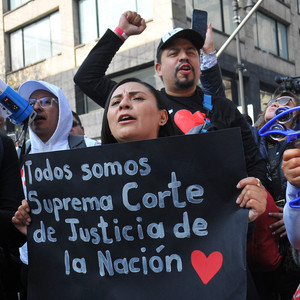
So starting this year, every single judge in Mexico, both local and federal, will be elected by the people instead of appointed.
Yasmin Robles -Cortes is one of those judges, and she says the changes are going to be challenging.
We aren't politicians.
We aren't trained for that.
Today on the show, the debate over judicial reform in Mexico.
Why is it happening now?
What could the consequences be?
And how uncertainty over this big change is creating an unsettling business environment in Mexico and potentially threatening its commercial relationship with the US.
Support for NPR and the following message come from Betterment, the automated investing and savings app.
CEO Sarah Levy shares how Betterment utilizes tech tools powered by human advice.
Betterment is here to help customers build wealth their way.
And we provide powerful technology and complete human support where technology can deliver ease of use and affordability, and the people behind that technology can provide advice and guidance.
Learn more at betterment .com.
Investing involves risk.
Performance not guaranteed.
This message comes from Capital One.
Banking with Capital One helps you keep more money in your wallet with no fees or minimums on checking accounts.
What's in your wallet?
Terms apply. See capitalone .com, slash, bank, for details.
Capital One N .A. member FDIC.
This message comes from Amazon Business.
Free your team from time -consuming office tasks with smart business buying tools.
Enable buyers to find and purchase items fast. Learn more about the technology, insights, and support available at AmazonBusiness .com.
To really understand what's going on in Mexico right now, we need to look back to the 1990s.
Back then, Mexico had an economist as its president, and he wanted to make the judicial branch more professional.
David Lopez is an attorney.
He also wrote the English -language textbook on Mexican law that everyone seems to use.
Mexico altered its judicial institutions to increase judicial independence, to increase the quality of the courts, and to increase the discipline of federal judges.
But there were critics of the system.
They said that it allowed the judiciary to continue to be pretty elitist. The fear was that a lot of wealthy or well -connected people were ending up in judicial positions.
They then favored their wealthy or well -connected friends both in their judicial decisions and their hiring practices.
One estimate from Itamu University in Mexico said that yes, about half of the federal judges in Mexico have at least one family member working in the regional court system.
And it's worth mentioning that the researcher behind that study said the numbers alone weren't evidence of nepotism per se.
Either way, this is the historical context for what's happening today.
So both former president Andrés Manuel Lopez Obrador, better known as AMLO, and his protégé, the current president Claudia Schoenbaum said the system was rife with nepotism, not to mention corruption, and reform was needed.
AMLO pushed through the policy change to elect judges in his final days as president last September.
And since he left office Schoenbaum has been enthusiastically rolling it out.
This is the defense of the people of Mexico for justice, for honesty, for integrity, and for eradicating Mexico of what has caused so much harm to our country, which is corruption.
Nepotism is corruption in the judiciary." David says there are questions, though, on whether combating nepotism is the real reason behind the reform.
Instead, he points to AMLO's prickly relationship with judges when he was president.
He continually ran into issues with the judiciary, the federal judiciary in particular, so that many of the social reforms, political reforms, and legal reforms that he wanted to bring into existence, he met opposition.
AMLO and political party he founded, Morena, are popular in Mexico.
They have the majority in both the House and the Senate.
Claudia Shane Baum is part of the party too.
David says, AMLO chose to wield that power.
He decided to use that political power to essentially eliminate his largest opponent, which is the Mexican judiciary.
Starting this year, citizens will vote on judges from state -level positions to the Supreme Court justices.
The elections will take place in two rounds.
Half of the country's judges will run in June and the second half will run in 2027.
The idea is to democratize the judicial system and have judges reflect regular people instead of a fancy judge calling the shots.
Yasmin, the federal judge we heard from earlier, is planning to run.
She says under the new system, she'll be running against some people with lesser credentials.
In the final stage of my class, there were about 1 ,800 or 1 ,900 people registered, and only 30 of us made it.
Access was so limited.
You had to have very good grades.
Now they've changed it, and it's good enough to have an 80 percent in your undergraduate degree.
Even the requirements for a Supreme Court judge have changed.
They've lowered the grading requirements, but have added a three -page essay explaining why you want the position and are asking for a few references from neighbors or colleagues.
And as you might expect, they got a lot of judge applications.
Nearly 50 ,000 of them!
Everyone wants to be a judge!
This could be a new reality TV show, just saying!
From there, the list was whittled down through a screening process and a random lottery draw.
A big portion of the final 4 ,000 candidates are actually current sitting judges like Yasmin.
They're automatically put on the ballots if they choose to run.
I know that in some parts of the United States, the public can vote on local and state court judges.
And when I go to vote, it always takes me forever to read up on everyone.
That's one of the reasons that the US and basically every other country doesn't allow the public to choose judges at the top level.
David, our legal expert, says there is an argument for experts making those decisions.
I think that when the Founding Fathers were creating the federal judiciary, they felt that the voters may not be the best persons to decide on the qualification of federal judges.
Another argument is that it helps shield judges from voters if they make unpopular but constitutionally sound decisions.
And so the big question is, will voters choose judges who have the training and expertise they need, especially when it comes to antitrust, intellectual property and tax cases, which can be very complicated.
Most of the experts I spoke to said it's way too soon to say for sure.
Still, fear of the unknown has already done some damage to Mexico's reputation.
We spoke to Moody's who warned that a downgrade to Mexico's credit rating could be coming soon, partly because of the reform.
The ratings agency said the judiciary used to help balance out the will of the president in Congress, but without a good safeguard, they could pass what Mudis has called radical legal changes.
It says some international companies won't want to take on that much risk.
Mexican President Shainbaum said these worries are way overblown.
No American entrepreneur or any businesses in any other country nor Mexicans have anything to fear about the judicial reform.
on the contrary, we are cleaning up the judiciary." For her part, Yasmin worries that the judicial overhaul creates more problems than it solves.
It wouldn't benefit us as Mexicans and I'm telling you this, not as a judge, but as a citizen, it could create devaluation of the peso.
We have to create the legal certainty that ensures investment can come to the country.
Meanwhile, the US Ambassador to Mexico says that the reform is threatening the historic commercial relationship between the two countries.
Either way, with Mexico's trade with the US at 30 % of its GDP, Mexico has a lot to lose, whether from the issue of judges or from the ongoing trade spat.
This episode was produced by Julia Ritchie, with engineering by Jimmy Keeley and Robert Rodriguez was fact check by Cooper -Katz McCam.
Kakenkannon is our editor and the indicator is a production of NPR.
This is Tanya Moseley, co -host of Fresh Air.
Amanda Knox spent nearly four years in prison for a murder she did not commit.
When she was exonerated, she made an unusual decision to befriend the prosecutor who argued for her guilt.
Maybe he could help her make sense of her case.
I spent years thinking about it and trying to understand it until I realized that I could just ask.
Listen to this interview on the Fresh Air podcast. When Malcolm Gladwell presented NPR's ThruLine podcast with a Peabody award, he praised it for its historical and moral clarity.
On ThruLine, we take you back in time to the origins of what's in the news, like presidential power, aging, and evangelicalism.
Time travel with us every week on the ThruLine Podcast from NPR.
This message comes from the John D.
and Catherine T. MacArthur Foundation.
Recognizing extraordinarily creative individuals with a track record of excellence.
More information on this year's MacArthur Fellows is at MacFound .org.