Hello, welcome to Roundtable, where we serve a piping hot debate on the issues that scissor in China and beyond.
I'm Niu Honglin. In a world where urban spaces seem to be becoming more concrete and glass, there's a new movement taking shape, one that invites nature right into the heart of our shopping experiences.
Is this simply a luxury for a few cities, or is it a model that will define the shopping centers for tomorrow?
For this episode, I'm joined by Yu -Shan and Steve Hatherly.
Now grab your virtual compass, and follow us to the heart of the discussion.
What's the last time you hit the mall?
What if shopping could be more than just a transaction?
What if, while browsing through the latest fashion, or grabbing a coffee, You could also be surrounded by the calming presence of nature.
In cities like Shenzhen, this idea is becoming a reality, where commercial spaces are blending seamlessly with green areas.
But, can nature really enhance the shopping experience?
Or is it just a novelty?
Is this the future of urban development, or a passing trend?
And ultimately, how will this change the way we connect with both nature and commerce in increasingly urbanized world.
To answer all these questions, let's first figure out what's making headlines, what's making people talking about, and exactly what is this new type of mall.
Oh yeah, exactly. Well, as far as I've read, I think the city of Shenzhen is actually taking the lead here.
In case our listener is not familiar to this place called Shenzhen as much Here's a brief intro about what Shenzhen is.
This is a prefecture level city in Southern China's Guangdong province.
It is a special economic zone that some survey would call it the third most populous city by urban population here in China.
And that's right after Shanghai and Beijing.
And why we're talking about this city is because recently there are some shopping centers in that are built within or right next to some greenery areas like botanical gardens or just big vast open space featuring lake and waters.
Stuff like that and zoos even.
Can you imagine shopping mall that incorporates everything like commercial area and also gardens and zoos and urban parks.
and that's starting to, you know, gain traction online and through news reports as well.
Not every one of these shopping areas, they are brand new but they're just increasingly getting more populace among people, especially young people, these days.
One example would be the Da Yun Tian Di in… I think it's in Shenzhen, central Shenzhen as well and it covers over 65 ,000 square meters land and just to give you a general general idea I think it equals nine to ten football pitches, that's really a giant place, and you mean the equivalent of or there are actually nine football pitches there.
I mean relatively close to the size of nine to ten football pitches.
There's not that like so many football pitches all gathering in one place, it's just a say a metaphor.
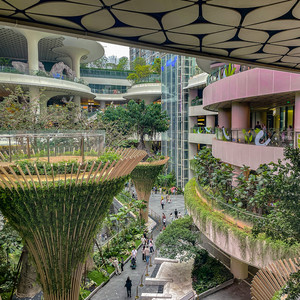
So this shopping center I just talked about It's known for its integration of natural elements – nature – that's incorporated within that commercial space and it's designed as one giant open block with its main building that's built around a lake.
So you can just imagine there's vast space for greenery on the shore, trees on both sides of the lake, and even wild birds resting inside and around the lake.
Because yeah, consumers had reported seeing white egrets occasionally stopping by, as well as other animals, like black swans, spotted deer.
Deer? The deer are raised there.
They don't just stop by.
That's cool. There's also Indian peafowl or more commonly known as peacock.
So they're just animals walking freely inside that zone.
So that space is kind of in the inside of, it's not inside the building, but the building is built around that.
Yeah, it's like a circle and with the center being just a huge nature park and surrounded by commercial areas.
Another very interesting example would be a botanical garden mall that's called Ban Tian Wang Ku Plaza, and it's also in Shenzhen as well.
Here, the commercial spaces are located on both sides of the atrium while various gardens are scattered around, including the orchard garden and the fern garden, and just different plantations surrounding that whole style, and that's along with many other greenery and plants as well.
And moreover, you can see lush green vines hanging down from the 2nd and the 3rd floor all the way down to the ground.
So that's like an intertwined leaning against each other, almost like a decorational wall that's giving people this sense that, oh, I'm walking in jungle, instead of an artificial mall of sorts.
Yeah, it's happening in the United States.
In fact, it's happening in other parts of the world too.
In LA, for example, in Los Angeles, there's a spot in Westfield Century City.
the landscape it considers or takes into consideration the entry experience for the shoppers which is kind of unique.
So when you go in to the mall you pass through a grove of olive trees and then they have this kind of fun whimsical lighting at the at another entrance to the mall and hanging grape planters at another entrance so they take the, I've never thought about the entrance to a shopping mall being important before, but there apparently it is.
Another example from this part of the world, in Bangkok there's a wooden amphitheatre at a place called Mega Banga and it guides visitors into this kind of lively forest -like dining and shopping promenade.
There's interactive landscape installations that enhance the climate and it creates this really pleasant experience for the shoppers.
Definitely. And we actually have seen the idea of decorating the mall with some greeneries for quite a long time.
It's not something novel.
What's interesting is that for some of these places, they're basically building the mall or the commercial areas centering nature.
So nature is supposed to be the main star and all of the other facilities are the sidekick.
And it is actually a concept.
We call it park oriented development and it inferred as a strategy that integrates green spaces and parks into urban development similar to green space oriented development or god.
It is quite an idea that has been there since the late 19th century and this movement, which is a movement idea of integrating green spaces into urban planning, has its historic routes in the Garden City movement.
And the Garden City movement aimed to create self -contained communities with ample green spaces reducing urban overcrowding and promoting a healthier environment.
Because if we think about it, the creation of malls is basically integrate a lot, a lot, a lot of shops and put them all together.
And so that when people go inside, they can get all of their purchases for maybe a week or even maybe a year of at least clothing or season of clothing or just one stop?
Or maybe you don't do any shopping at all, right?
I mean the the old concept of a shopping mall I'm not sure about China but in Canada in America it was like an event, right?
A day at the mall. If you're a teenager you'd get together with your friends and go to the mall on a Friday night or something like that and just walk around.
Teenage loitering would be a problem, businesses would complain about it.
What I'm aren't say is it used to be a thing to do even if you didn't do shopping there but now the way that people shop is shifting and in fact you could probably say it's already shifted the former mall model of a giant building with all the shops in closed on one two three four floors that seems to be going by the wayside now in the United States maybe Canada to some malls are having trouble staying open, because the model just doesn't seem to be working as well as it used to.
Yeah, and I think apart from just developing malls as one type of, say, shopping scenario, it's more of an urban planning, say, new concept as well.
Because like you mentioned, Honlin, the park -oriented development, the POD commerce, it focuses on everyday life scenarios, not just shopping, that includes dining, entertainment, sports, and social interactions, all that.
And also, we know the CBD area, or the commercial center for each city is an area where every inch of the land is weighted by a very expensive price, and that makes the developer have to be kind of cautious when they're planning how to use that land in a more efficient way.
So here we see so many real life examples of how the Garden City concept is so well integrated with that as well.
And that's something that's unconventional and kind of cool.
It attracts a lot of people every day.
I was about to say that, previously, malls are really concentrated shops putting together, but with the development of online shopping, with people finding out that if they really need to buy something, actually going online is a better option.
Malls should return to be what Steve has just described, to be an event, to be something that you can do for maybe a day to enjoy your leisure time.
And that requires the designer of the different centers, different commercial centers, to be smarter, to think about other needs of consumers.
Funnily enough, we see that there are a lot of these kind of using nature as the main element as a shopping center happening all around the world, Shenzhen is making headlines because there are more of these kind of GOD design in Shenzhen than other cities.
So what is with the city of Shenzhen that can allow these kind of commercial centers to happen in a more frequent and easier -to -see kind of way?
As I mentioned just now, Shenzhen is such a developing economic center, and it's very populous in recent years as well.
And there is also official data that's from China News Service reported in February this year that the city's government work report revealed that Shenzhen's GDP had already reached 3 .68 trillion yuan and that equals 510 billion US dollars in 2024, which placed Shenzhen among the leading large and medium sized cities in China.
As of last year, I think what's been discussed the most about Shenzhen lies in its production of new energy vehicles as well.
Because, well, just in 2024, it increased by almost 70 % year on year, accounting for 22 .3 % of the national total just on that new energy vehicle production industry.
And also... Here's a fun fact related to that.
They are the first city in the world to have more charging stations than gas stations.
I thought... I would've thought it's Hangzhou or somewhere in, say, East China's Zhejiang Province.
I wouldn't have guessed anywhere in the world would have had that statistic.
But it's just testament to the importance and the success of new energy vehicles there.
There are the headquarters for a bunch of big name companies from China, Tencent I think has their headquarters there.
Huawei has their headquarters there.
And then a name that's been in the news a lot recently, even internationally BYD, the energy vehicle company, they have their headquarters there as well.
It's a big city, a lot of people live there, economically it's doing really well.
Yeah and it's really astonishing when you look at the size of the city because I just learned about this as well because the size of Shenzhen is only 31 % of Shanghai, 26 % of Guangzhou and only 12 % of Beijing.
It's got more parks though doesn't it?
Yeah, like just an official report saying that in January, it revealed that Beijing has 1 ,100 parks, while Shenzhen, as mentioned, it has 1 ,320 parks already as of the end of last year.
12 percent the size of Beijing.
So much smaller, but yet a couple of hundred more parks.
that means that you're gonna see them.
Here in Beijing there are tons and tons and tons of parks, but in Shenzhen you would notice them a lot more because they would be more condensed wouldn't they?
Because of the size difference.
And one other thing I think is very important is that it has really good climate condition.
I've visited Shenzhen.
It has subtropical monsoon climate with long summers and short winters and mild climate.
But according to data released by the city's related department, the annual average temperature is 23 .3 degrees Celsius.
It sounds quite pleasant.
With the lowest average temperature in January at only 15 .7 degrees Celsius.
That sounds nice, too.
Exactly. And the highest can be a little bit high, but it's still only the average, highest average temperature in July at 29 degrees Celsius.
And I visited the city of Shenzhen.
I have to say my feeling is that because I visited Shenzhen and Guangzhou pretty closely that year and together for several times, my feeling is that Shenzhen is a younger city in the sense that a lot of its facilities are built more or rather nearly to today, which means the designing concept, the way it organize itself, is more towards a relatively modern kind of concept, which makes it even more pleasant, at least for me personally, and allowing these kinds of different types of plants to be able to co -exist with human activities in these different commercial centers.
Because if you think about it, when we decorate our malls or decorate the open spaces with plants.
The main character is still the buildings.
It's still the little cafe, the still the small restaurants.
Yet one you design the entire area surrounding a lake or in certain occasions I've seen this huge, huge, ancient tree staying standing in the center of a road and the road has to go around that huge tree.
It makes you feel like the tree is the main character.
It makes you feel like you are a guest in the tree's home and you would respect nature a little bit and you would more likely to feel that you're in a natural environment.
Yeah, I think what we're seeing now is that shopping malls are I don't know if realizing is the right word that they need to make a change, but they are making a change.
and I think one of the reasons behind that is the popularity of online shopping.
We know here in China it's huge.
There was a report.
It was on digital consumption, published by the China Internet Network Information Center in June of 2024.
Over 900 million people here in China had engaged in online shopping, including 95 % of those born in the 90s almost 90 percent of those born in the 2000s, so if we look at a city like Shenzhen, and you said it's a it's a youthful city right and the age, the average age of Shenzhen citizens is 32 and a half so think about all of those things put together if online shopping is incredibly popular with people in that age group and that city is populated by people in that age Well then, people aren't going to go to the mall to do their shopping, right?
So we have to redesign the concept of what a mall actually means to people.
So instead of being a place to go buy a t -shirt and a pair of socks, it's now a place where you can go enjoy some peacocks or deer, right?
And have a nice lunch at a really good restaurant.
Not just a food court restaurant, not that those are bad, but typically that's what shopping malls are known for, right, or at least they used to be.
So do you see what I mean?
Shopping malls now are kind of need to change the concept of of what it actually means to a person to change it into a meeting place, a place where you can go and do a lot of different types of things with your friends or with your family members, not just to do your monthly or yearly shopping.
It used to be that place, right?
Now we need to bring back the glory for malls, which is why I am asking a more specific question to different people, different group of people, for example, for a young kid like you, Yu -Hsien.
What is the last time you visit a mall and what do you think would attract you more to a mall?
Because the reason I'm asking this is that I have a different reason to go to malls these days.
I've shared it before the show to walk my kid.
I need a place where my kid can also enjoy.
Actually, I need a place where my kid can enjoy.
It's more important than I enjoy the place.
And if a place can hit both targets at one go, definitely that would be my most basically weekly go to places.
So for me, the most if they can incorporate natural or an element of the nature, if it can have I don't even need wild animals.
I'm happy with indoor animals like cats that can pet or a little rabbit that I recently am enjoying petting with my kids.
So that is already really good.
But what about you Yuxin?
One very lively example I can refer to is just yesterday, I went to a nearby one down wall that's kind of close, 10 minutes walk from our office building.
And I wasn't there to shop, but I was there for a yoga class.
So that's how the malls are kind of evolving in the past few years is incorporating, not just say green plants.
Well, as a matter of fact, not many malls here in Beijing have the power to do that, but they're trying to incorporate more, say, diverse commercial ways for people to spend money, including shopping for not only, say, products but also services, as in class and trainings, and there are also more gyms in the malls as well, and places to pet little animals, like you said.
I've been to one in another wonder mall in a different part of Beijing that's featuring just a hub where fox, raccoon and i don't remember if they have an alpaca too but just animals that are insta famous got getting all together in one little hub within the mall and I would believe that that's one of the most popular place in that one single mall because you know it drives people young people to want to see, wow, real alpaca in an artificial design or say just a place where it shouldn't be even, quote, unquote.
So that's what experts are saying as well.
There's one guy named Li Jiayu that's the director of the Housing Policy Research Center of Guangdong Urban Planning Institute.
And I think he would agree with you too, Steve, that he believes that young people pursue a relaxing experience for both the their body and their mind and that's better achieved in online shopping or rather online just walking around in the city facilities such as a mall and commercial centers such as those that we've mentioned in Shenzhen.
They are very well an illustration of how the combinations between commercial centers and personal relaxation, personal leisure, and just closeness to nature and just going together as friends, that forms closeness among different people.
That's all incorporated within offline shopping as well.
Now comes the next question.
We have already seen the success in the city of Shenzhen, and we've seen some really good examples in other parts of the I am curious, do you think this trend can, will be, or will this trend be the future of malls?
Will it be the, take the center stage of mall designing?
I think so from an aesthetic point of view, but money has to be taken into consideration, right?
eco -friendly spaces can occupy nearly one -fifth of a project's entire commercial area but that can increase construction costs by a lot compared to your traditional malls, right?
So, maintenance costs can be higher than your standard shopping center, high investment projects, they require a lot of foot traffic, don't they?
To maintain or to keep up with the costs so they have to generate a lot of money, right?
So there's a lot of pressure on these types of spaces but I was reading about these types compared to your traditional shopping malls and it can be cheaper too if you think about air conditioning, right?
In your traditional style shopping mall?
Well, if you take every single shop into consideration.
That's a ton of money every single year, but if you look at an open -air retail center where each individual business is in charge of their own shop and control of their own shop, that puts the onus on the business owner as opposed to on the shopping mall as a whole, so there can be cost -effective ways of doing it that way too.
But money, of course, has to be, has to be thought about.
Yeah, and just take the Ma Xin Shen as an example, the Ban Tian Wankui Plaza.
It gathered over 200 foreign and local plants in the public space and various animal species as well, as we talked about, and this covers 27 ,000 square meters, that's nearly one -fifth of this commercial area, that's a vast space.
And meanwhile the Da Yuan Tian Di, it also has leverages ecological design to drive a 17 percent rental premium in the surrounding area as well so the while the Hati Harbor I think that's some facility within that whole mall say bigger area that that one facility the Hati Harbor has capital capitalized on its waterfront Park setting to achieve a 40 % increase in non -weakened foot traffic as well.
Well, these are the more positive examples, but it is worth noting that these say equal -friendly space occupies nearly one fifth of the commercial area of such moths.
So imagine the construction costs, the operation costs, the maintenance costs.
You have to have a lot of foot traffic there.
You have to have people coming to spend the money because it costs a lot to build it.
It costs a lot to maintain it.
Definitely. And previously we didn't used to have many of those.
It's not because we didn't like nature 10 years ago.
It was mainly because we were not just there yet.
The technology, the business model does not allow us to have such kind of commercial centers that can be both cost effective and also attract as many traffic and business as today.
So I do also agree that it will be a future model.
When we put more and more emphasis on eco -friendly, on co -exist with the nature, on inviting more greeners in our lives, we would love to embrace this kind of designing mode.
In the meantime, local governments are doing their share in this designing.
It's not only a commercial center designing, it's the city planning as well.
They are making sure that if a place designs such kind of G .O .D.
commercial areas, they can have related governments departments to coordinate the designing of it, making sure the safety issue, the traffic, the designing and if a restaurant decides to have open cooking area in that space, we want to make sure it's safe and delicious at the same time and do not have too much cooking smoke affecting people walking around.
So see it's these little details like this that need to be maintained to make this kind of very enjoyable area happen in our cities.
So hopefully, we are going to see more and more of such malls in the future and Roundtable is always here looking at some new trends that are making our lives better.