A cancer diagnosis changes everything. At Kansas City Proton Institute, we combine expert physicians with advanced proton therapy technology.
Our cutting edge imaging and high intensity proton beams target cancer precisely while minimizing damage to healthy tissue.
That means better outcomes, fewer side effects and faster recovery.
If you have prostate, breast, head and neck or brain cancer, proton therapy may be a better option than traditional radiation therapy.
Get a second opinion today. Visit kcpi.com and take the next step toward healing with precision.
This Labor Day at Lowe's. Shop member-only door buster deals for a limited time.
Save $50 on an Ego string trimmer. Now $169.
Plus, get 50% off select Holland pavers.
Not a rewards member? Sign up for free today.
But hurry, Labor Day doorbuster deals won't last long.
Lowe's. We help, you save. Valid through 9-1 while supplies last.
Programs subject to terms and conditions.
Details at Lowes.com slash terms. Subject to change.
The History Channel original podcast. History This Week, September 5th, 1698.
I'm Sally Helms. The first man to lose his beard is the commander of the army.
Next up, a childhood friend of the Tsar.
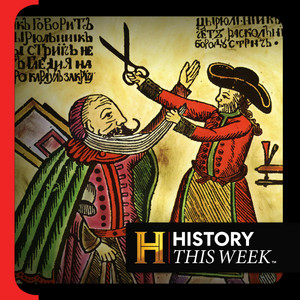
And then... All of the noblemen assembled, one after the other, get their beards chopped off by none other than the Tsar himself.
The men had come out this morning just to welcome their leader home.
Peter the Great has returned to Moscow after a year-long tour of Europe.
He got in last night. And so his friends and supporters showed up today to pay their respects.
Many of them are boyars, the most important and wealthy members of the Russian elite.
Some are religious officials or royal advisers.
None of them are expecting Peter to pull out a barber's razor and hold it to their throats.
This is intimidating. The Tsar is very tall, six foot seven.
He towers over the assembled bearded boyars.
Peter himself is clean-shaven, which is the fashion in Europe.
And in fact, that's why he's doing this.
He thinks that the long beards all around him represent the old Russia.
He wants to ring in the new. And so this morning, Thanks to Peter's razor, long beards are falling into the street as the confused noblemen look around and see new faces emerging. from beneath collective decades of beard.
Peter does stop short of shaving a few faces.
The patriarch of the Russian Orthodox Church is there, and he gets a pass.
Beards have a religious significance in Russia.
A serious one. They're tied to piety and self-respect.
The apostles wore beards. In many depictions, God himself is shown with a beard.
Czar Ivan the Terrible put it this way, quote, To shave the beard is a sin that the blood of all the martyrs cannot cleanse.
As they walk away with their freshly shaved faces, these men know that something deadly serious has occurred.
What this was, was creating a clean slate to introduce something new.
Peter utilized that in order to transform Russia, you had to get rid of these old traditions and superstitions.
And doing so required something which to us in the 21st century seems to be rather significant. silly, but for Russians, it was fundamental and it was tied to identity.
Today, Peter the Great essentially holds a razor to the throat of Russia and says, westernize or else.
How did Peter almost single-handedly drag his country onto the world stage?
And how did these beard-shaving theatrics help lead to the Russia that we know today?
Abercrombie denim is everything right now.
Denim should feel like this. Confident, easy, like your butt has never looked better.
If you didn't know, Abercrombie's Curve Love denim went viral in 2019 for eliminating waist gap, and it's still a game changer.
Between that and their classic fits with a straighter line from waist to hip, the perfect denim does exist.
Shop Abercrombie Denim in the app, online, and in-store.
Obsessed with true crime cults or conspiracy theories?
Conspiracy Theories, Cults and Crimes is a weekly podcast from Crime House and Pave Studios. that dives into the darkest corners of human behavior.
Every Wednesday, we uncover the true stories behind the world's most shocking crimes, deadly ideologies and secret plots.
Follow and listen to Conspiracy Theories, Cults and Crimes, an Odyssey podcast in partnership with Crime House.
Available now wherever you get your podcasts.
This episode is brought to you by State Farm.
Checking off the boxes on your to-do list is a great feeling.
And when it comes to checking off coverage, a State Farm agent can help you choose an option that's right for you.
Whether you prefer talking in person, on the phone, or using the award-winning app, It's nice knowing you have help finding coverage that best fits your needs.
Like a good neighbor, State Farm is there.
Professor Lynn Hartnett has been interested in Russia since she was a kid.
I blame the nuns at my Catholic school. The nuns were Polish, so we used to pray for the liberation of the Poles from the Soviets all the time.
And I think I'm just an inherently dramatic person.
So I just loved the idea of what was happening in the Soviet Union.
And it's big and it's bold and it's dramatic.
Russia has had a number of rulers big and bold and dramatic enough to earn a special moniker.
There was Nicholas the Bloodstained. Ivan the Terrible, and of course, Peter the Great.
Russia in the centuries before Peter's reign was vast, cold, and largely undeveloped.
So in the mid 17th century, Russia was one of the biggest countries in the world, but it was also one of the least populated.
I'm picturing like People in fur hats, like farming on vast tracts of isolated land.
Do I have it right? What should we be seeing in our mind's eye?
You have it exactly right. That's exactly what it was.
People lived in these isolated ways. Peasants lived in these huts.
They would have the stove in the center of the the room and that was the great place for people to sleep.
So grandma and grandpa would often get the spot right by the stove to keep it warm.
Conditions were terrible. It was a grueling life.
Many of these people were serfs, peasants who were bound to the land where they worked.
The nobles who owned that land, meanwhile, lived in the cities.
The richest and most powerful nobles lived in the capital, Moscow.
That was where the Tsar and his family were in the Kremlin, surrounded by the boyars and various top military and civic leaders.
Now, at this time, the Russian church rivals the royal family as a major power in the country.
They also have a big presence in the capital.
If you go to the Moscow Kremlin today, what you're struck by the first time you go are all these beautiful domed cathedrals.
They blend the style that you would see in Byzantium, but with a very Russian flavor.
Byzantium. The Russians think of themselves as inheritors of the great legacy of the Byzantine Empire.
They call themselves the Third Rome. The second was Constantinople, the Byzantine capital, and the first was Rome.
Russia thinks of itself as this elite sort of chosen nation.
But at the same time, they aren't participating much on the world stage.
Even though Russia is enormous, and extends across what's now 11 time zones, they were essentially landlocked.
Sweden in the northwest blocks their access to the Baltic Sea.
The Ottoman Empire in the southwest cuts off the Black Sea, And then to the north, their working port is only usable for three months out of the year.
Other than that, it was iced over. No water access means no Navy. which in terms of military power, really cuts them off at the knees.
And partly because of their isolation, Russia also misses out on some of the cultural and technological changes that are happening in Europe.
They don't take part in the Renaissance.
They don't take part in the scientific revolution.
And so they are in many ways living on this enormous landlocked island, thinking themselves better than the foreigners who have a military and economic advantage over them.
So huge, isolated, and a few steps behind the rest of Europe.
This is the Russia into which Peter the Great is born.
He spends his childhood in Moscow. He's the son of the second wife of the Tsar, and he has several older half-brothers and half-sisters.
So he's not first in line to take over as ruler.
His father died relatively early, and so Peter's oldest half-brother became the Tsar.
His name was Fyodor. And Fyodor was smart, but he was only 14 years old.
So Fyodor's mother's family steps in to advise him.
Remember, they're half-brothers. This isn't Peter's mom.
So when that happens, Peter and his mother Natalia are kind of pushed aside.
They move to the outskirts of the city, ironically, to this place called the Foreign Quarter. where many foreigners lived.
Peter's mother Natalia was raised in a very pro-Western household.
And he spends part of his childhood in a rare section of Russia that has a ton of foreign influence.
Meanwhile, Fyodor was actually not in good health.
So he ruled for six years and then he died.
Well, what should happen then is that his next brother, Ivan, should take over.
But Ivan suffers from physical and mental disabilities.
So in 1682, the powers that be decide that Peter will take over instead.
Not everyone in the family is thrilled. Peter had an older sister by the name of Sophia, and Sophia was not very happy about the situation.
Sophia wanted to have power herself. And what we believe happened is that she started spreading rumors.
There were these personal bodyguards to the Tsar who were called streltsy.
And what seems to have happened is someone started to spread rumors among the Streltsy that Peter and Peter's family had murdered Peter. his older half-brother Ivan.
Ivan is in fact alive. But people get suspicious.
On this one day, these angry crowds go down to the Kremlin, demanding to see the young boys, the heirs to the throne. and they're clamoring and they're killing people on the way, they get to the Kremlin and Peter's mother, Natalia, who's still relatively young herself,
In an effort to try to appease the crowd, brings both Peter and Ivan out onto the balcony.
And the people, they start to calm down. but not before they grab Peter's uncle and they murder him.
And then this man, who was one of the closest advisors, who was actually standing right next to Peter, his brother Ivan, and Natalia on this balcony.
And they grab this man. They throw him over the balcony.
And he is impaled on the Streltsy spears below.
Peter is just 10 years old. A lot of scholars think that this moment, plus his upbringing in the foreign quarter, have a huge impact on the way that he will rule Russia in the years to come.
But first... What happens in the aftermath of this is that there's a decision that Ivan and Peter will rule as co-czars. with Ivan being the senior czar, Peter being the junior czar.
Their sister Sophia steps in as regent for the time being.
And so, young Peter isn't that involved in the day-to-day business of being a czar.
He was the co-czar, and so he had every material advantage you could ever want, We also have this degree of freedom that doesn't normally happen.
That freedom allows him to get into some exploits.
Oh, Peter was something else. Peter liked to have fun and a little bit too much fun.
He formed his friends into a group called the All Drunken All Jesting Assembly. and they just raised havoc by all accounts.
They drank copious amounts of alcohol and it was not uncommon for people to just pass out left and right at some of his gatherings with his friends.
Peter also has a chance to indulge his interests.
He becomes obsessed with boats. and the Navy.
He teaches himself to sail, not a common skill in a landlocked country.
And he's obsessed with military might. With his friends, he'd play these games.
He would form them into mock military units.
They have mock battles and literally fight to the death.
Literally to the death. It wasn't like Peter was running around killing his friends intentionally, but these rowdy teenage games got very out of hand.
When Peter becomes Tsar, that rowdiness will give way to cruelty.
He eventually has his own son killed for treason.
But that's a different story. He rises to power in 1696 when his brother Ivan dies.
Peter's in his mid-20s. and he's finally able to pursue his obsession with military expansion.
Peter really wants a Russian navy. But he's facing down two tough opponents, the Ottoman Turks and the Swedes.
At the time, both are among the greatest military powers in the world.
So Peter will need some help if he wants to make his naval dreams come true.
What he decides to do is to go to Europe to find and recruit allies.
And in addition, he believes that while he's there, he's going to bring people with him to learn some of the trades, crafts and skills that Western Europeans seem to be so proficient at, and also to recruit some Western experts to come back to Russia.
The tour is called the Great Embassy. Peter will travel around with a big entourage of about 250 people.
They'll be gone for a year and a half. He is the first Tsar ever to take this kind of peacetime trip to Europe, just to travel and learn. and he decides that he wants to fly under the radar.
He goes in disguise because he believes that he'll be able to dispense with formality this way.
So when monarchs would travel, there was a lot of pageantry that was associated with it.
And although there were times that Peter wanted those to take place, and he does in trying to secure allies, there are other points that he just doesn't want to have to deal with it.
And so he goes not as Tsar Peter the Great of Russia, he goes as Peter Mikhailov. along with 250 of his closest friends.
The big question oftentimes was which member of this 250 member retinue was actually Peter the Great. okay so he's not in disguise like wearing a fake mustache or something he's like he like has a different name and identity that he's assumed and he's in this big group of people so he can kind of like Pass unnoticed is the idea.
That's exactly it. Yep. It doesn't always work because he's six foot seven.
But he tries. He travels through Sweden, Germany, then the Netherlands.
He spent four months there. living as a carpenter, learning how to build ships, and by all accounts it was one of the best periods of his life.
Then he goes to England, attends a session of parliament, tours the Greenwich Observatory, trashes a rental house on the Thames with his friends.
And through all this, Peter is learning about advancements in military and Navy technology, in science, in the arts, He also meets with foreign leaders and goes to fancy parties.
When Peter was at one of his first balls in the Germanys, the first woman he danced with He was taken aback by what she felt like.
And she later said that it was funny because he didn't know what to make of her corset, which were made out of whale bones.
She said she wondered if he was curious if Western European women were built differently than Russian women were.
In general, Peter is noticing that people in Europe dress differently from the people at home.
In Russia, men and women dressed for the elements.
So they'd have these long, calf-down coats.
They'd have leather boots. and almost tunics, right?
The European elites aren't quite so practical.
So they'd have patent leather shoes and lace collars and short jackets. and it just looks so much crisper.
At least that's Peter's take. And he zeroes in particularly on the beards. or really on the lack of beards.
When he looks at the men who were clean-shaven, he thought they just looked so much more modern.
And it's his idea that if Russia wants to be more European, if they want to be more modern, they have to look more modern.
In 1698, Peter's trip ends in a hurry. There are rumors of a rebellion back home, so he goes back to Moscow. and immediately he sharpens his razors.
Mint is still $15 a month for premium wireless.
And if you haven't made the switch yet, here are 15 reasons why you should.
It's $15 a month. Seriously, it's $15 a month.
No big contracts. I use it. My mom uses it.
Are you playing me off? That's what's happening, right?
Okay. Give it a try at mintmobile.com. upfront payment of $45 for three month plan $15 per month equivalent required new customer offer first three months only then full price plan options available taxes and fees extra Get out of her life.
Boring money moves make kind of lame songs, but they sound pretty sweet to your wallet.
BNC Bank. Brilliantly boring since 1865.
Gatorade is the number one proven electrolyte blend designed to hydrate better than water.
So you can lose more sweat and raise your game.
Gatorade. Is it in you? The day after Peter returns from his great embassy, his first major public act is to shave off the beards of the Russian elites.
Remember, he is doing this himself. with a dry razor.
It leaves scrapes and cuts in some places.
These men have had their beards for a long time. and they are taken aback because to a Russian man, their beard was part of their identity.
This is more than a haircut, and everyone knows it.
It seems like this is just a superficial thing and it is silly and almost kitschy, but it was something so much more than that because it's what it represented.
Particularly because shaving is a sin. Beards are religiously important.
But Peter believed that the Russian people were just stuck in the past, that superstitions held them back.
And beards were part of that. This idea that you had to maintain this long beard to be in the image of God to have salvation.
And so this is the first step, because if you put aside superstitions, then you can open your mind to the future.
After that first public beard shaving, Peter goes even further.
A few days later at a banquet celebrating Moscow's New Year, the court jester weaves his way among the guests, shaving off any beards in sight.
If someone refuses, He boxes their ears.
One observer wrote, quote, Between mirth and the wine cup, many were admonished by this insane ridicule to abandon their old guys.
This new fashion is happening among the elites, but it doesn't really reach the common people, which just creates a wider gap between the haves and the have-nots.
The peasants, those who worked the lands, which, if we remember, were 90% of the population, and priests were permitted to keep their beards.
But as time went on, if anyone decided to travel to town, even if they were a member of the peasantry class and were coming to town, If they had a beard, they had to pay what was called a beard tax.
A beard tax. You can keep your beard if you pay a fine.
Men would wear a little coin around their neck to signify that they've paid the beard dues.
The coin had a little beard and mustache imprinted on it.
So the Russian elites are starting to look more and more like the European elites.
And at the same time, Peter is implementing other big reforms, a major push towards westernization.
He overhauls the Russian economy, trying to stimulate agriculture and industry and commerce.
He creates the first universities, the first newspapers, the first printing presses in Russia.
There are also cultural reforms. He stipulates that men and women of the noble classes need to socialize at least twice a week.
He changes marriage. Previously, there had been a lot of arranged marriage, Peter instituted a policy whereby betrothals could last up to six weeks, that women and men who were to be married were allowed to see each other before the wedding. and that either side could call off the wedding if they chose.
Peter even changes the way that Russians count time — the calendar.
On the Russian Orthodox calendar, the year had been 7207.
But Peter wanted to get on the Julian calendar, which was still a little behind the rest of Europe.
They had moved on to the Gregorian calendar, but it was at least much closer.
So one day, it was no longer 7207, it was January 1st, 1700.
As he's introducing all these reforms, he's also consolidating power, reducing the power of the noble class, the boyars, and most importantly, wresting power away from the Russian Orthodox Church.
It's not that he is anti-religious. He just believes that the church should be subordinate to the state.
And so he makes that happen. During his reign, he's able to fold the church into his administration.
They sit under him now, not alongside him.
Peter's Westernization push also changes diplomacy.
He gains more allies in Europe, He implements a new military training program.
And he's finally able to defeat Sweden and achieve his dream of having warm water ports, and therefore a navy.
It allows Russia to become a global power.
And that global power just gains over the course of the 18th century.
So Peter's modernization campaign really brings Russia onto the world stage.
They get a seat at the table in Europe. And perhaps most importantly, Peter kind of creates the Russian cultural concept of a single strong leader who feels empowered to dictate almost every aspect of life.
A strong authoritarian ruler, a strong autocrat who was able to intervene in people's lives in the most seemingly minute ways, whether that was forcing a man to shave his beard wear a French-style coat, or whether it was him decreeing that the whole Russian Orthodox Church was going to be transformed.
After Peter, Russia is no longer this isolated, landlocked nation.
And his rule has long-lasting consequences.
It's hard to imagine today's Russia had there not been a Peter the Great.
Putin in speech after speech has alluded to the fact that Russia did not begin its history in 1917 or 1991, that it goes back a thousand years.
If Peter the Great hadn't overhauled the Russian military and made allies in Europe, maybe the Russians wouldn't have helped defeat the Nazis.
If he hadn't opened the door to technological exchange with the rest of the world, maybe there would have been no space race.
And maybe, without Peter, we don't get authoritarian rulers like Joseph Stalin and even Vladimir Putin.
This is something that Putin identifies with.
He understands this idea of a strong man who will not tolerate any opposition. who, in order to protect their prestige on the world stage, needs to push the boundaries literally and figuratively. by intervening in the politics of neighboring countries and others.
So there's a line to be drawn from the Russia of today. a major player on the world stage. back to that day in 1698, when a six foot seven autocrat with a razor stepped into a crowd of bearded nobles and created, by force, the new face of Russia.
Thanks for listening to History This Week.
For more moments throughout history that are also worth watching, check your local TV listings to find out what's on history today.
And if you don't have cable, you can sign up for a free trial of History Vault at historyvault.com This episode was produced by McKamey Lin.
History This Week is also produced by Julie Magruder, Ben Dickstein, and me, Sally Helm.
Our researcher is Emma Fredericks. Our editor and sound designer is Chris Boniello.
Our executive producers are Jesse Katz and Ted Butler.
Don't forget to subscribe, rate, and review History This Week wherever you get your podcasts.
And we will see you next week.