Squeeze Kids acknowledges the traditional owners of the lands on which we podcast the Turrbal and Combermeri people.
Squeeze Kids!
It's your daily news fix.
Fun.
Free.
Fresh.
Hello and welcome to Squeeze Kids today, your fresh take on what's happening in the world around you.
I'm Christy Kijarina.
It's Thursday, February 12th.
In Squiz Kids today, a shark in the Antarctic.
Kites dance in Pakistan skies.
AI unlocks a Roman board game.
And when politics gets sloppy, that's what's making news, kids style.
What would you expect to see on a deep sea camera near Antarctica?
Penguins?
Maybe seals?
Ice?
Definitely not this.
Scientists have captured the first ever footage of a shark swimming in the deep, icy waters of the Southern Ocean, right near Antarctica.
And no, it wasn't paddling past an iceberg or eyeing off a seal.
This shark was filmed far below the surface in dark, near freezing waters, where very few humans or cameras ever go.
The surprise visitor appears to be a deep sea sleeper shark, like the Greenland shark, that can live for more than 400 years.
These sharks aren't the fast, flashy hunters.
They're slow-moving deep ocean specialists built to survive cold temperatures, crushing pressure and total darkness.
So why might it be there?
One reason is that the deep ocean is more connected than we realised.
Cold deep water currents move around the planet like slow underwater highways, meaning animals can turn up far from where scientists expect them.
There's also food down there, and where there's food, predators usually follow.
And perhaps most interesting of all, the shark might actually not be new to Antarctica.
It might simply be the first time humans have managed to film one in those waters.
Spin the globe.
Each day we give the world globe a spin and find a news story from wherever it stops.
And today we've landed in Lahore in Pakistan, where the sky has finally filled with colour again.
For one weekend, bright kites took flight into skies better known for pollution.
They soared over Lahore as the Basant Festival returned after a 19-year pause.
Basant celebrates the arrival of spring and has roots stretching back centuries to the Mughal Empire.
Over time, it became a shared tradition across Punjab, bringing together people of different faiths, including Muslims Hindus, Sikhs and Christians.
The festival was stopped in 2007 after kite strings caused injuries to people below.
To protect the public, authorities banned the event altogether.
This year though, Basant made a carefully controlled comeback, with strict rules around kite materials, size and behaviour.
Even with these limits, the mood was incredibly joyful.
Families gathered on rooftops.
Neighbours waved to one another as the city came together to fly kites.
After nearly two decades, Basant's return has reminded many that traditions can bring people together.
Ancient Earth.
We're launching a brand new segment today called Ancient Earth, where ancient discoveries meet the modern day.
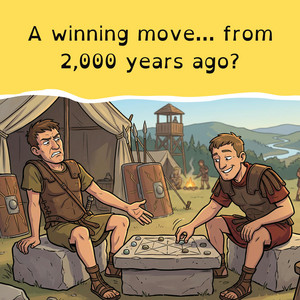
Archaeologists in the Netherlands have been puzzling over a flat limestone rock measuring about 21 by 14 centimetres.
That's roughly 8 by 5 and a half inches.
It was found beneath a modern city that was once a Roman town called Coriovalum.
The Romans were in this region nearly 2000 years ago, building roads, towns and military camps along their northern border, known as the Rhine Frontier.
At first, no one knew what the carved lines on the stone meant, but when scientists used artificial intelligence to simulate thousands of possible ideas, the wear patterns matched a blocking game where players try to trap their opponents' pieces.
We already know that Romans loved board games because they wrote about them.
They carved board games into stone and they left behind game pieces.
One famous example is Ludus Lan Truncularum, or the Game of Soldiers.
Researchers think that this mystery game may have been a thing too.
And while they can't be certain, AI is helping test ideas in ways that was never possible before.
Ancient Earth with a digital twist.
News Hounds.
Every Thursday, Squizzy the News Hound sticks his snout into Squiz Kids HQ to report back on fishy things that he's sniffed out on the internet.
And today, his nose is going crazy because of how artificial intelligence is being used in politics.
Over the past few months, AI-generated images have appeared on Truth Social, the social media platform owned and used by Donald Trump.
Some showed him as a king, a pope, or even a Jedi.
Experts say that this flood of exaggerated, attention-grabbing content is part of a trend called sloppaganda.
That word is a portmanteau or a mash-up.
Slop means low quality, quickly made content, and propaganda is media designed to influence how people think or feel.
Put together, slopaganda is messy, often shocking media made to grab attention and push a message, not to inform.
But one AI clip in particular crossed a serious line over the weekend.
A video briefly showed former President Barack Obama and his wife Michelle Obama in a way many people found deeply racist.
That's because, in the past, comparing black people to animals was used to dehumanise them and to justify discrimination.
The video was removed after a backlash.
But President Trump said he didn't believe he needed to apologise because he didn't make the clip and didn't see that part before it was posted.
For newshounds, the big lesson isn't just what was posted, but why.
AI makes it easier than ever to create media quickly.
Flood feeds, stir emotions and distract from careful thinking.
That's exactly why learning to ask who made this and what do they want me to think or do, matters more than ever.
And that's what newshounds is all about.
In the first three free sessions, kids learn how to spot different types of media, understand creators' motivations and they even make their own targeted media so that they can recognize slopaganda when they see it.
As Squizzy always says, if you see something online that makes you feel big emotions, make sure you stop think and check before you do anything.
Woo-hoo, time for the quiz.
This is the part of the podcast where you get to test how well you've been listening.
Question number one how long has the greenland shark been known to live for?
Well done people if you knew that it is 400 years.
Question number two the basant festival was held in pakistan over the weekend.
What does it celebrate?
Excellent listening if you said the arrival of spring.
Question number three.
Which portmanteau or mashup word describes low-quality AI-generated content designed to influence how people think or feel.
Yeah, I know you got this one.
It is slopaganda.
Shout out.
It's Thursday, February 12.
Hug Day.
Now, before anyone launches across the room like it's footy training, a quick reminder Hug Day is not about surprise tackles or forcing hugs on people who don't want them.
When hugs are welcome, though, they can help us feel calmer and happier.
That's because they can trigger feel-good chemicals in the brain which help people feel safe, supported and connected.
Everyone likes hugs and that is completely okay.
A smile, a kind word or a thumbs up or just being there for someone can work just as well.
So today, whether it's a hug or something else, the goal is simple show kindness in a way that feels right for everyone.
It's also a special day for these quiz kids celebrating a birthday today.
Charlotte from Ivanhoe, Annie from Forest Lake, Cadence from Kalanga.
Lockie from Parabadoo.
Charlotte from Duncraig.
Arslan from Croydon.
Samantha and Olivia from Vermont South.
Abigail from Point Cook.
Miss Beck from Gladstone.
Tanvi from Oran Park.
And Charlie listening all the way over there in Rome, Italy.
And classroom shout-outs today go to Class 5-6 OPAL with Mr H at Canalla Bar Primary School.
Class Blue with Mrs Murphy at St Pius X Primary School in Wyndale.
Classes 5A, C, D and E at the Willows State School in Townsville.
Class B, where are you?
And lastly, but definitely not leastly, Class 5 White with Miss Higgins at St Eugene's College in Burpingerry.
Now don't forget if you've got a birthday coming up and you want a shout out, or if you're after a classroom shout out, drop us a line at squizkids at squizcomau, or you can just fill out the form on our website.
Well, that's all we have time for.
Thanks for listening to Squiz Kids today.
We'll be back again tomorrow with our Kids vs Adults weekly news squiz so you can see who's smarter, kids or adults.
In the meantime though, get out there and have a most excellent day.
Over and out.