When you're smoking there's not a personal issue, it causes problems for people around you.
If you suddenly remove such sort of operation you know the local government could go bankrupt.
One thing that's very very clear in Australia that I've never seen anywhere else, every cigarette packet has to have a very ugly health picture on it, like a picture of someone with suffering lung cancer or a picture of a heart of a smoker.
The chat lounge, chat lounge, chat lounge.
The chat lounge unpacks views and opinions on hot issues in a more casual way.
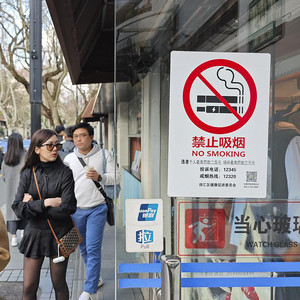
Shanghai has become a pioneering city in China to introduce standards regulating smoking in outdoor public spaces.
Could this be the start of a nationwide shift?
China aims to cut adult smoking from 24 % to 20 % by 2030, but with cigarette sales still climbing, how challenging is that goal?
Can this policy truly make an impact, or will deep -rooted smoking cultures stand in the way?
Welcome to the Chat Lounge.
I'm Thuyen. Joining the chat are Dr. Lauren Johnston, Associate Professor, China Studies Centre, University of Sydney Australia.
Dr. Pan Chung -Fei, a professor of epidemiology and population health, West China's Second University Hospital, Sichuan University and Dr. Liu Baocheng, Director, Center for International Business Ethics, University of International Business and Economics.
Thank you all for coming back to the chat.
So before we dive into Shanghai's pioneering move, let's first have a mini poll.
Do you smoke? If yes, where do you usually smoke?
If not, is smoking in outdoor spaces acceptable to you?
Shall we start with the lady.
Lauren, please. Guess you don't, right?
No, I've actually never smoked a cigarette in my entire life.
That's good. Good for you.
And I guess I prefer it when people aren't smoking, but I don't have an issue when people smoke outside because so many people like to smoke at least a high enough number that it's just sort of socially easier if they can enjoy that, but I definitely don't like it when people smoke inside.
Isn't that a kind of, you know, what they call wondering, smoking, mind boggling or annoying to you?
You don't feel that way.
Well, it's probably one of the many things people do that might annoy me.
At least smokers aren't paying taxes when they buy cigarettes.
So I guess there are worse habits, but I definitely prefer smoke free environments.
You're quite tolerant.
And what about Shofei?
Well, I don't smoke, and most of my family members don't smoke anymore.
Well, because I have medical research, smoking is not acceptable to me, even in other places, we do accept smoking in certain restricted areas.
So the others won't be affected.
Here, quite rare cases, especially given that you're from Chengdu, southwest China, which is an area where a lot of smokers accumulate.
Yeah, that's true. Smoking is quite prevalent in Sichuan and then Chengdu, I'm not a local actually.
I was only in another city in Hubei actually.
But here I do have a lot of friends or even colleagues who smoke.
But you haven't been affected by them.
Good for you too. Well, let us know at least Bag Sheng, you're a smoker.
Yes, thank you for telling me that.
We can, we can shoot that.
Actually, when I was in a teenage school, I had a great idol, which was Lu Xun who was a great writer and critic.
And I even painted his picture with the pipe or with a cigarette.
I thought it was cool.
And then I realised that our great leader Chen Meimao was a smoker and Deng Hao -ping was a big smoker.
But, uh, my indoctrination into smoking was when I was doing business.
People told me that throwing cigarettes around can really build a closer network and break the ice in negotiation.
And so, because for years I've been running business into different cities, dealing with stevedores and they are all big smokers.
That's why I maintained such a sort of bad habit so far, but I normally, I smoke in the finer areas in my home, normally on the balcony or at least to keep the window open in my study.
and then the worst thing is that people know that I'm a smoker and they continually gave me temptation and they sent me cigarettes as a gift, so that is now the current situation.
But you never thought of about quitting smoking?
No, I haven't convinced myself because I thought, you know, life even biologically is far more complex and dealing with one variable may not really help the entire health situation.
But of course I try to avoid any type of annoying nuisance to other type of people, you know, when there is a smoke -free environment I'm highly disciplined.
Everybody's their own reasons to be a smoker or a non -smoker but the city of Shanghai has decided to say no to outdoor smoking.
As the first step of Shanghai's outdoor smoking management, local government departments are teaming up to regulate Youyen, or wondering smoking, at eight scenic spots popular with the tourists, including the Bund and the Yuyan Garden Mall area.
So Shoufei, why is Shanghai targeting wondering smoking in your understanding?
Well, and I think before our discussion we just need to clarify what is wandering smoking.
So wandering smoking is kind of smoking while moving around, especially through public or open spaces such as sidewalks or streets or roads.
So in this way wandering smokers are kind of a moving source of pollution.
They can create unique challenges for sort of public health and also uh when you're smoking it's kind of causes um passive smoking and causes and significant health risks for uh non -smokers particularly those vulnerable people children pregnant women and some individuals with pre -existing health problems so it's a when they're smoking is not a personal issue it causes problems for people around you and So scientifically we understand within 10 meters, the tobacco smoking could be detected and from a smoker and such to expose our standards to harmful chemicals.
So it's not a personal issue at all.
And smoking per se was found to be causally associated with lung cancer in the 19, well, 1950s and later to other cancers, heart disease and metabolic diseases.
And then later evidence is also accumulating that plastic smoking or even wandering smoking could be linked to these major non -communicable diseases in the same way.
So because it's a major poverty issue, it causes problems to people around And that's why it's targeted by local governments but this time in Shanghai.
But in other cities where other countries, for example Australia, Japan, UK, wondering smoking is kind of prohibited in most major cities.
So it's really, it's kind of a common practice to control smoking in the population.
You're talking about Australia, so I'm asking Lauren, is such kind of smoking also a big issue in your country in Australia and is it like the more developed the country is, you know, stricter the bans would be on outdoor smoking?
I think it's maybe more common to do it in richer countries but it's definitely not something that's consistently done across countries.
I've lived in several different countries.
And when I was growing up in Australia, it was legal pretty much to smoke anywhere.
And by today, there's not a lot of public smoking, except perhaps like people sitting outside in the beer garden or something like that.
In terms of wandering smoking, I really can't remember the last time I felt impacted by it except perhaps around a bus stop perhaps or on a train station.
It's not so common I guess personally I've occasionally found it annoying not necessarily here in Australia but maybe even in Europe where there's a bit more smoking than here.
Sometimes people can be quite careless with their cigarette.
I will say that like I don't have an issue with them wandering smoking but I think there's a responsibility to take more care with their cigarette than many wandering smokers do.
So as if the cigarette sends a smoker into this sort of relaxed state and then they forget they're actually carrying this, you know, thing that actually is alight.
And it can be a risk to people's clothes or, or hair or whatever if they, you know, touch someone's skin.
And so perhaps one aspect of concern for wandering smoking now in China is just to take care of older populations who might either A be more careless with this cigarette or be less able to move out of the way of someone you know being careless with a cigarette so that's I guess that's the only aspect but I think in Europe some European countries they're quite liberal towards smoking still so I don't think it's strictly a rich country thing.
All right, Dant. I do agree with Laurene, they said smoking popularity has no correlation with the income level or development stage of different countries.
If you go to India, there are very few people who smoke or Indonesia and some African countries also, but if you go to France, I observed that old ladies, they do the wondering smoking while they are picking clothes in Lafayette, so I just feel it's really scary and it may set the clothes on fire but you know people just accept that as a normal routine.
The chat lounge. The chat lounge unpacks views and opinions on hot issues in a more casual way.
But Baojun, as a smoker, do you agree with Shanghai's you know new policy or why do you think, you know, Shanghai would become a pioneer in introducing such a policy, economic reasons.
I agree that smoking is a bad habit and it needs to be controlled and behavior needs to be re -engineered.
And Shanghai is really taking a pioneer position in targeting the wondering smoking because it may cause harm to other innocent people.
So, there's a moral bottom line here, where, you know, people can choose to suicide themselves, but you do not really, are there to kill other people.
So, that's the basic moral bottom line.
Shanghai is there to be very determined to shape itself as a global metropolis.
And they also wanted to present a great image for global investment, for attracting tourism, and boost a more health culture to improve the public health, and also reduce the smoking -related diseases, which cause far more expenses in the government culture.
But if you look around the whole country, we still have 300 million smokers, particularly in some areas where you know like Guizhou or Yunnan and they rely very heavily on the tax revenue from the operation of the tobacco industry and also they are one of the mainstream provider of employment from the planting, to processing and to the sales distribution, et cetera.
And also for the Chinese government, the tax revenue generated by tobacco sales is always ranked on the top three.
Right now, it's around 7 % of the total government fiscal revenue, so, therefore, from a financial gain side, by either central and local government, it's quite a temptation.
From what you just said, it would be a very big challenge to just introduce or expand.
Can I just say, can I… Sure, go ahead please.
Sorry, can I begin with one more point on Shanghai?
which I think I don't know the exact statistics, but Shanghai has to be one of China's most densely populated cities.
Like Beijing is a large city, but it's very spread out and has extremely wide footpaths and roads, and you know that it's very well spread out.
So if one person is smoking outside the chance that another person is impacted in Beijing is just arguably a little bit less.
Whereas Shanghai has these sort of narrower streets, you know, more people in taller buildings, smaller, kind of, you know, sexier clubs and bars.
I think it's a density issue as well.
It's just you're more at risk of people accidentally hitting you with a cigarette, but you're more at risk of breathing in their cigarette smoke just because of population density.
That's a good point.
And also, Shanghai, I think a lot of the proportion of elderly people is probably greater than that of other cities.
Maybe like you just mentioned, they have to take care of the welfare of the elderly.
But, based on what Bao Zhong just said, Dao Zhong, does that mean it would be difficult or very challenging to promote this kind of practices nationwide like a lot of netizens would want.
Well, it depends on first of the government policy directives.
Actually, you know, the tobacco into China in the mid of 17th century and before, we had no tobacco at all and Chinese people survived.
So therefore, we can completely eliminate tobacco.
But now as I said, one is that there is a past dependence both at the government level and also at the civic level because the government relies on the revenue earned by the tobacco industry.
And now if you look at Yunnan, more than 50 % of their fiscal revenue comes from tobacco tax.
So if you suddenly remove such sort of operation, then, you know, the local government could go bankrupt.
So that's the current situation.
The other is that given the Chinese culture networking and by engaging with each other, spreading cigarettes is a gesture of friendship.
So that culture is highly rooted in the business circle and even in many other sort of networking circle.
And now the other issue is that China has really implemented a lot of restrictions, but the enforcement is not there.
Even the Shanghai rule is more percussive than punitive.
So if you look at the restaurants run by so many private proprietors and they are rather lenient on regulating that, even though they put a sign on it, no smoking, but when people smoke, they do not really want to drive their gas way, because that's their income.
Therefore, how to popularize this culture and also to make the government realize that the housing expenditure on smoking is far more than the tax revenue they can earn from the tobacco industry so that they can look into a long -term trajectory in their policy directives.
So I think that's also very important.
And now particularly now in the third tier cities in the rural area, smoking is also very popular.
And also they turn more into the industrialized cigarettes, because they used to, you know, use pipes or water pipes to smoke on the raw materials, which did not really come to the fiscal counting.
But now more of these people are shifting to the industrial type of smoking.
And then so that also, you know, gives more of a tax contribution.
But another issue is that the international companies like the BET and Philip Morris, they are also pushing very hard and trying to cut corners to raise the new generation in smoking, particularly targeting young women, because women can really be more influential in social circles.
So we need a very holistic but also decisive approach to do that.
And lastly, I should say, I did a test. I sent my nephew who is only like nine years old to buy a pack of cigarettes in the shop and they do sell it because they love the money and they do not really care about the situation, the regulation because the regulation is very clear that no case, you know, can really be permitted to buy cigarettes.
In which city in Beijing?
Well, anywhere. All right, well we'll dive deeper into the solutions to this kind of dilemma later on.
But now let's focus a little bit on what's going to be practiced in Shanghai and according to the new guidelines, tourist sites, restaurants and bars must add no smoking signs in waiting areas.
Train staff will also discourage people from smoking and metro stations must install new no smoking signs outside all entrances and tighten supervision of public areas to ensure passengers obey the rules.
New rules also prohibit smoking in other outdoor areas inside venues frequented by large crowds, including schools, hospitals, and stadiums. I thought Shanghai is the first city to introduce such rules.
Actually, it's not Beijing has this kind of regulations, or I should say guidelines, 10 years ago.
But it's just like, it's been ignored by a lot of people and you can smell or find wandering smokers or outdoor smoking, basically wherever you go.
So maybe to Zhuongfei, what's your expectation for the new regulations, you know, to be implemented in Shanghai and maybe difficulties in implementation?
Well, as you mentioned, Shanghai is actually one of the four runners, kind of front runners for public health initiatives.
And as we all know, it has the highest life expectancy.
And it's actually one of the three, probably three or four cities, which formerly banned smoking in indoor and areas and smoking in certain outdoor areas.
for example, areas around schools, hospitals or parks.
So Shanghai has done pretty well actually in tobacco control.
And I think the current smoking rate in Shanghai among people aged 15 years or above is 20 % or so, it's much lower than the average rate across China.
I think the average rate is about 25 or 26%.
So it has done well so far, but it could do more actually.
So this time I think banning smoking or wandering smoking in a few selected tourist areas is kind of pilot act.
And I think it's pretty important to force the climate for smoking control across the population.
It's kind of a pilot action, but I think it can raise awareness if the harms of smoking across the populations, especially in Shanghai.
So once the public recognize the harms of wondering smoking to local or regional campaigns, we can expect that the roll outs have penalties even for wondering smoking in a wider scale.
Well, it's always a long way to go for addressing a deeply, really healthy, to like smoking, you know, we need to understand the history of tobacco control in China.
It took a long time, actually, for China to go so far.
For example, in about 20 years ago, China signed a World Health Organization Framework Convention on Tobacco Control, which is a legally abiding treaty to reduce tobacco use through legal measures.
So that was 20 years ago.
And then about 10 years ago or so, the state council in China approved the draft regulations on smoking control in public places to propose a last -in -white indoor smoking ban.
But anyhow, due to sort of conflicts of interest as mentioned by Bao Chen, you know the regulations were not formally implemented.
So in Shanghai, like in 2017 in Shanghai, the local government revised the smoking control regulations to include indoor public places and certain outdoor areas to ban smoking.
So now was eight years ago and Shanghai was still that time, kind of the front runner.
And today, when we talk about smoking, we also need to think about sort of the healthy China 2030 and goal you know in that goal was that China needs to reduce smoking rate to 20 % and you know in Shanghai the smoking rate was kind of around 20 % last year or a year earlier it's done well but it could do more in the near future because you know it's kind of a good example for smoking control for other cities like Chengdu or even Beijing to reduce smoking.
I think Shanghai has done well so far.
It can do more in the future to be a good example for other appear cities.
This has been the Chenpilaunch. When we return, we'll explore more solutions for a smoke -free China.
Stay with us! With a history of 5000 years, it's no surprise that China has created a fabulous treasury of folk tales.
Once a year, on the seventh day of the seventh month, all the Magpies fly up to heaven and form a bridge.
So many amazing worlds to discover.
I want a new palace, said King Mu of Zhou one day.
Chinese folk tales retold for audiences today.
we'll will you marry me he asked and with little hesitation she said yes five thousand years of amazing Chinese folk tales my father must not go to war someone must take his place you'll find Chinese folk tales season 3 wherever you discover your favorite podcasts interests.
Welcome back to the Chat Lounge.
We continue our discussion on smoke -free China.
Right, seems Shunfei has a lot of confidence in Shanghai.
But uh you know, I'm not so sure about Beijing like you just mentioned because according to the regulation, current regulation, violators will be fined like some 200 yuan.
That's about less than $30.
And you can also report this to the authorities.
But after you make a phone call to the authorities, the violated may have just long gone.
So it's actually quite challenging to enforce or implement such rules.
Bao Cheng, what do you think?
Do you think a higher penalty, like Zhongfei just mentioned, would be a effective way to just implement a such a new policy?
Well, for any policy, it's really a social equilibrium that really works, people are pulling the tug of war into different directions and policymakers will have to take into consideration.
Over the past two or three years, Shanghai's collection of the punitive fund It's less than half a million.
So that means that the implementation is not very satisfactory.
However, the smoking rate has dropped a great deal, not because of the penalty or not because of the tax, but rather because of the culture they're going to shift. and it seems that the public communication Shanghai has been doing is highly effective and also that more of the white collar workers are clustering together so that they form a more healthy culture.
So this is something important because peer influence is my observation and to support it by many studies is the strongest driver for smoking.
And so, therefore, to build such a sort of cultural environment and was more of the social regulation and the social climate, so all combined, it can really help to reduce the smoking rate.
And actually, Lauren, I asked the chat GPT, which country is the most successful in reducing smoking rates and the answer is Australia.
So probably we should learn from the the best students in class.
What's practice in your country, in Australia, that we can learn?
Well, having never smoked and never bought a packet of cigarettes, I'm probably not the best person, best Australian to ask.
But I have observed a lot across countries, one thing that's very, very clear in Australia that I've never seen anywhere else is really, really ugly cigarette packaging.
So if I'm not wrong, every cigarette packet has to have a very ugly health picture on it.
Like a picture of someone with suffering lung cancer or a picture of a heart of a smoker to show the sort of damage done to a person's heart when you smoke long -term or a picture of someone coughing with emphysema or some type of lung condition.
So these are really graphic images that convey to the smoker very instantaneously what they're doing, even though I remember when they were implemented, it was almost a bit of a joke because I oh, look, I've got the lung cancer cigarettes, or look, it's my heart that will be damaged from this packet of cigarettes, But, you know, these things probably had an effect even if, to prompt those around smokers to say listen, like doesn't that packet tell you what you're doing to yourself?
Why are you why are you subjecting your lungs to that image?
So I would say that's one.
And just extremely high taxes.
Cigarettes smoking is very expensive here.
It's a very expensive habit.
So, you know, people for And if people go on holidays to Vietnam or China or something, they say bring me back some cigarettes, can you bring me back some cigarettes, just because of the price differential.
So I would say price is one, very, very high taxes.
A lot of limitations on where you can smoke outside.
But I don't think that extends to wandering smoking.
And then these horrible images, just really graphic Grim Reaper type images on every cigarette packet.
And some public advertising to the same effect.
To the point where it's saying every cigarette is killing you, is the public slogan.
Right, that's a brilliant idea.
But, Xionfei, it seems ugly packaging and some ads or TV commercials or something that we like here, right?
Can we also learn or copy that kind of a solution?
Why haven't we done so yet?
Yeah, there are quite a few barriers, as mentioned by Paul -chan earlier.
And this is a very strong vested interest in the tobacco industry.
So as we understand, about 70 % of the national tax revenue was attributed to smoking.
So the tobacco industry has a strong influence in decision -making for all sorts of efforts to reduce smoking, so far, in this country.
And also, local governments, they have also kind of best an interest in the efforts to reduce smoking.
As Pao -Chan mentioned earlier, the provinces like Yunnan or Kui -Jo, These two provinces are heavily reliant on tobacco industry.
So, it's difficult to implement nationwide policies to reduce smoking, even like plain packaging for smoking.
That's difficult to implement actually, on warpacks and cigarettes.
And also we need to understand the urban or rural divide in China, probably in Shanghai or Beijing.
It's easier, much easier to strictly enforce the fines, for example.
But in rural areas or small cities, it could be super, super difficult to do so.
And also there are some sort of loopholes from e -cigarettes which are very difficult to, to regulate so far.
And the e -cigarettes are particularly being used to target the young, young people.
So they are just all sorts of barriers so far but I think the major barrier is just from the tobacco industry in China.
And it has a strong force in the regulation formulation or the enforcement of the regulations.
Yeah, but just like mentioned earlier, China, especially some big cities has done some, I can say a good job right?
Like Beijing and Shanghai.
Adult smoking rates in those cities dropped below 20 percent, which is the target of China to reach by 2030.
And nationally, the country's adult smoking rate decreased from over 26 % in 2018 to 24 % in 2020.
Then probably you can tell us what we've done right, and maybe we can build on this, and going forward, build on what's been done correctly.
That could be a solution, too, right.
Yeah, and that's true.
In the past 10 years or so, China has achieved the reductions in smoking and nationwide but particularly in these major cities like Shanghai or Beijing, and the government, one of the central and local governments do have done quite a lot.
For example, one of the major effort is the tax increase.
So for example, from between 2015 and 2023, the tax and the tobacco tax has been raised.
I think at the moment it's about 45 % to 50 % in tax for the tobacco, but it's quite still, must be load the World Health Organization recommended level.
For example, 75 % and in countries like Australia, think it's like 60 % or so.
And in Singapore the tax rate for tobacco is almost 75 % of the retail price.
So China has done quite a bit on tax increases.
And also, the country has done a lot of public health campaigns, for example, nationwide initiatives like Smoke Free China or smoke -free cities.
You know, so these happen and effective in some way.
And also, for example, celebrity endorsements have been used to denormalize smoking in the population.
And they are also efforts targeting young people and especially efforts to control flavored e -cigarettes and online sales restrictions and other efforts could be the efforts in the healthcare sector for example smoking cessation services have been you know implemented in hospitals and clinics so people can consult doctors for smoking cessation and these are just you know from the medical sector so I think these Efforts from governments and specific sectors have been used for in the past few years in reducing tobacco use, but we can do more, as we mentioned that the tax could be even raised to
a higher level. The chat lounge.
The chat lounge unpacks views and opinions on hot issues in a more casual way.
But maybe, Bao -Chun, you have a different opinion, because you said it's not about raising taxes.
It's about the change of a culture.
But can it be really changed?
It's deeply rooted in the culture, like for hundreds of years, right?
Yeah. Maybe, as a professor specialized in business ethics, we should remind those tobacco companies of business ethics more.
Well, when you talk about the tobacco company, you are, for restraining the sales, you are really talking with prostitutes on how to play catch yesterday.
But the key issue is that, the government will have to be very decisive in viewing how the tax income from tobacco industry can be offset by the health expenditures, the out the government cover and the other issue is that I know different regions they are competing with each other.
If you really raise the local tax and then more of the industries will grow into other provinces so they cannot really afford to lose the business.
For example, if Guizhou is playing a more tough policy, you now will be happier to attract more of businesses over there.
So, therefore we need a coordinated policy approach based on the basic understanding of pros and cons from the tax revenue into public health expenditure.
And then, China can be very tough if they really are decisive, like drunk driving.
So right now there are very few cases because if you really take, it's not really drunk driving, it's drinking driving.
If you really have half a bottle of beer and then you are detected and you're going to be thrown into detention centre for two weeks and your organisation will completely have every reason to fire you, et cetera.
So, immediately, we can really stop over there.
But it's really the level of determination.
But on a soft side, to increase tax it doesn't really help a great deal because China's tax rate, if you combine production tax, the value added tax and conception tax is already up to around 65%.
And where in the US it's only no more than the 50%.
So therefore, because the competition is very tough, if you really have higher tax, there you can also push forward for ground economies, for underground economies.
There are hundreds of brands with different price tags on it.
That's why I would call more on the government policy and the tougher regulation, and the other of course is public communication.
The signage is already there.
So on every cigarette box, the major conception revenues, they are already there.
But it's really the implementation.
Now they know advertising is permitted for tobacco.
You know, these companies are there to cut corners by doing sponsorship into certain or brands or certain events, and that can also disseminate their good images.
So, you know, we need really to tighten up further on the restrictions over their public promotion for this type of industry.
And then on a regional basis, or even on the organizational basis, we can really have tougher control.
Like, for example, my university can have a smoke -free campus, et cetera.
So it's really the decisive implementation that really works.
Yes, when you say that the government should be more decisive in doing this, I think the authorities, at least the central government, is quite serious because they know when they weigh in pros and cons.
There are quite specific numbers.
You know, in 2018 the total economic burden of tobacco related diseases in China was over 1 ,500 billion yuan.
That's over $200 billion US, which is equivalent to 1 .7 % of GDP.
And while tobacco tax revenue in the same year was worth $165 billion US.
dollars. So the tax revenue was over 20 percent less than the loss caused by tobacco.
So it's a very, you know, effective economic lesson for the country.
I think China is serious about tobacco control.
But for now, a lot of, you know, guidelines like what we've just heard the Shanghai introduce this guidelines and that kind of regulations, they're not necessarily laws or maybe when it comes to implementation, the action could be very loose.
So is it necessary for the country to stipulate or introduce some acts or laws regulating this with much harsher punishment?
Would that be – Let me give you a very, very vivid example.
Along my street you see there are four – well, six restaurants, three pharmacies and four tobacco shops.
So you see that the distribution network is so pervasive in every household and every community.
So therefore it gives people the convenience and they also do some promotion and this is not really regulated.
And where the entire production And tax contribution is highly monopolized.
So this is really a very ambivalent situation.
So we need really streamline the entire ecosystem and also entire supply chain so that it can really serve over the same track, over the same trajectory to promote the restriction.
Indeed. That's a big project.
But for now, maybe, yeah, Lauren, you just said that you're not a smoker.
Maybe you haven't paid much attention on this, but from your observation in Australia, what kind of practices China may borrow from Australia, with regard to what Baoqian just mentioned, forming a whole systematic chain in doing this?
Yeah I think in terms of the whole systematic chain I think Australia never grew much tobacco it might have grown some but not much so it didn't have the same industry challenges that China has from places like Yunnan and Guizhou so I guess part of China's strategy would need to be to work on alternative of industries or sources of fiscal revenue for those provinces as part of the whole package.
Indeed, but that's not easy.
The package in terms of consumption and there was a lot of public advertising.
There still is a little bit, but nothing like there was.
Like, this was also, the changes really took place before people got lost in mobile phones in their own sort of space.
And so it was on mainstream TV and these advertising.
I mean, it was said by one of the speakers earlier that it might be hard to put these images onto Chinese cigarette packets the way they are in Australia.
And they can be really, really graphic.
So perhaps, I mean, there might, I mean, I don't know if that can, But perhaps even as China swaps to digital currency payments, you know, perhaps they can cut out even, you know, like you can extend provisions to people on government support, pensioners, and so on.
And you could just, you know, really keep to a minimum the amount of a central bank digital currency transfer that even could be spent on cigarettes.
you could almost reduce consumption by diminishing the amount of money people can spend on that.
But in terms of learning from here, maybe China needs to learn more from Europe just because Europe perhaps has a more similar history and cultural kind of depth.
I wonder if there's more to learn from those contexts, even then Australia.
Australia sort of clamped down on it.
And I guess Australia promotes a healthy sort of outdoor sporty, you know, outdoor health consciousness, which also helps.
But yeah, I'm not quite sure exactly what China can learn, except to make cigarettes really expensive, and to really emphasize the cost that one brings to themselves.
Like it's about, well, you know, you're free to smoke, but this is actually what you're doing to your heart, this is what you're doing to your lung, this is a picture of somebody dying from lung cancer, like if that's the destiny you want for yourself, this is how it looks.
Right, Bo - shouldn't, did you hear that?
Yeah. I think they, yes, actually all these signs are there and the warning sign on every pack of cigarette, but that's more of a soft prescription.
I think it is a safe transformation could be that more of the companies can really think of developing a kind of route of doing business.
I think Starbucks has done one of our example, which can really produce a certain inspiration is that go to Burma and tell those people who grow not only tobacco, but rather grow the marijuana, that, okay, if you guys shift to growing coffee, then I pay you upfront money and you get even more than growing the drug materials.
So therefore they have been rather successful.
example, if we devise ways to strategize for the industries that are heavily reliant on the tobacco growth and also tobacco manufacture and shifting Yunnan and Guido into growing more of the coffee, more of the cash crops so that people can really reap more economic benefit by shifting into other healthy products, that could be a more decisive way that which pause on the big companies and also these social entrepreneurship.
So really to think about that to help to mitigate the situation because right now you know these provinces they suffer a great deal in the revenue income from real estate development and now they need certain other type of lines to be able to give them quite a momentum in diverting from the excessive reliance on the tobacco business.
It sounds very smart and feasible.
And last but not least to Xiong -fei, as a health expert, from your perspective, I know you've lived in a lot of countries, the States, and the U .K., and Australia.
Apart from raising tax on tobacco businesses, what else would you recommend to improve the situation?
Well, I mean, tobacco control is kind of one of the most successful public health initiatives around the world.
So, you know, globally, especially in those developed countries, pretty good efforts have been done to reduce the smoking rate drastically.
So this is actually a, that's why the World Health Organization recommends these countries is to use legal instruments, for example, use regulations or local laws to enforce the heavier taxes for smoking.
But besides taxes, I should say, particles education campaigns through war channels could be very useful.
I mean to create a sort of an environment And everybody knows smoking is bad.
Everybody knows smoking does not affect themselves but also affects the others around them.
So it takes a long time to see the new effects as you know, education or promotion campaigns.
But obviously living heavy taxes have been recognized It's most useful instrument to reduce smoking so far.
And for some other modifiable risk factors, for example drinking, risky drinking, or physical inactivity, for these risk factors, I was so advised to use some sort of legal measures to reduce the potential risks.
So, so far, it's difficult to find some other more useful or more effective alternatives to reduce smoking in the population.
After war, it's not a smoking state, it's deeply rooted in all cultures, not only in Chinese culture.
is also faced with strong barriers or strong forces from the tobacco industries.
So there's no other better ways to reduce smoking rates and accept living heavy taxes.
That wraps up our chat for this session.
Many thanks to Dr. Peng Xiongfei, Professor of Epidemiology and Population Health, West China Second University Hospital Sichuan University, Dr. Liu Baoqiang, the Director of the Center for International Business Ethics, University of International Business and Economics, and Dr. Lauren Johnston, Associate Professor, China Studies Center, University of Sydney, Australia for your time and enlightening insights and suggestions.
The show is available on all major podcast platforms. Please email us your comments at radio at CGTN dot -com.
I'm to you Thank you for listening.
Join us again next week for more chat at the chat lounge.
Goodbye. I Cannot marry you while your mother regards stepping to the world of timeless elegance with mrs. Spring fragrance a A captivating audiobook by Edith Eaton read by Manliang.
Experience the lively yet complex lives in Chinese -American communities at the turn of the 20th century as Edith Eaton's delicate prose weaves together themes of tradition, change, love, and identity.
forget all that belongs to the joy of life!
Follow the journey of Mrs. Spring fragrance and witness the struggles and fights of those living on a rapidly changing exotic land while holding on to their cultural traditions or more importantly to their identities!
You could hardly believe that his daughter was seriously opposed to becoming the wife of a such a good -looking prosperous young merchant as well enjoy books and beyond for mrs. spring fragrance let the stories come to life in your imagination subscribe to books and beyond for free on your favorite podcast platforms or log on to radio .cg T and calm for more sideline story brings you all things sports related the hottest topics latest events, juiciest stories, all with a very personal take.
Subscribe to SideLine Story podcast for heated sports discussions covering events that are happening in China and around the world.