Squiz Kids acknowledges the traditional owners of the lands on which we podcast, the Turrbal and Combermeri people.
This is a Squiz Kids podcast. Your fresh take on what's happening in the world around you.
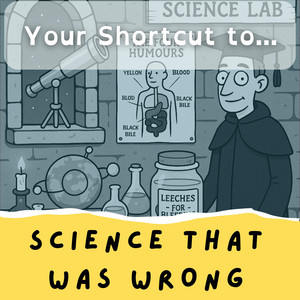
We believe the earth was flat. We thought illness came from too much phlegm and black bile.
And we were sure that heavier things fell faster than lighter ones.
This is your Squiz Kids shortcut to science that was wrong.
The podcast where we dive into the who, what, where, when, why and how of the big news story.
I'm Christy Kijerino. And I'm Bryce Corley.
Um, Bryce, why are there empty cereal boxes, fidget spinners and half a dozen coat hangers all wired together on your desk?
Don't touch it, Christy, because you are looking at the world's very first perpetual motion machine.
Once it starts moving, it will never stop.
Unlimited energy. I'm thinking Nobel Prize, maybe my own museum.
Right, except... You know, physics says perpetual motion machines are impossible.
Well, yeah, with what we know now. But that's the great thing about science, Christy.
It's based on evidence. And evidence can change. once people thought that the earth was the center of the universe or that sickness came from bad smells and unbalanced bile now we've got wi-fi and flying robots so maybe one day my invention will work just imagine yeah now that's a shortcut i can get behind today we're unwrapping what science used to get wrong how science learns from its mistakes and why being wrong is actually one of the best things about science so Grab your lab coat and your magnifying glass and let's get started.
Listen carefully, there's a squiz at the end. what bryce before we had microscopes telescopes and supercomputers people used the best tools that they had their eyes and their imagination which led to some very creative ideas about how the world worked yeah that's right like thinking that the sun went around the earth instead of the other way around i mean it does look like it moves across the sky i guess yeah and that idea stuck around for a really long time especially because the Catholic Church supported it.
But then along came Galileo with his telescope.
He noticed planets and moons doing things that they shouldn't if the Earth was the centre.
He said, hang on, it's us going around the sun.
And, of course, the church said, you are grounded for life.
No, really. Galileo was found guilty of what was called heresy and he spent the rest of his life under house arrest.
Just... For daring to tell the truth. And it wasn't the only idea we eventually tossed out.
People also believed in what they called the four humours.
What? There were four liquids inside your body called blood, yellow bile, black bile and phlegm.
Yeah. And if you were sick, they'd try to balance them out. sometimes by bleeding you.
Yikes! Doctor, I have a sore throat. Let's just drain a litre of blood and see what happens.
And then there was spontaneous generation.
That's the belief that living creatures like maggots just appeared from rotting meat.
Until scientists like Francesco Redi sealed meat in jars and proved that maggots only appeared when flies could lay their eggs.
So it turns out that maggots don't magically appear and that my perpetual motion machine... probably won't start spinning by itself either.
It's unlikely, Bryce. But these outdated ideas show us something important.
People believed them because they didn't have better evidence yet.
And when new tools and new minds came along, those old ideas were replaced.
Okay, so how did science figure out that it had been wrong?
And how do we make sure the new ideas are actually right?
How? So, if science has been wrong before, how do we know that we can trust it now?
Yeah, if scientists once thought the Earth was flat and that leeches were a good form of medicine, what if they're wrong again now?
It's a really fair question, Bryce. But here's the thing.
Science isn't about guessing or making stuff up.
It's about asking questions, collecting evidence and testing ideas.
Right. and when we get new evidence we don't just ignore it we update our thinking and that's what makes science strong so it's kind of like your teacher marking a maths problem and then saying oops that answer's not right let's try again you wouldn't want them to keep getting the wrong answer just to look smart exactly would you rather science stubbornly stick to the old wrong ideas Or to admit a mistake and get closer to the truth.
Yeah, like if we never updated science, we'd still be afraid of going over the edge of the earth on a ship.
Or we might think that mosquitoes were born out of swamp mud.
And instead, we have something called the scientific method.
It's a step-by-step way of figuring things out.
First you make an observation, then you ask a question, form a hypothesis, that's just a fancy word for an idea that's testable, you run experiments and collect results, and then you share your findings with others so they can check your work.
Which is why Galileo dropped two objects of different weights from the Leaning Tower of Pisa in Italy to test if heavy things really did fall faster than light things.
And they didn't. They hit the ground at the same time.
Yep. So that old belief, whoop, out the window.
And the same goes for atoms. The word atom, A-T-O-M, actually means uncuttable in Greek because people thought that they were the tiniest things in the universe.
Now we know that atoms have electrons, protons, neutrons and even smaller particles inside them.
And that whole, we only use 10% of our brain idea, totally false.
What? Brain scans show that we use all of our brain, just not all at once.
Which is good to know. I was starting to think I had a super lazy brain.
So science doesn't always get it right the first time, but it does have a way of learning from its mistakes, which might sound like a problem, but it's actually one of science's greatest strengths.
Hmm, I think... I get it. But I need a bit more of an explanation.
So tell me, Christy, why is admitting to being wrong the smartest move that science can make?
Why? So far, we've looked at some pretty wild scientific ideas that turned out to be wrong, like maggots appearing from mead or the Earth being the centre of the universe.
Mm-hmm. And we've seen how science improves when it tests questions and admits when it made a mistake.
But what happens when someone doesn't admit they're wrong?
Oh, that's when things can go wrong. Take the myth that vaccines cause autism.
Way back in 1998, a British doctor published a study claiming that there was a link between a vaccine called the MMR vaccine, that's measles, mumps and rubella, and autism.
And that study scared a lot of people. Yeah, and lots of people stopped vaccinating their kids, right?
Yep, and that led to outbreaks of diseases that had almost disappeared.
But here's the thing. Other scientists tried to repeat the experiment and they couldn't.
Investigations found the doctor had used only 12 children, which is a really small sample size, changed medical records and didn't follow proper research rules.
Ugh. So that study was actually removed from the scientific journal and that doctor lost his license to practice medicine.
So the system did catch the mistake, but not before it had caused a lot of damage.
Exactly. And that's why science has something called peer review, which means that other scientists check your work before it's shared with the world.
They look at your evidence, test your ideas and try to make sure that it's accurate.
It doesn't always catch every problem straight away, but it helps make science much more trustworthy.
So being wrong isn't the problem. It's pretending you're right when you're not.
That's where things get dangerous. That's the thing about science.
It doesn't pretend to have all the answers.
But it does give us the best explanations we've got so far.
And it keeps asking questions to get even closer to the truth.
Which is kind of brilliant, because if science never changed its mind, we'd still be using leeches to fix up a common cold, and we'd be thinking that the Earth was the centre of the universe.
That's right. And this National Science Week is the perfect time to celebrate that curiosity, to ask some questions, to explore new ideas and to remember that being wrong is just the first step to getting things right.
So the big lesson from today's podcast, don't be afraid to make mistakes as long as you learn from them, because that's not just science, that's smart.
Time for the quiz. This is the part of the podcast where you get to test how well you've been listening.
Question number one. Which one of these fluids was not, repeat, not one of the four humours people believed controlled health?
A. Blood. B. Phlegm. C. Stomach acid. Or D. Black bile.
Bit of a tricky one that one, wasn't it?
The answer is C, stomach acid. Oh, that was a tricky one.
Question number two, true or false? Galileo was rewarded with a medal for discovering that the sun is at the centre of the solar system.
That is actually false. He was put under house arrest instead.
Poor Galileo. Question number three, what is peer review?
Is it A, your friend checking your homework?
B, scientists checking each other's work before it's published, or C, a type of science exam?
The answer is B, scientists checking each other's work before it's published.
That's all we have time for today. Thanks for joining us as we explored the who, what, where, when, why and how of science that was wrong.
Now get out there and have a most excellent day.
Over and out.