This video is sponsored by Craftsy.
In the early 1500s, two of the greatest artists of all time were working just a few rooms apart in the Vatican.
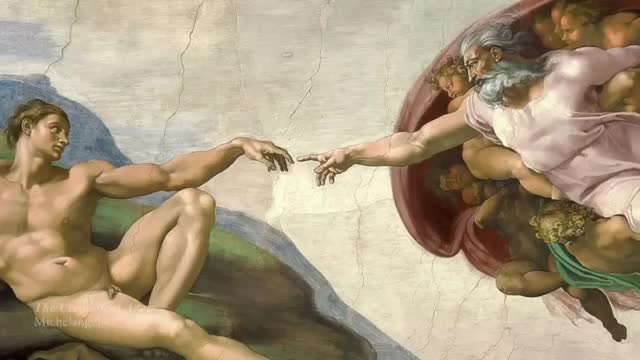
Michelangelo was painting the ceiling of the Sistine Chapel.
At the same time, Raphael was working on a painting in the Pope's private library, the School of Athens.
Both are considered masterpieces of the Renaissance.
Michelangelo's work set out to reveal divine truth through the human form, while Raphael's work celebrates human intellect and classical heritage, two defining ideas of the Renaissance.
Michelangelo, a brooding difficult loner, paints figures charged with emotion and tension, figures who often struggle alone and who are deeply introspective.
By contrast, Raphael was sociable, charming and widely adored, and his work is balanced, serene and idealised.
His figures are elegant calm, engaged and intellectually poised, the sort of company the artist surrounded himself with in real life.
Both artists shared a sense of theatre and the School of Athens is certainly a theatrical painting.
It is clearly a stage set with a proscenium arch, props, costumes and a cast of characters.
And as we shall see, it is a painting where everyone is playing a role.
One day, so the legend goes, when Michelangelo was away from Rome, Raphael sneaked in to see the as yet unfinished ceiling, and what he saw astonished him.
He promptly returned to his own painting, the School of Athens, which was more or less finished, and made a last-minute change.
He added a portrait of Michelangelo, his colleague and rival.
Not as himself though, but as the ancient Greek philosopher Heraclitus, also known as the Weeping Philosopher.
It could be seen as the ultimate tribute, but it was so much more.
Raphael died tragically young, at just 37, and yet what he left behind is nothing short of extraordinary.
In a career spanning just 20 years.
The Vatican Commission was the beginning of the most important phase of his short but remarkable career.
Three giants of the High Renaissance were all active around the same time.
Michelangelo, Raphael and Leonardo da Vinci.
Each was trying to outdo the other.
While, at the same time, the popes were trying to outdo their predecessors with extravagant commissions.
Pope Julius II, who commissioned the Raphael frescoes as well as the Sistine Chapel, despised his predecessor, Alexander VI, and artistic commissions were a way for him to stamp his mark.
Together, artists and patrons pushed Renaissance art to exceptional heights.
In the Vatican, Raphael was just meters away from Michelangelo, who he greatly admired.
But the feeling was not mutual.
Michelangelo saw Raphael as a threat and had accused him of stealing ideas.
Before this period, artists were often anonymous craftsmen.
Then they began to be recognized as individual geniuses, when patrons like the Medici helped elevate their social standing.
They weren't celebrities as such, but some, like Raphael and Michelangelo, were widely known, admired and even mythologized in their own lifetimes.
In the School of Athens, Raphael places artists amongst the great thinkers of the world.
By showing Michelangelo, Leonardo da Vinci, Donato Bramante and himself among the giants of history, he is elevating the role of the artist to that of philosopher, intellectual and visionary.
This is the beginning of the artist as a personality and a public figure.
In 1508, a 25-year-old Raphael was summoned to the Vatican by Pope Julius II to decorate a suite of rooms in the Pope's private apartments.
For the ambitious young painter, it was the opportunity of a lifetime.
The first room that Raphael tackled was the Stanza della Segnatura, or the Room of the Signature.
At the time of the commission, it was the Pope's private library.
This is precisely the period when the philosophers, mathematicians and scientists who had been forgotten about for centuries were being rediscovered and their texts translated.
The rebirth of ideas or what we now call the Renaissance.
There was even a belief in Rome that you could trace the development of philosophical thought from Zoroaster in the 6th century BCE to Christian thinking.
And that is what Raphael was hired to illustrate.
His concept for the room was ambitious.
He wanted to represent the totality of human knowledge in four branches.
Theology, philosophy, poetry and law.
The idea was that Pope Julius would place his collection of theology books under the theology fresco, his philosophy books under the philosophy fresco, and so on.
The walls are designed to be conversations between opposites, a humanist synthesis of classical and Christian traditions, and to emphasize their complementary roles in the pursuit of ultimate truth.
In Raphael's decorative scheme.
Law faces poetry and philosophy.
What we now call the school of Athens faces theology.
The open sky to the outside world is one way in which Raphael links all the four walls.
Theology, or the study of the divine, is centered entirely on the Eucharist and the concept of transubstantiation, the belief that during Mass, the bread and wine become the actual body and blood of Christ.
Figures in the fresco include God, the Father, Jesus Christ and the Holy Spirit, amongst church figures like Aquinas, Augustine and Pope Gregory the Great, who laid the groundwork for this core Catholic belief.
The painting is a clear-cut piece of theological propaganda.
Whilst only feet away, on the opposite wall, the School of Athens represents philosophy and features pagan philosophers, which seems an unusual choice at first pagans in the Holy Father's library.
But the prominent placement of figures of humanist classical teaching like Plato and Aristotle opposite Christian figures of prophets and saints reveals a great deal about the intellectual and spiritual climate of the High Renaissance, especially under Pope Julius II.
Their placement on opposite walls reflects the humanist view that classical wisdom could coexist with Christian doctrine.
The Church, particularly during the Renaissance, was on a mission to absorb and elevate the wisdom of antiquity by positioning ancient philosophers as precursors to Christian truth.
This is why the School of Athens has become known as the embodiment of the Renaissance.
In Raphael's paintings, faith and reason, scripture and science, revelation and inquiry are not enemies but partners in the search for truth.
And we should look at it as a powerful visual testament to the intellectual and spiritual confidence of the time.
To emphasize the theme of each wall, Raphael has painted an allegorical medallion above each fresco, helping viewers interpret the more complex wall frescoes below.
This figure is holding a book labeled knowledge of causes and represents philosophy.
This graceful figure in flowing robes is holding a lyre which links her to Apollo, so she represents poetry.
This woman, holding scales and a sword, is justice, representing law.
And this woman, holding a book inscribed with knowledge of divine things, represents theology.
Raphael clearly looked to Michelangelo's ceiling for inspiration for the allegorical figures.
After completing the disputa, the theology fresco, he turned to the most famous of his four frescoes decorating the Stanza della Signatura the school of Athens on the opposite wall.
We are incredibly lucky that his full-scale preparatory drawing or cartoon has survived from this period, which tells us so much about the work that would become one of the most celebrated paintings in Western art.
Raphael was not just a painter.
He was also a stage designer, printer, architect, poet, tapestry designer and intellectual.
And many of these skills would filter down into the school of Athens.
The young artist brilliantly transforms what could have been a static parade of historical figures from several eras into something full of movement dynamism, clarity and subtle drama.
Using thoughtful composition, carefully placed gestures and dynamic groupings, he helps us make sense of what might otherwise feel like a long list of names from a philosophy textbook.
The stage is set by the clever use of the architecture of the room itself.
Raphael uses a series of Roman arcs and circles which frame the action within the architecture of the room.
Then he repeats the shape in receding forms through the coffered-barreled vault ceiling, creating depth.
He has placed his ancient philosophers not in Greece, but in a grand Roman interior reminiscent of the Basilica of Maxentius, which Raphael was very familiar with.
Some believe the architecture is based on early plans for the new St.
Peter's Basilica, no longer existing, drawn up by Raphael's friend and mentor, Donato Bramante, who features in the School of Athens as Euclid.
It was Bramante who recommended Raphael to Pope Julius II.
The question is whether Raphael is deliberately Romanizing the space to connect the ancient Greek philosophers to Rome, or whether he simply didn't know about Greek architecture.
Either way, the architecture isn't just a backdrop.
It is there to connect the intellectual and artistic achievements of classical antiquity to the Renaissance.
Raphael leads our eyes up to the grand proscenium arch, using single-point perspective to focus our gaze on the central figures of Plato and Aristotle, who anchor the composition, while the rest of the painting radiates outwards from them, visually and thematically.
The painting is divided into two halves of almost equal number of characters.
The left represents the philosophy of the ideal, the belief that ultimate reality is found not in the physical world, embodied by Plato.
And the right represents empiricism and the study of the natural world, science and reason embodied by Aristotle.
Even the ancient gods set into the architecture as statues reinforce this duality.
On the left is Apollo, the god of poetry and music, who is linked to hearing a sense connected to abstract ideas, harmony and the ideal.
On the right is Athena, the goddess of wisdom, who is linked to vision, the sense most tied to evidence, reason and the physical world.
So the sensory divide mirrors the philosophical one hearing for the ideal vision, for the empirical.
Raphael even sneaks in a self-portrait on the right-hand side, the side of vision, the voice of evidence-based thinking.
In this film I want to do something different.
We will look at the full cast of characters, but then I want to pay special attention to the figure of Heraclitus.
The figures are mainly in groups, with a couple of exceptions and mostly Greek philosophers, but not exclusively.
They are standing sitting discussing, listening and taking notes, creating a real sense of movement and energy and, most importantly, cooperation.
Plato and his student Aristotle, two of the most influential thinkers in Western philosophy, take center stage.
Each of them has played a major role in shaping Western thought, and their distinct philosophical ideas were integrated into Christian doctrine in different ways.
Plato holding his book.
The Timaeus believed that true knowledge comes from above, from the metaphysical world, and he gestures upwards towards the heavens.
Aristotle, who holds his ethics, was grounded in the empirical world, that which can be observed, categorized and reasoned through in daily human experience.
And he extends his hand outward, palm facing down towards the earth.
Those simple gestures captured something essential about these two philosophers, but also reveal something of Raphael's own time.
Plato is portrayed using the likeness of Leonardo da Vinci, who Raphael had studied and almost certainly knew.
Here it's a visual argument that Leonardo, like Plato, sought eternal truths, unified disciplines and elevated human thought, making him the perfect embodiment of the Platonic ideal.
Raphael then arranges the other philosophers to align loosely with this abstract versus practical divide.
To the left of Plato we can see Socrates, who is shown mid-discussion embodying the Socratic method, a form of cooperative argumentation through questioning and logical reasoning.
In the foreground writing sits the mathematician Pythagoras, surrounded by students writing his philosophy based on the harmonic proportions of music.
Pythagoras' presence on the left side, beneath Apollo, the god of music, reinforces the connection between mathematics and the harmony of sound.
Just above Pythagoras is a figure in a white cloak with a hand on their chest.
It is thought to be a portrait of the Pope's nephew.
His feminine features reflect the revived classical Greek ideals, where youthful men often had androgynous features.
Some suggest it is Hypatia, the greatest mathematician and astronomer of her time, during the late Roman Empire, and the only woman in a room full of men.
Like many in Raphael's painting, identities can be ambiguous and shift as time passes.
Rafael also includes Islamic scholarship in his grand tableau.
A figure in a turban is thought to be Averroes, the influential Spanish-Arabian philosopher who also contributed to early music theory.
Moving over to the right side of the painting, we move from the ideal to the empirical, from the world of theory to the world of evidence and observation.
In the right foreground, we see another contemporary figure, Bramante, playing the part of Euclid.
He is pictured opposite Pythagoras the Idealist and, by contrast, represents mathematics as a practical, rational tool for understanding space and structure.
In other words, observation, logic and method over mysticism.
He is explaining geometry to his pupils, showing us the stages of understanding.
One leans forward reading, another turns to his companion as he grasps the concept.
The one above is already thinking about how to apply his newfound knowledge.
Comprehension grows as we move around the group.
Raphael reinforces the theme of pedagogy, teaching and learning.
Both Euclid and Pythagoras are surrounded by students, showing how important knowledge and learning were to Raphael and the intellectual climate of the Vatican.
The man with his back turned, holding a globe, is thought to be Ptolemy, the astronomer, mathematician and geographer.
While the figure holding a celestial globe is likely to be Zoroaster, the Iranian prophet associated with astrology and cosmology.
Raphael's overarching message is that truth is a shared human endeavor, not confined to geography, religion or even philosophical schools.
And there, amongst Ptolemy and Zoroaster, the very cream of intellectual thought, is Raphael himself, whose placement here may signal the artist's role as a modern synthesizer of cosmic and earthly knowledge.
And just below Aristotle, we see the first of our two lone figures Diogenes the Cynic, the outsider, who often insulted or ignored other philosophers, especially Plato, who he mocked for being too abstract.
Raphael places him right on the steps beneath Plato and Aristotle, symbolizing how challengers and critics are part of philosophy's legacy.
But now, let's focus on the other lone figure.
The figure is Heraclitus of Ephesus, also known as the Weeping Philosopher, one who retired to the mountains to contemplate the cosmos apart from society.
Like Diogenes, Raphael has him alone absorbed in thought and brooding, as he leans on a block of marble.
He is not classically dressed like the others, but more like a stonecutter or sculptor, and his heavy limbs and worn dogskin boots identify him unmistakably as Michelangelo.
The figure's muscular form is stylistically distinct from the rest of the fresco, more Michelangelo-esque, and it is suggested that, once again, Raphael was inspired by his secret visit to the Sistine Chapel.
The two artists were contemporaries but radically different people, opposites even.
Michelangelo was not welcoming to the new boy wonder.
After all, it wasn't so long ago that he too was the hot new artist in Rome.
Despite this, Raphael deeply admired Michelangelo's art and I think he included him as Heraclitus in the School of Athens, first as a tribute to his philosophical and artistic stature and secondly to encapsulate larger ideas.
If we look at the preparatory drawing... it clearly shows the composition without the figure.
Raphael never intended to have a figure there and in fact, the entire painting was already finished when he saw the Sistine Chapel ceiling.
He then went back to his work and made a dramatic last-minute change.
Because of the fresco technique, as explained in other videos on this channel, this is not an easy task.
It involved scraping back the image, adding fresh new plaster and painting on top of dried paint.
It is extremely hard to match up the two different areas.
The inclusion of Michelangelo as Heraclitus is so perfect and so central to Renaissance thinking that it is surprising it was a last-minute decision.
It is as if Raphael's viewing of the Sistine Chapel ceiling brought on a Eureka moment.
Heraclitus was important in the Renaissance because his ideas aligned closely with the intellectual and artistic values of the period, particularly his emphasis on change and the unity of opposites, at a time when Renaissance artists, scientists and philosophers were rethinking the very nature of reality, perception and truth.
Heraclitus' most famous idea that everything flows, stated that reality is not fixed, but is in constant motion and transformation.
And this view perfectly aligned with the Renaissance's radical break from medieval scholasticism, which had emphasized stability and eternal truths.
The world, Heraclitus suggested, is constantly changing, and so are we.
Even his inkwell, balanced precariously on the edge of the marble block, hints at mutability and movement the flow of ink alluding to the flow of water, of thought, of time.
Science during the Renaissance was beginning to observe and describe a dynamic universe, and Heraclitus' ideas suddenly felt modern and relevant.
It gave the Renaissance thinkers a language for embracing change, paradox and creative insight, all central to the era's rebirth of art, science and human thought.
The idea of the unity of opposites is integral to this thinking.
And Heraclitus saw opposites as interconnected and necessary, not contradictory, essential for the existence of each other.
For example, hot cannot be understood without cold.
Likewise, light cannot be understood without darkness.
The unity of these opposites is what defines reality.
Raphael places Heraclitus on the left of the painting.
His ideas sit better on this platonic side, the world of ideas.
But visually he looks like he should be on the right.
His flat marble slab echoing the horizontal nature of Aristotle's book and Euclid's slate and his heavy boots seem grounded in reality.
And so Michelangelo, as Heraclitus becomes the unity of opposites, a bridge between the two sides and a reminder.
The truth also comes from doubt, solitude and shadow.
By including Michelangelo as Heraclitus, Raphael has perfectly encapsulated and unified the most important core ideas of Renaissance thinking.
It is a celebration of personal identity and intellectual originality.
If the school of Athens is the embodiment of the Renaissance, then Heraclitus is its anchor.
Raphael reminded us that opposites are not necessarily contradictions, but parts of a unified whole.
He draws connections between old and new, the ideal and the worldly, between theology and science, and rivalry and kinship.
That perhaps is the true legacy of the School of Athens.
It's not just a celebration of knowledge, but an invitation to live with and even enjoy complexity and nuance, to recognize that difference need not mean division.
And now for a short ad.
So many of you who follow my channel are creatives, and Craftsy is a great online source for all levels of creativity.
They have drawing and painting classes, which are superb, and I've been following for a while, but I've also been trying out new courses.
I haven't tried them all, as there are over 2000 classes in over 20 different categories, but the ones I have have helped me immensely to release new areas of creativity.
It's an outlet for our imagination, a place to do and create.
And, like my YouTube channel, it's an artistic community inviting us to learn something new and exciting, to be inspired.
This is where we can learn directly by taking part in classes taught by experienced, award-winning instructors who share their professional techniques that take our skills to the next level.
They also have a great deal right now for my subscribers, where the first 1000 of you to click the link in the video description below will get a full year of premium membership to Craftsy for only 149.
This offer is valid for new members only.
Thank you.