Grownups, Wondery Plus subscribers can listen to Wow in the World early and ad-free right now.
Join Wondery Plus in the Wondery app or Wondery Kids Plus on Apple Podcasts.
Hey, Wowzer fans, Mindy here.
And before we start the show, I gotta let you know that this November, with a special new episode featuring our friends at Circle Round and Terrestrials on Radiolab for Kids,
And don't miss when Elmo from Sesame Street stops by Wow in the World to make us all belly laugh on November 24th.
Oh, but that's not all, Reg.
On December 1st, we are sharing our 250th episode of Wow in the World with all of you.
We think this one is going to be music to your ears.
Literally.
Did I mention it's a musical?
And if you're a member of the World Organization of Wowzers...
Oh boy, do I have a surprise for you.
You can listen to our 250th episode early with me and other members from around the world on Saturday, November 22nd, at 7 pm.
Eastern.
That's right, we are throwing another listening party.
Join us as we dance along to our new songs.
React to the episode with other members in the chat and more.
Grownups.
If you want your wowzer to join this members-only listening party, you can sign up to become a member today at Tinkercastcom.
Slash wow.
Already a member?
Well, you can find the link and password to join the event when you sign in at Tinkercastcom.
Slash wow.
That's it.
It's going to be a November to remember.
But for now, let's get on with the show.
Woo!
Okay, let's see here.
Hot quinoa, check.
Salted seaweed, check.
Kale chips, mmm, check.
Now, just to shake this all up.
And there we go, the snack mix for my movie marathon snack-tacular special.
Ooh.
Coming!
Good morning, Guy Raz.
Good morning?
Mindy, it's 5 o'clock in the afternoon.
Yeah, but I only got up like five minutes ago, so... Still bright and early for me.
Oh, right.
Anywho, I brought over a few snacks for the movie marathon.
Thought they might give us a little energy boost that we need to get through the next few hours.
Back her up, boys!
What in the...
Dennis, stop!
And... Dump.
Dump.
Whoa!
All right, let's get out.
Perfect.
Bye-bye.
Mindy, what is all this stuff?
Pop rocks?
This is popping candy broccoli?
Well, you're always going on and on on about healthy eating habits, so I thought I'd shake up my snack habits a bit.
Mindy, this isn't what I meant when I said healthy eating habits.
Have you got anything that's actually made of real food here?
I mean, look at this stuff.
Isn't it beautiful, Guy Raz?
Fish oil sherbet?
What is this?
Um, just a snack-tacular source of omega-3s.
Oh, you making popcorn over here?
Well, actually, quinoa puffs.
Ah, quinoa?
Well, it's got some kale mixed in.
Yeah, I think I'll stick with my fish oil sherbert.
Okay, suit yourself.
So, did you decide on what movie we're going to watch tonight?
Oh, yeah.
I've got the trailer queued up here.
Check it out.
No one knows where they came from.
Oh, honey, you look tired.
No one knows how it happened.
Mom, my portable game device is out of batteries.
I need batteries.
And no one will survive the curse.
Of the mom bees.
Brains.
Mom, you're scaring me.
Brains.
What about my brain?
Use your brains.
What?
Where are your brains?
I don't know.
Well, where did you leave them last?
I don't know.
I don't know.
From the director that brought you Who Moved Dad's Tools and the 50-Foot Sister comes.
Is that what you're wearing?
With extra raisins!
Raisins are good for you.
It's the invasion of the mom bees.
I'll treat you like an adult when you start acting like one.
Looks pretty great, huh?
I don't know, Guy Raz.
I mean, I love a good zombie movie, but are you sure you're going to be able to handle this?
Well, what do you mean?
Well, the last time we watched a scary movie, you had nightmares for a week.
No, no, don't go into the fire station.
No, stay away from me, Robo Rescue Dog.
No.
Nah, I'm sure I'll be okay.
All right.
Well, park your keister, meester, and let's get this party started.
Well, we can't start just yet.
Why not?
Reggie isn't here yet, and... Oh, that's my phone.
Let's see.
A text from Reggie.
Oh, what's it say?
Running late.
Traffic on the polar jet stream is...
Finger wave?
What?
Let me see that.
Oh, Guy Raz, that finger person wave is the emoji for cuckoo.
He's saying that the traffic is crazy.
Well, whatever it is, looks like Reggie's going to be late.
Oh, man.
Don't worry, man.
It's going to be so worth it.
I've been waiting to see this movie ever.
Ever since I started reading about another kind of invasion.
Another kind of invasion?
Are you talking about the invasion of the killer cucumbers?
No, Mindy, I... Or that other movie, The Grandma from Outer Space?
No, Mindy, I'm not talking about a movie.
Oh.
I'm talking about a wide-scale invasion that's happening in nature, right now, right here in the United States.
What is it, Kale?
Is it those frozen yogurt shops, Guy Raz?
They are everywhere.
No, actually, it's none of those things.
Then what is it?
Mindy, I'm talking about invasive species.
Invasive species?
That's right.
What exactly is an invasive species?
Well, I think I have a... Because it sounds like an alien sci-fi movie.
I think I have a book on this topic.
Let me see.
Ah, here it is.
Biodiversity, the interconnected nature of nature.
Biodiversity, huh?
Isn't that just a fancy-pants word for how many species live in one particular place?
That's exactly right.
Biodiversity is the variety of plant and animal life in one specific habitat or ecosystem.
Gotcha.
So what does that have to do with our invasive species?
Ah, here we are.
Let me read it.
Ahem.
An invasive species is a species whose introduction to a new habitat causes environmental damage.
Oh okay.
So it's kind of like when I come over to your house but then leave a five-foot-high pile of garbage behind.
Well, a little.
But to really be an invasive species, the animal or plant not only has to come from a different ecosystem, but it also has to cause damage damage to the new ecosystem.
I've heard about this problem.
And you know what?
Now that I've think of it, I think the lionfish is an invasive species in parts of the Atlantic Ocean around Florida.
That's right.
They originally came from the Pacific Ocean.
And now these lionfish are eating many of the smaller fish in the Atlantic.
But they sure are beautiful.
They are.
But invasive species are a huge problem, Mindy.
In fact, invasive species are one of the biggest threats to animals and plants in the wild.
Oh no!
Yeah, just take a look at these horror stories in here.
Horror stories?
I thought this was a textbook.
Well, it jumps around a lot.
The Tale of the American Chestnut.
The year was 1904 and a trading ship traveling from Asia docks New York City.
Little did they know that the cargo they were traveling with would go on to wipe out one of the country's most beloved trees, the American chestnut.
Oh, golly, I love my chestnut tree.
On board that trading ship was a disease known as Asian chestnut blight fungus.
Over the next 40 years, this fungus killed off more than four billion billion trees, wiping out almost 180 million acres of chestnut trees.
180 million acres?
That's almost twice the size of California.
Ahem, Guy Raz.
I wasn't finished with my story.
Oh, sorry, Mindy.
The loss of these chestnut trees was a disaster, not only for the tree lovers... No!
See, my beautiful American chestnut tree.
But also for the animals that lived in them.
With no home left, 10 moth species that lived in chestnut trees went extinct.
Oh, no.
And look, this isn't even the only horror story in this book, Guy Raz.
These invasive species keep popping up all over the place.
Brown tree snakes in Guam.
Goats on the island of St.
Helena.
Okay, Guy Raz, these stories might be a little too spooky, even for me.
I know what you mean.
I think I preferred it when the invasive species were just undead mambis.
Whoa, look here, Guy Raz.
What is it?
The Great American Plague of 2018.
One part residential nuisance, one-part agricultural nightmare.
Smaller than a penny, this six-legged shield-shaped insect has devastated crops across the United States and shows no signs of slowing down.
What is it, Mindy?
The brown marmorated stink bug.
Stink bugs?
Yeah, just like this guy.
Calm down, Guy Raz.
You're going to scare him And who exactly is him?
Steve!
Steve?
Yeah, Steve.
Stinkbug Steve.
Uh, Mindy, you're friends with a stinkbug?
Well, he's more of a friend of a friend.
Started crashing here in the winter with about 25,000 of his friends.
Everyone else left in the summer, but Steve decided to stick around.
Isn't that right, Steve?
I brought him from home.
I keep him in my pocket.
Ah!
Mindy, I had no idea your house had a stink bug infestation.
Oh, yeah.
But it's not just me, Guy Raz.
Stink bugs are found all over America now.
They were first spotted in Pennsylvania in 1998, then Maryland in 2003, West Virginia and Delaware in 2004, New York and Ohio in 2007.
Oh, man.
Guy Raz, stink bugs can now be found in every US state other than Louisiana Oklahoma, South Dakota Montana, Wyoming and Alaska.
Man, those stink bugs really get around.
Oh, hang on a second.
What was that, Steve?
Oh.
Oh, yeah, I'll tell him.
Tell me what?
Steve says he used to average a mile and a half of travel every single day with those little wings.
Wow, and so why are Steve and his friend considered a... What did you call them again?
Oh.
The Great American Plague of 2018.
Well, it's because of their redonkulous appetites.
Really?
Really.
Check out this list of foods they eat.
Whoa, that's one long shopping list.
Apples, peaches, sweet corn, soybeans, tomatoes, bell peppers.
It just keeps going.
And the list? is only getting longer.
What do you mean?
Well, when the stink bug found its way to California, it ate through all of the almond trees in the area, despite the fact that, as far as we know, they've never done that before.
So these stink bugs are just roaming across the country trying out the local delicacies?
Yeah, pretty much.
You stink.
No, you stink.
Howdy, y'all.
Welcome to Uncle Leo's American Diner.
What can I get for you today?
Oh, so many things to choose from.
Everything looks great.
I'll take a peach from Georgia a Californian orange, some Ohio soybeans, a couple of Washington apples.
Ooh, we are out of the Washington apples.
Oh, that stinks.
I am sorry.
Could I interest you in one of these New York apples?
They're big.
So what are farmers doing to try and stop these invasive insects from eating all their crops.
Well, according to your big old textbook over here.
Well, technically a text slash horror story book.
Right.
So according to this, there are a couple of ways that we can try to control invasive species.
Uh-huh.
Let's see here.
Number one, a chemical control.
Chemical control?
You mean like pesticides?
Yep.
Pesticides are chemicals that farmers put on their crops to stop insects from nibbling on them.
So why aren't these chemicals keeping the stink bugs away?
Well, it has something to do with how the stink bug eats.
How they eat?
What do they do?
Put their food in a smoothie blender?
Nope.
But you're not far off.
Really?
So even though these six-legged pests might not smoothie their food...
They do juice their food.
Well, sort of.
Well, you know what I always say.
Cold-pressed kale juice in the morning can't be beat.
What?
No.
They're not drinking cold-pressed juices, Guy Raz.
You see, the stink bugs like Steve here have a very thin and sharp mouth which makes it almost like a straw.
See?
Oh, yeah.
And so...
Hold on a second.
I can give you a live demonstration here.
I'll be right back.
Wait here with Steve, okay?
What?
So, Steve, do you like neckties?
Okay, I'm back.
Where'd you go?
Oh, to get this.
An apple?
Yeah, check this out.
Hey, Steve, who's a good stink bug, huh?
Who's a good stink bug?
You want an apple?
Yeah?
All right.
OK, Guy Raz, now watch this.
This is how stink bugs juice their food.
Whoa.
They stick their straw-like mouths into the plant, which in this case is this apple.
Oh, oh, oh.
And then they suck out all of the juicy nutrients.
Whoa, wait.
Wait, now it's starting to make sense.
If Steve was out in the wild and this apple was covered in pesticides, Steve wouldn't get poisoned because his mouth wouldn't ever touch the surface of the apple at all.
Exact Doritos.
And to top it all off, the brown marmorated stink bugs like Steve here have long, stilt-like legs which keep them high above the poisonous surface.
Here, check it out.
Oh, yeah.
So let me get this straight.
The stink bug avoids getting poisoned by drinking its food through a straw while on stilts.
Pretty crazy, right?
Anyway, what's the second way to control an invasive species?
Well, it's a little something called, let's see here, a hawk.
Biological control.
Huh?
This is when you bring a natural predator to the invasive species inside the environment.
Oh, I get it.
Because a predator is an animal that would eat the invasive species.
So if you bring in an invasive species predator, then that predator will hunt it down and reduce its population.
You got it, Guy Raz.
Huh, so what's the stink bug's natural predator?
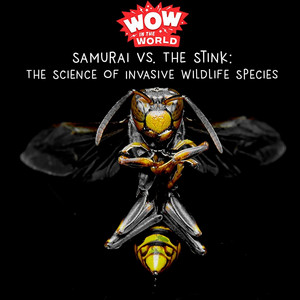
It's a little insect known as the Samurai Wasp.
Of course, the Samurai Wasp.
Trisulcus japonicus.
Oh, no!
Steve!
What?
Did I scare him off?
Yeah, I think you did.
Man, these Samurai Wasps must really be something.
Nah, it wasn't the wasp part.
He just really hates Latin.
Oh.
Anywho, right now, these researchers from the U.S.
Department of Agriculture are trying to see how good these samurai wasps are at hunting down and killing the stink bugs.
Go on.
And when they studied them, the researchers found that these wasps like to crawl inside the eggs of the stink bug and lay their eggs own eggs inside of them.
Yikes!
Now that seems like a scary movie.
Tell me about it.
So these researchers are making more of these wasps in the lab so they can then One day release them into the wild and stop the march of the stink bugs.
Yeah, that's the plan.
It's a real bug-on-bug battle.
They've already been released in Oregon, and later this year the researchers are hoping to release them in New York State as well.
Well, I hope it works, because a similar thing has been tried before and well, it doesn't always turn out well.
Really?
Yep.
Let me tell you about...
Another invasion.
The invasion of the killer cucumbers.
No, no.
Man.
This invasion takes place in Australia.
Australia, aye?
Ugh, nuts on it.
What?
Reggie!
Hey, Reg.
Big news.
We're going to Australia.
Wait, what?
What about our movie night?
Eh, the mommies will still be in the movie when we get back.
Come on, you ready?
Mindy, isn't it getting a little late?
What are you talking about?
I just woke up.
Mindy, it's 5 p.m.
Yeah, but it's 5 a.m. in Australia.
Come on, let's go.
Okay, fine, but only if we're quick.
I still want to see this Momby's film.
Don't worry, Guy Raz.
We'll be back before you can even say brain.
Okay.
Now hold on tight, because here we go.
Reg?
It's hotter than a billy goat with a blowtorch smothered in spicy salsa out here.
It must be 100 degrees.
Well, we are in Australia, so technically it's 40 degrees Celsius.
Well, whatever it is, I'm going to need a popsicle.
Wait, where are we, Guy Raz?
I think we're in the state of Queensland Mindy and, by the looks of it, in the middle of the desert.
Oh, man, not again.
Reggie!
Take me to the Australian dessert, not the Australian desert.
Anyhoo, Guy Raz, why did you want to bring me all the way out here to the other side of the planet?
Me?
It was your idea to come out here.
Well, my idea based on your idea.
So why did I bring us all the way out here to the other side of the planet?
Well, because Australia, and particularly the state of Queensland, has had a pretty rocky history when it comes to invasive species.
Oh, yeah?
Yeah, it all started in the early 1800s when an invasive species, a cactus called the prickly pear, was brought to the country and started popping up all over the place.
Oh, man.
So the Australian government decided to introduce a moth, and that moth, the cactoblastis moth, which is actually native to South America, came into the areas that were overrun with this cactus.
But why?
Well, as it turned out, this moth, or rather the caterpillars that eventually turned into the moths, had an appetite for prickly pear.
And the idea was that this moth would lay its eggs in the cactus then, when the caterpillars would hatch, They would chomp down on the cactus and keep them from spreading.
A biological control.
Exactly.
So what happened?
Well, after three billion moth eggs were placed strategically around Queensland, the prickly pears were completely gone in just seven years.
So it worked.
Well, it did.
But Queensland also happens to be the home of one of the biggest birds biological control blunders in the history of invasive species.
In fact, I think you can see one right there.
Ooh, let me just get out my adventure toolbox here.
I know I've got some magnifying goggles in here somewhere.
Ooh, got him.
All right, now what am I?
Ooh, gyros.
What is that?
That, Mindy, is a cane toad.
Oh, there must be...
Hundreds of them.
There are.
And they were originally brought to Australia in the early 20th century to prey on a beetle that was eating all of the farmer's sugar cane.
Oh, and then what happened?
Well, they did just that.
They got rid of the sugar cane beetle.
But then, But.
Then they started popping up all over the place because they don't have a natural predator here.
Exactly.
There's nothing to eat the cane toads.
So now there's over 200 million of them all across Australia.
Oh, man.
So the species brought in to stop the invasive species... has become an invasive species itself?
Exactly.
Because, just like the stink bugs, these cane toads eat crops and they can even harm the native wildlife in Australia.
That's awful.
Yeah, and that's why the United States Department of Agriculture is being so careful about releasing those wasps to eat.
Yeah, I guess they don't want to repeat what happened here in Australia.
Yeah, and speaking of that, we should probably head back home now, before this horde of cane toads gets any closer to us.
Oh, yeah, before they get any closer.
Right.
Mindy, what was that?
I didn't hear anything.
Ah!
Mindy, did a cane toad just jump out of your pocket?
Um... Ah!
Mindy, what are you doing with pockets full of invasive species?
I just wanted to bring back some souvenirs from our trip to Australia.
We just talked about this.
They're everywhere.
Oh, but look at their little faces.
They're so cute.
Come on, Guy Raz.
Give him a little snuggle.
Here, come on.
Do it.
Keep that thing away from me, Mindy.
Oh, come on.
He likes you.
Run, run, run, run, run, run, run.
Hey, grownups, it's Mindy and Guy Raz here from Wow in the World.
Mindy and I have some brand new Wow in the World toys out in the world just in time for the holidays.
Made for the kids who love science and for the ones who don't yet.
From our 100 experiments, that Wow kit to the telescope and astronomy kit.
Our Wow in the World toys help your wowzer learn about their world through play.
Plus, you can hear exclusive audio content from me and Guy Raz to help your wowzer discover even more wows.
Grown-ups.
Give the gift of wow and wonder this holiday season with our latest Wow in the World toys designed with your curious wowzer in mind.
You can shop our Wow in the World toys at Tinkercast.com slash toys.
That's Tinkercastcom slash toys show.
Hi, thanks for calling wow in the world after the beep get ready to record.
Hi, Mindy.
Hi guys, my name is Hannah, I am from Edmonds Oklahoma, and my wow in the world is that my grandma has anesthesia.
She can taste names Mindy is a chocolate dipped cherry, Guy Ross is a pie crust and Ross is a dried Kool-Aid.
Bye, Mindy.
Bye, Guy Ross.
Keep up the good work.
Love your show.
Hi, my name is Joy, and I'm from Orlando, Florida, and my wow is that scientists can clone animals.
Bye, Mindy and Guy Ross.
I love your show.
Hi, my name is Addison, and I am 8 years old.
I live in Bloomington, Illinois.
My wow in the world is that iguanas can look both left and right at the same time.
I love your show.
Bye.
Hello, my name is Diego and I live in San Juan, Puerto Rico.
My wow in the world is that Einstein's theory was energy equals mass times.
The speed of light squared.
And I'm in second grade and I was Bye.
Hi, Guy Ross and Mindy.
My name is Miranda, and I'm six years old, and I live in Gargina, California.
And my wow in the world is that there are good germs and bad germs.
Bye, Guy Ross and Mindy.
I love your show.
Hi, Mindy and Guy Ross.
My name's Tyler.
I'm from Portland, Oregon, and I'm seven years old.
My wow in the world is that elephants have feelings.
Hi, Mindy and Guy Ross.
I love your show.
Hi, my name is Nolan, and I live in Monmouth, Colorado.
And my round the world is that lightning is the main cause of forest fires.
I love your show, Mindy and Guy Ross.
I'm seven.
Hi, Mindy and Guy Ross.
I'm Robert from San Francisco.
My round the world is I'm up at three in the morning at a sleepover playing my friend's piano.
You got it, Roz.
End of messages.
Hey, everyone.
Thank you so much for joining us this week on Wow in the World.
And if you want to keep the conversation going, check out some of the questions we posted on this episode at our website, wowintheworldcom.
And grownups.
There you can find more details on how your kids can become part of the World Organization of Wowzers.
Lots of cool perks.
Exclusive t-shirts, autographed pictures of us, and a bunch of other cool stuff.
Wowintheworld.com.
Our show is produced by Jed Anderson.
Say hello, Jed.
Hello.
With help from Thomas Van Kalken, Chelsea Erson, and Jessica Bode.
Meredith Halpern-Ranzer is the big boss.
Our theme song was composed and performed by The Pop-Ups.
You can find more of their awesome all-ages music at thepopups.com.
And parents and teachers, if you want to send us an email...
Our address is hello at wowintheworld.com.
Grownups, you can also find us on Facebook, Twitter, and Instagram at wowintheworld.
And if you want to be featured at the end of the show, call us up and tell us your wow in the world.
Our phone number is 1-888-
And parents.
If you want to upload any photos or videos or messages to us, please visit wowintheworldcom and find a link where you can do just that.
And if you haven't already done so, please subscribe on Apple Podcasts, or however you get your podcasts.
Leave us a few stars and a review and be sure to tell a friend about the show.
Until next time, keep on wowing.
Wow in the World is made by Tinkercast.
Grownups, if you like Wow in the World, you can listen early and ad-free right now on Wondery Plus.
Join Wondery Plus in the Wondery app or on Wondery Kids Plus on Apple Podcasts.
Prime members can listen ad-free on Amazon Music.
And before you go, tell us about yourself by filling out a short survey at wondery.com slash survey.