Hello History This Week listeners, it's Sally here.
As we are heading to the end of the year, I just wanted to thank you all for sticking with us these last five years.
We really do love bringing these stories to you every week and we cannot wait to keep it going in 2026.
If you like what you have been hearing, you can always support our work by subscribing to History.
This Week Plus, exclusively on Apple Podcasts.
You can also get email notifications and bonus content by signing up at historythisweekpodcast.com.
And of course you can follow us on Instagram or Facebook.
Thank you so much for listening.
We could not make this show without you.
Like a good neighbor, State Farm is there.
Prices are based on rating plans that vary by state.
Coverage options are selected by the customer.
Availability, amount of discounts and savings, and eligibility vary by state.
The holidays mean more travel, more shopping, more time online and more personal info in more places that could expose you more to identity theft.
But LifeLock monitors millions of data points per second.
If your identity is stolen, our US-based restoration specialists will fix it.
Guaranteed or your money back.
History This Week, December 16th, 1773.
I'm Sally Helm.
The men had just a few hours' notice.
It'll happen tonight.
Gather your disguises.
Gather your resolve.
Wait for the signal to strike.
Three British ships are anchored in Boston Harbor, unable to unload their store of tea because the American colonists have been protesting a tariff on that tea, negotiating to keep the British from importing more of it.
As of today, those negotiations have failed.
Nothing to do now, the colonists think, but throw that tea into the harbor.
Sounds disorderly, even chaotic, but it all unfolds with great precision and secrecy.
On this night, December 16th, there's a big gathering at Boston's Old South Meeting House American colonial leaders talking about this tariff business.
And at the appointed moment, a group of men rise from their pews in the Meeting House.
They slip into the streets, walking together towards Griffin's Wharf.
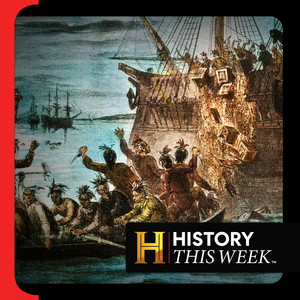
They've disguised themselves as Native Americans with headdresses and tomahawks.
When they arrive at the harbor, they move swiftly, take over the ships, jump down into the holds, attach ropes to chests of tea, then hoist those chests onto the decks, where they use their tomahawks to chop them open and then dump the tea into the water.
One of the participants will recall, years later we were merry in an undertone at the idea of making so large a cup of tea for the fishes.
But we used not more words than absolutely necessary.
I never worked harder in my life.
When it's over, the men scatter without revealing their identities.
It's all so well planned that it's clear they must have been acting under some kind of leadership.
We don't know for sure who made this happen, but we have an idea.
A patriot in his 50s named Samuel Adams.
Because the secrecy itself, the precise coordination.
Biographer Stacey Schiff says that has Samuel Adams written all over it.
Every account of the Boston Tea Party is in the passive voice.
The tea simply seems to have sailed overboard of its own volition.
That's really Adams at his best.
Today, a forgotten founding father lays the groundwork for revolution.
How did a major American rebel manage to maintain such a low profile, which carries on to this day?
And how did the Boston Tea Party help tip the colonies towards war?
Deck your home with Blinds.com.
Fa-la-la-la-la-la-la-la-la.
Fa-la-la-la-la-la-la-blinds.com.
DIY or let us install.
Fa-la-la-la-la-la-la-la-la.
Fa-la-la-la-la-la-la-blinds.com.
Free design consultation.
Free, free, free, free, free, free.
Plus free samples and free shipping.
Free, free, free, free, free, free.
Head to Blinds.com now for up to 45% off site-wide plus a free professional measure.
Fa-la-la-la-la-la-blinds.com.
Rules and restrictions may apply.
What's up, world?
It's Von Miller, Super Bowl MVP, chicken farmer, and now host of Free Range.
This is a show where I go off the field and off the script.
We're talking what's hot in music, film, trending news, and everything blowing up your feet.
If you love football, you'll feel at home.
But if you're here for the vibes, the internet deep dives, the conversation, this is your podcast.
Join me every Wednesday.
Follow and listen to Free Range with me, Von Miller, everywhere you get your podcasts.
I am Nina Khrushcheva, the great-granddaughter of Nikita Khrushchev, the leader of the Soviet Union in 1962.
And I'm Max Kennedy, the nephew of U.S.
President John F. Kennedy.
We explore what was a terrifying moment in history.
The story of the Cuban Missile Crisis.
How close the world came to nuclear war.
And what they had to do to pull it back from the brink.
The Bomb, Kennedy and Khrushchev.
Listen on BBC.com or wherever you get your podcasts.
It's 1732, 41 years before the Tea Party.
Boston, Massachusetts is an orderly city of nearly 15,000 people, a very pleasant place to be.
Samuel Adams is growing up there with his family.
They live in a nice home with an orchard and an observatory and views of the harbor.
At this time, there are no shouted threats in the air, no sounds of weapons discharging and bodies hitting the cobblestones.
There's none of that yet.
The only cries in the air come from seagulls.
Visiting Englishmen remark on the quality of the food, on the spare sublimity of the architecture, on the overall air of sophistication.
To the British, all this is surprising.
I think probably the best assessment is that of a British officer who says that everything about it is lovely.
He just wished the people would be more so.
That's Stacey Schiff.
Her biography of Samuel Adams describes the Boston of his youth and the tensions between the colonists and the British that were even then pushing their way toward the surface.
It's growing pains, really.
No one who's ever studied adolescence or lived with an adolescent would fail to recognize these symptoms.
But Adams' boyhood is seemingly calm.
His parents are raising him to one day live the quiet life of an educated elite.
Before we say any more about Adams, this forgotten founding father, let's get a few things straight.
Samuel Adams is not John Adams, the second president of the United States.
That is Samuel's second cousin.
Samuel Adams is, however, the namesake of the popular modern beer.
Schiff says that is in fact how his name has come down to most people.
Until recently, even she, who's studied this period, couldn't have told you much about it.
At a certain point I was, I think, a little bit embarrassed to realize that he had a cameo in my book on Benjamin Franklin and I knew next to nothing about him.
And that was particularly galling because I'm from Adams Massachusetts, which is named for Samuel Adams.
So Schiff did a deep research dive to uncover who Adams was.
And the first thing that struck her was his fiery prose.
Lines.
Like All, men have a right to remain in a state of nature as long as they please and, in case of intolerable oppression, civil or religious, to leave the society they belong to and enter into another.
And the more I read around, the letters are very rousing stuff.
There are lots of anthems to American liberty.
They're extremely interesting.
And I kind of just fell hook, line and sinker.
It's clear to Schiff that in the years leading up to the American Revolution, Samuel Adams is right at the center of things.
He helps to unite the colonies over those years.
And he is utterly instrumental in articulating American grievances and in basically making himself extremely unloved by crown officers in Massachusetts and throughout the colonies.
He's pretty much at the forefront of things until the revolution and then falls off the radar, as he remains very much to this day.
But strikingly, that rebellious Adams doesn't emerge until middle age.
He doesn't make agitation his career until he's in his 40s.
The conflict between Britain and its American colonies galvanizes him, focuses his energies and his mind, partly because he believes in the principle of liberty.
But that's only part of his motivation.
He also writes The colonists have been branded with the odious name of traitors and rebels only for complaining of their grievances.
That's the other part.
Samuel Adams has grievances.
And they likely go way back to the time in 1740 when Adams was 18 and the British appointed governor of Massachusetts mucked with his family's financial affairs.
Back then, the British are keeping a tight hold on trade with the colonies.
They want to make sure that more gold and silver flow into royal coffers than come out of them.
That leaves the colonies low on cash.
So Adams's father and other prominent men come up with a plan.
They want to turn something that they have in large amounts land into something that they lack cash.
So a group of men get together, including Samuel Adams's father, and they found something called the land bank, which in simplest terms is just a bank where notes are secured by their land holdings.
Adams's father is a believer.
He pours his fortune into the project, and the land bank takes off.
It works well, it's popular with colonists, but upsetting to a powerful group of merchants.
Those merchants have political sway, and so The governor of Massachusetts writes to Parliament, asks them to shut down the land bank, which they do.
And in the process of shutting down this venture, they basically bankrupt Samuel Adams' father, because he had invested so heavily in the bank.
The young Samuel Adams sees that his father is ruined.
So you have this unusual situation where you have an organic colonial effort that is utterly squashed out of the blue by this bolt from London.
Remember Samuel Adams' picturesque family home, the one with the orchards?
The British authorities move to seize it.
Samuel will fight them off for years, but he still has to sell parts of the family estate to pay the bills.
And you know you could see how that could potentially bring someone around to the ideas that they're being dealt with arbitrarily and that there seems to be parliamentary overreach.
Resentment festers in Adams and in the colonies at large.
They're both struggling to find their role in the world.
It takes Adams a while.
For much of his young adulthood, he's just knocking around, not sure what to do with himself.
The astonishing thing is that he never manages a career period which, in early America, early New England in particular, was just absolutely singular.
For perspective, think of some of the other founding fathers.
They glimmered with ability from the very start.
Washington, with his leadership skills and physical courage.
Franklin, with his entrepreneurial savvy.
Madison, philosophical genius.
And now consider Samuel Adams, a guy who graduated from Harvard yes, but who, Schiff says, spent years cycling through jobs that didn't add up to much.
He fails at accounting, then becomes a clerk helping vendors at crowded markets.
After that, he's a tax collector.
Not a very good one.
He can't muster much enthusiasm for collecting money for the British crown.
Painted portraits usually show him later in life, and he looks average.
His plain coat, his serious expression, even his hair length, are pretty typical of the styles of the day.
But Schiff points out that Samuel Adams wasn't just one thing.
In a way that is very true, I think of many of us, he's several people at once.
So from John Adams' descriptions in particular you get a sense of an immensely affable decorous, somewhat formal man who's very charming and very easygoing, who entertains in great simplicity at his home, but who is just a genteel individual.
The model son of an upper-class Boston family.
But other sources paint a different Adams.
You get the sense that he's sharp, elbowed and brawling and he's extremely eager to mix it up and doesn't ever hesitate really to kind of upset the apple cart.
He's equally at ease on the elite of Boston as he is in the streets of Boston.
In 1748, Samuel Adams launches a newspaper with friends.
It's called the Independent Advertiser.
And this is when he begins to find his calling.
He writes editorials lashing out at the British and articulating an early version of America's democratic ideals.
There is nothing so fretting and vexatious, nothing so justly terrible to tyrants as a free press.
Adams' writing brings him notice, a lot of it.
And soon, his objections to British rule will focus in on one man, Thomas Hutchinson.
Hutchinson will become Adams's nemesis.
He's the kind of highborn gentleman who has his London tailor send him rust-colored coats and lace.
He's elected to the Massachusetts House of Representatives by the age of 26, then rises to become the lieutenant governor of Massachusetts.
He works for the British, but he was born in Boston.
He is a very decent, very sober, very modest, very diligent man.
Unlike Adams, he was making a fortune even while he was still at Harvard.
What would Hutchinson have been like to be in a room with?
This may be unfair of me.
I think he would be terribly boring.
And I'm perhaps basing that on his history of the Massachusetts Bay Colony, which is not exactly an exciting book.
Hutchinson wrote that book with an eye towards comprehensiveness.
It has a passage about a group of settlers debating at length whether to build their cottages on this side of the river or the other side of the river.
Hutchinson is as boring a writer as Adams is fiery.
But in other ways, the men are similar, starting with their upbringing.
Entirely the same world, entirely the same education.
And now, like Adams Hutchinson, is a man of strong conviction.
Duty was immensely important to him.
He would say that he lay awake for nights on end in the colonies hoping that he had properly done his duty to the king.
But on questions of politics, the two men are diametrically opposed.
They have utterly distinct views of how colonial life should be regulated.
Samuel Adams and Thomas Hutchinson are on a collision course, as are the American colonies and Great Britain.
In the 1760s, British authorities were saying to themselves how lucky the Americans are to be ruled by us.
We're like their caring parent.
We send our troops to protect their borders, to keep them safe from Indians and French invaders.
But you know, that costs money.
And so, dear little colonists, you'll need to give us more of that.
More money.
Stacey Schiff explains.
So essentially in the 1760s, Great Britain looks to the colonies.
They seem to be prospering beyond anyone's wildest imaginings.
And yet the amount of money it's costing to administer the colonies is proportionately great and the revenue is proportionately small.
So the British do what they've done before.
They raise taxes and prepare to endure some colonial grumbling.
But this time, they get more than they bargained for.
The tax they've levied is actually raising revenue for the crown, not just covering costs.
That's new.
And the colonists get angry.
Resistance begins to travel sort of up and down the East Coast.
Everyone comes around to this idea that, wait a minute, we are not complicit in our own taxation.
Therefore, isn't this an arbitrary decision?
Taxation without representation.
Does that start to be said around this time?
Absolutely.
And Hutchinson himself will say, yes, it is taxation without representation.
This is overreach on the part of the British administration.
Hutchinson, who lies awake at night thinking about how he can serve the crown.
Even he thinks it's too much.
But still, he keeps doing his job, looking after British interests.
Meanwhile, the colonists around him can't stop talking about this latest tax and how it might be just the beginning.
Samuel Adams, at this point, is helping to foment opposition to these taxes.
He writes, If our trade be taxed, why not our lands or produce?
In short, everything we possess.
Sure enough, in 1765, the British levy a tax on paper, the Stamp Act.
By law, all paper in the colonies now requires a special stamp.
It would apply to almost anything a deed to your home, your legal documents, the playing cards, your Harvard diploma.
Pretty much any piece of paper you could name would require a stamp.
And all that stamped stuff would be taxed.
This does not go down well in Boston.
There's a lot of street theater around this which I mean I think we all heard about in grade school in a vaguely amusing way but was really threatening.
Like a mob makes an effigy of a Boston tax collector and hangs it from a tree.
Adams is writing about all of this.
He doesn't seem to be complicit in the violence.
He does what any smart member of the opposition should do at this point, which is that he downplays it tremendously.
In August of 1765.
Two weeks after that effigy swings from a tree, Thomas Hutchinson sits down to dinner in his elegant home.
A dinner he will not finish.
Word comes to him that a mob has formed.
It's attacking nearby houses and heading in his direction.
Hutchinson flees with his children.
Good thing for him, because the mob destroys his home.
They chop down the door with axes, put holes in the walls, demolish the furniture, make off with his valuables.
The next day, Hutchinson shows up at his job as a chief justice.
He's a pathetic sight.
His judicial garb was stolen during the raid, so he's in his normal clothes.
And he rails against the mob, whoever they were.
So what does Samuel Adams think of all this?
After all, he too lost parts of his family estate back when the British moved to seize it.
It's conceivable that he might be sympathetic.
But Stacey Schiff says, not really.
To Adams, the blame for the anger of the colonists lies squarely with the British.
If Thomas Hutchinson has felt the wrath of his fellow Bostonians, too bad.
Hutchinson will make demand after demand to be reimbursed, obviously, for the damage to his home.
And Adams seems to stand in the way of that reimbursement on principles.
So you know, there does seem to be something between Adams and Hutchinson, even as early as this point.
In terms of like a personal beef?
Yeah, there's clearly something going on between the two men there, which we can't document.
One thing we can document is that on September 30th, 1768, the British turn up the heat.
Royal Navy ships sail into Boston Harbor.
It's very tense.
I mean, there's a soldier in Boston for every Boston family.
This amounts to a military takeover of Boston with no end in sight.
There's a great deal obviously, of dissatisfaction with the fact that the town has been occupied by these men who are obviously, you know, not necessarily church-going, children-loving friends to meet in the street.
So it's a little bit gnarly.
Adams pours his version of the gnarliness into vivid dispatches for the Boston Gazette.
And he also expands his reach.
It's at that point that he and his colleagues start a sort of news service.
Adams' accounts of the conflict in Boston become regular reading far and wide.
These kind of lurid, sensationalist items about various assaults on women, various guns in the chest and knives in the throat, all of these brutal encounters between the soldiers and the population.
And those accounts are sent everywhere, out of Boston to New York and Philadelphia, so that the other colonies hear about poor, martyred Boston, and then only later printed in Boston, by which time no one's really sure if it ever really happened in the first place.
So it's a kind of genius fake news operation.
Is he especially skilled at that, or is he just especially prolific?
I would say he is a master propagandist.
Yes, in the sense that he seems to be able to pull these ambient ideas out of the air and crystallize them.
He's by no means the only person who's opposing British policy at this point, but he seems to be able to pin it to the page very colorfully and very artfully.
In his dispatches, Adams hammers home the fact that the colonists have essentially no say in their governance.
They, the colonists, have as much power in parliament as they did to choose the emperor of china, or you know, london knew about as much about them as they did about the moon.
Thomas hutchinson is reading these stories too, and he fears that these are just paving the way, essentially to something like the boston massacre on march 5th 1770.
He's proven right.
The moon shines down on a blanket of snow.
As a lone british sentry stands guard outside the customs house, A crowd surrounds him.
Insults begin to fly.
A redcoat captain, hearing the commotion, calls for reinforcements.
The troops post up around the sentry and raise their bayonets, the blades glinting in the light.
The crowd advances.
The detachment of soldiers then let loose with a volley of bullets.
Men fall.
Their blood stains the snow.
This all happens very quickly.
Nobody's really sure who instigated what.
But it's massive chaos in the immediate wake.
Bells ring out a makeshift signal to rally the local militia.
By now, hundreds of people are out on the streets.
So the town has gone quite wild.
Thomas Hutchinson comes on the scene and does his best to restore order.
Hutchinson has tried to calm everyone.
He's essentially said, go home.
I've got this.
Justice will be served.
Let us please find out precisely what happened.
But a lot of colonists aren't satisfied with that.
They don't want to wait.
Instead, they decide to confront Thomas Hutchinson.
And the man they choose to do it is Samuel Adams.
He goes to address Hutchinson at a meeting of the governor's council, while his fellow colonists wait nearby at a town hall meeting of their own.
The British officials on the council are in a room ringed by painted portraits of their forefathers.
Adams stands before them.
He addresses Hutchinson directly.
So John Adams leaves us this depiction of Samuel Adams essentially reading in the riot act, telling him that if the troops are not immediately evacuated, there will be blood in the streets and that Hutchinson should consider his own life to be in danger.
Hutchinson understands the threat, but makes a counteroffer.
At first, Hutchinson will agree to remove one regiment.
Adams brings the offer back to the colonists at the town hall meeting.
Soon enough, he leaves that meeting to tell Hutchinson if you have the power to remove one regiment, you have the power to remove them all.
Adams, who doesn't normally gloat, will admit that he saw Hutchinson's knees tremble and that he enjoyed the sight.
Hutchinson and the governor's council give in.
So it's this sort of monumental showdown of the people demanding something and, in a funny way, outmaneuvering the authorities.
Adams has scored a victory, and he can sense that tensions will only continue to rise.
The colonists need to be ready.
So in the years after the massacre he begins an effort to connect Boston with the rest of Massachusetts— and eventually with other parts of the colonies.
He forms these groups that aim to share information and hone revolutionary ideals.
The groups have a pretty boring name.
They're called the Committees of Correspondence.
I think he picked that name to be as inoffensive sounding as possible.
So nobody would sort of say, wait, these are revolutionary.
These are proto-terrorist committees.
I mean, it's like when you're a kid and you have a diary and you call it you know my book instead of my secret diary, so that nobody's going to think it's interesting.
It's the same kind of thinking.
He tried to make it sound just utterly anodyne, and they do.
Totally.
It works.
I mean, but what you're saying is that what he's doing is actually really important.
He's laying this secretive foundation for the revolution that is going to come eventually.
Yeah, what he essentially does with those committees is he just wires the continent.
It's like an electrical network that he's formed.
That network is ready for the next British provocation.
And in 1773, that provocation arrives.
It has to do with tea.
The Crown decides to let the British East India Company flood the colonial market with their tea.
And oh, by the way, that new supply of tea will be taxed.
So it's a very explosive act which no one in London or very few people in London seem to realize at the outset is going to be explosive.
From their vantage point, this act will lower the price of tea.
The Americans will be thrilled.
Increasing the supply of tea in the colonies will make it cheaper all around.
The British are like, that added tax will be nothing but a minor inconvenience.
The Americans feel differently.
When the tea arrives in Boston Harbor, a clock starts ticking.
Adams and his colleagues essentially band together and start holding a series of meetings as to how they are going to meet this crisis.
And the way that Adams articulates it is as follows.
He doesn't trust, as he puts it, the private virtue of his fellow citizens to not drink the tea.
So he prefers to trust their public virtue in rejecting the tea.
He means it's going to be too tempting if this tea is actually on the market.
We could boycott it once it gets into the city.
But instead, let's just not let it into the city.
We're worried people will be a little bit too tempted by this cheap tea.
Exactly.
As soon as that tea is unloaded, people are going to be buying and drinking it.
So the colonists tell the ship's owner, Francis Roach, turn around and bring your tea back to England.
But it's not so simple.
Roach says he's legally bound to unload the tea before departing.
Samuel Adams reminds Roach of a loophole in the law.
It allows him to sail back home if his ship is battered by a deadly storm.
And he says to Roach, if you're faced with a tempest, you can turn around.
And you, sir, are facing a howling political tempest.
So why would that not apply to you?
And so, as the deadline to unload his tea approaches, Roach rides his horse through the pouring rain to the country estate of the new governor of Massachusetts, Thomas Hutchinson.
The ship's owner stands before the governor mud splattered, soaking wet, begging for permission to turn his ship around.
Hutchinson stands firm.
He refuses to issue a pass.
Hutchinson says, Roach, unload your tea.
Roach rides back to Boston, arriving just past sundown on December 16th, 1773.
He tromps into the Old South Meeting House and delivers the bad news to a crowd of six men, thousand people, a crowd that includes Samuel Adams.
Samuel Adams, shortly after hearing the report, says that it is clear that nothing more can be done to save the country.
And very shortly thereafter, a portion of the room begins to melt very silently away.
And then these men move together toward the harbor, disguised in their Native American garb.
There does seem to be this almost jeering at the British.
You know, you think we're a bunch of savages.
We're going to show you.
American Indians had already established themselves as avatars of independence.
Let us show you what that means here.
Another benefit?
No one can tell who they are.
But we know one person who isn't among them.
Samuel Adams.
He stays behind with John Hancock and other rebel leaders.
Hancock and Adams very conspicuously remained behind at the Old South and missed the most fateful moments in American history and missed the dumping of the tea into the harbor.
He and the others couldn't hear the sounds from the harbor, Schiff says.
But some British officers later described what those sounds were like.
They could hear the splintering of the chests.
There obviously would have been the noise of the rigging being maneuvered throughout this.
They could hear cheers.
The protest takes two hours, and it goes off without a hitch.
As Adams will say, the whole thing was conducted with decency, unanimity, and spirit.
And we know that everyone at the end of this just goes home extremely quietly, that there's no commotion in the streets afterwards.
There isn't any commotion, but there is some quiet celebration.
We hear from Thomas Hutchinson afterwards that Adams was never in greater glory than he is at this moment.
So the implication is that there's a certain amount of gloating about what's happening.
And yet Adams, this well-known agitator, this man who has spoken of the virtue of rejecting British tea, you can't easily pin this on him.
After all, he was in the Old South Meeting House at the time.
He clearly wasn't one of the men splitting crates open with a tomahawk.
I mean, it's one of the rare moments where we know precisely where he is.
And he's there very much clearly for a reason.
That reason?
Essentially, an alibi.
Still, pretty much everyone knows that Adams was involved.
Some of the men who witnessed all this later give testimony in London and they name Adams as the chief conspirator.
So there's a fairly good indication that if he didn't mastermind the thing, he was at least complicit in the masterminding of it.
It is, in fact, if you think about it, a perfect crime in the sense that there is no perpetrator.
So it is very Adams-like in the sense that the principles rise above the perpetrators.
The principle of independence, which in the wake of the Tea Party, takes off in a major way.
Parliament reacts to the tea protest with a series of drastic punishments.
They start by closing Boston's port and demanding that its citizens pay for the ruined tea.
And because of the machinery that Samuel Adams has already set in motion through the committees of correspondence, the other colonies will react to what is truly now Boston's martyrdom with enormous sympathy.
Those committees that had formed a kind of revolutionary electrical grid for the colonies.
They are ready for this moment.
After the Tea Party, the current just begins to run so much more quickly from north to south.
After that, things happen fast.
Anger over the punishment in Boston leads to the first Continental Congress.
And before too long, the colonists' desire for independence has broken out into a full-blown war.
During that war, Samuel Adams keeps a low profile.
A low profile that still persists.
Why is he a forgotten character in the first place?
Who made that happen?
I think he's to some degree complicit in his own disappearance.
Adams is not vain.
He's very modest.
Obviously, he's operating in the background.
His entire methodology is based on the no-fingerprints school, so he really does need to remove himself from the scene.
There's an amazing moment in John Adams's writings in which he describes Cousin Samuel at the Continental Congress feeding his papers to the fire.
And Samuel Adams, I know this just like breaks the biographer's heart.
You must have been like, no, I had trouble writing that scene.
Exactly.
And Samuel explains to John that he needs to preserve the anonymity of his colleagues, that he doesn't want anyone to be compromised.
They're fomenting revolution.
Obviously, the whole point is you can't leave a paper trail.
So to some extent, he does pretty much erase the record after him.
I forget that they would have wanted to cover their tracks, because I feel like we all spend so much time like reading the tracks that they did leave you know.
But you're right.
It would have been dangerous to leave those letters lying around.
And I think that was one of the other things that so thrilled me about the story was precisely we forget the peril that these men are in at that moment.
We all know that Paul Revere gets on his horse on April 18th, 1775, but where is he riding?
And suddenly it dawned on me, he's riding to warn John Hancock and Samuel Adams that, as the two most wanted men in Massachusetts, they are about to be arrested for treason.
And I think we tend to think, oh, Paul Revere, he just rode off to warn the countryside.
I think we forget the destination at the other end.
Which was Samuel Adams.
Which was Samuel Adams, exactly.
Thanks for listening to History This Week.
For moments throughout history that are also worth watching.
Check your local TV listings to find out what's on the History Channel today.
If you want to get in touch, please shoot us an email at our email address historythisweekathistorycom, or you can leave us a voicemail 212-351-0410.
Special thanks to our guest, Stacey Schiff, author of The Revolutionary, Samuel Adams.
This episode was produced by Corinne Wallace.
It was sound designed by Dan Rosato and story edited by Jim O'Grady.
Our senior producer is Ben Dickstein.
History This Week is also produced by Julia Press and me, Sally Helm.
Our associate producer is Emma Fredericks.
Our supervising producer is McKamey Lynn and our executive producer is Jesse Katz.
Don't forget to subscribe, rate and review History This Week, wherever you get your podcasts, and see you next week.