Hello.
Welcome to Chinese Folk Tales.
I'm Paul Osborne, and I've got another great story to tell you.
I hope you enjoy it.
Do you like music?
Maybe you play a musical instrument.
Have you ever wondered where they came from?
How they came into being?
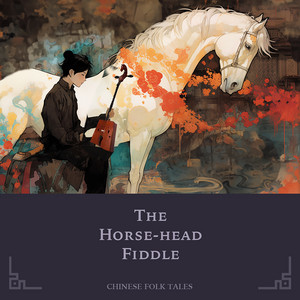
The Mato Chin, for example, a proud symbol of the Mongolian people who live in northern China and elsewhere.
It's made of a little wooden box which sits on the musician's lap.
It has a long neck and has two strings.
The musician plays it with a bow made of horse hair, and the top of the neck is usually carved into the shape of a horse's head.
What if I told you that this famous instrument was actually made by a Chinese young shepherd?
With a little help from a magical horse.
At least, that's how the story goes.
Let me explain.
Once upon a time.
I can't tell you exactly when, but it was long enough ago for people to have forgotten.
Anyway, legend has it that there was once a young shepherd boy called Su He.
He lived on a remote grassland along with his grandmother.
They had 20 sheep in all, and that's how they survived.
Morning and evening, Suha would help his grandmother with the chores around the house cooking and cleaning.
She was getting old and sometimes there was too much to do.
Go get some more dung for the fire.
There's a good lad.
We're so lucky to have wool from the sheep's back for warmth, their milk for tea and their meat for feasting.
During the day, he would ride off into the fields to tend to his sheep and sing.
He loved singing.
He had a very fine voice, and all the shepherds around would come to listen to him.
Oh, such a lovely voice.
Sing us another song, Sue, huh?
Okay, but I really must keep an eye on our sheep.
At the end of one day, as the sun was setting and night was drawing in, Suha's grandmother started getting anxious.
Oh dear, where is that boy?
Why hasn't he come home?
I'll ask the other herdsmen if they have seen him.
But they had not.
Just when his grandmother thought he would never come home, Suha appeared and he was carrying something.
Grandmother!
Grandmother, come see what I found.
It was a newborn foal.
I was heading back from the fields when suddenly I noticed something in a ditch.
It was this foal.
There was no sign of the mother at all.
I thought that if I left him there, the wolves would eat him.
So I decided to bring him home with me.
Day by day and week by week, Suha would sing to the little foal and it grew and grew until it became a beautiful and strong white horse.
Everyone admired it and Suha loved it most of all.
One night, Suha woke up with a start.
What's that noise?
He looked outside the yurt and there... Oh no!
No!
No!
No!
There was a great big, bad snarling wolf being held at bay by the brave little white horse which was protecting the sheep in the sheepfold.
Get away, you nasty wolf!
Off!
Off into the night!
And don't come back!
He turned to the horse.
My beautiful white horse, you saved the sheep.
I cannot thank you enough.
When the spring came, news spread across the land that the prince was going to hold competition at the temple.
Now the prince had a daughter, and he had decided that whoever was the best horseman would become her husband.
All the local herdsmen encouraged Suheir to take part, to ride his fine, brave little white horse to the meeting and take part in the competition.
Go on!
Go on!
Go on!
Okay, then I shall.
So he set off.
On the day of the race, Suha thought he didn't stand a chance.
There were so many big, strong riders and very fine horses indeed.
But it was too late to back out now.
The race was fast and furious.
There was so much shouting and cheering.
This is anyone's race.
Bay, bay, hooray.
Losing ground.
Pushing on now the grey.
Wise man's wages.
Wise man's wages from bay, bay, hooray.
And pretty soon, Sue Hart realised that they were shouting for him.
It's between these two.
Coming up on the outside.
It's a dash for the line.
And by a horse's head, it's the white.
The white ridden by Sue Hart.
His little white horse raced ahead at the very last moment and crossed the line first.
He had won.
Bring the winning rider to me, said the prince.
But seeing that he was a poor herdsman and not wanting him to marry his daughter, he said Here I'll give you a big bag of copper coins.
Leave the horse and go back home.
Suha was so angry.
I came to race, not to sell my horse.
I could never do that.
The prince was angry at his insolence.
Dare you go against my wishes?
You are but a poor herdsman.
What right do you have to choose what happens to your horse?
He called over his guard to knock Suha to the ground.
And the prince took his horse.
Suha's fellow herdsman picked him up, dusted him off and took him home.
With the help of his grandmother's cooking he soon recovered.
He was so sad that he had lost his horse to the prince.
For a while he could only sing sad songs.
But one night he was awoken suddenly by a knocking.
Someone was at the door.
Who's there?
Tell me at once.
He opened the door, but there was no one to be seen.
He went back to sleep, loudly this time, waking his grandmother.
She went to look.
Suddenly suha heard a scream.
Oh my goodness, it is a horse, but not a horse, a flying horse, oh my word.
And she ran inside and hid under the bed cautiously.
Suha went to the door again and peered out.
At first he saw nothing, But then he looked into the sky and saw a little white shape.
A horse.
Not just any horse.
It was his horse.
The one which had been taken by the prince.
He watched as it carefully landed before him.
You came back.
But how?
He reached out to touch it but his hand passed straight through like it wasn't there.
Master, you were so kind to me.
I was so sad when the prince took me from you.
Suha could see that the horse had wounds all over his body, with arrows sticking from his hide.
What happened?
Who has done this to you?
The evil prince wanted to brag about his new possession and invited all his friends to a feast.
He tried to climb on my back, but I threw him off.
All his friends laughed at him.
He was so angry that he told his archers to catch me and beat me, and if they couldn't, then they were to fire their arrows at me.
To kill me.
I ran and ran, all the time feeling the arrows cutting into my skin.
I kept running in the hope of finding you.
It was all too much.
I couldn't make it.
But you are here.
As a spirit, yes.
Suha was so sad.
He cried and cried until he had no more tears.
Sadly, I cannot stay, said the horse.
But I want you to remember me, and I don't ever want you to feel alone.
Go find where my body lies.
Save the hares from my mane and use them to make an instrument that you can play while you sing.
Sing songs to me.
Praise our friendship.
Tell the world we ran the race together and won.
Wherever I am, I will hear them.
And with that, the horse flew away.
Suhe did just as his horse had said.
And the instrument that Suhe made?
Well, that was the mato chin, of course.
Over the years, it's become more than just an instrument.
For many people in Inner Mongolia and Northern China, it's a symbol of their proud and vibrant culture and was internationally recognized as an intangible cultural heritage by China's State Council back in 2009, to make sure that its wondrous sound is fostered and gets passed on to later generations.
With that, we conclude this episode of Chinese Folk Tales.
Thanks for listening.
If you like our stories, do give this podcast a five-star rating, leave your comment and share with your friends.
To hear more, please subscribe to Chinese Folk Tales on all major podcast platforms.
We'll see you next time.
Bye for