Hello.
Welcome to Chinese Folk Tales.
I'm Paul Osborne, and I've got a wonderful story to tell you.
I really hope you enjoy it.
This one is about one of the most famous Chinese philosophers ever to have lived.
His name was Laozi, but he also went by other names.
Li Er, sage ancestor, or even the mysterious and primordial emperor of the Great Way.
He's most famous for writing a great book called the Tao Te Ching, in which he explained the way he believed the world worked and how we should live within it.
This was around two and a half thousand years ago.
You might be wondering how relevant his ideas are now, but many are as fresh as the day he wrote them.
Maybe you've heard this one.
The journey of a thousand miles begins with a single step.
That's one of his.
And there are plenty more.
81 altogether, in fact.
Needless to say, as such a big figure in Chinese history.
So many stories have been written about him that it's not always clear which are true and which are not.
But, as Lao Tzu would say, whether it's true or not, it really doesn't matter.
Not if you enjoy it and you learn something from it.
Anyway, one day...
The great philosopher Laozi decided he wanted a new servant to help him about the house and to carry his bags when he traveled and to run errands for him to the shops.
He asked around the neighborhood and had all but given up when there was a knock at the door.
He opened it to find a man lying on his doorstep.
Hello.
What have we here?
Lao Tzu, most esteemed philosopher.
Yes?
I come in hope of being your servant.
Oh, good.
I wondered when you might come.
Were you expecting me?
I was neither expecting to see you, nor was I not expecting you.
I act without expectation.
The young man who wished to be his servant was confused.
But that's neither here nor there.
Can you start immediately?
Most wondrous philosopher!
Indeed I can!
Okay, that's good.
And Lao Tzu set him to work.
Go fetch my cloak from my study.
I'm getting quite cold.
At once, sir.
Fetch some logs and light a fire.
Run to the village to collect some herbs to make some tea.
And while you are there, I have run out of inkstone and paper.
Drop by the stationers to get some more, and the young man carried out all his chores swiftly and efficiently.
At the end of the day, when all was done, he approached Lao Tzu while he was sitting watching the sun setting.
Sir, may I ask... How you shall be paid?
How did you know my question, great sage?
I didn't.
The philosopher thought for a few moments, then beckoned the servant to come close.
Here, eat this.
What is it?
Just eat it, be a good fellow.
Then we can talk wages.
I hate talking about money on an empty stomach.
And the servant ate the thing that Lao Tzu had given him a little metal pill which had some writing on it.
After a few moments' reflection.
The great philosopher said I shall give you one hundred copper coins a day for your labor.
Agreed?
Agreed.
The servant thought it a very good price and looked forward eagerly to his first payday.
The days, weeks and years went by and the servant carried out his duties well.
Every day the servant was permitted to ask the great philosopher a question.
He didn't always understand the answer, but knew that because Lao Tzu was so wise and honourable that what he said was probably very important indeed.
I was going to run some errands, master.
But which way should I go?
If you do not change direction, you may end up where you are heading.
And the next day... Oh, great philosopher.
There are always so many distractions in your house.
I never seem to get my work done.
Mastering others is strength.
Mastering yourself is true power.
Oh, right.
Okay.
Whatever that means.
And the day after that?
Master, I worry so.
I'm never sure if we have enough food in the house or if I have bought enough paper for your office.
And what if it rains while I'm trying to do your laundry?
To which Lao Tzu said To the mind that is still the whole universe surrenders.
Oh sir, sometimes I get so confused by what you say.
I listen hard, but I'm not sure I have time to work out what you mean.
Time is a created thing.
To say I don't have time is like saying I don't want to.
And so it went on day after day, year after year, always the same.
The servant would work hard.
Latze would dispense his wisdom.
And at the end of each day, as the sun was beginning to set, Latze would turn to the servant and say Good night.
Sleep well.
And he went to his bedchamber without saying anything about paying his servant.
Eventually he reckoned that almost 200 years had passed and the philosopher now owed him 7200000 copper coins.
I know my master is honorable and I don't like to nag him for payment, but if I ask, he'll just tell me a riddle and go to bed.
The next morning the servant was awoken early.
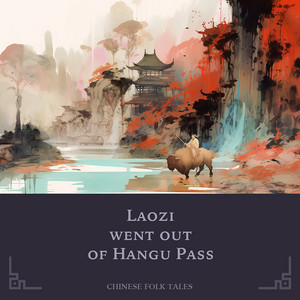
The philosopher announced that he wanted to mount his black horse and ride into the west.
His servant was to come too.
Where are we going?
A good traveller has no fixed plans. and is not intent on arriving.
Master, though it pains me to go against such a great and wise man, I cannot and will not come with you.
I have served you faithfully and asked for nothing.
You've not paid me since the day I started working for you.
You must pay me.
Ladzer thought for a few moments.
Are you quite sure about that?
And he kept riding.
Eventually, they reached the Hangu Pass, the gateway to the west.
When they reached the house of the guardian of the pass, red clouds appeared in the sky.
The guardian knew this was a sign that a wise man was drawing near, and he came out of his gatehouse to greet him.
He looked at the old man and his servant.
Hello, hello.
What have we got here then?
The sky said there was a wise man approaching.
You don't look all that wise.
Lao Tzu stared at him for a moment and then stuck his tongue out.
Then he said, Those who know do not speak.
Those who speak do not know.
Charming, I'm sure, said the guardian.
Despite this, he led him into the house and looked after him like a king.
While they were chatting over dinner, Lautzer's servant ate with the servant of the guardian.
As they were in the same line of work, they got on well, and soon Lautzer's servant was telling his new friend all his problems.
And I have to cook and clean, tidy his study, wash his beard and clean up after his horse.
That's awful!
And he's not paid me in 200 years!
He seems such a wise and honourable man to me.
I'll tell you what.
Why don't I have a word with my master?
See if he can't talk with the philosopher to get you paid.
Would you?
That would be great.
It's worth a try.
And so the next day, as Lao Tzu was preparing to set off on his journey, the guardian came to him and said Now look, far be it from me to tell such a great and wise man how he should run his affairs.
But I understand that you haven't paid your servant for two hundred years.
Is he not a good servant?
Lao Tzu seemed to think for a moment.
Then he called his servant over and slapped him on the back of the neck so hard that a little metal pill flew out.
It was the same one he'd swallowed all those years ago.
Be content with what you have.
Rejoice in the way things are.
When you realize there is nothing lacking the whole world belongs to you.
All those years ago, I was poor and had no money to give you.
I promised you copper coins and told you I would pay you at the destination.
What I did have was something much more valuable, a talisman which gave you everlasting life.
That was the little metal pill.
Have lived in my company for two hundred years and have had a good life, eaten good food and had a safe place to sleep.
I hoped you would see this was more than enough for your labor.
But you want to give up at halfway.
Just then there was a thunderclap and great wind and the servant collapsed to the ground instantaneously became a heap of dry bones.
Wait, said the guardian in a loud voice.
Great philosopher, please take pity on your servant.
He hadn't realized the great gifts you had bestowed upon him.
Bring him back to life.
Lao Tzu thought for a few moments and then agreed with the guardian.
The truth is not always beautiful, nor beautiful words the truth.
And he threw the talisman down onto the dry bones, which miraculously turned back into the servant.
We all have more lessons to learn, including me.
Stay a while longer.
Teach me your wisdom and perhaps you can share some of mine.
And he did.
Lao Tzu wrote down all his wisdom in the Tao Te Ching and gave it to the guardian.
Next morning he awoke to find the great philosopher gone and he was never ever seen again.
So there you go.
Money isn't everything.
Be happy with what you have and always be open to learning from others.
And with that, we conclude this episode of Chinese Folk Tales.
Thanks for listening.
If you like our stories, do give this podcast a five-star rating.
Leave your comment and share it with your friends.
To hear more, please subscribe to Chinese Folk Tales on all major podcast platforms.
We'll see you next time.
Bye for now.