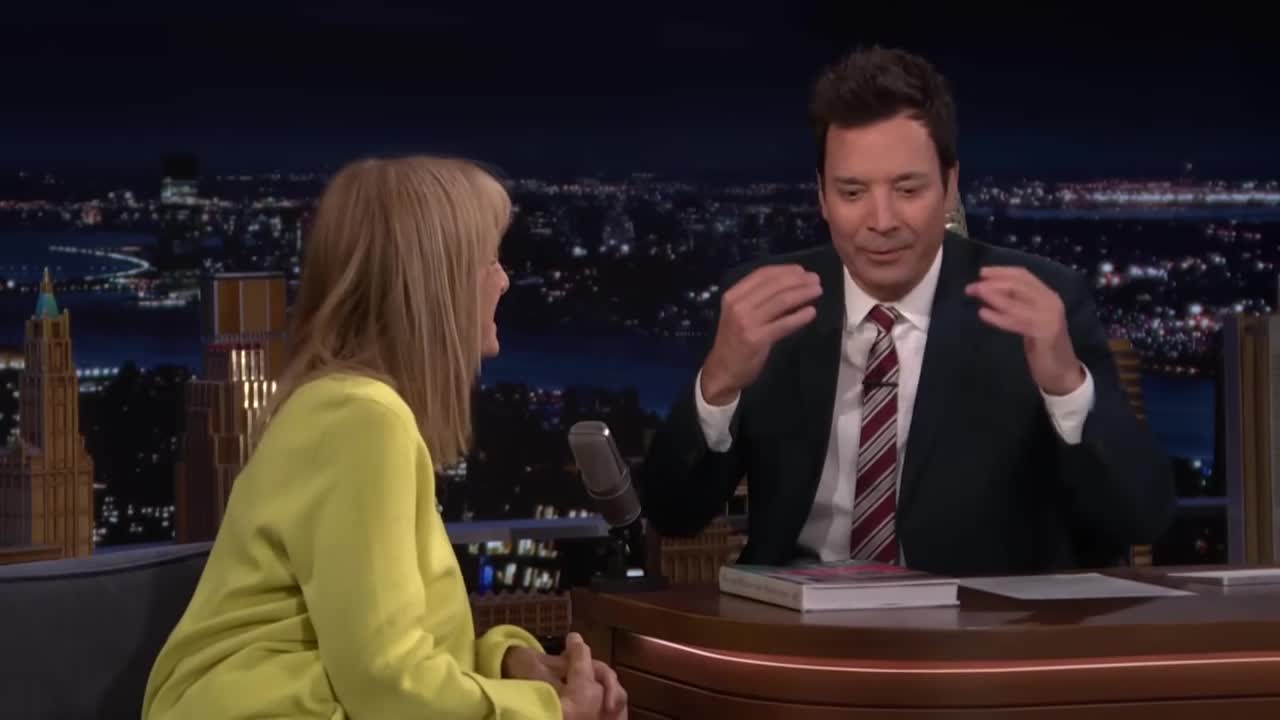
Ruthie, I had to beg you to be here.
I'm the biggest fan.
I love you so much.
I love you.
Should we just stop here, then?
We have an upstate New York connection.
We have a London connection.
A food connection.
You know, you really know in the restaurant when people come in, who are the food lovers?
I mean, and you are one of them.
You go and see the chefs first.
You look at the menu.
You talk about everything.
You are a food person.
No, but you're so personable. and helpful and nice and happy.
You talk to everybody.
You treat everyone like a million dollars.
And I went in and I just was like, I'm a fan.
And you're like, no, I know you, Jimmy.
And you kind of knew who I was, but not really.
But I think Lauren introduced us.
And I was like, I'm such a fan.
You're like, well, come see the kitchen.
Come meet the chef.
Do you want to see the oven?
All you want to do is sit down and eat.
Probably.
No, no, I wanted to meet you.
But look, the oven is right out in the open.
Yeah, that's our wood oven.
So you can see where all the food gets done.
And I'm telling you, this menu, you can close your eyes and just point to anything.
It's the greatest thing you've ever had in your life.
And you make it so fun.
And I was telling you, years ago, when I was in college, I started collecting cookbooks.
This is when no one really, there wasn't celebrity chefs, no one really had that many cookbooks.
I thought maybe I could complete the full collection. of just every cookbook.
But I started just getting, you know, Joy of Cooking, blah, blah, blah.
And somebody said, you have to get the River Cafe, the London River Cafe, Ruthie Rogers.
That's the coolest cookbook out there.
And I brought a, this is the one I had.
It's like a mirror and it's just the coolest cover.
Can you see yourself?
Yeah, I'm looking at myself right now.
We look fantastic.
Yeah, we look great, yeah.
And so here, it's kind of full circle that I'm having you here.
And this is your book right here, which is available this week, table four at the River Cafe.
What does, what is table four?
Do I know?
Well, it's kind of a pun on the word four.
The River Cafe has, you know, tables have numbers so waiters can find it.
Table four is one of the tables in the window.
Oh yeah.
And Michael Caine used to love eating there.
That was his spot, table four?
But you know there's no good section or bad section.
It's a pretty democratic space, but it was a pun on the word for.
So it's for Jimmy Fallon or for Jake Gyllenhaal, or for somebody we don't even know.
Table four.
And so, table four.
Ah, brilliant.
See, clever, always clever.
It's a book.
It's a great book.
It's conversations with legends.
Super funny people, by the way.
Tina Fey is in here.
Yeah, Tina's in there.
Love Tina.
Liz Lemon.
Liz Lemon, of course.
Mel Brooks.
Mel Brooks actually has a quote on the back.
But I'm just going to go down quickly.
Francis Ford Coppola.
You have J.J.
Abrams, by the way, who we love.
Yeah, we love.
Jamie Oliver, Sarah Jessica Parker, Nancy Pelosi.
But Mel Brooks' quote was on the back, which made me laugh.
It says, when I see you, I get hungry.
And I think that's... People probably think that when they...
Well, the thing about the guests is that what this book is, it's really, it's memories.
It's your memories, it's stories.
I think everybody has a story.
And this one is told through the lens of food.
And so if I went to, for instance, Paul McCartney and said, can we talk about the Beatles?
He might say, been there, done that.
Or David Beckham about...
You know, being a footballer, Nancy Pelosi being Speaker of the House.
But if you said, we're just going to talk about food.
Who cooked?
Did your mother cook?
Did your father?
Did you go to restaurants?
When you left home, did you have a flat?
Did you ever try to seduce somebody through food?
You know, food is a connection.
And what about you?
We did one.
We did.
Your podcast, your great podcast.
Yeah, we did one together.
Jimmy was amazing because we sang, we talked.
You talked about your grandmother lived in the garden, right?
Yes.
We had a tomato plant garden.
You remember that?
Yeah, I do.
Yeah, we talked about this.
Yeah.
But I love that when you go yeah, you just have a conversation you go like Austin Butler.
You asked him what's his comfort food.
Anything in the world, what can we make?
And he says, peanut butter and jelly sandwich.
Peanut butter and jelly, but you know there was a story about that though, because his mother was very ill and she passed away when he was about 22.
And he used to come home every lunchtime and they would have a peanut butter and jelly sandwich.
So, you know, that was a memory.
And then other people's comfort food might come from a time that their grandmother took care of them.
It might come from a time when they were celebrating.
People eat out of hunger, of course, first of all.
They eat out of sharing or expressing love.
There are so many reasons why people cook and eat.
And comfort is something that food can give you.
It does give you comfort.
Where did the idea for the podcast come from?
Just because it's so personal in the restaurant?
It really started in the pandemic because you know going to a restaurant, if you'd asked me, you know what was important in a city.
I might say hospitals or parks or theaters or opera houses or concert halls, but schools.
But I think when we didn't have restaurants, people really missed them.
It was, you know, so we missed our people who ate in restaurants.
We thought, how can we connect?
Because connecting is so important.
It's what you do and what I do.
And so we thought, maybe just read a recipe every day.
Just read a recipe.
But then a friend, Graydon Carter, said to me, Ruthie, you have to have more than that.
You have to segue into a story.
And so, you know, those are the questions we asked.
And when you ask people like Tina Fey, like Michael Caine, Ian McKellen, you know, to tell us about their memories, then it becomes a story.
We had when we did Elton John, The woman who works with him for 25 years said I've sat through so many interviews and I never knew that when he was growing up, his grandmother lived next door and they would pod peas together every night.
So things come out.
When River Cafe first came out, there was a review that said I'm going to tell you about a restaurant that you can't go to.
Can you describe why was that?
Well, I was living in Paris.
My husband, Richard Rogers, with Renzo Piano, did the Pompidou Center.
And when we came back, he didn't want to go into a building in the city or skyscraper.
He wanted to make a community.
He was Italian.
He always thought the best conversations came out for work over food, over a table.
So we wanted to set up a little cafe in this place the warehouses we found that you came to on the Thames.
Yeah and um, i just said you know what, maybe i'll do it, and so my, you know, rose gray, who'd work with keith mcnally here.
We just started with six tables, and the reason people couldn't go to is that the planners were very is very.
You know, a neighborhood of houses were really worried about the noise, and so they only let us open at lunch.
But in a way, you know, restrictions are a good thing, aren't they?
You know we Rules are meant to be broken yeah.
Yeah, and also we were two inexperienced chefs and restaurateurs, so we started small.
We started with lunchtime, then we got to dinner, then we got to the weekend.
And you learned and you came who you are.
And we've had some ragers at the restaurant.
We've had some fun, haven't we?
We've had the best parties ever.
I mean, I asked you, I go, because we never have anyone who has a camera out or anything.
And you go, I might have something I could bring.
And so this is a quick little video.
It's an unknown musician who I had to teach something to.
She's always breaking new artists.
Here's Ruthie Rogers and Paul McCartney.
Children.
Come on.
He'll get there one day.
One day.
The one and only Ruthie Rogers, everybody!
Table 4 at the River Cafe.
Conversations about food and life is available everywhere this Tuesday.
We'll be right back, everybody.