This BBC podcast is supported by ads outside the UK.
America is changing, and so is the world.
But what's happening in America isn't just a cause of global upheaval.
It's also a symptom of disruption that's happening everywhere.
I'm Asma Khalid in Washington, DC.
I'm Tristan Redman in London, and this is The Global Story.
Every weekday we'll bring you a story from this intersection, where the world and America meet.
Listen on bbc.com or wherever you get your podcasts.
This is the Global News Podcast from the BBC World Service.
I'm Emily Thomas and at 16 hours GMT on Wednesday the 4th of February, these are our main stories.
There's little hope of a breakthrough between warring Russia and Ukraine at peace talks in Abu Dhabi.
Dozens of people are feared dead and the death toll is still rising after armed gangs attacked a remote village in central Nigeria.
And women are for the first time officially allowed to ride motorbikes in Iran.
Also in this podcast.
Now we've made it so far with commitment.
You are doing something because of the pain that you have.
So we made it here.
The former child refugees walking the length of Britain to highlight the war in South Sudan.
It's not been the best start to peace talks to try to end the war in Ukraine, nearly four years after Russia launched its full-scale invasion.
Ukrainian and Russian negotiators are in Abu Dhabi for the US-brokered negotiations, but the Kremlin said that the war will continue until Kiev agrees to Moscow's terms.
President Putin wants the land his forces have captured and more.
President Zelensky has rejected any withdrawal of Ukrainian forces.
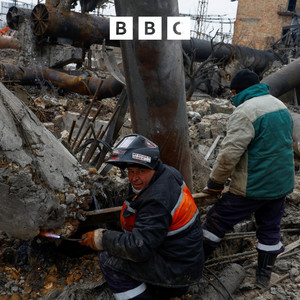
In the meantime, Russia is continuing to attack Ukraine's energy infrastructure.
Irina Vovk is a resident in Kiev.
Now we have a very big problem with electricity.
We don't have heating in our homes.
Room temperature is about 6 or 10 degrees.
And I use warm bottles of water to sleep.
I live with my daughter.
She cannot study normal.
She cannot use online lessons.
And now I am thinking that maybe in some days later I must go to the village to my parents, because here in Kyiv living is very awful.
So what hope is there for the latest talks?
General Keith Kellogg was President Trump's envoy to Ukraine until his term ended last month.
He said Ukraine might have to give up some land, at least in the short term.
Go back to the Baltics from World War II, when Lithuania and when Estonia and when Latvia were all under Soviet control.
We never said they were Soviet territory.
We never recognized that they were.
And when land has given up, hopefully it'll come back.
I think you have to look to the future out there.
And what they're really talking about, at least with Russia.
You're talking about Luhansk, which is about 98 controlled Donetsk, which is about 70 controlled, and Kherson and Zaporizhzhia.
Those are the four oblasts.
If you count Crimea, that's your five.
And maybe there'd be a loss of territory in the near term.
I said near term.
In the long term, as long as you end this conflict, allow everybody to reset, allow Ukraine to build up where they want to build up, which is 800000 troops.
That'll be the largest army in Europe.
But as long as there's strong security guarantees from the United States and others, I think you can get away with that.
It's hard to take.
It's hard to say.
But over the long term, is this what you want to do to end the war?
And they're going to have to think hard about that, where they want to be.
On Wednesday afternoon, the regional governor in Donetsk said that at least seven people were killed in Russian attacks in the town of Drivkivka.
Vitaly Shevchenko is Russia editor at BBC Monitoring.
Alex Ritson asked him what's been happening at the peace talks.
All we've been hearing are rather vague statements, Alex.
The Ukrainians are saying that the negotiators are going to divide into two working groups one presumably, as far as we know, focusing on military issues ie who controls Donbass and the other group focusing on political issues, such as whether an election of some sort will be held in Ukraine at some point in the future.
But that's guesswork.
In terms of what's expected, very little.
I've seen leaks in the media suggesting that a prisoner exchange is possible tomorrow.
But, as we've just heard, it's not a very good beginning to the talks, with continued Russian attacks on Ukraine.
Donetsk is in the eastern region of Donbass, which Russia wants.
What are you hearing about this latest attack there?
Well, I'm looking at the latest telegram post by Vadim Filashkin, the head of Donetsk region, which is at the heart of these talks in Abu Dhabi today.
And he's saying the latest is seven people dead, 15 injured.
And the demographic of the dead and injured reflects who's still there.
The oldest casualty, the person who was killed, is 81 years old.
So when negotiators are talking about Donbass and Donetsk, it's not exactly barren wasteland.
There's still people living there who are too old or too frail to leave.
And in fact, I was speaking to a volunteer based in London who's been delivering aid to Drushkivka.
And he told me that the security situation was gradually deteriorating there, because that town is right on the edge of Ukrainian-controlled territory in Donbass.
So it looks like an attack like this was just a matter of time.
With neither side prepared to budge, is there any room for manoeuvre in these talks over the next two days?
I think Alex, it's a question of how long Ukraine can withstand Russia's military pressure and diplomatic pressure from both Russia and the United States, because we've seen an increasing convergence of their positions.
And if that pressure mounts, and if Ukraine doesn't get enough assistance to keep pushing back, well, it doesn't really have much choice but to, well, give up territory and hope for the best.
Vitaly Shevchenko To Nigeria next, where dozens of people are feared to have been killed by armed gangs in a remote village in the country's central Kwara state.
The government has pledged to do more to crack down on the recent surge in violence in the region.
My colleague Lucy Hocking spoke to the BBC's Makwachi Okafor in Lagos to learn more about this latest attack.
I spoke with a lawmaker from the community that's the Woro community and he did say that gunmen attacked the village, killed some people and raided some shops and set it ablaze.
So it seems like they are now seeing more and more numbers of deaths.
I have seen that the AFP news agency said that the Red Cross has seen over 100 deaths.
So the numbers are increasing.
We don't know specifically what group has carried out this attack, as no group has come out to say it's them that did it.
But it kind of shows the trend of violence we're beginning to see across many parts of Nigeria.
Parastatism is not central, which isn't interesting historically.
One of the parts of the country where you will see violence like this
But in recent weeks and months, we're beginning to see such attacks across central Nigeria.
And what has been the reason for some of these attacks in other parts of central Nigeria?
It's been difficult to say, but most of the attacks in the area have been a mix of many issues.
You see, banditry what we locally call banditry where armed men attack villages, abduct people for ransom, loot villages and loot shops, loot marketplaces and carry out people's belongings.
Sometimes it can be economical.
But we've also seen some cases where they are ideological, where jihadists also carry out attacks like this in central Nigeria, not just in Kwera State, but in neighbouring Niger State, which has also seen abductions in schools.
And even Kwera State at the end of last year saw an abduction in a church where worshippers were having an evening worship and people were abducted and even some people died in that attack.
And what is the government saying and what is the government doing to try and prevent these attacks?
The government has said it is ramping up efforts to clamp down on insurgency.
We have seen even stronger collaborations with countries like the U.S.
Yesterday, the Nigerian government did confirm that a team of US soldiers are now in the country to help assist the country both with intelligence sharing and training.
The recent data from the Nigerian military did show that lots of attacks impacted on the insurgents in different parts of the country.
But this doesn't mean that there has been a complete halt of violence across many parts of the country.
Iran has made a concession to female motorcyclists by formally allowing them to obtain a licence.
Women have been riding motorbikes for years, but traffic laws were vague about whether this was legal.
It's not clear if this move was made in connection with the widespread anti-government protests last month that were brutally put down by the authorities.
Thousands of people are thought to have been killed.
Gonche Habibi-Azad is from the BBC Persian service.
Yesterday, Iran's first vice president ordered police to begin training and testing female applicants for them to get licences.
I've been talking to some women in the capital Tehran who ride motorcycles and they see this move as long overdue because it followed a bill submitted to Parliament last year in summer to amend traffic laws that previously limited licences to men.
And in that law, in that article, it included the word men and in practice excluded women from eligibility and left like a legal loophole.
And we have seen a rise in female riders in recent years.
And we could spot them in videos and photos coming out of Tehran and other cities in Iran.
But I have to say this that the Instagram account of a female motorcyclist was blocked back in October last year after she posted a video criticising the authorities for failing to issue the licenses to women.
So why now?
So the decision is following widespread public discontent and a deadly crackdown on protesters that rights groups say left thousands dead.
And the protests started in late December over Iran's worsening economic conditions, and the conditions have not improved yet.
And in BBC Persian, we've seen people in Tehran send text messages informing them of this new law allowing women to get licenses for motorcycles.
So it comes at a time when, following the protest, it's just the time that it seems that the public are not happy with the authorities.
It's still hugely tough being a woman in Iran, isn't it?
I was born and raised in the capital of Tehran, and living there as a young woman for me was not easy.
I faced many restrictions.
And like the first one, when stepping out of the house, I had to observe mandatory hijab.
Although we are now seeing more women coming out and going out without a mandatory hijab, but they're still breaking the rule.
And in 2020, a woman was killed in Morality Police's custody over not observing mandatory hijab.
That led to a widespread protest called Women Live Freedom.
And whenever in Iran I went to mixed gender parties or drank alcohol in these parties which is also illegal, but there is a moonshot market for alcohol I always had this fear that what if the police decides to raid the party and arrest us all?
Gonsher Habibi-Azad.
Now, an inspiring story about two former child refugees who settled in the UK.
They've just completed a marathon walk along the length of the British mainland to draw attention to the war in South Sudan.
Giel Maluol and John Quay originally fled the violence there after a civil war broke out in 2013.
During their epic journey, they raised money to build new schools in refugee camps for children displaced by the war.
Patricia Whitehorn caught up with them as they finished.
In the howling wind, greeted by supporters, Gyal Maluwal and John Queg arrive at their final destination, the Duncan's Behead Lighthouse in the Scottish Highlands.
It really feels great to finish this and then it's a wonderful achievement.
They have just completed their gruelling walk, which began mid-December when they set off from Dungeness Beach on the southeast coast, heading to the northernmost tip of Britain.
To every child in Sudan.
Whether you are from the north, the south, the west or the east, the long walk of freedom belongs to you.
They covered more than 900 miles, around 1500 kilometers, walking up to 15 hours a day through rain, snow and ice.
Speaking over a very welcome cup of hot chocolate in the nearby John O'Groats cafe, Giel and John tell me how they've lived through conflict themselves.
They're from the Noor tribe in South Sudan, the country's second largest ethnic group, and were caught up in fighting before coming to the UK as child refugees.
Giel says his childhood experiences have influenced his fundraising.
I am a genocide survivor.
In 2013, when the conflict unfolded in South Sudan, I was a young boy.
I really lost a lot of relatives in that war based on ethnic targeting by the government.
And I was displaced from my home in Juba into the UN camp.
And I stayed there for five years.
And I love to, you know, become a lawyer when I grow up.
That was the dreams that I had when I was a child.
But staying in those camps feel like that dream is never achievable because the educations that we received is not that proper.
It's not that enough.
You know, it does not get the best out of us.
As Gil and John began their journey, many people told them they were crazy for walking during the cold and icy winter months.
But Gil says that was a deliberate decision to show solidarity with the suffering of the Sudanese people.
John Kwe says he was daunted by the task but agreed to join Gil on his mission because of the cause.
We all were used to motivate each other. when you feel like you are tired and you are exhausted.
Now we made it so far.
It was a commitment.
You are doing something because of the pain that you have of the other children.
So we made it here.
I don't think if could be another thing.
I would not do it, to be honest with you.
Gail and John's original fundraising target was just under $50,000.
But the two men have raised three times that amount.
Gail says this will enable them to open up more than one school.
We are going to build them around all the neighbouring countries that the Sudanese children have fled into, like Chad, like Uganda, like Egypt, and support them as these children go along to discover the best version of themselves.
Former child refugee Giel Maluel ending that report by Patricia Whitehorn.
Still to come in this podcast.
My favourite moment was doing a Royal Variety performance.
Prince Charles walking along the line-up and him saying, are there any women in the Muppets?
And I leapt at him.
Prince!
Prince!
Prince!
Muppets.
To mark the TV programme's 50th anniversary, an insider looks back.
America is changing, and so is the world.
But what's happening in America isn't just a cause of global upheaval.
It's also a symptom of disruption that's happening everywhere.
I'm Asma Khalid in Washington, D.C.
I'm Tristan Redman in London, and this is The Global Story.
Every weekday, we'll bring you a story from this intersection, where the world and America meet.
Listen on BBC.com or wherever you get your podcasts.
This is the Global News Podcast.
The International Energy Agency has warned that increasing demand for rare earth minerals, essential in many modern technologies, is putting energy security at risk.
Global demand for these minerals is expected to increase significantly in the coming years, creating pressure on supply chains.
Now, more than 50 countries are gathering at a conference in Alex Ritson asked our business correspondent Jonathan Josephs what role China, which controls many of these resources, had to play in all this.
China controls so many of these critical minerals, things like rare earths, but also has a lot of influence when it comes to things like copper and lithium.
So I asked Tae-yoon Kim, who is the head of the critical minerals division at the International Energy Agency.
I asked him what the risks were.
There are some growing questions about whether the future supplies can keep up with rising demand.
We see some progress has been made in recent years.
Investment increasing and also many governments are introducing new policy support to make projects happen.
But the same cannot be said for diversification.
We need to develop some more mines and more smelters and more refineries to serve the rising demand.
And so what?
The fear here is that China, because it's dominating the production and refining of these elements, these minerals, it potentially can hold the rest of the world over a barrel.
Well, that's not just a potential fear, Alex.
That's something that actually happened last year, when China renounced export controls on rare earths.
And that was at the heart of the US-China trade war.
China has a really strong bargaining chip when it comes to its trade negotiations with America, with Europe, with all parts of the global economy.
If they do things that China doesn't like, it can hold back some of these supplies.
Because, if we look at rare earths as an example, China has about 70 of mining capacity in the world.
But, even more importantly, it has about 90 of refining capacity, because it's quite a dirty process to extract these minerals and turn them into usable substances which you might find in a smartphone, you might find them in a jet engine, you might find them in a wind turbine.
And to do all of that.
China is prepared to accept those risks and that's given it a lot of leverage in the global economy.
So now other countries are trying to lessen their dependence and reduce.
Mr Kim says that they need to invest more in doing so, that they need to expand their own mining and refining capacities to do that.
And there's a huge meeting in Washington to look at this.
That's right.
There's this gathering happening in Washington.
Marco Rubio, the Secretary of State, is hosting.
They're all coming together to try and work out how they can diversify their own supply chains for critical minerals and move away from this dependence on China.
Now it's going to be a long-term game to achieve any of that, and how far they will get in this one meeting remains to be seen.
But America has already been talking about this in recent days.
President Trump announced on Monday a $12 billion strategic mineral reserve.
The EU is also trying to put money into it, and China has responded quickly by saying that it thinks more communication is necessary and that it believes that free market economies and international trade rules should be adhered to in terms of these critical minerals, and that they should just be allowed to flow under those terms.
Jonathan Josephs.
For more on this story, you can go on YouTube search for BBC News.
Click on the logo, then choose Podcasts and Global News Podcast.
Next, Walmart surpassed a market valuation of 1 trillion on Tuesday, becoming the first so-called traditional firm to hit the milestone.
In doing so, the US retail giant joins a small club mostly made up of tech giants like Apple and Microsoft.
It marks a significant moment for America's largest retailer, known for its large stores and low prices.
Pete Ross has more.
The share price has been rising for the last year or so, going up by around about 26%.
So analysts have expected that it would pass this milestone.
This has been achieved by a traditional retailer.
When you think of some of the world's biggest companies and indeed the world's biggest companies are, you know, populated by the big tech giants Google Meta, those sorts of companies, not a traditional bricks and mortar retailer known for its vast stores.
You Huge numbers of products, low prices that traditionally attract low and middle income families.
So it's broadened its customer base significantly.
As we all feel the pinch of rising grocery prices, higher income customers have begun shopping there.
Like most of us, they're looking for value, for convenience, at a time when all households are feeling the pinch.
You know they're facing a number of financial strains, factors such as inflation, particularly in the US as well a cooling job market.
The company's been able to take advantage of that challenging consumer environment and it's broadened its appeal, reaching out to, as I said, those customers that traditionally look elsewhere, while retaining its lower income shoppers.
They're still going there.
Digital sales have driven it as well.
It's been a major driver of growth.
It's grown the number of items online.
Apparently, according to one report that I read, there's over a half a billion items available to shop online now.
It's making basically a direct challenge at one of its main competitors, Amazon Prime.
Also critically.
Walmart went big early on AI technology and that's helped it across the business by pouring billions of dollars into supply chain automation, and It allows it to restock more quickly and that means it can offer more products and it can increase its profit margins.
Another thing that it's done, it's also tried to appeal to tech workers.
So it's built a new headquarters or a new campus, a 350 acre campus in Bentonville, Arkansas.
It's sort of something that resembles more of those kind of headquarters.
You would expect to see something like Google or Meta.
So it's got childcare facilities.
There's a vast food hall amphitheatre, basically trying to bring in new tech workers to help it with this push, with its AI push.
Pete Ross.
Water shortages are worsening in parts of South Africa.
The latest casualty is the coastal town of Gneisner, whose residents are fearing the prospect of municipal taps running dry so-called day zero.
Dams are critically low and water restrictions have been imposed to slow down the decline.
Authorities have even declared a local state of disaster amid concern over dwindling supplies.
The BBC's Pumza Filani has been to Gneisner.
Naisna, home to turquoise beaches, smooth sand and pleasant weather, is popular with international visitors and is a retirement haven for its more affluent locals.
But beneath the pretty veneer, the town's water system is on the brink.
We are at Akarkloof, one of the town's main storage dams.
It was the super low water levels here that sparked panic and warnings of a day zero.
At this level, you're looking at less than 20 days of water reserves.
It's a crisis that's sponsored both by nature, through a localised drought plus years of poor maintenance of the town's ageing infrastructure.
Maizena loses up to 56 of its drinkable water through pipes that have not been upgraded for over 30 years.
Amble Ridge Care, a sprawling retirement village, in recent months had a taste of what a town without water would look like, when a fault at a local municipal plant left the elderly residents without any for 10 days.
This prompted owner Franco de Grandes to invest in a backup water supply.
We need water in the apartments.
We need water when people are bedridden in nappies and without water we cannot function.
He spent around 16000 on three large water tanks and specialised pumps to feed that water into some of the facility's main buildings.
This latest crisis has led to a scramble for funds from the national government and promises of solutions by its latest mayor, Tando Matika.
He's been in the role for 11 months.
I asked him what his council is doing now to save Naisna's water.
We are looking at water use and also we are looking at building an extra dam.
Some water experts are warning that, without proper planning, more towns could face similar trouble in the coming years.
Dr. Ferial Adam from WaterCan, a Johannesburg-based research and advocacy group, explains.
Almost half of our population do not have running water within their homes.
So there's definitely an issue with the infrastructure, the access, and then there's an environmental one.
And if you put those two together, it's what we have right now.
And back in Naisna, local NGOs like Gift of the Givers have been a lifeline, bringing in thousands of litres of water daily from private boreholes to boost municipal reserves, even delivering to those often worst affected.
In Kaileto Township, irregular water supply is already a painful norm dating back months and, in some areas, years.
But on this day, help has come.
I see people carrying buckets and starting to form a line from small children to adults.
The residents say the day-zero anxiety has at least brought attention to their daily struggle.
Sixty-year-old Kanye Suasehula explains.
Whenever there's no water, we're forced to wait for the municipal water trucks.
I am an old woman and I struggle to walk.
Nizno's troubles are far from over, experts tell me.
What's needed beyond temporary plugs is an overhaul of the outdated water system.
And that will require millions of dollars and political will to deliver on this basic right.
Finally, The Muppet Show is celebrating the 50th anniversary of the original series that made stars of Kermit, Miss Piggy and The Grumpy Old Men Statler and Waldorf.
A brand new special episode of the show premieres today on Disney's streaming service and ABC's television network.
Louise Gold was a puppeteer and voice actress for The Muppet Show for four seasons from 1977.
She spoke to my colleague Johnny Diamond.
He asked her if she could believe that they're doing it all again.
Just listening to the news, it's just what we need.
Oh my God, do we need some laughs.
Take us back to when you joined.
You joined after the first series, didn't you?
They were auditioning tall women.
Right.
So I have no skill other than being tall, the miracle of height which had kept me out of a lot of other jobs.
I auditioned for Jim Henson at a desk.
I didn't really know what The Muppet Show was.
I said, I've never done any puppeteering.
He said, that's OK.
Nobody does what we do.
We'll teach you.
And...
They tried three women out and I was the mad one that they kept on.
I think I had some anarchic spirit that made me fit in.
I think that anarchic spirit lives on.
Louise, do you remember your parts?
Of course I do.
Share it with the rest of the class.
I was a singing tomato.
Oh, well, who'd forget that?
Yeah, how can you forget?
A big mum on one of the big monsters.
My favourite moment was doing a Royal Variety performance.
Prince Charles walking along the line-up and him saying, are there any women in the Muppets?
And I leapt at him.
Prince, Prince, Prince!
Also... my character was called Annie Sue Pig.
And all the Muppet characters are taken from the souls of the performers.
They're all split personalities.
They're all our essences.
And I didn't realise this at the time, but mine was a very young, ambitious pig who worshipped Miss Piggy but was obviously a great rival to her.
Louise Gold.
And that's all from us.
And don't forget our sister podcast, The Global Story, which goes in-depth and beyond the headlines on one big story, available wherever you get your podcasts.
This edition of The Global News Podcast was mixed by Mark Pickett, and the producers were Daniel Mann and Mickey Bristow.
The editor is Karen Martin.
I'm Emily Thomas.
Until next time, goodbye.
America is changing, and so is the world.
But what's happening in America isn't just a cause of global upheaval.
It's also a symptom of disruption that's happening everywhere.
I'm Asma Khalid in Washington, D.C.
I'm Tristan Redman in London, and this is The Global Story.
Every weekday, we'll bring you a story from this intersection, where the world and America meet.
Listen on BBC.com or wherever you get your podcasts.